

You have two quotes for the same Miami roof, and they are $18,000 apart. Then you search for a reasonable Florida roofing price and find statewide averages that do not come close to either quote.
That mismatch is not necessarily a sign that both contractors are wrong. Miami-Dade is not an ordinary Florida roofing market.
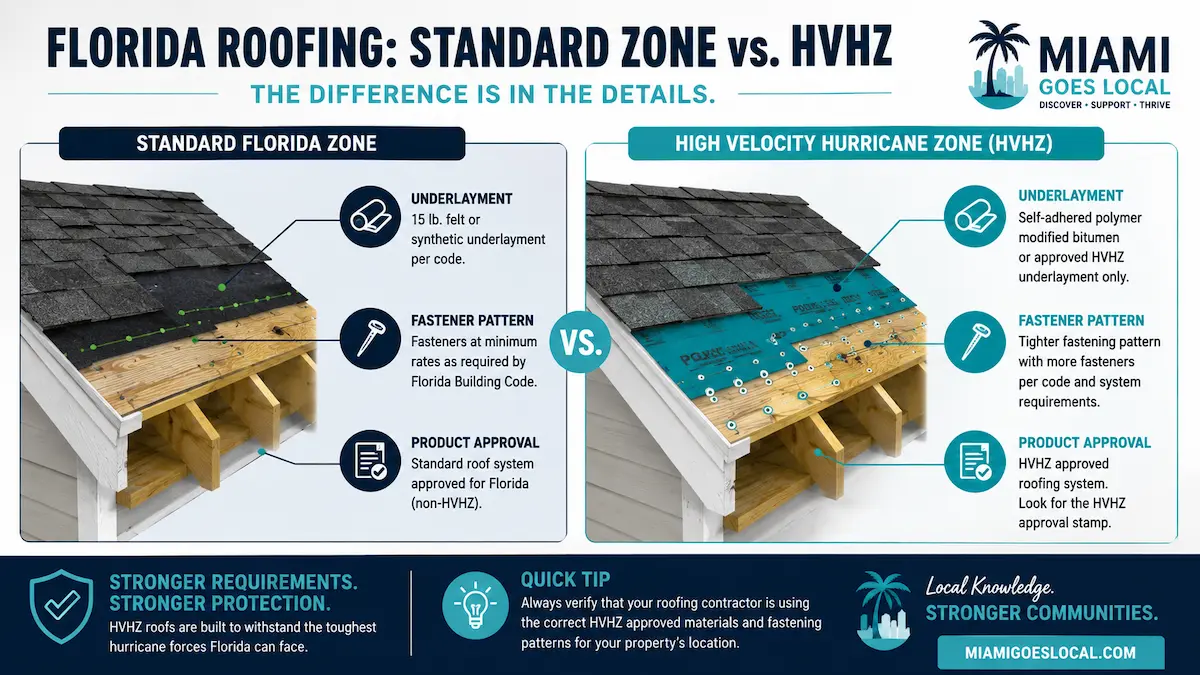
Miami-Dade sits inside Florida's High-Velocity Hurricane Zone (HVHZ), the part of the Florida Building Code with additional requirements intended for extreme wind conditions. Roofing products and assemblies used here have to meet HVHZ requirements, and Miami-Dade maintains its own Product Control approval system for products that meet those standards.
That changes what can appear in your quote.
The roof system has to match an approved assembly. The underlayment, attachment method, fasteners and other components have to satisfy the applicable requirements. A contractor may also need to identify a Notice of Acceptance (NOA) Miami-Dade's product approval documenting that a particular product or system has been evaluated for use under the applicable requirements.
So a Florida-wide price can be a poor starting point for a Miami-Dade roof.
There is another complication. Your permitting authority matters. The paperwork and local permitting process can depend on where the property sits, while the underlying roof still has to comply with the Florida Building Code and applicable HVHZ requirements.
Insurance can matter just as much. Some homeowners arrive at this decision because a carrier has questioned the roof's age or condition rather than because they planned to replace it this year.
And one rule deserves clarification before you compare quotes.
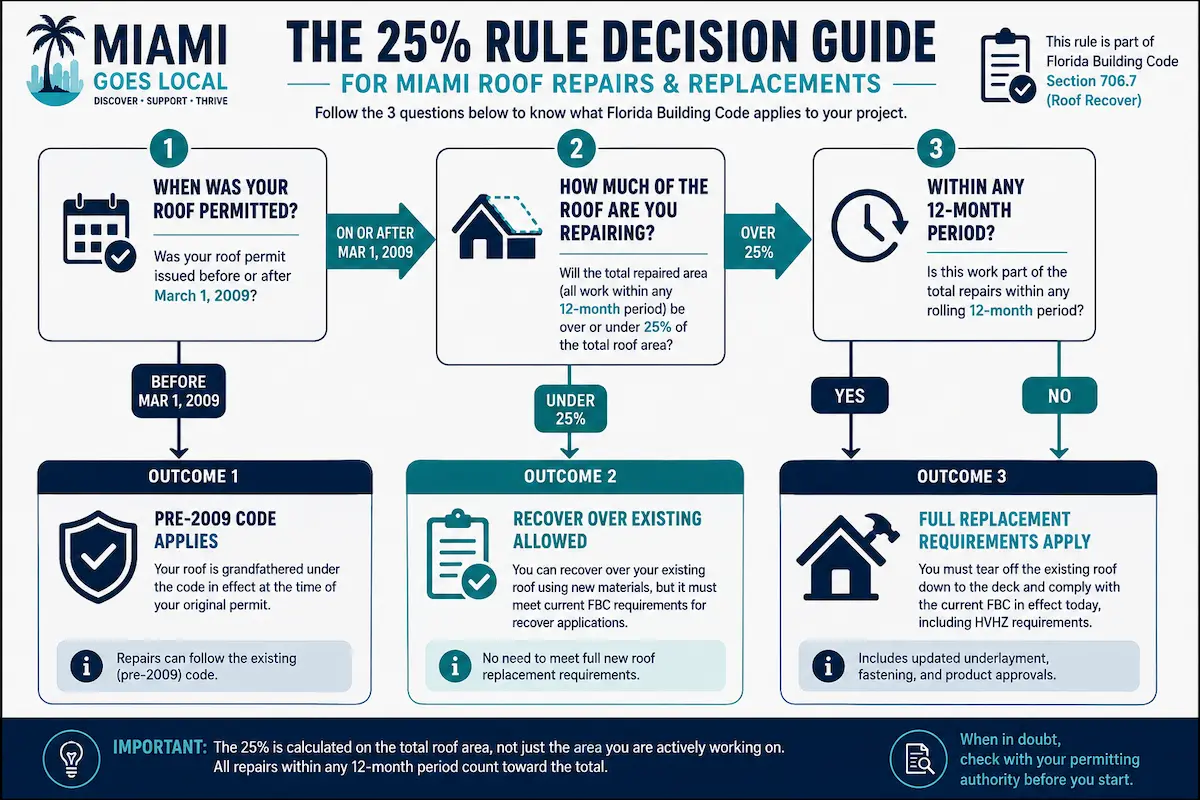
You may still hear that repairing 25% or more of a roof automatically means replacing the entire roof. Florida law changed that calculation. If an existing roofing system or roof section was built, repaired or replaced in compliance with the 2007 Florida Building Code or a later edition, Florida Statute §553.844(5) says that even when 25% or more is being repaired, replaced or recovered, only the portion being worked on is required to comply with the currently applicable code.
The roof's history therefore matters. Verify the permit history before accepting “the 25% rule” as an explanation for a full replacement.
What this guide will do
We have no roof, inspection or roofing service to sell you this guide is published by Miami Goes Local, a Miami-Dade business directory with no roofing product or installation business of its own. This guide is about the number in front of you: what a roof actually costs in Miami-Dade specifically, what belongs inside that price, and how to determine whether the written quote you received is reasonable.
We will separate the total into the parts that create it:
- roofing material and approved roof system
- tear-off and disposal
- underlayment
- deck repair, priced per sheet where applicable
- flashing and edge components
- labor
- permits and inspections
- HVHZ-specific requirements
- optional upgrades that should appear as a priced line item, not disappear into the total
Where a Miami-Dade roof requires an approved product or assembly, I'll also show you how to ask for the NOA number and verify the approval yourself.
The price figures in this guide are Miami-focused, sourced and capture-dated rather than averages assembled from unrelated Florida markets. Where reliable evidence does not support a precise number, I will say so rather than manufacture one.
By the end, you should be able to take the quote already sitting in your inbox and answer three questions:
Is the total price plausible?
What exactly am I paying for?
Can I independently verify the contractor, materials and permit requirements before I sign?
Miami Roof Replacement Costs by Material
For planning purposes, a 2,000-square-foot Miami-Dade roof can run from roughly the low five figures for architectural shingles to $40,000 or more for clay tile or standing-seam metal. The material matters, but so do the roof geometry, deck condition, tear-off, access and the exact High-Velocity Hurricane Zone assembly being installed, and if you haven't settled on a material yet, our tile vs. metal vs. flat roof guide for Miami's climate walks through which system actually fits your slope, structure and salt exposure.
These are planning ranges, not quotes. I built them from published 2026 Miami-Dade and South Florida pricing and checked the assumptions against current HVHZ requirements. Prices were captured August 24, 2026.
Swipe horizontally to compare roofing systems →
Roofing Material
Planning Cost per Sq. Ft. in Miami-Dade
Installed Total for a 2,000 Sq. Ft. Roof
Realistic South Florida Service Life
What HVHZ Compliance Actually Adds
Architectural Asphalt Shingle
$7–$11
$14,000–$22,000
About 15–20 years
An approved HVHZ roof assembly, qualifying shingles and
underlayment, specified attachment patterns, edge details
and product-approval documentation.
Concrete Tile
$10–$16
$20,000–$32,000
Roughly 20–30 years for the waterproofing system;
properly maintained tiles may last substantially longer.
Approved tile and underlayment assembly, calculated design
pressures, specific tile attachment method, flashing/edge
requirements and NOA information.
Clay Tile
$14–$22
$28,000–$44,000
Roughly 20–30 years before underlayment becomes a major consideration;
clay units themselves can last much longer.
The same HVHZ assembly controls as concrete tile, plus the
higher material and handling cost associated with clay systems.
Standing-Seam Metal
$12–$20
$24,000–$40,000
About 25–50+ years, depending heavily
on metal, coating, coastal exposure and attachment.
Tested uplift resistance, approved panel/clip system,
tighter prescribed clip or fastener spacing where required
by design pressures, plus compatible edge and flashing details.
Flat / Low-Slope Membrane
About $9–$16 for TPO;
$10–$15 for modified bitumen
About $18,000–$32,000
for a full 2,000 sq. ft. membrane roof.
Roughly 15–25 years,
system-dependent.
HVHZ-approved membrane assembly, attachment or adhesion
method tied to uplift pressures, insulation/substrate
requirements and approved perimeter/termination details.
Miami note:
These figures are planning ranges, not quotes. Your actual cost and
system life depend on roof geometry, deck condition, tear-off,
drainage, approved assembly, design pressures, coastal exposure,
labor and the exact products specified for your address.
| Roofing Material | Planning Cost per Sq. Ft. in Miami-Dade | Installed Total for a 2,000 Sq. Ft. Roof | Realistic South Florida Service Life | What HVHZ Compliance Actually Adds |
|---|---|---|---|---|
| Architectural Asphalt Shingle | $7–$11 | $14,000–$22,000 | About 15–20 years | An approved HVHZ roof assembly, qualifying shingles and underlayment, specified attachment patterns, edge details and product-approval documentation. |
| Concrete Tile | $10–$16 | $20,000–$32,000 | Roughly 20–30 years for the waterproofing system; properly maintained tiles may last substantially longer. | Approved tile and underlayment assembly, calculated design pressures, specific tile attachment method, flashing/edge requirements and NOA information. |
| Clay Tile | $14–$22 | $28,000–$44,000 | Roughly 20–30 years before underlayment becomes a major consideration; clay units themselves can last much longer. | The same HVHZ assembly controls as concrete tile, plus the higher material and handling cost associated with clay systems. |
| Standing-Seam Metal | $12–$20 | $24,000–$40,000 | About 25–50+ years, depending heavily on metal, coating, coastal exposure and attachment. | Tested uplift resistance, approved panel/clip system, tighter prescribed clip or fastener spacing where required by design pressures, plus compatible edge and flashing details. |
| Flat / Low-Slope Membrane | About $9–$16 for TPO; $10–$15 for modified bitumen | About $18,000–$32,000 for a full 2,000 sq. ft. membrane roof. | Roughly 15–25 years, system-dependent. | HVHZ-approved membrane assembly, attachment or adhesion method tied to uplift pressures, insulation/substrate requirements and approved perimeter/termination details. |
Ignore a Florida roofing price guide that cannot show you how its numbers apply to Miami-Dade. Miami-Dade and Broward make up Florida's High-Velocity Hurricane Zone (HVHZ), where roof systems are subject to additional wind-design, product-approval and installation requirements.
What HVHZ compliance adds and what it does not
HVHZ compliance adds requirements, not a universal percentage markup. I could not verify a primary government source establishing that every Miami roof costs a fixed percentage more because it is in the HVHZ, so I would not publish one.
The current Miami-Dade roofing documentation shows what the difference actually looks like.
For a tile roof, the permit documentation can call for the roof-system manufacturer, Miami-Dade Notice of Acceptance (NOA) number, field/perimeter/corner design pressures, underlayment system, fastener type and spacing, drip-edge details and tile attachment method.
A metal roof approval can likewise specify exactly how the system achieves its allowable uplift pressure. One current HVHZ approval, for example, changes the clip spacing and fastener pattern depending on the pressure the assembly must resist.
That matters when you compare quotes.
Do not ask only:
“How much extra are you charging me for hurricane code?”
- What roof assembly are you pricing?
- What is the NOA number or Florida Product Approval number?
- What underlayment is included?
- What attachment method is included?
- Are perimeter and corner requirements already priced?
- Does the quote include permit and inspection costs?
How to read these ranges
The bottom of a range usually describes a simple roof with a clean deck and easy access. The top describes a roof that takes more material, more labor or more correction before the finished roof can even go on.
Five conditions move the number quickly.
1. Roof geometry
A simple gable roof is cheaper to install than a roof broken into hips, valleys, dormers and multiple transitions.
More cuts mean more labor. More transitions mean more flashing and detailing.
2. Pitch
A steeper roof can require additional staging, fall protection and slower material handling.
That increases labor even when the measured square footage is identical.
3. Tear-off
One clean existing roof system is different from multiple layers or a difficult tile tear-off.
The quote should tell you what demolition and disposal are included.
4. Deck condition
Rotten or deteriorated plywood can turn a reasonable base quote into a much larger final invoice.
This is one of the places where vague contracts hurt homeowners most.
Ask for deck replacement to be listed as a priced line item, preferably per sheet, before work begins.
For example:
“Deck replacement: $___ per 4 × 8 sheet, labor and material included.”
You may not know how many sheets will be needed until the old roof comes off. You can still know the unit price before signing.
5. Access and site conditions
A wide suburban lot with driveway access is a different job from a tightly spaced property where material has to be staged carefully and debris cannot be dropped directly into a container.
Condo buildings and HOA-controlled properties can add another layer of access, scheduling and documentation requirements.
A 2,000-square-foot house is not automatically a 2,000-square-foot roof
Do not multiply your home's living area by the table's square-foot price and treat the result as a quote.
Roofing is priced from roof area, not air-conditioned living area.
Pitch, overhangs, garages, porches and attached sections can push the actual roof surface above the home's floor area. Roofing contractors also account for material waste created by hips, valleys, cuts and system-specific installation requirements.
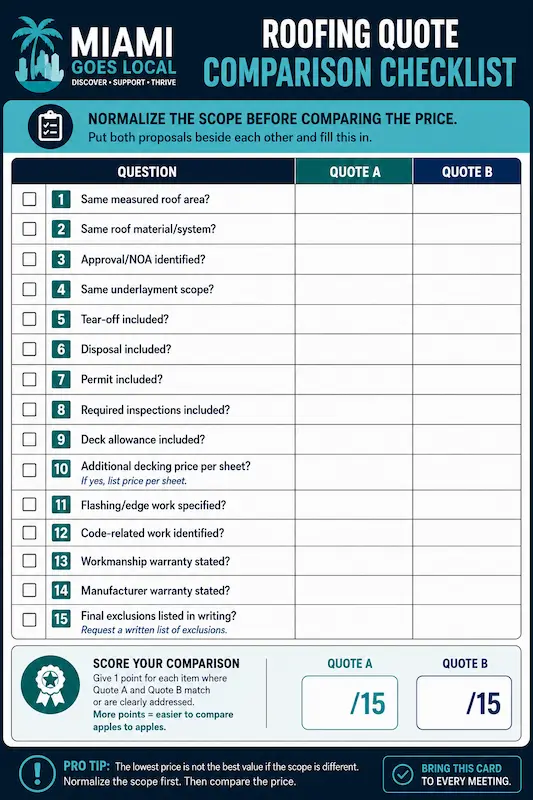
When comparing two bids, verify that both contractors are pricing approximately the same measured roof area.
If one proposal says 24 squares and another says 31 squares, you have found part of the price difference before discussing materials at all.
A “square” in roofing means 100 square feet of roof area.
The only real price is the written quote after inspection
No online table can tell you what your roof will actually cost. A physical inspection followed by a written, itemized quote can.
That is not a disclaimer added to make the ranges meaningless.
It is the reason the ranges are useful.
Use this table to decide whether:
- a $16,000 shingle quote looks plausible;
- a $37,000 clay-tile quote deserves examination rather than immediate rejection;
- two contractors are actually pricing the same roof system;
- a surprisingly low bid has omitted tear-off, permits, underlayment or deck work;
- a high bid contains legitimate scope that the cheaper proposal does not.
Then compare the written scopes line by line.
A useful Miami quote should make it possible to identify the roof covering, approved assembly or product, underlayment, tear-off, flashing, permit responsibility and how unforeseen deck replacement will be charged.
If those details are missing, the total at the bottom of the page is not enough information to decide whether the quote is fair.
The 8th Edition changed peel-and-stick use in the HVHZ
The important 2023 code change was not that Miami suddenly required peel-and-stick everywhere. It was that self-adhered underlayment could now be used directly on the deck as an approved option for applicable systems.
Miami-Dade's Product Control notice confirms that the 8th Edition changed the use and installation of self-adhered roofing underlayments and also added updated requirements for synthetic and tile underlayments.
This matters because older Miami roofing guidance can now be misleading.
Earlier HVHZ guidance commonly required full-sheet self-adhered membranes to sit over a mechanically attached base sheet. The current 8th Edition introduced the direct-to-deck method for applicable systems.
If your contractor says:
“Miami code requires this exact peel-and-stick system.”
ask for the product approval and the applicable installation method.
It may be an excellent system.
That does not mean it is the only legal system.
Tile has its own approval and attachment requirements
Tile roofs are not priced by counting concrete or clay pieces alone. The tile, underlayment and attachment method have to work as an approved system capable of resisting the roof's uplift demand.
Miami-Dade's current code-change materials state that clay and concrete roof tile systems must be tested under the Chapter 15 HVHZ provisions. They also state that tile underlayments in discontinuous tile systems are subject to TAS testing requirements, with NOAs required for certain tile-underlayment systems.
Miami-Dade also tests tile assemblies for their ability to resist the rotational force created by wind uplift.
That is why two “concrete tile” quotes can be thousands of dollars apart while appearing to list the same visible roof covering.
The difference may be underneath it or in how it is attached.
Ask for:
- tile manufacturer and profile;
- product approval or NOA number;
- underlayment system;
- tile attachment method;
- calculated design pressures;
- whether perimeter and corner conditions require different attachment;
- flashing and edge-metal details.
Fasteners are not just a quantity issue
In the HVHZ, where and how a roofing component is attached can matter as much as the component itself.
For asphalt shingles, the current Miami-Dade code summary states that shingles must follow their product approval and, in no case, use fewer than six approved roofing nails or approved fastening devices under the cited HVHZ provision.
Underlayment attachment can likewise have prescribed spacing.
Metal assemblies can use different clip and fastener patterns as the required uplift resistance changes.
This is the part hidden by quotes that say only:
“Install new roof to code.”
That sentence tells you almost nothing about what has actually been priced.
A better proposal identifies the assembly and enough detail for you or the permitting authority to verify it.
Inspections are part of the Miami roofing process
Miami-Dade roofing work can be inspected at stages before the completed roof receives its final inspection.
The county's current inspection-code list includes:
- 001 Final
- 009 Time of Installation
- 010 Tile Placing
- 059 Tin Cap / Dry In / Base Sheet / Anchor Sheet
- 063 Cap Sheet Inspection Hot Mop / In Progress
Which inspections apply depends on the roof system and your permitting authority.
That last point matters because every municipality in Miami-Dade has its own Building Official for work inside that municipality. If the property is in unincorporated Miami-Dade, the county handles the permitting process directly.
I would therefore avoid any contractor quote that treats inspections as an afterthought.
Ask whether the contract price includes:
- permit preparation;
- product-approval documentation;
- required inspections;
- corrections if an inspection identifies installation work that does not match the approved system.
What HVHZ actually adds to your bill
HVHZ raises cost by constraining the system and installation not by adding one standard surcharge.
Depending on the roof, the added cost can come from:
Requirement
What It Can Add
HVHZ-Approved Roof System
Different or more limited product choices
Design-Pressure Requirements
Engineering, calculations or a more robust assembly
Underlayment Requirements
Additional membrane, tape, layers or attachment labor
Enhanced Attachment
More fasteners, clips, adhesive or installation time
Field / Perimeter / Corner Conditions
Different attachment density in higher-uplift roof zones
Product Documentation
More permit preparation and system verification
Staged Inspections
Scheduling and labor coordination before work can be covered
Required Corrections
Cost if the installed work does not match the approved assembly
What I cannot verify from Miami-Dade or the Florida Building Commission is a universal claim that HVHZ compliance adds, for example, 30%, 40% or 60% to every Miami roof.
So this guide will not publish one.
The more useful question is:
What exactly does this approved assembly require that the cheaper quote has left out?
Get that answer as a priced line item wherever possible.
Where the Money Actually Goes
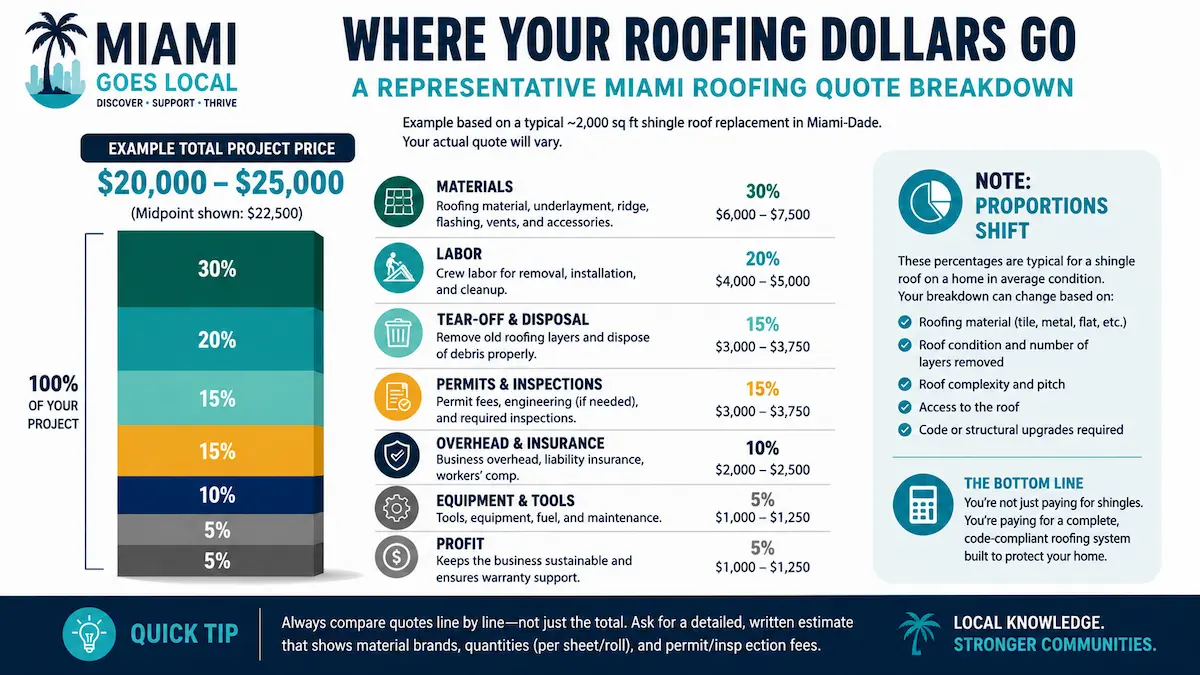
The number at the bottom of a Miami roofing proposal is usually paying for much more than the shingles, tile or metal you will eventually see. To compare two bids properly, separate the total into materials, labor, tear-off, disposal, deck repair, permits, code-required work and warranty scope.
A $28,000 quote and a $36,000 quote are not meaningfully comparable until you know whether they include the same work.
That is the purpose of this section.
The seven parts of a Miami roof quote
A useful written proposal should let you identify at least these seven cost areas:
Cost Component
What You Should Be Able to Identify
Roofing Materials
Manufacturer, product, roof system, underlayment and applicable
NOA or Florida Product Approval.
Labor
Installation, attachment, flashing and completion of the approved
roof system.
Permit and Inspections
Who pulls the permit, whether permit fees are included and who
schedules required inspections.
Tear-Off and Disposal
Removal of the existing roof, hauling and disposal charges.
Deck Replacement
Included allowance, if any, followed by a fixed
per-sheet rate for additional replacement.
Code-Required Work
Deck fastening, secondary water-resistance work or other required
corrections that are actually applicable to the property.
Warranty
Contractor workmanship coverage and any manufacturer warranty
being included or registered.
Do not assume a line item is included because the proposal says “complete reroof.” Ask.
Then get the answer in writing.
Materials are only one part of the number
The visible roof covering may be the easiest part of the quote to compare, but it is not the entire roof system.
For a shingle roof, “materials” may include shingles, starter material, ridge products, underlayment, drip edge, flashing and specified fasteners.
A tile system adds the tile itself plus its approved underlayment and attachment system.
Metal pricing depends not only on the panels but on the approved clips or fastening system, flashing, closures and edge conditions required by that assembly.
That is why:
“Concrete tile $23,000”
is much less useful than:
“Concrete tile system manufacturer/product identified, underlayment identified, approval number provided, attachment method specified.”
You are trying to establish what the contractor has actually priced.
Labor is one of the largest variables between competing bids
Roof installation is labor-intensive, and differences in crew time can materially change two otherwise similar proposals. Complex geometry, steep sections, restricted access, detailed flashing work, tile handling and HVHZ attachment requirements all increase the hours required to complete the same measured roof area.
I would not publish a fixed Miami percentage such as “labor is always 40% of the quote.” I could not find sufficiently reliable Miami-Dade data showing that one percentage applies across shingle, tile, metal and low-slope systems.
But labor is still one of the first places to investigate when one quote sits materially below the others.
A low bid does not automatically mean an inexperienced crew or skipped permit.
It means you should find the missing difference.
Ask whether both proposals include the same:
- measured roof area;
- tear-off;
- underlayment;
- attachment system;
- flashing;
- permit;
- inspections;
- cleanup;
- deck-replacement allowance;
- workmanship warranty.
If one contractor is genuinely cheaper after those items match, you have learned something useful.
If they do not match, you were never comparing the same roof.
Do not assume the lowest bidder found substantially cheaper tile. First compare the scope. A large price gap is often explained by labor-intensive work, excluded demolition, different approved assemblies, permits, deck repair or items one proposal intends to handle later as a change order.
Tear-off and disposal should not disappear into the total
Removing the existing roof creates a real material-handling and disposal cost. The quote should tell you whether that work is included.
Tile is particularly heavy to remove. Multi-layer existing systems can require additional labor and disposal.
The questions are simple:
Does this price include complete tear-off of the existing roof system?
Does it include hauling and disposal?
Is there a limit on the amount or number of existing layers included?
Do not wait until demolition day to establish the answer.
Decking is the number your contractor cannot know exactly before tear-off
A contractor can inspect a roof before quoting it, but the exact amount of damaged roof decking may remain unknown until the old roofing and underlayment are removed. Some deterioration may be visible from an attic or evident around known leaks; concealed rot, delamination and soft panels can appear only after the deck is exposed.
This is one of the legitimate unknowns in a reroof.
It does not need to become an unknown price.
Current South Florida roofing companies publishing 2026 pricing commonly quote replacement plywood by the 4-by-8-foot sheet. Published Miami-Dade/Broward estimates I found range roughly from $80 to $160 per installed sheet, depending on thickness, labor, access and disposal. These are contractor-published market figures, not a government-established rate, so use them as a comparison point rather than a required price.
The more important number is the one in your contract.
Get the deck rate before signing
Ask for wording similar to:
“Additional roof-deck replacement: $___ per 4 × 8 sheet, including material, installation and disposal.”
Then establish:
- what material and thickness that rate covers;
- whether labor is included;
- whether disposal is included;
- how many sheets, if any, are already included in the base contract;
- how additional sheets will be documented;
- whether you will receive the final sheet count.
Get the decking replacement rate in writing as a fixed price per sheet before tear-off begins. The quantity can remain unknown. The unit price does not have to.
For example, suppose the contract includes five sheets and tear-off reveals another twelve that need replacement.
You should be able to calculate the change:
12 additional sheets × the agreed per-sheet price.
That is much easier to audit than:
“Wood repair additional $3,000.”
Ask for the sheet count to be documented
The contractor should be able to tell you how many sheets were replaced once the deck is exposed and repairs are complete.
For a substantial change order, ask for photographs as well.
That does not mean arguing over every soft corner of plywood from the ground. It means establishing a paper trail for one of the largest variable costs in the job.
I would also avoid saying that a contractor offering a fixed total for unknown decking is necessarily dishonest. Some proposals intentionally include a defined or even unlimited wood allowance.
The right question is:
What exactly does the fixed price cover?
If the contractor includes all necessary deck replacement at no additional charge, get that in writing too.
Florida code can make some deck work mandatory
Damaged or unsuitable decking cannot simply be covered because replacing it was not in the original estimate. The exposed deck has to provide a substrate capable of receiving the permitted roofing system, and reroofing in Miami-Dade also brings applicable HVHZ deck and attachment requirements into the project.
That distinction matters.
There are two different expenses homeowners sometimes see described as “wood”:
- Replacing damaged or deteriorated decking
- Bringing an existing deck or its attachment into compliance with applicable reroofing requirements
Ask the contractor to separate them.
If the proposal contains a generic:
“Code upgrades $2,800”
ask what the upgrade actually is and which requirement triggers it.
A code requirement should be explainable.
Permits depend on your exact address
Before comparing permit charges, identify your permitting authority. An incorporated Miami-Dade address generally deals with its municipal building department; an unincorporated address deals with Miami-Dade County.
Miami-Dade's current permitting guidance says the county has 35 municipalities, each with its own building and zoning officials overseeing permits and inspections. Properties in incorporated cities begin with the applicable city, while the County handles zoning and building permitting for unincorporated areas.
That means “Miami-Dade permit fee” is not one universal number.
Your neighbor across a municipal boundary may be dealing with a different:
- building department;
- fee schedule;
- permit workflow;
- local administrative charges;
- inspection scheduling process.
The underlying Florida Building Code and HVHZ requirements still apply, but the permitting authority changes.
Before judging one quote's permit charge against another, enter the property address and confirm which jurisdiction actually issues the roof permit. Do not compare a City of Miami permit allowance with an unincorporated Miami-Dade permit allowance as though they are interchangeable.
Miami-Dade's roofing e-permitting system is not the portal for every Miami-Dade address
Miami-Dade County offers an E-Permitting for Contractors system that allows qualified contractors to submit roofing applications, pay fees and print permit cards remotely.
But there is an important limitation.
The County's roofing guidance says that system allows contractors to obtain roofing permits for addresses located in the unincorporated portions of Miami-Dade County.
If your property is inside an incorporated municipality, start with that city's building department.
Useful official resources:
Miami-Dade Centralized Review & Permitting Hub use it to identify your jurisdiction and find permitting information.
Miami-Dade Roofing Permits use this for County roofing forms, current roofing requirements and County e-permitting information.
Miami-Dade E-Permitting for Contractors applicable to qualifying County permits, including roofing work in unincorporated Miami-Dade.
Permit fees should be visible somewhere in the proposal
You should know whether permitting is included in the contract price before signing.
Miami-Dade's published fee material demonstrates why permit costs cannot simply be treated as a flat statewide allowance: roofing fees can be calculated by roof area and roof type, and additional charges or surcharges may apply.
A proposal can handle permits in several reasonable ways:
Permit included:
“Roofing permit and standard required inspections included.”
Permit identified as a line item:
“Permit and associated jurisdiction fees: $___.”
Permit passed through at actual cost:
“Owner responsible for actual permit fees charged by jurisdiction.”
Any of those can be understandable.
This is not:
“Permits extra if needed.”
For a Miami-Dade roof replacement, establish who is obtaining the permit and what happens to the fee before work begins.
Inspections have a labor cost even when the inspection fee looks small
The government's permit charge is not the only permitting-related cost inside a roofing bid.
Someone has to prepare and submit the roofing documents. Product approvals have to match the proposed system. Required stages must remain accessible until inspection. The crew may need to sequence work around those inspections.
Miami-Dade currently provides separate roofing forms and checklists for roofing work, including its Uniform Roofing Permit Application and system-specific documentation. Its e-permitting guidance likewise requires contractors to submit the appropriate information before obtaining the permit.
So if one contractor says:
“Our permit cost is higher.”
ask them to distinguish the actual jurisdiction fee from their administrative or permit-processing charge.
There is nothing inherently wrong with charging for administrative work.
It should simply be identifiable.
“Code upgrades” should never be a mystery charge
A required code item should have a reason attached to it.
Miami roofs can legitimately require work beyond placing a new covering over the old deck.
But “Miami code” is not a blank check.
If a contractor adds a code-related charge, ask for:
- what condition was discovered;
- what work is required;
- the applicable requirement or approved-system specification;
- the price of that work.
For example:
Deck re-nailing $___
is auditable.
Hurricane code upgrade $3,500
is not very useful until the contractor tells you what is being upgraded.
A warranty is part of what you are paying for
Two identical-looking roof systems can come with materially different warranty obligations.
Separate the two types.
Manufacturer warranty
This generally concerns the roofing product or approved system and is governed by the manufacturer's written terms.
Ask:
- what manufacturer warranty applies;
- whether registration is required;
- who registers it;
- what materials it actually covers;
- whether labor is included in any covered claim;
- what installation conditions can affect coverage.
Contractor workmanship warranty
This concerns the contractor's own installation work.
Ask:
- how many years it lasts;
- what is covered;
- what is excluded;
- whether it transfers when the property is sold;
- how a claim must be submitted.
Do not compare:
“10-year warranty”
with:
“25-year warranty”
until you know what each one actually warrants.
What about the Ninth Edition in December 2026?
The 9th Edition (2026) Florida Building Code is scheduled to take effect December 31, 2026. It is not the governing code as of this section's August 24, 2026 verification date.
The Florida Building Commission has already published 9th Edition development materials and analysis-of-change resources.
There has also been industry discussion about further revising or aligning the remaining 25% language with the statutory exception.
I would not publish “the 25% rule is being eliminated” as a current fact without pointing to the final adopted 9th Edition provision.
More importantly, the statutory exception in Florida Statute §553.844(5) already controls qualifying roofs regardless of contrary code language, and a local government cannot override it by ordinance.
Quote Audit: if a contractor invokes the 25% rule
Before signing a replacement contract based on the 25% rule, get answers to these questions:
- What percentage of my roof or roof section is being repaired?
- How was that area calculated?
- Does the percentage include permitted repairs from the previous 12 months?
- What exactly is the applicable “roof section”?
- What is the permit date for the existing roof?
- Which Florida Building Code edition governed that permit?
- Does Florida Statute §553.844(5) apply?
- If not, why not?
- Has my permitting authority confirmed that interpretation?
- Is full replacement required by code, required by my insurer, or merely being recommended?
- Can I get that explanation in writing?
If a $4,000 repair has just become a $25,000 replacement, those are reasonable questions to ask before you sign.
Roof Age, Insurance, and the 15-Year Threshold
A roof turning 15 does not automatically mean Florida law requires you to replace it. For qualifying homeowners policies, Florida Statute $627.7011 gives an owner of a roof that is at least 15 years old an inspection route that can prevent nonrenewal or refusal based solely on roof age if the roof still has at least five years of useful life remaining.
That distinction matters in Miami because many owners reach the reroofing market through an insurance notice rather than a leak.
If the letter in your hand says the roof is too old, do not assume replacement is your only statutory option.
This section is general information, not insurance or legal advice. Policy forms, underwriting standards and individual circumstances vary. Confirm your own coverage with your insurer, insurance agent or qualified adviser.
What Florida law says about a roof under 15 years old
For a qualifying homeowners policy, an insurer cannot refuse issuance or renewal solely because a roof is younger than 15 years.
Florida Statute §627.7011(5)(b) says exactly that.
That does not mean every roof under 15 must be insured regardless of condition.
A carrier can still rely on other lawful underwriting grounds. Section 627.7011 expressly preserves an insurer's ability to reject or nonrenew a property that fails applicable underwriting criteria or for other lawful reasons.
So if a carrier letter concerns a 12-year-old roof, ask:
Is the decision based solely on age, or is the carrier identifying a specific condition?
Get that reason in writing.
What happens when the roof reaches 15 years
At 15 years, Florida law does not say “replace the roof.” It says the insurer must give the homeowner an inspection opportunity before requiring replacement based on roof age.
The inspection has to be performed by an authorized inspector.
Under $627.7011, that can include an insurer-approved:
- licensed home inspector;
- certified building-code inspector;
- licensed general, building or residential contractor;
- roofing contractor ;
- professional engineer;
- professional architect; or
- another person or entity the insurer recognizes as qualified.
The insurer's approval requirement is important.
Do not hire an inspector first and assume the carrier must accept the report.
What happens when the roof reaches 15 years
At 15 years, Florida law does not say “replace the roof.” It says the insurer must give the homeowner an inspection opportunity before requiring replacement based on roof age.
The inspection has to be performed by an authorized inspector.
Under §627.7011, that can include an insurer-approved:
- licensed home inspector;
- certified building-code inspector;
- licensed general, building or residential contractor;
- roofing contractor;
- professional engineer;
- professional architect; or
- another person or entity the insurer recognizes as qualified.
The insurer's approval requirement is important.
Do not hire an inspector first and assume the carrier must accept the report.
Ask:
“Who does the carrier recognize as an authorized inspector for purposes of 627.7011(5)?”
Get that answer before spending money.
If your carrier is requiring replacement because the roof is at least 15 years old, ask whether you can use the remaining-useful-life inspection procedure under Florida Statute $627.7011(5)(c) before agreeing to reroof. If an authorized inspection determines that the roof has at least five years of useful life reThe five-year remaining-life number matters
The statutory threshold is five years of useful life remaining.
If the authorized inspection reaches that finding, $627.7011 says the insurer may not refuse to issue or renew solely because the roof is old.
That does not guarantee:
- the same premium;
- the same deductible;
- acceptance despite unrelated defects;
- acceptance by every different carrier in the market;
- coverage indefinitely.
It answers a narrower question:
Can this insurer require replacement solely because this roof has reached the age threshold?
For a homeowner staring at a $20,000 or $30,000 replacement decision, that narrower question can still be financially significant.
Do not assume the insurer has to pay for the inspection
Under the statute in force as of August 24, 2026, the homeowner pays for the remaining-useful-life inspection.
There was a 2026 proposal, SB 128, that would have required insurers in some circumstances to reimburse inspection costs up to $300.
It did not become law.
SB 128 died in the Senate Banking and Insurance Committee on March 13, 2026.
So do not publish an article stating that carriers currently owe homeowners up to $300 for this inspection.
They do not under that failed bill.
How Florida calculates the roof's age
The statute does not necessarily measure roof age from the age of the house.
For purposes of this provision, 627.7011 measures the roof's age from the last date on which 100% of the roof surface area was built or replaced in accordance with the code then in effect.
The statute also addresses situations where successive partial replacements eventually resulted in 100% of the roof being replaced.
That makes permit history useful again.
If your house was built in 1988 but the entire roof was permitted and replaced in 2015, the house is not carrying a 38-year-old roof for this statutory calculation.
Verify:
- reroof permit date;
- scope of the permit;
- whether 100% of the roof was replaced;
- final inspection or completion record.
maining, the carrier cannot refuse to issue or renew solely because of roof age.
Roof age and claim payment are two different issues
The 15-year underwriting rule should not be confused with how an insurance claim will be paid after storm damage.
Those are separate questions.
The first asks:
Will the carrier issue or renew the policy?
The second asks:
If there is a covered loss, how will the insurer calculate and pay the claim?
Florida Statute $627.7011 requires insurers to offer certain replacement-cost coverage options for homeowners policies. When a dwelling loss is insured on a replacement-cost basis, the insurer generally makes an initial payment of at least the actual cash value of the insured damage, less the applicable deductible, and then pays remaining replacement-cost amounts as qualifying repairs are performed and expenses are incurred.
Actual cash value (ACV) generally reflects the value of damaged property after depreciation.
Replacement cost coverage (RCV) is coverage intended to pay the reasonable replacement or repair cost subject to policy terms, limits, deductibles and statutory rules.
That distinction can create a substantial cash-flow difference after a roof loss.
There is no automatic “ACV at 15 years” rule in $627.7011
Do not tell a Miami homeowner that Florida law automatically converts a roof to actual-cash-value coverage when it reaches 15 years. I could not verify such a rule in the current statute.
The 15-year provision is contained in subsection (5), dealing with roof-age underwriting and inspections.
Replacement-cost claim payment is addressed elsewhere in the same statute.
Florida law says that when a dwelling is insured on a replacement-cost basis, the insurer initially pays at least actual cash value and then releases remaining amounts as the covered repairs are performed and expenses incurred, subject to the policy and statutory conditions.
That is not the same as saying:
“Your 15-year-old roof is now an ACV roof.”
What to check in your actual policy
Before choosing one insurance policy because its premium is lower, find the property-loss settlement section and ask:
- Is the dwelling insured on a replacement-cost basis?
- Does the policy contain a special roof endorsement?
- Is there a separate roof deductible?
- How is depreciation handled?
- Is depreciation recoverable after repairs?
- Does the policy contain a roof sublimit or other limitation?
- What law-and-ordinance coverage applies if code-required work increases the repair cost?
- What conditions must be met before additional replacement-cost payments are released?
That language can matter more after a loss than a modest difference in annual premium.
Do not shop homeowners insurance on premium alone. Ask for the roof-loss settlement provision and any roof endorsement in writing before binding coverage. A policy that handles roof losses differently can change your out-of-pocket exposure after a hurricane even when the declarations pages look similar.
Be careful with online “roof depreciation schedules”
Some proposed Florida legislation has contained age-based roof reimbursement schedules, but proposed legislation is not the same as current law.
For example, 2025 SB 1746 proposed allowing specific roof-covering reimbursement schedules based on roof age and material.
That bill died in committee and did not become law.
This matters because search results, insurance blogs and AI summaries can continue repeating figures from failed bills long after the legislative session ends.
If someone gives you an age-based payout percentage, ask:
Is that number in my insurance policy, in current Florida law, or in a bill that never passed?
Those are three different things.
Wind mitigation: what the inspection is actually documenting
A wind mitigation inspection documents building features that can reduce hurricane losses and may qualify the property for insurance credits or other rating adjustments.
Florida Statute §627.0629 requires residential property insurers' rate filings to include actuarially reasonable discounts, credits or other rating differences for qualifying wind-resistance features.
Those features include measures related to:
- roof strength;
- roof covering performance;
- roof-to-wall connections;
- wind-uplift resistance;
- opening protection;
- windows, doors and skylights;
- other construction techniques that reduce windstorm losses.
A wind mitigation inspection is therefore different from the remaining-useful-life roof inspection discussed above.
One documents mitigation features for insurance rating.
The other addresses whether an older roof has at least five years of useful life for purposes of the roof-age underwriting statute.
Do not assume one report automatically substitutes for the other.
The wind mitigation form changed on April 1, 2026
Florida's Uniform Mitigation Verification Inspection Form, OIR-B1-1802, was updated effective April 1, 2026.
The Florida Office of Insurance Regulation says the change followed an updated residential wind-loss mitigation study.
That date matters if you are arranging a new inspection today.
The OIR page now distinguishes between:
- the older OIR-B1-1802 form revised January 2012; and
- the new OIR-B1-1802 effective April 1, 2026.
The Office also states that a completed Uniform Mitigation Verification Inspection Form can remain valid for up to five years, provided there have been no material structural changes and no inaccuracies are identified.
So I would slightly change the instruction in the outline.
Do not assume every pre-April-2026 report became invalid on April 1.
Instead ask your carrier:
Is my existing wind mitigation report still valid for this policy, or do you require the April 1, 2026 form for a new inspection or updated credits?
Any new wind mitigation inspection performed on or after April 1, 2026 should use the current OIR-B1-1802 form. If you are relying on an older report, confirm its remaining validity with your carrier rather than assuming it either remains acceptable or automatically expired.
What wind mitigation credits can actually affect
Wind mitigation features affect the windstorm-related rating of the policy; they are not a promise that your entire homeowners premium will fall by a particular percentage.
Florida law requires insurers to recognize qualifying construction techniques through actuarially supported discounts, credits, rate differences or deductible reductions in their filings.
The Office of Insurance Regulation also requires insurers to publish information on their websites describing available hurricane mitigation discounts.
That means the right question is not:
“Will a new roof reduce my insurance by 30%?”
There is no universal answer.
Ask:
“Which mitigation features on my report qualify for credits with this carrier, and what dollar amount does each credit change on my premium?”
Get the revised declarations or rating breakdown if available.
Send the complete report
When your insurer requests a wind mitigation inspection, send the complete signed report unless the carrier instructs you otherwise.
Do not send only a photograph of the first page.
The supporting sections and photographs are part of how the inspector documents the construction features reported on the form.
Keep a complete copy containing:
- every form page;
- inspector information and signature;
- roof and structural findings;
- opening-protection information;
- supporting photographs;
- report date;
- form version.
Then verify that the carrier actually applied the features it accepted.
A submitted inspection and an applied insurance credit are not the same thing.
My Safe Florida Home may reduce the cost of mitigation work
The My Safe Florida Home Program can provide no-cost wind mitigation inspections and grant assistance to eligible Florida homeowners when funding is available.
Florida Statute §215.5586 establishes the program within the Department of Financial Services. The statute expressly says implementation is subject to annual legislative appropriations and that the program does not create an entitlement to funding.
As of this article's August 24, 2026 capture date, the program's official site advertises free wind-mitigation inspections and grant availability for qualifying homeowners.
Current published eligibility information includes restrictions.
For grant eligibility, the program currently lists conditions including:
- an eligible initial program inspection;
- an insured value of $700,000 or less;
- qualifying older construction;
- specified ownership and occupancy requirements;
- use of a properly licensed contractor for funded work.
Not every Miami reader qualifies.
The current program materials specifically exclude several property types from the standard homeowner inspection route, including condominiums and various multifamily properties.
The Office of Insurance Regulation separately lists the My Safe Florida Condominium Pilot Program as a mitigation resource for condominium associations.
Program Check: Before budgeting around a My Safe Florida Home grant, verify current funding, application status and eligibility on the official program site. Florida Statute §215.5586 makes clear that assistance depends on legislative appropriations and available program funds.
Does replacing the roof pay for itself?
Do not assume a new Miami roof automatically returns 100% or more of its cost. I could not verify a primary source that justifies publishing a universal “107% return” claim for a 2026 Miami reroof.
A roof replacement can still have financial value.
It may:
- resolve an insurer's roof-condition concern;
- improve access to insurance options;
- create or improve qualifying wind-mitigation features;
- reduce expected repair exposure;
- remove an aging-roof objection during a home sale;
- make the property easier for a buyer to insure.
But none of those guarantees that a $30,000 roof increases the home's sale price by $30,000.
And insurance savings vary by property, carrier, mitigation features and policy.
Treat the reroof as a building and insurance decision first.
Treat resale value as a possible secondary benefit.
If your insurer tells you to replace the roof
Do not start by calling three roofers. Start by identifying exactly what the insurer is requiring and why.
Use this checklist:
- Is the carrier relying only on roof age?
- How old does the carrier say the roof is?
- Does the permit history support that date?
- Is the roof under 15 years old?
- If it is at least 15 years old, is the $627.7011 remaining-useful-life inspection route available?
- Which inspectors will the carrier accept?
- Does the carrier require at least five years of certified remaining useful life?
- Is the concern age, physical condition or another underwriting issue?
- Is the replacement demand in writing?
- Is the insurer asking for a wind mitigation report as well?
- If you already have one, when was it completed and which OIR-B1-1802 version was used?
- What roof-loss settlement language is actually in your current policy?
- Does your policy provide replacement-cost coverage for the dwelling?
- What deductible applies to a hurricane or roof loss?
- What law-and-ordinance coverage do you carry?
Only after those questions are answered do you know whether the problem in front of you is:
an old roof, a damaged roof, an insurance-documentation problem, or a mandatory replacement.
Those are not interchangeable.
Concrete tile: Miami's familiar middle ground
Concrete tile combines a higher entry price with a substantially heavier, more durable roof covering. In many Miami neighborhoods it is already the architectural norm, which can make it the path of least resistance with an HOA or an existing tile-designed structure.
But do not evaluate a tile roof by looking at the tiles alone.
The tile is the visible covering.
The waterproofing system underneath it is what keeps the building dry.
In South Florida, it is entirely possible for reusable concrete tiles to outlast the underlayment beneath them. That is why I prefer to describe tile life in terms of the roof system, not publish “50 years” and leave the homeowner assuming every component will last that long.
Concrete tile and color
Concrete tile gets its appearance from pigments, coatings or surface treatments.
Miami's UV exposure can change that appearance over time.
The tile may remain structurally usable after the roof no longer looks the same as it did when installed.
That matters when repairing a visible section 15 or 20 years later.
A technically compatible replacement tile can still be an obvious visual mismatch.
Clay tile: higher material cost, better color permanence
Clay tile usually costs more than concrete tile, but high-quality fired clay has an important aesthetic advantage: its color can be integral to the material rather than relying primarily on a surface coating.
That makes clay attractive where long-term appearance matters.
It is also deeply associated with Mediterranean Revival and Spanish-influenced South Florida architecture.
Miami Beach's design guidance specifically addresses tile in its architectural standards. For existing historic buildings, the City's guidelines call for retaining or replacing the roofing material original to the building, and its broader guidance favors flat or barrel tile for single-family and Mediterranean Revival buildings.
The tradeoffs are weight, price and fragility.
Clay tiles can crack under foot traffic or impact. Repair crews need to work carefully, and matching an older imported or discontinued tile can become its own sourcing problem.
Before switching an older house to tile, check the structure
Do not assume an existing shingle-framed roof can accept tile merely because the tile contractor can install it. Tile creates materially more dead load than shingle or sheet-metal roofing.
Florida building-code material recognizes the underlying structural principle: structural roof components have to support the roof-covering system and the loads associated with it.
The Florida Office of Insurance Regulation's wind-loss research makes the distinction clearly as well: sheet-metal roofs are comparatively lightweight, shingles are light to medium, while clay tile is a heavy roof covering requiring an appropriately capable supporting structure.
That is why the useful question on an older Miami house is not:
“Was the house built before 2000?”
It is:
“Was this structure designed or subsequently verified for the dead load of the tile system I am proposing?”
If the property already has tile and you are replacing tile with a comparable system, the answer may already be evident from the existing design and permit history.
If you are changing from shingle or another lightweight covering to concrete or clay tile, ask whether structural verification is required.
On an older house especially when changing from shingle to tile budget for the possibility of a structural review before treating the tile-table price as your final number. If reinforcement is required, that is a separate construction cost, not a roofing-material surcharge.
I would not write that every pre-2000 house requires reinforcement.
That is too broad.
The structure either has adequate capacity for the proposed loads or it does not.
Verify it.
Metal: expensive upfront, compelling over a long ownership period
Standing-seam metal belongs at the high end of the initial cost table, but its long potential service life can make the economics very different when you expect to own the property for decades.
Metal also has two Miami-specific advantages.
First, many systems are relatively lightweight compared with tile.
Second, a properly specified system can perform well under intense UV exposure because there is no asphalt-based surface relying on granules for protection.
Coastal exposure changes the specification
“Metal roof” does not automatically mean “salt-air proof.”
The exact metal, coating, clips, screws, flashing and dissimilar-metal interfaces matter.
Miami-Dade Product Control maintains separate fastener approvals and identifies corrosion-testing categories for roofing fasteners rather than treating all screws as interchangeable.
On a coastal or barrier-island property, ask the contractor:
- what panel metal is being proposed;
- what coating is used;
- what material the clips and exposed fasteners are;
- whether the manufacturer's warranty has a coastal-distance limitation;
- whether dissimilar metals are being isolated appropriately;
- what the product approval requires.
Get those specifications in writing.
A long metal-roof warranty is much less useful if the fine print excludes the exact coastal environment where your house sits.
Insurance does not simply rank shingle, tile and metal
Do not choose a roof because someone says “insurance companies prefer metal” or “tile gets the best discount.” Florida's mitigation system looks at documented wind-resistant characteristics, not a generic material hierarchy.
The Office of Insurance Regulation's mitigation notice identifies the roof covering and, separately, how the roof deck is attached as rating factors. It also makes clear that wind-mitigation credits apply to the wind portion of the premium.
The insurer can therefore care about:
- whether the covering meets applicable code;
- roof-covering age;
- condition;
- deck attachment;
- roof-to-wall connections;
- secondary water resistance;
- roof geometry;
- opening protection.
The name of the visible roof material is only one part of that picture.
Before spending an extra $15,000 on one roofing system because someone claims it will “pay for itself in insurance,” ask your carrier or agent to show you the expected rating difference in writing.
Flat and low-slope roofs deserve their own comparison
A low-slope Miami roof is not a cheaper version of a pitched roof. It is a different water-management system with different materials, details and failure modes.
That distinction matters across Miami Beach and older parts of Miami where flat-roofed Art Deco, MiMo and mid-century buildings are common.
The City of Miami Beach's own structural recertification guidance specifically discusses flat built-up membrane roofs separately from pitched clay and cement tile roofs and identifies deterioration signs such as blistering, wrinkling, surface degradation, punctures, failed flashing and ponding.
The systems you are likely to encounter
A Miami low-slope roof may use:
TPO a thermoplastic membrane commonly heat-welded at the seams.
PVC another heat-welded thermoplastic membrane with different chemical and performance characteristics.
Modified bitumen an asphalt-based membrane system installed in sheets.
Built-up roofing multiple asphaltic layers forming a continuous roof membrane.
Do not compare them only by square-foot price.
Ask how the system handles:
- standing water;
- drains and scuppers;
- parapet walls;
- equipment penetrations;
- flashing;
- solar exposure;
- existing substrate;
- future repair compatibility.
Drainage is part of the roof
On a pitched roof, gravity moves water rapidly toward the edge.
On a low-slope roof, small drainage defects can leave water sitting on the membrane.
That means a low quote that simply says:
“Install new TPO roof.”
is not enough information.
You want to know whether the scope includes:
- removal or recovery of the existing system;
- substrate repair;
- tapered insulation if required;
- drain and scupper work;
- parapet flashing;
- penetration flashing;
- attachment or adhesive method;
- perimeter termination.
If the existing roof ponds badly, putting a new membrane over the same geometry does not necessarily solve the underlying problem.
Repairability matters more as the roof ages
A material is only easy to repair if replacement material and compatible installation methods are still available.
Shingles tend to perform well on this measure.
Tile becomes harder when the exact profile is discontinued.
Historic clay can become a sourcing exercise.
Standing-seam metal often requires matching the panel profile, seams, coating and flashing details.
Old thermoplastic membranes can become increasingly difficult to weld reliably as their surfaces weather.
So when comparing a 30-year ownership horizon, ask not only:
“How long will it last?”
“If 200 square feet fail in year 17, can somebody repair it without rebuilding half the roof?”
Compare cost per year but do the math honestly
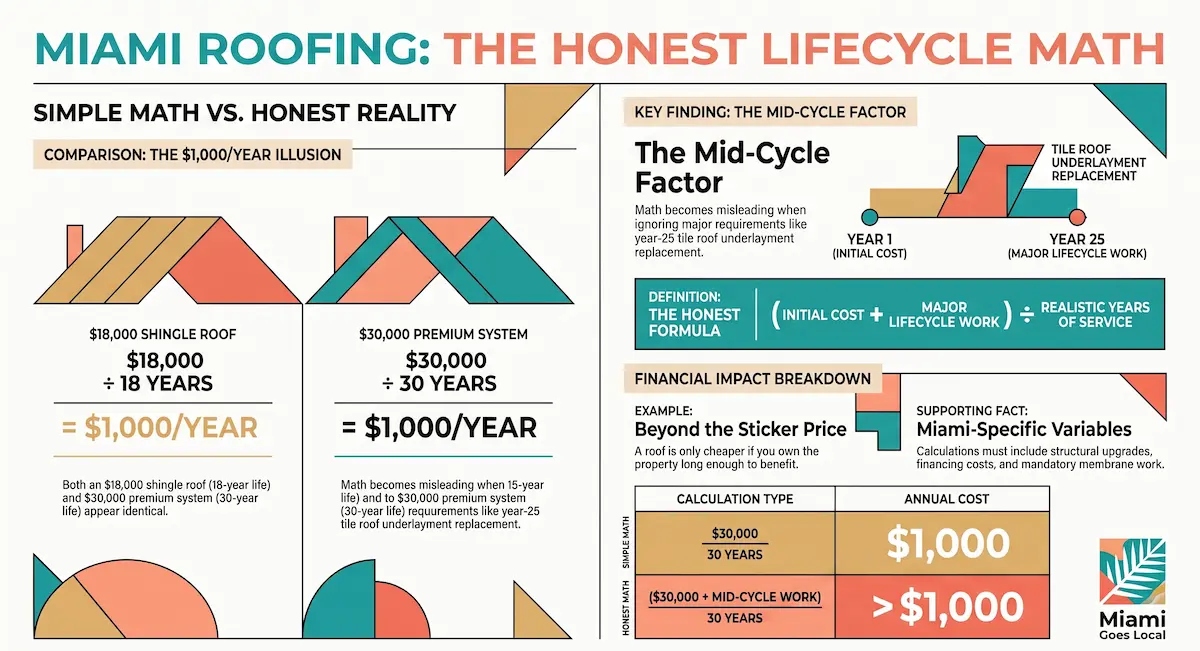
Cost per year is a useful comparison tool, provided you use a realistic service life and include major mid-cycle work.
Suppose, purely as an example:
- a shingle roof costs $18,000 and gives 18 years of useful service;
- another system costs $30,000 and gives 30 years.
The simple annualized cost is:
Shingle: $1,000 per year
Longer-lived system: $1,000 per year
The more expensive roof was not actually more expensive on that narrow lifecycle measure.
But the math becomes misleading if the supposedly 40-year tile roof needs a major underlayment replacement in year 25.
Your calculation should therefore be:
Initial installed cost + expected major lifecycle work ÷ realistic years of service
not:
Sticker price ÷ manufacturer's longest advertised warranty.
Compare roofing systems by cost per year of realistic Miami service, not price today. But include likely underlayment or major membrane work, structural upgrades and financing cost. A roof that costs twice as much is only cheaper over time if you actually receive the longer service life and own the property long enough to benefit from it.
Miami Roofing by Property Type
The building type can determine your roofing decision before the material table does. A single-family house, condominium tower, historic Miami Beach property and waterfront home can all sit in the same HVHZ and still have completely different cost drivers.
Start with ownership responsibility, structural system and local approval requirements.
Then compare materials.
Condo and co-op owners: first find out who owns the roof obligation
For many condominium owners, the first roofing question is not “which contractor should I hire?” It is “is the roof my responsibility at all?”
Florida condominium law defines common elements broadly as condominium property outside the individual units, and §718.113 places maintenance, repair and replacement of common elements on the association except where the declaration assigns responsibility differently for qualifying limited common elements.
Roof responsibility therefore starts with the declaration.
Do not rely on:
“The association usually handles roofs.”
Get the actual provision.
Ask the association or management company for the declaration language defining the roof and assigning maintenance, repair and replacement responsibility. Get it in writing before requesting contractor bids for work you may not legally control.
If the roof is an association responsibility, your financial exposure may arrive through:
- regular assessments;
- reserve contributions;
- a special assessment;
- association borrowing;
- an insurance deductible or uninsured loss allocated through association finances.
That is a fundamentally different decision from a homeowner signing a $25,000 reroof contract.
Florida Statute §718.115 treats expenses for maintenance, repair, replacement and protection of common elements as common expenses, subject to the declaration and statutory framework.
Ask for the project documents, not just the assessment number
If your association proposes a roofing assessment, ask for:
- professional condition report;
- roof age and permit history;
- measured roof area;
- proposed assembly;
- product approvals;
- contractor bids;
- engineering or design scope;
- expected project life;
- reserve allocation;
- assessment calculation.
A $9,000 unit-owner assessment can be reasonable or unreasonable.
The number alone cannot tell you.
HOA boards and multi-building communities
For an HOA controlling multiple roof assets, the defensible starting point is a professional condition assessment not a contractor walking the property and producing one replacement number.
A board may have ten buildings that were all constructed together but did not age identically.
Different buildings can have different:
- leak histories;
- solar exposure;
- tree coverage;
- prior repairs;
- deck condition;
- drainage;
- maintenance records.
That creates a choice between:
one large replacement program
and
phased work over several budget years.
Neither is automatically better.
Build the forecast from condition, not age alone
A useful roof forecast should identify:
- current condition by building;
- remaining useful service estimate;
- known leaks;
- repair history;
- expected replacement scope;
- planning cost;
- contingency;
- recommended replacement year.
Then update the forecast periodically.
That gives owners something more defensible than:
“These roofs are 18 years old, so we're replacing all of them.”
For boards, the inspection report is not simply a technical document.
It is the evidence behind the reserve forecast and owner communication.
Historic districts can remove choices from the material table
If the property sits in a locally designated historic district, the cheapest otherwise-code-compliant roof may not be an approvable roof.
Miami Beach has 14 local historic districts and reviews alterations within those districts under its Certificate of Appropriateness process.
The City's design guidelines state that original roofing material on existing historic buildings should be retained or replaced, and they specifically address flat/barrel tile and sympathetic metal-roof design depending on building type.
That can affect:
- roofing material;
- tile profile;
- color;
- visible flashing;
- metal-roof appearance;
- parapet details;
- whether an alternate system is allowed.
Do not order material before checking.
Historic Cuban tile is a special case
Older Miami Beach properties can contain historic Cuban barrel tile.
City materials have specifically addressed retention and preservation of historic Cuban tile, subject to applicable building-code requirements.
That creates a very different budget from purchasing standard new concrete tile.
The work may involve:
- salvaging;
- sorting;
- replacing broken units;
- finding compatible matching tile;
- installing a new compliant underlying roof system while retaining visible historic material where approved.
That is why a historic-property quote can look expensive even when the visible finished roof appears almost unchanged.
Older housing stock: separate structural age from roof age
An older house does not automatically need a more expensive roofing material, but its framing and deck deserve more attention when you change roof type.
The most important scenario is a move from a lightweight covering to heavy concrete or clay tile.
The cost table assumes the structure is already capable of carrying the proposed roof.
If it is not, the actual project becomes:
roof replacement + structural work.
Those are different budgets.
Before switching materials, verify:
- original roof type;
- existing framing;
- deck material;
- previous structural alterations;
- permit history;
- whether a design professional needs to confirm capacity.
Coastal and barrier-island properties
Near salt water, material compatibility becomes a lifecycle cost. A roof system that performs well inland can age differently when exposed continuously to airborne chlorides.
This matters particularly for:
- exposed fasteners;
- clips;
- screws;
- flashings;
- gutters;
- rooftop equipment interfaces;
- metal-panel edges;
- dissimilar-metal connections.
Miami-Dade's roofing-fastener approval materials distinguish products by corrosion-test performance and allowable uses, which is a reminder that “galvanized screw” is not a complete coastal specification.
For a waterfront roof, ask for the actual fastener and metal specification.
Not:
“corrosion resistant.”
Ask for:
manufacturer, material/coating, approval and warranty limitation.
Salt exposure can change your warranty before it changes your roof
Some manufacturer warranties contain restrictions based on proximity to salt water.
That can be more important than the headline warranty length.
A “40-year finish warranty” is not useful if the coastal exclusion begins closer to the ocean than your property sits.
Read the warranty before choosing the system.
Flat-roof neighborhoods
Flat and low-slope roofs deserve a different budgeting method because the square-foot membrane price is only part of the job. Drainage, parapets, substrate and rooftop penetrations can dominate the scope.
That is especially relevant to older Art Deco, MiMo and mid-century housing stock.
Miami Beach's architectural history makes low-slope roofs common enough that a Miami cost guide should not treat them as an afterthought.
What changes the price
For a pitched tile or shingle roof, complexity often comes from hips, valleys and pitch.
For a low-slope roof, look instead at:
- number of drains and scuppers;
- ponding;
- parapet-wall length;
- flashing height;
- HVAC curbs;
- vents and penetrations;
- existing insulation;
- substrate condition;
- number of existing membrane layers;
- whether the old roof must be removed;
- whether slope needs to be corrected.
Two 2,000-square-foot flat roofs can therefore have very different prices.
One may be a clean rectangle with good drainage.
The other may contain four HVAC units, two drains, parapets on every side and deteriorated substrate.
The measured area is the same.
The job is not.
Do not use pitched-roof lifespan logic
A low-slope membrane normally fails differently from tile or shingle.
Common warning signs include:
- seam failure;
- flashing separation;
- punctures;
- blistering;
- surface deterioration;
- persistent ponding;
- deterioration around penetrations.
Miami-Dade's structural-recertification guidance specifically identifies blistering, wrinkling, loss of surface protection, punctures, flashing deterioration and ponding as conditions of concern on flat membrane roofs.
That makes periodic inspection especially useful.
A small seam or flashing defect caught early can be repairable.
Water that has been moving through the assembly unnoticed can turn the same roof into a deck and insulation replacement.
The Miami decision tree
If you want the material comparison reduced to one screen:
Choose architectural shingle when:
initial cost is the priority and shorter replacement cycles are acceptable.
Choose concrete tile when:
the structure already supports tile, the architecture favors it and you are comfortable paying more upfront.
Choose clay tile when:
appearance and long-term color retention justify the additional material cost and the structure can support it.
Choose standing-seam metal when:
you are willing to spend more now for a potentially much longer ownership horizon and the exact coastal specification is appropriate.
Choose a low-slope membrane when:
the roof geometry requires it then compare TPO, PVC, modified bitumen or another approved assembly on drainage, substrate, attachment and repairability rather than trying to compare it directly with barrel tile.
The material is not the decision by itself.
The approved assembly, structure, property type, insurance situation and expected ownership period are what turn the material into a sensible or expensive choice.
How to Verify a Miami Roofing Contractor
Do not rely on the license number printed on a truck or proposal. Check the state record yourself, then check the permit after it is issued the same verification sequence we lay out in full in our guide on how to hire a contractor in Miami.
This takes a few minutes and gives you evidence independent of the salesperson, and if you're still building your shortlist of candidates, our directory of Miami contractors and construction pros is a good place to start gathering names to check.
Step 1: Find the contractor in the DBPR database
Use the Florida Department of Business and Professional Regulation's Verify a License search.
Search by:
- license number;
- individual name;
- business name.
For a statewide certified roofing contractor, look for a license type reading:
Certified Roofing Contractor
and a number normally beginning:
CCC
DBPR uses CCC for Certified Roofing Contractor and CGC for Certified General Contractor.
Do not confuse CGC with a roofing credential
A CGC number by itself is not the same thing as a Certified Roofing Contractor license.
Florida Statute $489.113 generally requiresgeneral, building and residential contractors to subcontract roofing unless they hold the appropriate roofing certificate or registration. The statute contains limited exceptions for example, specified wood, asphalt or fiberglass shingle work on a new building of that contractor's own construction.
The statute also says a general, building or residential contractor certified after 1973 may not hold itself out or advertise as a roofing contractor unless certified or registered as a roofing contractor.
So for a normal standalone Miami reroof, ask:
Who is the roofing license holder or qualifying agent for this job?
Then verify that person and business relationship.
Some DBPR records show multiple credentials attached to the same qualifying agent or business for example, a CGC and a separate CCC. That is exactly why checking the actual record is more useful than seeing one license number in an advertisement, and any legitimate Miami-Dade roofer serious about being found can back that up with verifiable details starting with a free business listing.
Step 2: Check the status not merely whether a record exists
A license search result is not enough. Look at its status.
You want to see that the applicable credential is current and active.
Florida law treats a person or business operating on an inactive or suspended certificate or registration as unlicensed for purposes of §489.127.
Check:
- license type;
- license number;
- status;
- expiration date;
- name of licensee;
- qualifying business relationship.
Make sure the business collecting your money is connected to the qualifying contractor you verified.
Step 3: Check complaint and disciplinary information
Look beyond the green “Current, Active” status.
DBPR maintains public licensing and enforcement information, including a separate public search for complaints alleging unlicensed activity.
Do not treat the existence of a complaint as proof that wrongdoing occurred.
A complaint is an allegation.
What matters more is whether the public record shows:
- a final disciplinary order;
- suspension;
- revocation;
- fines;
- repeated enforcement history;
- unresolved licensing issues.
If something concerns you, open the underlying public record rather than judging the contractor from a search-result label.
Step 4: Verify the permit after the contractor says it was pulled
Do not stop at “we submitted it.” Look for an issued permit.
For unincorporated Miami-Dade, the County allows the public to search building permits, application history and inspection history online.
Miami-Dade says its records can be searched using the permit number, process number or property address.
The County Building Permit Selection Menu includes searches for:
- permit inspection history;
- permit history;
- application history;
- open permits by address;
- outstanding requirements;
- inspection holds;
- project status;
- permits associated with a contractor.
What you are trying to verify
Before significant roofing work begins, confirm:
Property address: correct
Permit type: roofing / reroof
Permit status: issued
Contractor: matches the contractor you hired
Scope: generally matches the work being performed
Florida Statute §489.127 expressly prohibits commencing or performing work for which a building permit is required without the required permit being in effect.
If your house is inside an incorporated Miami-Dade municipality, use that city's permit portal or building department rather than assuming the County system contains the complete municipal record.
Step 5: Check the inspections as the project progresses
An issued permit is the beginning of the public record, not the end.
Miami-Dade's online system allows property owners to review permit inspection history. The County also publishes roofing-specific inspection procedures and requires the approved plans and permit card to be available for inspection.
A permit history can show inspection activity and results.
For the final check, you are looking for evidence that required inspections were completed successfully and that the permit reached its required final status.
Do not confuse:
permit applied for
with
permit issued
or
inspection requested
with
inspection passed.
Those are different stages.
Why an unpermitted roof matters later
An unpermitted reroof does not disappear when the contractor leaves. It becomes part of the property's permitting history.
Miami-Dade specifically allows searches for:
- work-without-permit violations;
- expired permits;
- open permits;
- code-compliance records.
Those records can become relevant when property records are reviewed later.
That is enough reason to verify the permit yourself.
I would not promise that every unpermitted roof automatically defeats an insurance claim or automatically stops a resale. Those outcomes depend on circumstances.
The more defensible statement is simpler:
You do not want a 20,000–50,000 roof project sitting in the public record as unauthorized work.
Post-storm contractors: verify harder, not faster
A contractor arriving after a hurricane is not automatically illegitimate. A major storm is exactly when legitimate roofing companies are busiest too.
But the environment changes.
Demand is high.
Homeowners are under pressure.
Temporary repairs are urgent.
Out-of-area crews can appear.
Insurance money is involved.
That is the wrong moment to relax your verification standard.
Unlicensed contracting becomes more serious during a declared emergency
Florida Statute §489.127 makes ordinary unlicensed contracting a first-degree misdemeanor in the circumstances covered by the statute.
An unlicensed person committing the prohibited contracting activity during a state of emergency declared by executive order of the Governor commits a third-degree felony.
So after a storm, verify the license before discussing the deposit.
Not afterward.
Expert Tip: Treat an unsolicited post-storm roofing pitch as an automatic verification trigger, not automatic proof of fraud. Ask for the roofing license number, verify it independently through DBPR, verify the business relationship and do not let storm urgency shorten the process.
Insurance-related roofing pitches have additional rules
Florida places specific restrictions on contractors soliciting insurance-related roof work.
Section 489.147 prohibits, among other things, certain inducements for inspections or insurance claims, deductible waivers, a contractor acting as an adjuster without the proper license, and insurance-related repair agreements that fail to provide a good-faith itemized and detailed estimate.
The same statute requires residential roofing contracts to contain specific notices.
For contracts entered into within 180 days of events subject to a gubernatorial state-of-emergency declaration, qualifying residential property owners also receive a statutory cancellation window: generally within 10 days after executing the contract or by the official start date, whichever comes first.
That is more useful than a blanket rule saying:
“Never hire anyone who knocks on your door.”
Read the contract.
Verify the license.
Understand the cancellation rights that actually apply.
Assignment of Benefits: the rule changed substantially
For most current Florida property policies, the old roofing Assignment-of-Benefits model should not be part of a new claim.
An Assignment of Benefits (AOB) transfers post-loss insurance benefits to a third party such as a repair contractor.
Florida law changed this for policies issued or renewed on or after January 1, 2023.
Florida Statute §627.7152 provides that, subject to limited exceptions, a policyholder may not assign post-loss benefits under a residential or commercial property policy issued on or after that date; an attempted assignment is void and unenforceable.
Florida's Department of Financial Services gives homeowners the same instruction: property-policy post-loss benefits generally cannot be assigned under policies issued or renewed from January 1, 2023 onward, and an AOB is not required to have a claim processed or a home repaired.
So I would replace the old warning:
“Never sign an AOB on the spot.”
with the more current one:
If a contractor asks you to sign a document assigning insurance benefits, stop and identify exactly what it is. For most current Florida residential property policies issued or renewed since January 1, 2023, post-loss AOBs are prohibited. Do not assume insurance paperwork put in front of you is routine.
If your policy predates that cutoff or the document is something other than an AOB, read the actual policy and obtain insurance or legal advice when necessary.
Do not let anyone “waive” your deductible
A contractor offering to absorb your insurance deductible is not giving you a normal roofing discount.
Section 489.147 requires insurance-related roofing advertising to disclose that the consumer is responsible for the deductible and states that knowingly and intentionally paying, waiving or rebating it as described by the statute can constitute insurance fraud.
If the pitch is:
“Insurance buys the roof and we'll make your deductible disappear,”
do not proceed until you understand exactly what is being proposed.
Timing: planned reroof versus emergency reroof
If the roof is serviceable and you are planning a replacement rather than responding to active storm damage, time is one advantage you can preserve.
A planned project lets you:
- obtain several physical inspections;
- normalize three written scopes;
- verify product approvals;
- check permitting requirements;
- review warranties;
- negotiate payment terms;
- verify the contractor without storm pressure.
Once a hurricane creates widespread damage, you may have fewer scheduling and contractor choices.
I would not publish a fixed claim that roofing prices always rise by a particular percentage after a South Florida storm without project-level evidence supporting that number.
The practical point does not need an invented percentage:
An emergency removes time from the buying decision.
If replacement is already foreseeable, use the time while you still have it.
Miami Roofing Verification Toolkit
Save these four official resources with the quote.
1. Florida DBPR Verify a License
Use it to verify:
- CCC roofing license;
- status;
- expiration;
- qualifying agent;
- related business.
Official DBPR License Search:
[Verify the contractor through Florida DBPR]
2. Miami-Dade Product Control
Use it to verify:
- Miami-Dade NOA;
- manufacturer;
- product/system;
- current approval;
- installation limitations.
Official Miami-Dade Product Approval Search:
[Check an NOA]
3. Miami-Dade Building Permit Records
For unincorporated Miami-Dade, use the County system to check:
- permit issuance;
- application history;
- inspection history;
- inspection holds;
- outstanding requirements;
- final project status.
Miami-Dade makes building permit and inspection history searchable online.
Official County Permit Search:
[Check the permit]
4. Your municipal building department
If the property is inside an incorporated municipality, identify your permitting authority and use that city's permit records.
Do this before relying on a County search alone.
Five-minute check before you sign
- Roofing license verified independently
- Qualifying business matches the company on contract
- Roof material and system identified
- HVHZ approval verified
- Underlayment specified
- Attachment method specified
- Tear-off and disposal included
- Decking priced per sheet
- Flashing and drip edge addressed
- Permit responsibility stated
- Code-related variables have fixed pricing rules
- Manufacturer warranty stated
- Workmanship warranty stated
- Payment schedule stated
- No unexplained “TBD” charges
- Insurance-related documents understood before signature
Frequently Asked Questions
How much does a new roof cost for a 1,500, 2,000 or 2,500 sq. ft. home in Miami?
If those numbers represent actual roof area not interior living area a 2026 Miami-Dade replacement can range from roughly $10,500 for a basic 1,500-square-foot shingle roof to more than $55,000 for 2,500 square feet of premium clay tile. These are planning ranges from published Miami pricing captured August 24, 2026, not quotes.
Why is my Miami quote higher than the Florida averages I found online?
Miami-Dade sits inside Florida's High-Velocity Hurricane Zone, so the roof has to meet requirements that do not apply to most Florida jobs. That affects approved roof systems, attachment, underlayment, design pressures, permit documentation and inspections.
That is why a cost guide built from Orlando or another non-HVHZ market is not an apples-to-apples comparison.
Miami-Dade roofing permit forms require system-specific information for shingles, tile, metal and low-slope assemblies, and the County maintains separate HVHZ roofing documentation.
There is no verified universal rule that says:
“HVHZ adds 30%.”
The better comparison is to ask what the Miami quote includes that the statewide estimate does not.
Do I need a permit to replace my roof in Miami-Dade?
Yes. A roof replacement requires a roofing permit, but the issuing authority depends on the property's jurisdiction. Miami-Dade requires a Uniform Roofing Permit Application for roofing permits and provides a County e-permitting system for qualifying work in unincorporated Miami-Dade.
If your property is inside an incorporated city, use that municipality's building department.
Before work starts, verify:
- who is pulling the permit;
- which authority is issuing it;
- whether permit costs are included;
- the permit number once issued.
A proposal does not legally have to show the permit as one universal fixed-price line item, but it should make responsibility and cost clear in writing.
Can I re-roof over my existing roof in Miami-Dade?
Sometimes. Current Florida code allows roof recovering in certain circumstances, but it requires full removal down to the deck when specified conditions exist.
Removal is required, for example, when the existing roof is water-soaked or too deteriorated to support another system, when certain existing coverings are present, when there are already two or more roof-covering applications, or when the existing roof cannot provide the attachment required for the new system.
So the correct answer is not:
“Miami always requires tear-off.”
It is:
“The existing roof and proposed assembly determine whether recovery is allowed.”
The separate 25% rule can also affect the permitted scope. For qualifying roofs built, repaired or replaced under the 2007 Florida Building Code or a later edition, Florida law now provides an important exception to the traditional 25% replacement rule.
Does homeowners insurance pay for a new roof in Florida?
Insurance can pay for covered roof damage, such as qualifying wind or hurricane damage, subject to the policy's coverage, limits and deductible. It generally does not function as a maintenance plan for a roof that simply wore out.
Florida's Department of Financial Services states that damage arising from general wear and tear or lack of maintenance is typically not covered under a homeowners policy.
Claim payment also depends on the policy.
Florida law permits hurricane deductibles and, under specified conditions, separate roof deductibles. A roof deductible cannot be applied to certain losses, including a roof loss resulting from a hurricane.
Document the damage before repairs where it is safe to do so, report the claim promptly, and read the actual policy rather than assuming that “storm damage” automatically means “new roof paid in full.”
Will a new roof lower my homeowners insurance premium?
It can, but there is no universal percentage. A newer roof can affect underwriting, while documented wind-resistance features can qualify the property for mitigation credits or other rating adjustments.
Florida's consumer guidance specifically says wind-mitigation inspections are used to determine credits available on the homeowners windstorm premium.
Do not assume that spending $30,000 on a new roof automatically produces a particular annual saving.
Ask your carrier or agent:
“Which features on the new roof change my premium, and by how many dollars?”
Can my insurer drop me because my roof is 15 years old?
Not solely because of age without giving you the inspection opportunity required by Florida law. Florida Statute 627.7011 says an insurer may not refuse to issue or renew a homeowners policy solely because a roof is less than 15 years old.
For a roof that is 15 years old or older, the insurer must allow the homeowner to obtain an inspection by an insurer-approved authorized inspector before requiring roof replacement as a condition of issuance or renewal.
If that inspection finds five years or more of useful life remaining, the carrier may not refuse issuance or renewal solely because of roof age.
The word solely matters. A carrier can still rely on other lawful underwriting criteria.
General information only, not insurance or legal advice. Policy terms and carrier underwriting rules vary.
What is a Miami-Dade Notice of Acceptance?
A Miami-Dade Notice of Acceptance, or NOA, is a county product approval documenting an approved building product or system and the conditions under which it may be used. For roofing, the approval can specify the approved assembly, attachment, deck type, design-pressure limits and installation details.
Do not use the overly broad rule:
“Every exterior component on my house needs its own NOA.”
Instead, ask for the approval applicable to the proposed roof covering or assembly and verify that it allows the intended HVHZ use.
Miami-Dade's roofing permit process requires system-specific component information for shingles, tile, metal and membrane roofs.
If the contractor gives you an NOA number, check it in Miami-Dade Product Control.
If the contractor uses a Florida Product Approval instead, verify that the approval is valid for the proposed HVHZ application.
What happens if the decking underneath my roof is rotten?
Damaged decking that cannot provide a suitable substrate or required attachment has to be repaired or replaced before the new roof system can be properly installed. The exact quantity can be genuinely unknown until tear-off exposes the deck.
That is why deck replacement should be priced with a unit rate.
 Thanksgiving in Miami 2026: Independent Restaurants, Bakeries and Takeout That Are Open
 Best Plumbers Near Little Haiti, Miami How to Choose One You Can Trust
 Different Types of Massage in Miami: How to Choose by Goal, Price and Licence
