
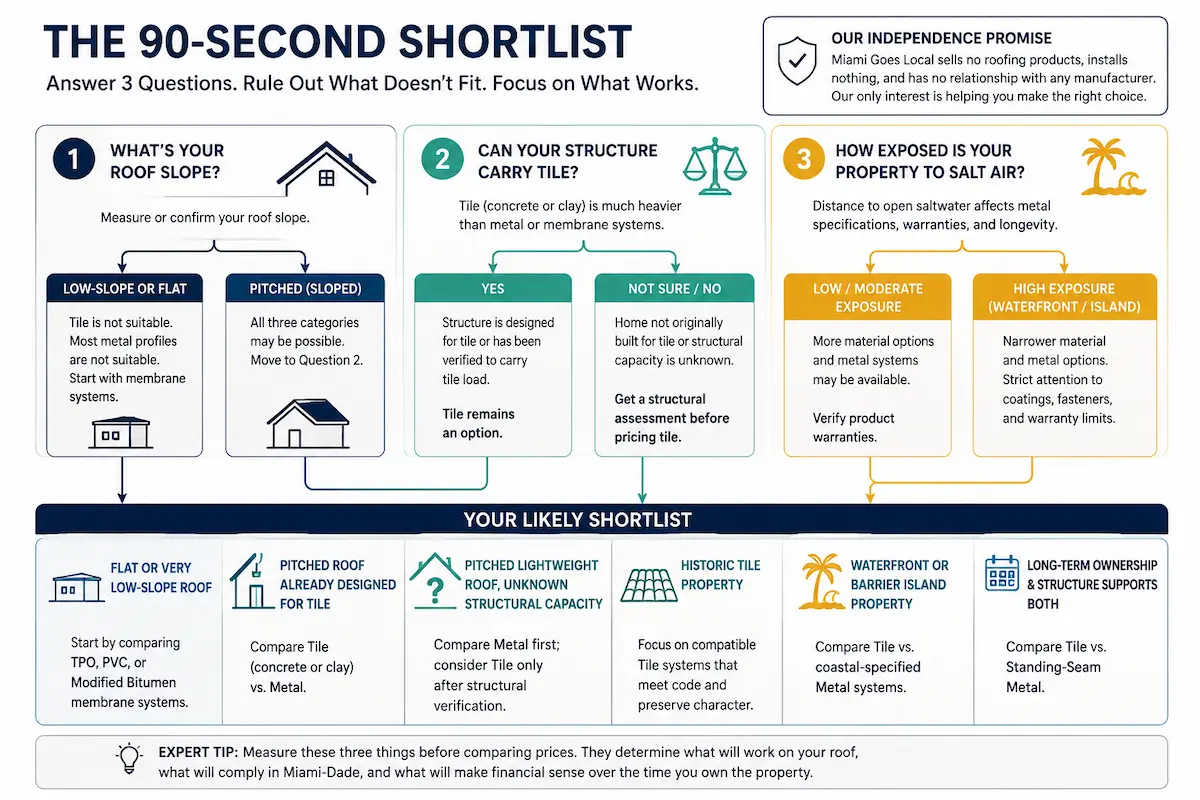
Before comparing tile, metal, and flat-roof systems, answer three questions. In many Miami homes, one or two options can be ruled out before price even matters.
1. What is your roof slope?
If your roof is flat or very low-slope, start with membrane systems such as TPO, PVC, or modified bitumen.
Some standing-seam metal systems can work on lower slopes, but the exact minimum slope depends on the approved system.
If your roof is pitched, tile and standing-seam metal may both be viable.
2. Can your structure carry tile?
Concrete and clay tile are much heavier than membrane or many metal roof systems.
If your home already has tile, replacing it with another tile system may be straightforward from a structural-load standpoint, subject to inspection and the proposed assembly.
You may need structural verification before switching to tile.
Ask this before pricing tile: “Has the existing roof structure been verified for the dead load of this tile system?” If the answer is no, treat structural review as a separate possible cost
3. How exposed is the property to salt air?
If the property is waterfront, on a barrier island, or directly exposed to coastal salt air, pay closer attention to metal specifications.
💡 Expert TipDo not rely on a generic rule such as “metal cannot be used within X miles of the ocean.” Check the exact product warranty and approved system for your address.
Miami Goes Local sells no roofing product, installs nothing, and has no relationship with any manufacturer, though any Miami-Dade roofing contractor who wants to be considered for future coverage can start with a free business listing.
Two of the three most-cited comparisons on this topic are published by companies that make or install one of the materials being compared.
Tile vs. Metal vs. Flat Roof: What Actually Works in Miami's Climate?
Search “tile vs. metal roof” and a pattern appears quickly: metal companies tend to favor metal, tile installers tend to favor tile, and many Florida comparisons are written for markets with different wind, salt-air and building conditions than Miami-Dade.
That matters because there is no best roof for Miami. There is a best roof for your address.
Miami-Dade is inside Florida's High-Velocity Hurricane Zone (HVHZ), the part of the Florida Building Code with additional wind-resistance requirements. Roofing systems installed here must meet the applicable HVHZ requirements, and Miami-Dade maintains separate permit documentation for tile, metal and single-ply membrane systems.
But wind is only the first filter.
A metal roof that makes sense inland may need a different specification near open saltwater, and individual steel warranties can contain coastal setback exclusions minimum distances from saltwater within which some warranty coverage changes or does not apply.
A tile roof can have another lifecycle problem: the concrete or clay covering may remain usable longer than parts of the waterproofing assembly underneath it. Miami-Dade's tile permit documentation treats the tile, underlayment and attachment as distinct parts of the roof system, which is why comparing tile only by the expected life of the visible tile can give you the wrong lifecycle cost.
And if your Miami property has a flat or low-slope roof, membrane roofing is not a commercial-building footnote. Miami-Dade has dedicated HVHZ permit forms for single-ply membrane systems such as TPO and PVC, as well as built-up and other low-slope systems.
Heat adds another layer. Roof color and solar reflectance—the amount of incoming solar energy a surface reflects rather than absorbs can matter when comparing systems in Miami's climate. Local roof-reflectance requirements also need to be checked against your specific jurisdiction and project type rather than assumed to apply identically to every reroof.
This guide compares tile, metal and flat/low-slope membrane roofing on Miami-Dade terms:
- HVHZ compliance and product approval
- salt-air exposure
- heat and reflectance
- structural load
- insurance considerations
- realistic service life
- repair cycles
- lifecycle cost per year
https://miamigoeslocal.com/The goal is not to make tile, metal or membrane win every column. It is to help you eliminate what does not work at your address, identify what each remaining system is worst at, and know what to verify in writing before signing a roofing contract.
By the end, you should have one or two systems worth pricing not three materials you are still trying to compare in the abstract.
The Comparison, Miami-Anchored
The right Miami roof depends first on slope, structural capacity and salt exposure not which material wins the most categories. In Miami-Dade, every option also has to work inside the High-Velocity Hurricane Zone (HVHZ), so a product rating that is acceptable elsewhere in Florida does not automatically establish that it can be installed at your address.
Tile vs. Metal vs. Flat Roof in Miami
Compare typical Miami-Dade costs, service life, HVHZ performance,
structural load, coastal exposure and heat performance before choosing
a roofing system.
Tile vs. Metal vs. Flat Roof in Miami
Comparison
Installed Miami-Dade cost
$14–$22/sq. ft. concrete;
$16–$25+/sq. ft. clay
$14–$20/sq. ft.
for standing seam
$18–$28+/sq. ft.
$8–$12/sq. ft. TPO;
roughly $7–$10/sq. ft.
modified bitumen
Realistic service life here
25–40+ years as a roof system.
Individual tiles may last longer than the underlayment beneath them.
30–50 years, highly dependent on
coating, installation and salt exposure.
40–50+ years is plausible with an
appropriate coastal system and maintenance.
15–25 years is a reasonable planning
window depending on membrane, drainage and maintenance.
HVHZ wind performance
Viable when installed as an approved HVHZ assembly.
Attachment method and design pressures matter.
Viable with an HVHZ-approved panel assembly sized for
the project's calculated pressures.
Same requirement. Aluminum is not exempt from HVHZ approval
because it handles corrosion differently.
Viable with an approved HVHZ assembly. Attachment and
perimeter/corner pressures are critical.
Structural load
Highest. Structure must be capable of
carrying the proposed tile system.
Low compared with tile.
Low compared with tile.
Generally low, although existing layers,
insulation and deck condition still matter.
Salt exposure
Good, but fasteners, flashing and
attachment components still need appropriate corrosion resistance.
Most specification-sensitive.
Coastal warranty/setback restrictions can apply to particular
steel products.
Strong coastal candidate because aluminum
does not rust like steel, but coatings, fasteners and warranties
still need verification.
Generally good, but metal flashings,
fasteners, rooftop equipment and terminations remain corrosion
considerations.
Reflectance / heat
Highly dependent on tile color and surface.
Light/high-reflectance tile can reduce solar heat absorption.
Cool-roof coatings and lighter finishes can achieve high
reflectance; verify the exact product value.
Same principle as steel; verify the coating rather than assuming
all metal is “cool.”
White TPO/PVC products can offer high initial solar reflectance;
modified bitumen performance depends heavily on surface and color.
Do not compare wind performance by one headline MPH number
For Miami-Dade, “rated to 150 mph” is not enough information to choose a roof. HVHZ compliance depends on the approved assembly and the design pressures calculated for the building, including different pressures at roof field, perimeter and corner zones.
That is why the useful document is the product's applicable NOA number a Miami-Dade Notice of Acceptance or other approval valid for the proposed HVHZ application, together with its allowable design pressures and installation limitations.
Ask the contractor:
“What product approval are you using, and does this exact assembly satisfy the calculated pressures at my address?”
Miami-Dade's current roofing permit documents specifically require system and product-approval information rather than accepting a generic manufacturer wind-speed claim.
The salt-air column matters more than it looks
Salt exposure does not automatically eliminate metal, but it can change which metal makes financial sense.
Steel depends on its metallic coating, paint system, edge detailing, fasteners and maintenance to control corrosion. Some manufacturers also impose setback exclusions warranty restrictions based on distance from breaking surf, coastline or saltwater on particular steel products.
Aluminum costs more but does not rust through the same iron-oxidation process as steel. That makes it worth pricing separately for directly exposed coastal properties rather than treating “metal” as one material.
“Is metal good near the ocean?”
“What metal, coating and warranty apply at my address?”
Ask the contractor to provide the manufacturer's coastal warranty language in writing before comparing steel and aluminum prices, and if you haven't settled on who's doing the installation yet, browse our directory of Miami contractors and construction pros first.
Why Miami Changes the Answer: HVHZ, Product Approval and Fasteners
Miami-Dade changes the material comparison before price or aesthetics enter the discussion. Every roof here sits inside Florida's High-Velocity Hurricane Zone (HVHZ), where the roof system has to meet additional wind, attachment and product-approval requirements.
That means the first question is not:
“Do I prefer tile, metal or membrane?
“Is this exact system approved for use at my address?”
Product approval: verify the exact HVHZ assembly
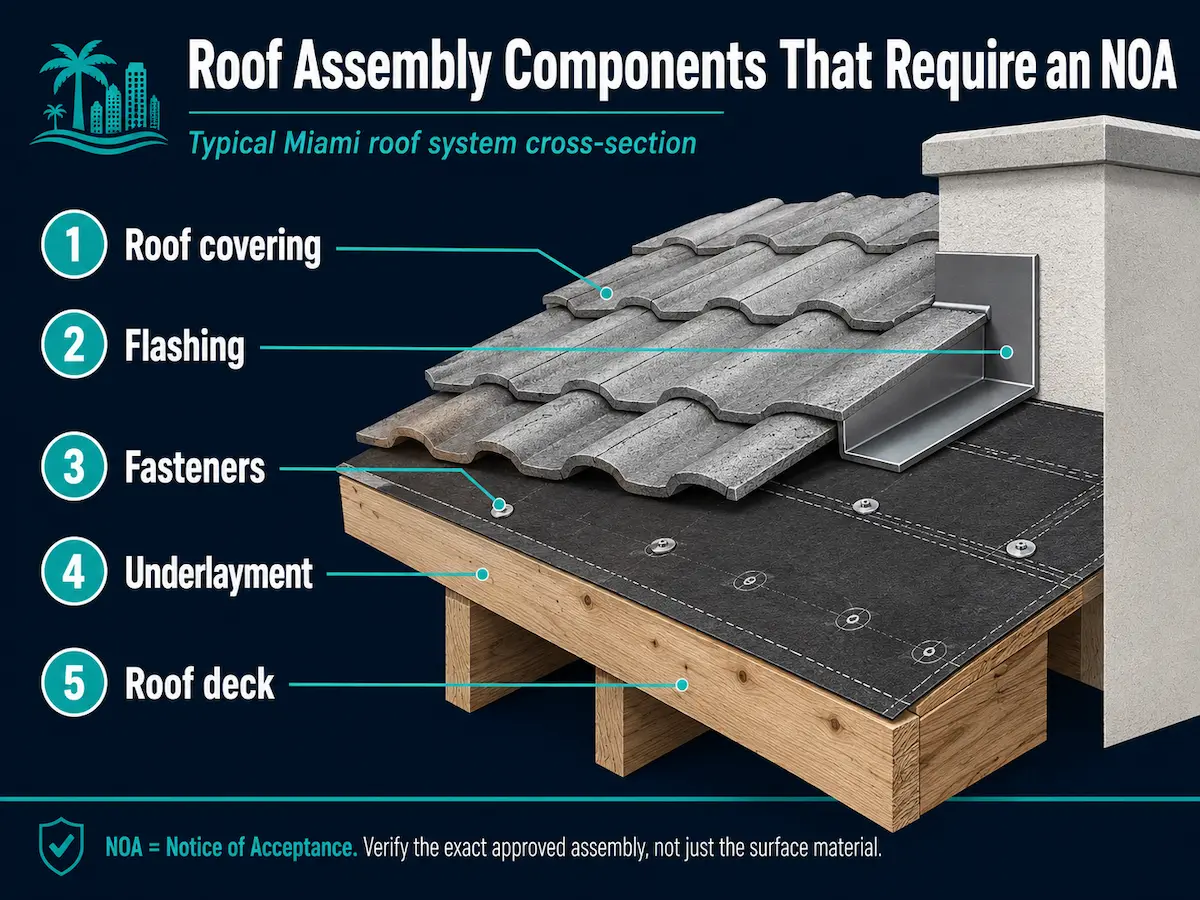
A Notice of Acceptance, or NOA, is Miami-Dade County's product approval for a building product or system.
Miami-Dade's Product Control Section reviews roofing systems and other building-envelope products and maintains a searchable public approval database.
But do not use this rule:
“Every component must have its own Miami-Dade NOA and a Florida Product Approval is never acceptable.”
That is too absolute.
The better rule is:
Ask for the approval number covering the proposed roof system and verify that the product, attachment method and installation are approved for HVHZ use.
If the contractor is using a Miami-Dade NOA, ask for the NOA number in writing.
Then check it yourself in Miami-Dade's Product Control database.
Search Miami-Dade Product Approvals
The approval is useful because it can tell you:
- permitted roof deck;
- underlayment;
- attachment method;
- fastener requirements;
- allowable design pressures;
- slope limitations;
- installation details.
A product name alone does not tell you those things, one of several reasons we cover vetting contractors in more depth in our guide on how to hire a contractor in Miami.
Ask your contractor:“What approval are you using for this exact roof assembly, and does it cover the calculated pressures at my address?”
Do not settle for:“Everything we install is Miami-Dade approved.” Get the number. Then verify it.
The roof has to work as an assembly
HVHZ compliance is not just about buying a stronger visible roof covering. Tile, metal and membrane systems are evaluated as assemblies.
The covering, underlayment, attachment and substrate have to work together.
That is why two quotes for the same visible material can differ materially.
One may specify:
- a different underlayment;
- tighter attachment;
- a different deck condition;
- different perimeter and corner requirements.
The other may not.
The system details are where the comparison becomes real.
Underlayment: current code gives more than one path
Miami-Dade does not currently require every roof to use self-adhered membrane directly over the entire deck.
As of August 24, 2026, the current code is the 8th Edition (2023) Florida Building Code. Miami-Dade's roofing update documents confirm that this edition changed the permitted use of self-adhered and synthetic underlayments in the HVHZ.
For several steep-slope systems, the current code allows different compliant methods, including:
- direct-to-deck self-adhered underlayment;
- sealed deck joints with approved underlayment above;
- prescribed multi-layer nailable underlayment.
So if one contractor says:
“Peel-and-stick is required everywhere in Miami,”
ask which code provision and approved system they are relying on.
The exact answer depends on your roof system.
Fastener schedules are part of the roof performance
In the HVHZ, a fastener is not just a screw or nail chosen from a hardware shelf. Its material, corrosion resistance, dimensions and use can be part of the approved roofing system.
Miami-Dade runs a specific Roofing Fastener Listing Program for roofing fasteners and batten plates.
The County's current certification checklist requires laboratory testing for listed products.
Depending on the fastener type, that can include:
- salt-spray corrosion testing;
- galvanization documentation;
- coating measurements;
- shear-strength testing;
- quality-control retesting.
Miami-Dade's Product Control database currently lists roofing fasteners by manufacturer, model, use and corrosion-test category.
That is especially relevant for metal and tile roofs.
Which fasteners are specified for this system, and where are they identified in the approval?”
For a metal roof, also ask whether the proposed fasteners are:
- concealed or exposed;
- compatible with the panel metal;
- appropriate for coastal exposure;
- listed for the intended HVHZ use.
Corrosion matters even when the roof covering does not rust
A clay or concrete tile does not rust.
The fasteners holding parts of the system can.
A membrane roof does not rust.
Its edge metal, screws and rooftop terminations can.
That is why Miami-Dade's fastener program includes corrosion testing rather than treating fasteners as interchangeable hardware.
For a coastal property, this becomes part of lifecycle cost.
The visible roof material may still be serviceable while an inappropriate fastener or flashing system is deteriorating.
Inspections are part of the HVHZ process
Miami-Dade roofing work is inspected as a system, not only as a finished surface.
The County publishes separate HVHZ roofing forms for different roof types, including tile, metal, single-ply membrane and other low-slope systems.
The permit package can require system details before installation begins, and staged inspection may occur before portions of the roof are covered.
This matters when comparing quotes because compliance requires:
- documentation;
- sequencing;
- inspection access;
- installation matching the approved assembly.
A statewide cost comparison usually does not price that distinction clearly.
What this changes when comparing tile, metal and membrane
HVHZ does not make one material automatically better. It removes unsupported combinations from consideration.
For tile, verify:
- tile approval;
- underlayment;
- attachment method;
- design pressures.
For metal, verify:
- panel system;
- clips or fasteners;
- allowable pressures;
- coastal compatibility.
For membrane, verify:
- membrane assembly;
- attachment or adhesive method;
- deck/substrate;
- perimeter and corner requirements.
The question is the same for all three:
Does the complete assembly work at your address?
That is the Miami version of the comparison.
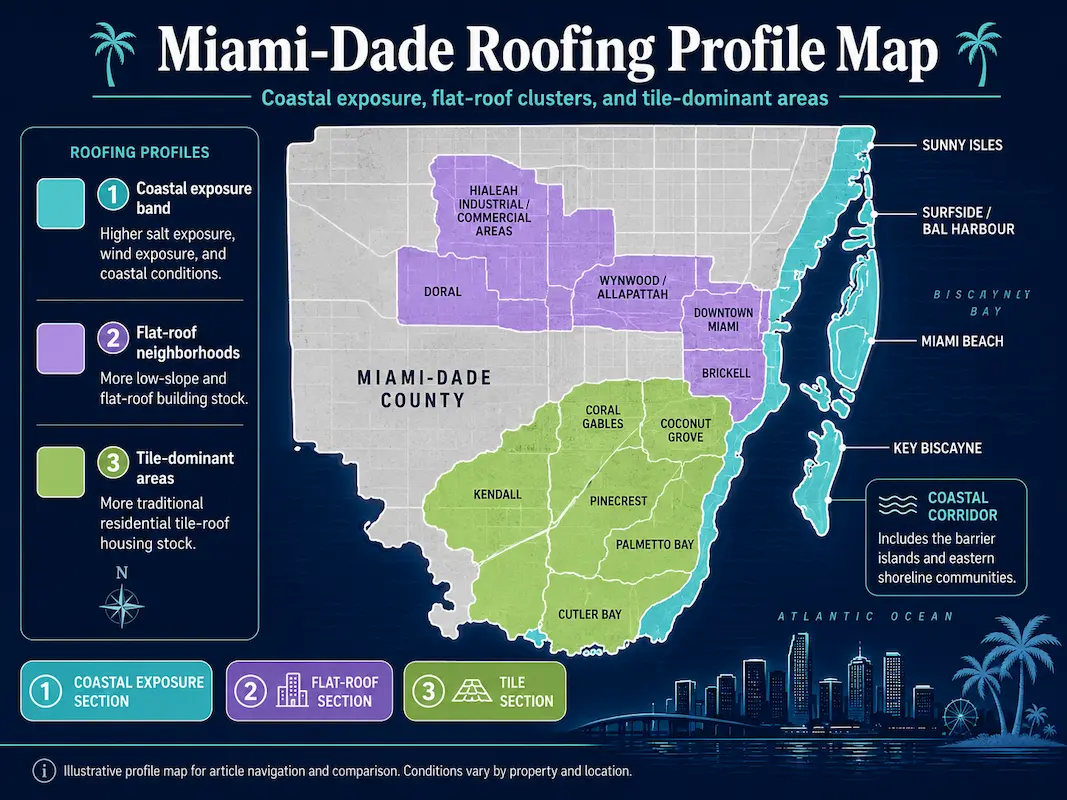
The Salt Layer: Distance From Water Changes What You Can Install
Salt exposure does not automatically rule out metal, tile, or membrane roofing. It changes the specification, the warranty, and sometimes which version of a material makes sense at your address.
That is especially important in Miami-Dade, where a property can be close enough to open saltwater for coastal exposure to matter even when the roof itself is fully HVHZ-compliant.
What the industry actually publishes
Gulf Coast Supply's 2025 metal-vs.-tile comparison describes metal roofing as corrosion-resistant and nearly maintenance-free. On its separate coastal product pages, the same manufacturer explains that standard steel warranties can carry saltwater setbacks and offers both a setback-finder tool and coastal-specific alternatives.
Its OceanGuard line uses aluminum with a PVDF finish polyvinylidene fluoride, a high-performance architectural coating and is marketed specifically for shoreline exposure because its standard steel products can be subject to coastal warranty restrictions.
That is not a contradiction that needs a gotcha.
It is the reason the warranty matters.
Expert Tip: Ask any metal contractor: “Does this exact panel, substrate, and coating carry a saltwater setback exclusion at my address?” Then ask how the manufacturer defines the measurement breaking surf, coastline, bay, canal, or another reference point. Get the answer in writing.
Do not treat 1,500 feet or any other commonly repeated distance as Miami-Dade code.
Coastal setback distances are manufacturer warranty terms, and they vary by product.
For example, Gulf Coast currently publishes one specialized coated-steel product that can be installed as close as 300 feet from breaking surf, while its aluminum coastal line advertises no saltwater setback under that warranty.
The number belongs to the warranty. Not the building code.
Steel vs. aluminum near saltwater
Coated steel can work in coastal environments, but its suitability depends heavily on the substrate, coating system, cut-edge protection, fasteners, and warranty. Aluminum removes the steel-rust mechanism, which is why it becomes more attractive as salt exposure increases.
Typical steel roofing uses either:
- galvanized steel, protected primarily with zinc; or
- aluminum-zinc-coated steel, often sold under trade names such as Galvalume.
Those coatings improve corrosion resistance.
They do not make steel indifferent to salt.
Gulf Coast itself states that its aluminum-zinc steel performs better than conventional galvanized steel in many conditions but that severe salty-air exposure can exceed what that protection alone is intended to handle.
Aluminum behaves differently because it contains no iron to produce conventional red rust.
That does not make aluminum maintenance-free.
Coatings, cut edges, flashings, sealants, clips, fasteners, and dissimilar-metal connections still matter.
What to ask for on a coastal metal quote
Require the contractor to identify:
- panel substrate: steel or aluminum;
- panel thickness or gauge;
- paint system: including whether it is PVDF;
- manufacturer's coastal warranty;
- saltwater setback exclusion, if any;
- clip material;
- fastener material;
- flashing material;
- treatment of field-cut edges and penetrations.
Do not accept:
“Coastal-grade metal roof.”
That is not a specification.
What metal is worst at near the coast
Metal is most vulnerable where the protective system is interrupted.
The middle of a properly coated panel is not necessarily the first place to watch.
More vulnerable locations include:
- cut edges;
- drilled penetrations;
- exposed screws;
- clips;
- flashings;
- ridge and edge terminations;
- gutters;
- locations where water and salt deposits remain trapped.
This is also why a coastal specification should cover the accessories, not just the panel.
If a contractor is proposing aluminum because of coastal exposure, ask whether the clips, screws, edge metal, gutters, and flashings are compatible with the aluminum system. Upgrading only the visible panel does not remove corrosion risk from the rest of the assembly.
Fasteners can decide whether the roof lasts
FEMA specifically recommends 300-series stainless-steel clips and fasteners for metal roofs located within 3,000 feet of the ocean line. That is federal coastal-construction guidance, not a Miami-Dade code setback.
The distinction matters.
3,000 feet is guidance.
It is not a legal boundary saying one fastener becomes compliant at 3,001 feet and noncompliant at 2,999 feet.
FEMA's broader coastal guidance also recommends corrosion-resistant fasteners throughout portions of a building exposed to airborne salts and notes that stainless steel offers particularly strong corrosion resistance where replacement would be difficult.
So for a coastal Miami quote, ask separately:
Panel: ____________________
Clips: ____________________
Fasteners: ____________________
Flashing: ____________________
Do not assume all four are the same corrosion grade.
Confirm the fastener specification separately from the panel specification. FEMA recommends 300-series stainless steel for metal-roof clips and fasteners within 3,000 feet of the ocean line, but your project's exact requirement still has to match the approved roof assembly and applicable Miami-Dade requirements.
Do not mix metals casually
Saltwater makes galvanic corrosion more aggressive when incompatible metals are allowed to touch in the presence of moisture.
Galvanic corrosion is accelerated corrosion that can occur when dissimilar metals are electrically connected through an electrolyte such as salty water.
FEMA's coastal corrosion guidance specifically warns that dissimilar metals can corrode rapidly when saltwater acts as the electrolyte. Aluminum sits substantially farther from copper on the galvanic series, making that pairing a particular compatibility concern.
The Metal Construction Association gives the same practical warning: installers should check compatibility before combining different roofing metals, and fastener selection is part of that decision.
Do not allow an aluminum roofing system to be casually connected to copper gutters, flashing, penetrations, or other incompatible metals. If different metals must meet, require the manufacturer-approved isolation or separator detail in writing.
This is especially important where runoff from one metal can wash across another.
The correct detail depends on the materials involved and the manufacturer's approved installation.
Salt does not affect only metal roofs
Tile and membrane roofs avoid some panel-corrosion problems, but their roof assemblies still contain metal.
That means coastal exposure remains relevant.
Tile
Concrete and clay tiles themselves do not rust.
Their fastening and edge systems can still contain:
- screws;
- nails;
- clips;
- straps;
- flashing;
- drip edge;
- valley metal.
A coastal tile quote should therefore identify the approved attachment system and corrosion-resistant fasteners required by that system.
Do not evaluate tile's coastal durability only by looking at the tile.
Flat and low-slope membrane
TPO, PVC, and modified-bitumen membranes also avoid corrosion across most of the waterproofing surface.
But low-slope roofs frequently rely on:
- perimeter edge metal;
- termination bars;
- screws;
- fastened insulation systems;
- drain components;
- scuppers;
- parapet flashing;
- rooftop-equipment curbs.
Those components sit exactly where wind-driven salt and water can concentrate.
A membrane roof can therefore have an excellent field surface and still develop expensive perimeter problems if the edge and fastener specification is wrong for the exposure.
What to do with this at your address
Measure exposure before comparing warranties. Then make the manufacturer confirm that your address fits the warranty being sold with the roof.
For a metal quote, ask:
- Is the panel steel or aluminum?
- What coating is on it?
- Does the warranty contain a saltwater setback exclusion?
- What distance applies to this exact product?
- How is that distance measured?
- Are the clips and fasteners specified separately?
- Are they appropriate for this coastal exposure?
- Are any incompatible metals present in gutters, flashing, or penetrations?
For tile or membrane, ask the same underlying question:
“Which parts of this assembly can corrode, and what has been specified for the salt exposure at my address?”
That is more useful than asking whether one roofing material is simply “good near the ocean.”
The Tile Underlayment Problem
A tile roof can still look good when the waterproofing underneath it is approaching the end of its useful life. That is the lifecycle cost most simple tile-vs.-metal comparisons miss.
Concrete and clay tiles are the visible weathering surface.
They are not, by themselves, the entire waterproofing system.
Underneath them sits an underlayment system that provides another layer of water protection. Flashings, penetrations, attachment details and the roof deck are also part of the assembly.
That distinction matters because these components do not necessarily age at the same rate.
Tiles can outlive what's underneath them
The tile itself can remain serviceable after the underlayment or flashing beneath it needs substantial work.
That is why:
“How long does concrete tile last?”
and
“How long will this tile roof system go before major re-work?”
are not the same question.
A roof can develop leaks while the tiles visible from the street still appear intact.
This does not make tile a bad Miami roof.
It means a lifecycle comparison that divides the initial installation price by the advertised life of the tile alone can make tile look cheaper than the complete roof system actually is.
What underlayment replacement can involve
If the waterproofing beneath serviceable tile eventually requires replacement, accessing it can become a labor-heavy project.
Depending on the existing assembly and condition, work can involve:
- removing or carefully lifting tile;
- removing the existing underlayment;
- inspecting and repairing the deck;
- installing the new code-compliant underlayment system;
- restoring flashing and attachment details;
- reinstalling salvageable tile;
- replacing tiles that cannot be reused.
The expensive part is therefore not necessarily buying another roof's worth of tile.
It is gaining access to everything underneath it and rebuilding that portion of the assembly correctly.
In Miami-Dade, the replacement system also has to satisfy the applicable High-Velocity Hurricane Zone (HVHZ) requirements in effect when the work is performed.
Do not assume “20 years”
There is no defensible universal rule that every Miami tile roof needs its underlayment replaced at year 20.
Service life depends on:
- underlayment product;
- installation;
- roof geometry;
- drainage;
- heat exposure;
- penetrations;
- previous repairs;
- flashing;
- storm history.
Different underlayment technologies also have different performance characteristics.
The useful financial rule is:
Expert Tip: When comparing tile with metal, include one possible major underlayment/re-work event in your long-term planning rather than assuming the visible tile's lifespan equals the service life of every component underneath it.
That gives tile a fair comparison without pretending we know the replacement year for a roof that has not been installed yet.
What to ask before choosing tile
Ask the contractor:
“What exact underlayment system is included?”
Then get in writing:
- manufacturer;
- product name;
- applicable NOA or other HVHZ approval;
- installation method;
- manufacturer's warranty;
- whether the proposed tile attachment penetrates the underlayment;
whether the chosen tile is reasonably salvageable if future underlayment work becomes necessary. That is roof-surface temperature.
It does not mean your Miami house becomes 50°F cooler indoors.
Tile, metal and membrane behave differently
All three can be part of a heat-conscious roof, but none should be judged by material name alone.
Metal
Metal roofing can achieve strong solar performance when paired with an appropriate reflective coating and color.
Do not assume:
“Metal reflects heat.”
Ask for the tested reflectance of the exact finish and color being quoted.
A dark metal panel and a light reflective panel are not thermally equivalent simply because both are metal.
Tile
Tile performance varies with color, surface and installation.
Light-colored tile can provide considerably greater solar reflectance than a dark product. Tile installations can also have thermal behavior influenced by the space and ventilation characteristics beneath the tile.
Again, verify the exact product.
Do not assign one reflectance value to “tile.”
Flat and low-slope membrane
This is where low-slope roofs deserve serious treatment.
White TPO and PVC products can achieve high solar reflectance, which is one reason reflective membranes are widely used for cool-roof applications.
Modified bitumen varies more with its surface treatment.
For a flat Miami roof, the membrane's tested solar properties should therefore be part of the product comparison not an afterthought.
Expert Tip: If heat performance matters, compare the exact color and finish, not just tile versus metal versus membrane. A lighter or purpose-designed reflective surface within your chosen system can matter more than the material category itself.
Miami Beach: the rule is real, but its scope matters
Miami Beach has a sustainable-roofing requirement, but you should not turn it into the blanket statement “every Miami Beach reroof must be a cool roof.”
Miami Beach adopted Ordinance 2019-4252, its Urban Heat Island Ordinance.
For covered new construction, the ordinance requires sustainable roofing and defines qualifying approaches including cool roofs, green roofs, blue roofs, solar systems or combinations of them.
The ordinance defines a cool roof using minimum aged solar-reflectance and thermal-emittance criteria and recognizes Cool Roof Rating Council data as part of the compliance framework.
The important phrase for this guide is:
new construction.
Do not assume that provision automatically applies to an ordinary replacement of an existing residential roof.
For a Miami Beach reroof, verify the current requirement with the City's building department for your specific permit before treating the ordinance as a material-selection mandate.
City of Miami: verify the project, not just the city name
The City of Miami also addresses heat-island reduction and roof-surface performance through its building and sustainability framework, but applicability depends on the project and governing provision.
That makes a generic internet instruction such as:
“Miami requires every new roof to meet X reflectance.”
unsafe.
Miami-Dade County, the City of Miami and Miami Beach are different permitting jurisdictions.
Before paying extra for a product because someone says the city requires it, ask:
“Which code or ordinance section applies to this reroof permit?”
Get the provision identified.
Then select the compliant product.
How to verify a reflectance claim yourself
Do not rely on “cool roof” printed in a brochure. Look up the exact product and color.
MODIFIED SENTENCE
The Cool Roof Rating Council (CRRC) maintains a Rated Roof Products Directory containing independently rated roofing products, and our ranked guide to the best roofing companies in Miami tells you which local installers actually work with CRRC-rated systems.
Explore roof product contractor
Cost Per Year, Not Cost Today
The cheapest roof today is not necessarily the cheapest roof over the period you own the property. Compare the initial installation plus predictable major re-work, then divide by the years you expect the system to serve.
The calculation is simple:
Lifecycle cost = initial installation + major re-work/replacement costs
Cost per year = lifecycle cost ÷ years
The difficult part is choosing honest assumptions.
A worked Miami example
To make the comparison visible, assume the same 2,000-square-foot roof area and use these illustrative current-dollar figures:
These are model assumptions, not predictions. Actual service life and re-work cost depend on the exact product, installation, exposure, maintenance and roof condition.
Over 30 years
Tile
$32,000 initial installation
+ $18,000 assumed underlayment/re-work
= $50,000
$50,000 ÷ 30 = $1,667 per year
Metal
$34,000 initial installation
+ $5,000 assumed maintenance
= $39,000
$39,000 ÷ 30 = $1,300 per year
TPO
$20,000 initial installation
+ $20,000 replacement at year 20
= $40,000
$40,000 ÷ 30 = $1,333 per year
Over 50 years
System
Initial Installation Used in Example
Lifecycle Assumption
Concrete Tile
$32,000
Major underlayment / re-work allowance at
year 25: $18,000
Standing-Seam Metal
$34,000
Inspection, coating/detail and fastener maintenance allowance:
$5,000 at year 25
TPO Membrane
$20,000
20-year planning life;
replacement at years 20 and 40
What this calculation does not capture
Cost per year is useful, but it cannot price everything.
It does not fully capture:
- insurance treatment;
- future insurability;
- HOA requirements;
- neighborhood resale expectations;
- structural reinforcement needed for tile;
- coastal material upgrades;
- unexpected storm damage;
- financing costs;
- the inconvenience of managing another reroof.
Treat lifecycle math as a decision tool, not a forecast.
All figures above are stated in current dollars and are not adjusted for inflation, financing, future labor rates or material-price changes. Replace the assumptions with the written figures from your own quotes before making a decision.
Insurance: How Material Choice Shows Up on Your Premium
Do not choose tile, metal or membrane because someone promises an insurance discount. Florida wind-mitigation credits depend on documented construction features, and carrier underwriting and policy terms vary.
A wind mitigation inspection documents characteristics such as:
- roof-covering compliance;
- roof-deck attachment;
- roof-to-wall connection;
- roof geometry;
- secondary water resistance;
- opening protection.
The material visible from the street is therefore only part of the insurance picture.
Get the new roof documented
After the reroof is completed and required inspections are closed, ask your insurer whether it needs a new wind mitigation inspection to recognize the upgraded features. If you obtain one, provide the carrier the complete signed report and required photographs not merely your own summary of the results.
Then ask the carrier:
“Which specific credits changed because of this reroof, and what does each change save on my wind premium?”
That gives you a dollar answer rather than:
“Metal should lower your insurance.”
If you are choosing tile, ask about damaged-tile claims
Tile creates a particular question worth asking before installation:
“How does my policy handle storm-damaged tile when matching replacement tiles are unavailable?”
Individual tiles can be damaged while much of the roof remains serviceable. The resulting claim can depend on the extent of covered damage, availability of compatible replacements, policy language and applicable Florida law.
Do not assume either:
“One broken tile means a new roof.”
or
“The carrier only owes for the individual tile.”
Read the policy that applies to your property.
Material does not override the policy
A new roof can improve the information available to an insurer about roof age and wind-resistant construction.
It does not guarantee:
- a particular premium reduction;
- policy renewal;
- a particular claim settlement;
- identical treatment between carriers.
If insurance cost is part of your material decision, get estimates from your carrier before signing the roofing contract:
Tile premium: $_____
Metal premium: $_____
Membrane premium: $_____
If the carrier says the material makes no difference but the attachment or secondary water resistance does, that is useful information too.
This is general information, not insurance or legal advice. Coverage, underwriting, deductibles, settlement provisions and mitigation credits vary by insurer and policy. Check your own policy and confirm potential premium changes directly with your carrier.
Match the Material to Your Miami Property
The best roof changes with the property. In Miami, neighborhood architecture, roof slope, structural capacity, salt exposure, association rules, and historic-review requirements can eliminate a material before price becomes the deciding factor.
Coral Gables and Coconut Grove Mediterranean homes with existing tile
If the house already has tile and the structure was designed for it, replacing tile with tile is often the simplest comparison to start with. It preserves the architectural character and avoids introducing a new structural-load question.
Coral Gables specifically requires reroof permit submissions to identify the proposed roof material and color, provide HVHZ product approvals, and obtain architectural or historical review where applicable. Its Board of Architects also reviews roof tiles as part of its design-review role.
Before assuming a like-for-like tile replacement, verify:
- the existing roof structure;
- the proposed tile weight;
- underlayment system;
- tile attachment method;
- whether existing tile can be salvaged;
- whether architectural or historic approval applies.
A house that already carries concrete tile is a different decision from a lightweight-roof house being converted to tile.
Best starting comparison: concrete vs. clay tile, with metal as an alternative where architecture and approvals allow it.
Miami Beach and the Upper Eastside Art Deco, MiMo and mid-century flat roofs
For a genuine flat or low-slope home, membrane roofing is not a second-choice commercial product. It may be the roof system the architecture was designed around.
Miami Beach itself identifies flat roofs with projecting eaves as a characteristic feature of Miami Modern, or MiMo, architecture.
That makes TPO, PVC, modified bitumen, and other approved low-slope assemblies primary residential options here.
Compare them on:
- drainage;
- membrane attachment;
- seam construction;
- substrate condition;
- parapet flashing;
- penetrations;
- solar reflectance;
- repairability;
- realistic service life.
The membrane brand matters.
The roof geometry matters more.
Expert Tip: On a low-slope roof, ask exactly how the project handles slope, drains, scuppers, and existing ponding. A premium membrane installed over poor drainage is still sitting under water. Treat a quote that says only “install new TPO” without addressing drainage as incomplete.
Reflective white membranes can also make strong sense where heat performance matters, but verify the exact product's tested reflectance rather than assuming every TPO or PVC roof performs identically.
Best starting comparison: TPO vs. PVC vs. modified bitumen, not membrane versus tile.
Barrier islands and waterfront properties
Near open saltwater, material specification comes before material preference.
A metal roof may still be an excellent option, but the quote needs to answer:
- steel or aluminum;
- exact coating;
- saltwater setback exclusion;
- clip material;
- fastener material;
- flashing compatibility;
- coastal warranty terms.
If coated steel carries a warranty restriction at your address, aluminum may become the more rational metal option despite the higher initial cost.
Tile avoids corrosion across the visible tile surface, but fasteners, flashing, drip edge, valleys, and other metal components still need a coastal specification.
Membrane roofs have the same issue at perimeter metal, termination bars, drains, scuppers, and rooftop penetrations.
For a waterfront property, ask “Which part of this roof assembly is most vulnerable to salt at my address?” The answer should cover fasteners and flashings, not just the visible roof material.
Best starting comparison: tile vs. coastal-specified aluminum or steel, or an appropriate membrane system where slope requires it.
Inland subdivisions and newer construction
This is where the full material choice is most likely to remain open.
If the property has:
- adequate roof slope;
- known structural capacity;
- no historic restrictions;
- no severe salt exposure;
- no association material restriction;
then tile and metal can be compared mostly on economics and ownership horizon.
The decision usually comes down to:
- initial installed cost;
- structural load;
- expected service life;
- future re-work;
- repair availability;
- heat performance;
- expected years of ownership.
A newer home already engineered for tile gives tile a structural advantage.
A lightweight structure may make metal more straightforward.
If you plan to sell relatively soon, the lowest cost per year during your ownership period may matter more than achieving the longest theoretical roof life.
Best starting comparison: tile vs. standing-seam metal, using your actual quotes in the lifecycle calculation.
Condos, townhouses and association-governed properties
Before comparing roofing materials, establish whether you are legally making the roofing decision.
Florida condominium law defines common elements as condominium property outside the individual units, unless the governing documents establish otherwise. Maintenance, repair, and replacement of common elements for which the association is responsible are handled by the association under the declaration.
So for a condo owner, the first documents to request are:
- declaration of condominium;
- roof-responsibility provision;
- association maintenance obligations;
- approved-material restrictions;
- current reserve information;
- proposed roofing scope.
Get the association's roof-responsibility language in writing before requesting your own contractor quotes. If the roof is a common element, your financial exposure may come through reserves or a special assessment rather than a roofing contract you personally control.
Townhouses and HOAs can be different.
An HOA may allow each owner to maintain the roof while restricting:
- material;
- profile;
- color;
- manufacturer;
- visible finish.
Verify the documents before assuming that a code-compliant metal roof is an association-approved metal roof.
Best starting point: governing documents first, material comparison second.
Historic districts
A historic property can have fewer roofing choices than the material table suggests.
Miami Beach currently has 14 local historic districts, and alterations within designated historic properties or districts can require a Certificate of Appropriateness.
Its design guidelines state that on existing historic buildings, original roofing material should be retained or replaced. The guidelines also favor flat or barrel tile on single-family and Mediterranean Revival buildings and require metal-roof designs to remain sympathetic to the architecture where metal is used.
That means appearance can become a permitting issue.
Before committing to a product, verify:
- whether the property is locally designated;
- whether it is contributing or non-contributing;
- existing roof material;
- required profile;
- acceptable color;
- whether staff or board review is required.
Do this before ordering material.
A roof can comply with the Florida Building Code and still fail the applicable historic-design review.
Best starting comparison: the historically acceptable systems first, then compare their lifecycle cost.
The Miami match in one table
Property Profile
Start Here
What Can Eliminate the Option
Mediterranean home already carrying tile
Tile vs. tile; then metal if permitted
Structural condition, architectural approval
Flat Art Deco / MiMo / mid-century home
TPO, PVC, modified bitumen
Poor drainage design, incompatible existing assembly
Waterfront or barrier island
Tile vs. coastal-specified metal
Saltwater warranty exclusion, incompatible fasteners
Inland newer home
Tile vs. metal
Structural capacity, ownership horizon
Condo
Check declaration first
Roof may be association responsibility
HOA / townhouse
Check permitted materials first
Association restrictions
Historic property
Historic-approved systems first
Material, profile, or color restrictions
Read the Warranty Before You Read the Brochure
The brochure tells you what the roof is designed to do. The warranty tells you when the manufacturer can refuse coverage.
For a Miami property, especially near saltwater, read the full warranty before treating any headline claim as meaningful.
The warranty checklist
- Saltwater setback: Is there a coastal or saltwater setback exclusion? What distance applies to this exact product?
- Definition of coastal exposure: Is distance measured from breaking surf, shoreline, bay, canal, or another point?
- Finish vs. substrate: Is the paint or finish warranty separate from the metal substrate warranty? Do they run for different terms?
- Fasteners: Are clips, screws, exposed fasteners, or other attachment components covered by the manufacturer, the installer, or a separate supplier warranty?
- Labor: If the material fails, does the warranty pay only for replacement material, or does it cover removal and labor as well?
- Exclusions: What specifically voids or limits coverage poor maintenance, ponding, incompatible metals, unapproved fasteners, field modifications, coastal exposure, or improper installation?
- Transferability: Can the warranty transfer to a buyer? Is registration required, is there a deadline, and is there a fee?
- Registration: Does the warranty have to be registered after installation to become valid?
- Approved installer: Does the manufacturer require installation by an approved or certified contractor?
- Claim process: What documentation is required if you make a claim later?
Ask for the full warranty document before signing the roofing contract, not the one-page summary in the sales brochure. The exclusions are usually where the important coastal, maintenance, and installation conditions appear.
For metal, ask one extra question
If the quote is for steel or aluminum, ask:
“Does this exact panel, coating, and substrate carry the same warranty at my address?”
Do not assume the warranty shown for an inland project applies unchanged near open saltwater.
A manufacturer may advertise metal roofing broadly as corrosion-resistant while maintaining separate coastal products or setback rules in its warranty documents. That is why the warranty not the comparison article is the controlling document.
For tile, focus on the system beneath the tile
Tile warranties can cover the tile itself while the underlayment, flashing, and installation are governed by different manufacturers or by the contractor's workmanship warranty.
Ask:
“Which parts of this roof are covered by which warranty?”
You may end up with separate coverage for:
- tile;
- underlayment;
- flashing components;
- installation workmanship.
Those terms can expire at different times.
For flat and low-slope roofs, check ponding language
Membrane warranties deserve particular attention around:
- ponding water;
- drains and scuppers;
- penetrations;
- rooftop equipment;
- maintenance requirements;
- approved repair materials.
If the warranty limits coverage where drainage problems persist, that belongs in your decision before installation not after the first leak.
Put the warranty beside the quote
Before signing, you should be able to answer:
What is covered?
For how long?
Who pays the labor?
What voids coverage?
Does coastal exposure change anything?
Can the warranty transfer when I sell?
If those answers are not clear, the advertised warranty term by itself is not useful.
A “50-year warranty” can still contain much shorter coverage periods for finish, labor, corrosion, or particular coastal conditions.
Read the document that controls the claim.
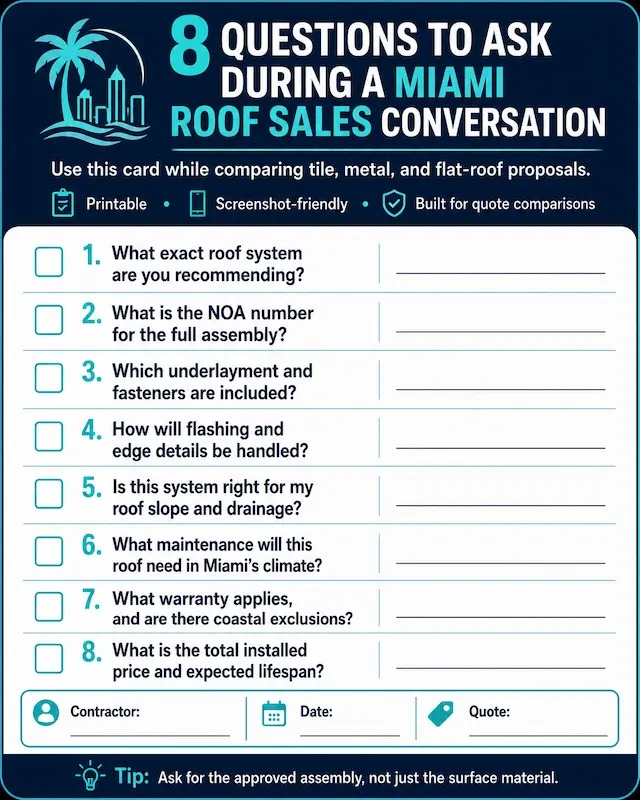
Frequently Asked Questions
Which roof lasts longest in Miami?
Tile can have the longest-lived surface material, but the tile and the waterproofing beneath it do not necessarily age together. Tile manufacturers commonly offer 50-year-or-longer warranties, the Metal Roofing Alliance cites 50+ years for metal, and SPRI documents quality sheet-membrane roofs still performing after 20+ years; NRCA notes most roof systems are designed for about 20 years, with clay tile and certain metals lasting longer.
For a Miami tile roof, ask about the underlayment lifecycle separately from the tile.
Is metal a bad choice near the ocean?
No, but the metal substrate, coating, fasteners, and warranty exclusions matter much more near saltwater. The Metal Construction Association documents coastal Florida use of aluminum specifically for corrosion resistance, while some manufacturers require aluminum and stainless-steel components for coastal warranties; other PVDF-coated steel warranties exclude properties within a stated saltwater setback.
Ask for the coastal warranty and setback exclusion in writing before you sign.
Does a tile roof need structural reinforcement?
It depends on what the house was designed to carry. Florida-approved tile systems can weigh roughly 9.5–10.5 pounds per square foot, and NRCA specifically notes that existing structural capacity can prevent the use of heavy clay or concrete roofing.
If the home was not originally designed for tile, have the structure checked before comparing tile quotes. The age of the house alone does not answer the question.
Can I put metal on a flat roof?
Not directly on a truly flat 0:12 roof in Miami-Dade. Under the current Florida Building Code High-Velocity Hurricane Zone provisions, architectural metal panels have a 2:12 minimum slope; outside the HVHZ, some standing-seam systems can go as low as 1/4:12, but Miami-Dade's rule is stricter.
A flat-roof building may need added slope or an approved low-slope membrane system instead.
Which roof gets the best insurance discount in Florida?
There is no automatic tile, metal, or flat-roof winner. Florida wind-mitigation credits are based on documented construction features, and the Department of Financial Services tells homeowners to obtain a qualified wind-mitigation inspection and submit the completed Uniform Mitigation Verification Inspection Form to the insurer.
Get the inspection after the reroof and let your insurer calculate the actual credit.
Do I need a cool roof in Miami Beach?
Not every Miami Beach roof replacement has to be a cool roof. The City's rules treat a cool roof as one type of sustainable roofing system; new roof construction is subject to stronger sustainable-roof requirements, while repair and replacement of existing roofs have broader permitted options and may require Planning or historic-preservation review.
Historic properties and Mediterranean-style buildings can have additional restrictions, so confirm the rule for your address with the City before choosing a material.
Why is my tile roof leaking when the tiles look fine?
Because the visible tile is only part of the roof system. Tile Roofing Industry Alliance guidance describes tile as a water-shedding outer shell, with underlayment and flashing providing additional protection beneath it.
A leak can come from underlayment, flashing, valleys, penetrations, or broken tiles, so intact-looking tile from the ground does not prove the roof underneath is sound.
What wind rating do I need in Miami-Dade?
For a typical Risk Category II building, the current 2023 Florida Building Code sets Miami-Dade's HVHZ ultimate design wind speed at 175 mph.
That does not mean you should simply buy a product advertised as “175-mph rated.” The complete roof assembly still has to meet the design pressures, exposure, attachment pattern, and approved system for your property.
What's the difference between a Florida Product Approval and a Miami-Dade NOA?
A Miami-Dade Notice of Acceptance (NOA) is a local product approval issued through Miami-Dade Product Control. A Florida Product Approval is state-level approval, and some Florida approvals are specifically approved for use in the HVHZ sometimes using a Miami-Dade NOA as supporting documentation.
So the important question is not simply “NOA or FL number?” Ask for the exact approval number and verify that the specific product and assembly are approved for HVHZ use.
Is flat roofing only for commercial buildings?
No. Flat and low-slope roofs are part of Miami's residential architecture as well; the City of Miami Beach identifies flat roofs with projecting eaves as a signature feature of Miami Modern, or MiMo, design.
For a Miami homeowner, the real question is whether the membrane, drainage, insulation, and approved assembly fit the property's roof geometry.
Find licensed roofing contractors in Miami
Still working out what any of this costs?
 Thanksgiving in Miami 2026: Independent Restaurants, Bakeries and Takeout That Are Open
 Best Plumbers Near Little Haiti, Miami How to Choose One You Can Trust
 Different Types of Massage in Miami: How to Choose by Goal, Price and Licence
