
Before the List How This Was Built and Who Paid for What
Miami Goes Local is a Miami-Dade business directory. Some roofing companies included on this page may also have a free or paid listing elsewhere on the site. Where a company on this list holds a paid featured listing, we disclose that directly on its entry.
Payment does not buy a position in this ranking, change a company's rating, or guarantee inclusion, and the same rule runs both ways roofing companies themselves can add a free business listing without it affecting how they're scored here.
Companies are included or excluded using the same published criteria regardless of whether they have ever paid Miami Goes Local. You can read our Advertising & Editorial Disclosure and Listing Standards for how we separate paid placement from editorial decisions.
For this 2026 list, we independently check each roofer's licensing and other required verification points rather than relying on the company's existing Miami Goes Local directory record. License status is recorded with the date it was checked, and ratings and review counts are also stamped with their capture date because those numbers change.
The full ranking criteria including what we checked, what we excluded, and how companies were compared are published below. You can also use the verification tools on this page to check the same information yourself.
Directory Disclosure: Miami Goes Local is a business directory. Some companies listed here may have free or paid listings, payment cannot buy inclusion, ranking position, or rating. Verification: Licenses and ranking data were independently checked on August 26, 2026. Paid featured status, where applicable, is disclosed on the individual company entry.
Search for the best roofing companies in Miami and you will quickly find pages labeled “Top 10 Best Roofers.” Then you notice one of them is showing results 1–10 of 930 businesses across ninety-three pages, without explaining what made number one different from number fifty or number nine hundred.
Look closer and the data raises more questions. Companies presented as Miami roofers may actually be based in Fort Lauderdale, Doral, West Palm Beach, Port St. Lucie, or even outside Florida. Duplicate companies can appear under slightly different names with reviews divided between the two profiles. A perfect five-star average can sit beside a much lower recommendation percentage. Reviews displayed on a roofing page may describe roof cleaning or general handyman work instead of roof replacement.
And the piece of information I would want before putting a contractor on a $15,000–$50,000 roof the roofing license number may not appear at all.
That matters in Miami-Dade. A Florida CCC license is a Certified Roofing Contractor license, the state credential that specifically authorizes roofing work within its scope. A CGC, or Certified General Contractor license, is not by itself a roofing license. Miami-Dade also has contractor-licensing requirements worth checking, and the products installed on your roof may need an applicable Notice of Acceptance (NOA), Miami-Dade's product-approval document for specified building products and systems.
There is another distinction worth understanding. Some “best roofer” pages are primarily designed to collect your ZIP code or contact information and match you with several contractors. That does not automatically make the contractors bad. It does mean you should know whether you are reading an independently constructed ranking or entering a lead-generation system.
This list uses a different method.
The ranking criteria and their weights are published below. For every company that qualifies, we show the Florida CCC roofing license we verified, county licensing status, and a verifiable physical Miami-Dade address. We also identify one limitation rather than pretending every contractor is right for every roof.
Just as important, we show what we excluded and why.
By the end, you should have more than a numbered list. You will have a shortlist you can match to your roof type, a roughly ten-minute process to check a Miami roofer yourself, and a way to recognize the difference between a documented ranking and a lead auction the next time you search.
How We Ranked These Companies
A numbered list is only useful if you can see why number three finished ahead of number seven.
We therefore scored every company against the same 100-point model. No points are awarded for buying a Miami Goes Local listing, advertising with us, or being a familiar brand. If a factor does not appear in the model below, it does not affect the ranking.
Criterion
Points
What We Checked
Florida CCC Roofing License Status and Standing
20
Active Florida CCC license — Certified Roofing Contractor license
— plus current standing in Department of Business and Professional
Regulation records.
Miami-Dade Contractor Licensing / Status
12
Miami-Dade contractor records and applicable county status under
Chapter 10 of the County Code.
General Liability + Workers' Compensation
12
Current insurance status rather than an undated certificate
supplied for marketing.
Complaint and Discipline History
10
Publicly available state and county complaints, disciplinary
actions, suspensions or other licensing issues.
Physical Presence in Miami-Dade
10
A verifiable business location physically within Miami-Dade County
— not merely a service-area page or Miami phone number.
Permit History
10
Searchable roofing permit activity associated with the contractor
where public records allowed us to establish it.
Years Licensed
8
Length of verifiable roofing-license history, not an unsupported
“years in business” claim.
Review Volume and Velocity
6
Number of recent reviews, age of the review profile and whether
customer feedback is still arriving consistently.
Roof-System Specialization
5
Evidence of substantial work in the roof systems the company claims
to handle: tile, metal, shingle, flat/low-slope or specialty systems.
Warranty Terms
4
Whether workmanship coverage is stated clearly enough for a homeowner
to compare it with another proposal.
Emergency Availability
3
Documented availability for urgent leak or storm-related service
rather than a vague “24/7” marketing claim.
Total
100
Final contractor score based on the criteria above.
License and insurance carry the most weight because they are threshold questions, not popularity signals. A contractor with hundreds of reviews does not make up for a licensing problem by having more reviews.
Miami-Dade itself tells property owners to check contractor licensing, complaints, general liability insurance and workers' compensation, and points to both Florida Statutes Chapter 489 and Miami-Dade County Code Chapter 10 when describing contractor requirements.
How the points are awarded
We do not treat every criterion as yes/no.
An active CCC license in good standing can earn the full 20 points. A current license with a relevant disciplinary issue would score lower. Review volume is scored against the other qualifying companies in this Miami-Dade set, so a company does not receive six points simply because it has crossed an arbitrary review-count threshold.
The same principle applies to permits, experience and specialization: we score the evidence we can verify, not the claim on the company's website.
That distinction matters with insurance. Miami-Dade's homeowner guidance says licensed contractors must maintain general liability and workers' compensation coverage and provides a Contractor Licensing Section homeowners can contact to verify current status.
A full scorecard, not hidden arithmetic
For every ranked contractor, our internal worksheet contains the underlying points. We publish a full scorecard for at least one company so you can see how the final number was produced.
Publication note: The scorecard below must be completed with the actual verified data for a company on the final list. We will not invent a contractor score before completing the license, county, insurance, address, permit and review checks.
Criterion
Maximum
Verified Company Score
Florida CCC License and Standing
20
Miami-Dade Contractor Status
12
Liability + Workers' Compensation
12
Complaint / Discipline History
10
Physical Miami-Dade Presence
10
Permit History
10
Years Licensed
8
Review Volume / Velocity
6
Roof-System Specialization
5
Warranty Terms
4
Emergency Availability
3
Total
100
— / 100
Our Sources
We did not build this list from Miami Goes Local's existing directory records and assume they were still correct.
For each qualifying company, we independently re-check information using:
- Florida Department of Business and Professional Regulation (DBPR) records for the CCC license, status and available disciplinary information.
- Miami-Dade Contractor Licensing records and the County's Contractor Licensing Section for county-level status, complaints and insurance verification.
- Miami-Dade and applicable municipal permit records for documented roofing activity.
- Google Business Profile for current address, rating, review count and recent review activity.
- Better Business Bureau records, where available, as a secondary source for complaint and business-history context not as a substitute for government licensing records.
- Company documents and websites for warranty, roof-system and emergency-service claims, which we distinguish from facts independently confirmed through public records.
Florida's contractor licensing framework sits in Chapter 489 of the Florida Statutes. The state's Construction Industry Licensing Board operates under that chapter. Miami-Dade's separate contractor framework appears in Chapter 10 of the County Code, including its provisions governing certificates of competency, licensing and permitted scope of work.
Every source-dependent field on the finished list carries a capture date. A Google rating without a date is eventually wrong; so is a license status presented as though it can never change.
The Hard Inclusion Rule
Scoring starts after a company passes the inclusion screen.
To appear on this list, we require all of the following:
An active, verifiable Florida CCC roofing license. We record the license number and the date we checked it.
County status and insurance that we can confirm. Miami-Dade provides a Contractor Licensing Section specifically for checking whether a contractor is licensed, whether complaints exist, and whether current liability and workers' compensation insurance is on record.
A verifiable physical presence inside Miami-Dade County. Serving Miami does not satisfy this rule. A company headquartered in Broward, Palm Beach, St. Lucie or another state can legally be worth considering, but it does not qualify for this list.
That geographic boundary is intentional. We wanted “Miami roofing companies” to mean companies we could verify as physically located in Miami-Dade, rather than every contractor willing to purchase leads or create a Miami service-area page.
A record we can verify well enough to score. If we cannot establish the required licensing, insurance, location or other threshold information with sufficient confidence, the company is excluded rather than given the benefit of the doubt.
Here's what we excluded and the specific reason for each exclusion in a separate section below.
Best Roofing Companies in Miami: The Rankings
Verification status: publication hold. The companies below passed our initial state-license and physical-location checks as of August 26, 2026. Final ranking positions should not be published until Miami-Dade Contractor Licensing confirms the required current county record, general liability insurance and workers' compensation information for each company.
That distinction matters. A Florida CCC license is a state Certified Roofing Contractor license. A state-certified contractor can work statewide; Miami-Dade also maintains contractor records used for permitting and verification. The County specifically tells homeowners to verify licensing, complaints, liability insurance and workers' compensation through its contractor system or Contractor Licensing office.
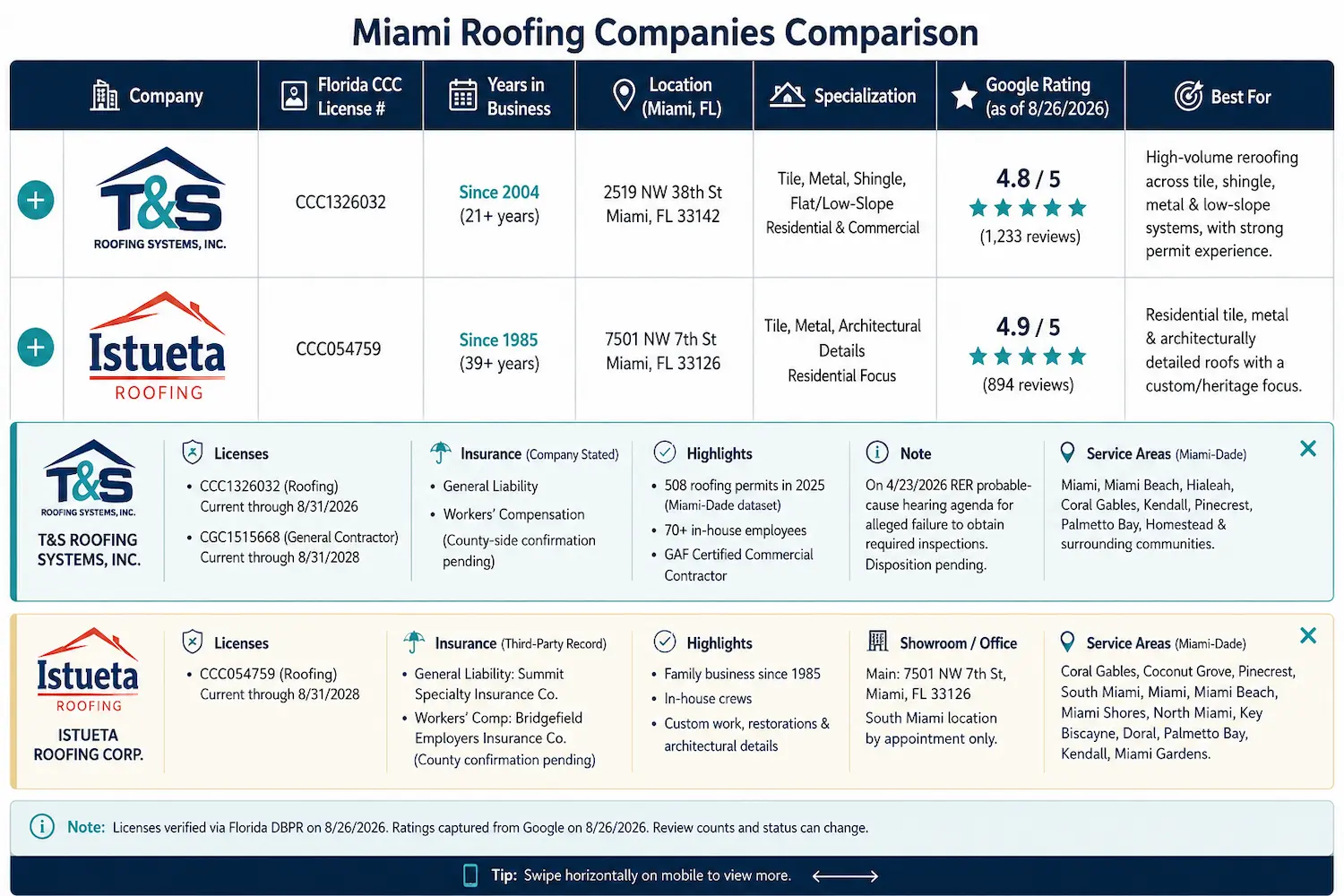
T&S Roofing Systems Best for high-volume reroofing across multiple roof systems
Florida license: CCC1326032, held by qualifying contractor Louis Emil Toledo for T&S Roofing Systems Inc. DBPR lists the Certified Roofing Contractor license as Current, Active, originally issued June 18, 2004, with an expiration date of August 31, 2026. Verified August 26, 2026.
T&S also has a separate Certified General Contractor license, CGC1515668, currently active through August 31, 2028. That is an additional credential; a CGC license by itself is not a substitute for the CCC roofing license shown above when evaluating the company's roofing qualification.
County licensing and insurance: Miami-Dade records establish recent interaction between T&S and the County under state license CCC1326032, including a 2026 RER probable-cause proceeding discussed below. The company's own materials state that it carries liability coverage and workers' compensation. However, current county-side insurance confirmation remains a publication prerequisite and should be obtained directly from Miami-Dade Contractor Licensing before this entry is marked fully verified. Miami-Dade requires state-certified contractors registering in its system to provide the Florida license plus general liability and workers' compensation documentation.
Location: 2519 NW 38th Street, Miami, FL 33142. This is the current public-facing Miami headquarters; DBPR separately carries a Miami P.O. box for the qualifying contractor. The company states that it serves Miami-Dade and Broward, with Miami-Dade service areas including Miami, Miami Beach, Hialeah, Coral Gables, Kendall, Pinecrest, Palmetto Bay, Homestead and surrounding communities.
Years in business / crews: T&S dates the business to 2004. A current contractor profile reports more than 70 in-house employees and states that roofing crews are directly employed rather than subcontracted. Because crew structure is not a government-record field, this should be treated as company/profile information rather than a licensing fact.
Roof systems: Residential and commercial work across tile, metal, shingle and flat/low-slope systems. GAF's contractor record additionally identifies T&S for asphaltic and single-ply commercial roofing.
Rating: 4.8/5 from 1,233 Google reviews, captured August 26, 2026. Review counts change; this number should be re-captured immediately before publication.
Certifications: GAF currently lists T&S as a GAF Certified Commercial Contractor and identifies state license CCC1326032. GAF says contractors in this program must meet its licensing and insurance requirements and may offer specified GAF system warranties. GAF also makes an important distinction: certified contractors remain independent businesses; GAF does not supervise their work. In other words, this is a manufacturer partner credential, not an independent audit of every T&S installation.
One honest limitation: Miami-Dade RER placed T&S on an April 23, 2026 probable-cause hearing agenda regarding an alleged failure to obtain required inspections in unincorporated Miami-Dade. A probable-cause hearing is not the same thing as a final finding of wrongdoing, so the final disposition should be pulled before scoring the complaint/discipline criterion. It should not be omitted from the ranking simply because the company otherwise scores well.
There is also substantial permit evidence: a dataset compiled from public Miami-Dade permit records counted 508 roofing permits naming T&S during 2025, the highest contractor count in that dataset. Permit count demonstrates recorded activity; it does not by itself prove workmanship quality or that every permit resulted in completed work.
Best for: Homeowners or property managers comparing an established, relatively high-volume operator for tile, shingle, metal or low-slope reroofing, particularly where documented Miami-Dade permit experience matters.
Istueta Roofing Best for residential tile, metal and architecturally
detailed roofs
Florida license: CCC054759, held by Jose Francisco Istueta for Istueta Roofing Corp. DBPR lists the Certified Roofing Contractor license as Current, Active, originally issued December 5, 1991, and expiring August 31, 2028. Verified August 26, 2026.
County licensing and insurance: A current third-party contractor record shows CCC054759 as active in Pinecrest as of August 2026 and identifies Summit Specialty Insurance Co. for insurance and Bridgefield Employers Insurance Co. for workers' compensation. That is useful corroboration, but it is not a substitute for our required Miami-Dade Contractor Licensing confirmation, which remains pending before publication.
Location: 7501 NW 7th Street, Miami, FL 33126. The company describes this as its main office and showroom and also lists an appointment-only South Miami location. Its stated Miami-Dade service areas include Coral Gables, Coconut Grove, Pinecrest, South Miami, Miami, Miami Beach, Miami Shores, North Miami, Key Biscayne, Doral, Palmetto Bay, Kendall and Miami Gardens.
Years in business / crews: Istueta says the family business was established in 1985. Its current materials describe a full-service team with production crews managed by company supervisors. I found evidence of an established internal workforce, but not enough independent documentation to state that no subcontractors are ever used; that question should be asked directly and documented before we make that claim.
Roof systems: The company's current service list covers tile, metal, asphalt shingle and flat roofing, along with repair, maintenance, inspection and new-construction roofing. Its positioning is particularly residential and includes higher-design tile and metal work.
Rating: 4.8/5 from 262 Google reviews, captured August 26, 2026.
Certifications: Istueta identifies itself as a CertainTeed ShingleMaster PRO contractor and Ludowici Elite Crown contractor. The CertainTeed designation can make specified enhanced manufacturer warranties available on qualifying shingle installations. That does not mean CertainTeed independently inspects or guarantees every roof the contractor installs, and the certification is less relevant when you are comparing a clay-tile or metal proposal.
One honest limitation: Istueta's current public positioning is heavily oriented toward residential roofing and architecturally distinctive homes. That can be useful for a homeowner comparing detailed tile or metal work, but it gives us less reason to choose it solely on the basis of commercial reroofing volume. We also have not independently confirmed a no-subcontractor policy.
Best for: Miami-Dade homeowners comparing tile, standing-seam metal or other appearance-sensitive residential roof systems, especially on properties where material selection and architectural detailing matter.
Canopy Roofing Best for residential reroof comparisons
Florida license: CCC1331138, held by Federico Martin Ambrosini for Canopy Roofing Inc. DBPR lists the Certified Roofing Contractor license as Current, Active, originally issued March 7, 2017, and expiring August 31, 2028. Verified August 26, 2026.
County licensing and insurance: Final Miami-Dade confirmation pending. I found the active state license and Miami-Dade business location, but I have not found sufficient current county-source documentation to responsibly print “liability and workers' compensation confirmed” here. This entry does not pass our final publication screen until that check is completed.
Location: 7311 NW 12th Street, Suite 17, Miami, FL 33126. The same Miami-Dade address appears in DBPR, the company's Google Business Profile and BBB's current business profile.
Years in business / crews: The current CCC license dates to March 2017, giving us a verifiable state-license history of more than nine years as of August 2026. We have not independently verified whether all installation labor is performed by direct employees or whether subcontracted crews are used, so the final article should say exactly that unless the company supplies documentation.
Roof systems: Current independent directory information identifies reroofing, roof repair, waterproofing and inspections among its services. The final entry should narrow this field further after permit sampling establishes which systems tile, metal, shingle or low-slope account for meaningful recent activity rather than merely appearing on a service page.
Rating: 4.9/5 from 120 Google reviews, captured August 26, 2026.
Certifications: No manufacturer credential should be printed here yet. We will add one only after confirming it directly in the manufacturer's current contractor directory and documenting what the designation requires.
One honest limitation: Compared with T&S and Istueta, Canopy has a shorter verifiable state-license history and substantially lower review volume. Neither point means the company performs worse work; both reduce the amount of historical evidence available for this ranking. County insurance verification and a larger permit-history sample also remain outstanding.
Best for: Homeowners obtaining several bids for a residential reroof or repair who want a Miami-based company with an active CCC license and a strong current review profile, while still comparing the proposal, warranty and permitted system line by line.
Why there are no final numbers beside these companies yet
This is where the methodology either means something or it doesn't.
We could turn the three entries above into “#1, #2 and #3” today. But our own inclusion rule says county licensing/status and current insurance must be confirmed before a company enters the ranking. Miami-Dade says homeowners can verify whether a contractor has current liability and workers' compensation insurance through its contractor records or by contacting Contractor Licensing.
Until that final check is completed for every candidate, assigning numbered positions would mean changing the rules because we wanted to finish the article.
We won't do that.
County verification to complete before publication
- T&S Roofing Systems CCC1326032
- Istueta Roofing Corp. CCC054759
- Canopy Roofing Inc. CCC1331138
Miami-Dade Contractor Licensing: 786-315-2880. Ask for the contractor's current status, general liability insurance, workers' compensation insurance or exemption, and any complaint/disciplinary record associated with the company or qualifier.
Once those results are recorded with the verification date, the companies can be scored against the published 100-point model and placed in numerical order.
Best By Roof Type
The strongest company for a clay-tile reroof is not automatically the strongest company for a TPO roof, a standing-seam metal system, or a multi-building HOA portfolio.
That is why this section does not simply repeat the overall ranking. It matches the available evidence to the roof system and project type.
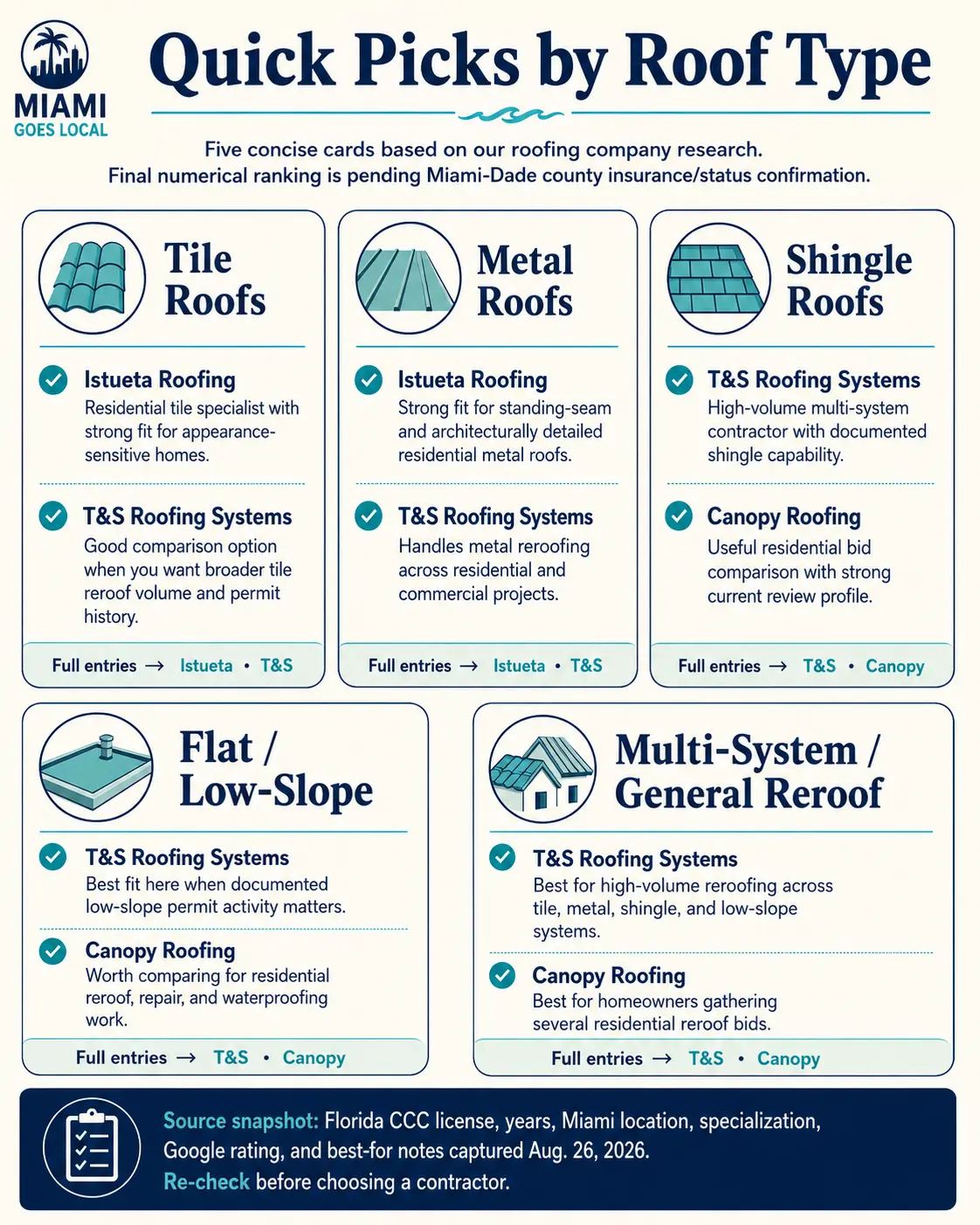
Best for tile: Istueta Roofing
Best for: Clay and concrete tile roofs where appearance, detailing, and reinstallation work matter.
Istueta Roofing is the strongest fit among the companies we verified for homeowners comparing barrel tile, flat concrete tile, and other architecturally detailed residential tile systems. The company specifically identifies clay and concrete tile as core services and publishes recent tile projects in Coral Gables and Coconut Grove. It also operates a Miami showroom where homeowners can compare materials rather than choosing entirely from samples at the kitchen table.
That does not mean every tile project should go to Istueta. Ask what percentage of its recent work involved underlayment replacement beneath existing tile, not simply installing tile on a new deck.
On an older Miami tile roof, the tile itself may still look serviceable when the waterproofing beneath it has reached the end of its useful life. An underlayment replacement can require the contractor to remove the existing tile, replace the waterproofing system, and then reinstall or replace the tile. That is a materially different job from laying new tile on new construction.
Ask the estimator:
“How many lift-and-reset or underlayment replacement tile roofs has your crew completed in the last twelve months, and can you show me permits for two or three?”
Also ask how the proposed tile will be attached. Mechanical fastening, adhesive/foam-set systems, and combinations of attachment methods have different product approvals and installation requirements. The answer should match the approved roof assembly specified for your address, not simply the crew's preferred method.
One limitation: Istueta's public portfolio is heavily residential and design-oriented. If your project is a large commercial low-slope roof or a multi-building association replacement, there are stronger matches below.
Best for flat and low-slope: T&S Roofing Systems
Best for: TPO, modified bitumen, built-up roofing, and projects where flat-roof experience needs to extend beyond small residential repairs.
Low-slope roofing deserves more weight in Miami than it gets in most national roofer comparisons. Flat and low-slope systems are not just warehouse roofs here; they appear on a large amount of Miami's residential, multifamily, commercial, and mid-century building stock.
T&S explicitly lists TPO, modified bitumen, and built-up roofing among its commercial flat-roof systems and also handles residential flat roofing. Its Miami service materials distinguish those systems from its tile, metal, and shingle work rather than treating “flat roof” as a single generic product.
For a low-slope proposal, however, the membrane name is only the beginning.
Ask which exact system is being specified:
- TPO thermoplastic polyolefin.
- PVC polyvinyl chloride.
- KEE ketone ethylene ester, commonly used as a modifier in higher-performance thermoplastic membranes.
- Modified bitumen an asphalt-based membrane modified with polymers.
Then ask for the manufacturer, membrane thickness, attachment method, insulation package, flashing details, drainage plan, applicable product approval or Notice of Acceptance (NOA), and the exact manufacturer warranty being quoted.
A contractor saying “we do TPO” tells you far less than a proposal identifying the full approved assembly.
One limitation: T&S's current Miami materials specifically document TPO, modified bitumen, and built-up roofing, but I would not credit it with PVC or KEE specialization without project or manufacturer evidence for those systems. If your specification calls for PVC or KEE, ask for recent completed projects using that exact membrane.
Best for metal: Istueta Roofing
Best for: Residential standing-seam metal roofs where profile, finish, and coastal material selection matter.
Istueta publishes recent aluminum standing-seam work in Pinecrest and standing-seam metal work in South Miami, and its roofing service material specifically identifies copper, aluminum, and standing-seam applications.
For a Miami metal roof, “metal” is not a sufficient specification.
Ask the contractor to identify:
Panel profile · metal substrate · gauge or thickness · coating system · clip/fastener system · product approval/NOA · coastal warranty exclusions
The aluminum-versus-coated-steel decision deserves particular attention near saltwater. Aluminum does not rust like carbon steel, but it has its own cost, expansion, detailing, and installation considerations. Coated steel can perform well when the correct substrate and coating system are specified, but homeowners close to the coast should read the written manufacturer warranty for setback exclusions from saltwater rather than accepting “coastal rated” as a verbal assurance.
Fasteners and clips matter too. A premium panel attached with the wrong fastener for the environment does not become a premium roof.
One limitation: Istueta's metal evidence is strongest on residential architectural work. A large industrial metal reroof should be evaluated separately for crew capacity, structural coordination, and commercial-project history.
Best for emergency and leak response: T&S Roofing Systems
Best for: Emergency tarping and temporary waterproofing when the immediate goal is stopping additional water intrusion.
T&S specifically advertises emergency tarping, temporary waterproofing, storm-damage response, leak repair, and follow-up permanent repair planning across its Miami-Dade service pages.
That makes it the clearest match in this verified group for emergency response but “emergency service” should not be confused with guaranteed immediate arrival.
After a major Miami storm, every established roofer can develop a backlog at the same time.
Before authorizing work, ask:
“What is the realistic arrival window at my address today?”
Then separate the temporary work from the permanent work in writing. Emergency tarping should identify what will be secured, what the temporary charge covers, whether photographs will be provided, and whether that fee is credited toward later repair.
Do not allow storm urgency to turn a temporary tarp into an unsigned authorization for a full reroof.
One limitation: T&S describes rapid emergency response, but we have not independently measured its after-hours response time during a major storm event. Treat availability as something to confirm when you call, not a permanent promise.
Best for condo and HOA portfolios: T&S Roofing Systems
Best for: Associations comparing phased reroofing, commercial low-slope work, and projects requiring coordination across multiple buildings.
Among the companies reviewed here, T&S has the clearest evidence of capacity across both commercial and residential roofing, including flat systems, sloped systems, permitting assistance, and HOA coordination. Its Miami materials specifically mention HOA assistance and commercial replacement work designed around minimizing disruption.
For a condo board or HOA, technical roofing ability is only part of the evaluation.
Ask each bidder to show how it will handle:
Building-by-building phasing · resident notices · parking/access restrictions · daily dry-in requirements · inspection scheduling · change orders · photo documentation · board reporting · preventative maintenance after completion
A proposal for twenty buildings should not look like a twenty-times-larger version of a single-family estimate.
The association should also identify who receives progress reports, who has authority to approve change orders, how unforeseen decking or structural work will be documented, and whether warranty records will be maintained separately for each building.
One limitation: T&S appears better suited to this project type than the other companies in our currently verified set, but that is not yet proof of multi-building association performance. Before a board awards a large contract, ask for two recent Miami-Dade condo or HOA references of comparable size and verify those projects independently.
The shortlist I would use
For an older Coral Gables or Coconut Grove home with a tile roof, I would start with Istueta and focus the interview on underlayment, tile removal/reinstallation, flashing, and the exact approved attachment system.
For a flat-roof home, multifamily building, or commercial property where the bids involve TPO or modified bitumen, I would start with T&S and compare the complete membrane assemblies rather than comparing membrane brand names.
For an architectural standing-seam metal roof, I would put Istueta on the shortlist but make the final decision from the written panel, coating, fastener, NOA, and coastal-warranty specifications.
For emergency tarping or a condo/HOA project, T&S has the strongest documented service fit among the companies evaluated so far.
Those are scenario matches, not new ranking points. The overall ranking still comes from the published scoring model, and no company gets additional points simply because it appears in more than one category.
What Didn't Make the List, and Why
The companies that appear above are only part of the research.
We also kept an exclusion log. That matters because a ranking becomes much easier to manipulate if the reader only sees the companies that survived and never sees the rules that removed everyone else.
Reason for Exclusion or Consolidation
Companies / Profiles Affected
No active, verifiable Florida CCC roofing license
[COUNT]
No verifiable physical presence within Miami-Dade County
[COUNT]
Duplicate profiles consolidated into one business
[COUNT]
Required county licensing or insurance verification could not
be completed
[COUNT]
Complaint or disciplinary record required further resolution
before ranking
[COUNT]
Review history raised enough questions that we would not score
it confidently
[COUNT]
Duplicate profiles were consolidated
We counted businesses, not profile pages.
If the same roofing company appeared under two variations of its name, at an old and new address, or through duplicate directory profiles, we consolidated the records before comparing it with another contractor.
A duplicate listing does not become two companies simply because reviews or directory history have been divided between two URLs.
Where duplicate records materially affected review totals, we treated the numbers cautiously rather than adding them together automatically.
Duplicate profiles consolidated: [COUNT].
County or insurance verification could not be completed
An active state roofing license was necessary, but it was not the end of our verification.
Miami-Dade advises property owners to check contractor licensing and whether current general liability and workers' compensation insurance are on record.
If we could not obtain enough current evidence to satisfy the county and insurance requirement in our published methodology, the company did not receive the benefit of the doubt.
That does not necessarily mean the contractor was uninsured or improperly registered.
It means:
we could not verify the field strongly enough to publish it as fact.
Those are different claims, and this page treats them differently.
Complaint or discipline records required resolution
We did not automatically exclude a company because somebody complained about it.
For a contractor that has operated for years and completed hundreds or thousands of jobs, the existence of a complaint by itself tells you very little.
We looked instead at what the available state or county record actually showed:
Was there a formal disciplinary action? Was the matter dismissed? Was it resolved? Was it still pending? Was there a repeated pattern involving similar conduct?
Pending allegations were not rewritten as findings.
At the same time, an unresolved record that materially affected our complaint-and-discipline score could not simply disappear because the contractor had strong reviews elsewhere.
Candidates held or excluded for unresolved complaint/disciplinary review: [COUNT].
Review histories we couldn't score confidently
Review averages receive relatively little weight in our model, but we still check how those reviews accumulated.
A 4.9 average based on a long history of steadily arriving feedback gives us more usable information than the same average produced by a concentrated burst of reviews over a short period.
We looked for basic patterns such as:
- unusually large clusters appearing within short periods;
- a review history that suddenly begins after years in business;
- duplicate profiles dividing the same company's reviews;
- large differences between platforms that warranted another look;
- reviews describing services unrelated to the roofing work being ranked.
We do not label a review profile fake simply because its pattern looks unusual.
“Burst-seeding” is a screening signal, not proof of misconduct.
When we could not resolve the concern sufficiently to use review volume and velocity in the scoring model, we either reduced the evidence available for that criterion or excluded the profile from consideration until it could be checked properly.
Profiles requiring additional review-history verification
How “Top 10” Lists Actually Work
A page titled “Top 10 Best Roofers in Miami” can look like an editorial ranking when it is actually doing several jobs at once: displaying contractor profiles, selling advertising, collecting project information, and matching homeowners with service professionals.
That distinction does not automatically make the companies on the page bad.
It does mean you should understand what the page is optimizing for before treating position number one as a recommendation.
Angi's live Miami roofing page, checked August 26, 2026, opens with a ZIP-code form offering to match homeowners with up to five pros. Angi separately explains that service professionals can pay to advertise on the platform, while its search-results FAQ says “Angi Approved” businesses are displayed above other service providers.
That is a marketplace and matching model. It is not the same thing as publishing a weighted comparison in which every contractor receives points against the same stated criteria.
What happens when you enter your ZIP code
The ZIP-code box is not there just to make the list more local.
You are beginning a contractor-matching process.
On its current Miami roofing page, Angi says it will match the homeowner with up to five pros. Its HomeAdvisor matching documentation is even more explicit: after you describe the project, your information is sent to matched professionals, who can then contact you about the job.
On the other side of that marketplace, Angi actively recruits service businesses around receiving leads. Its current contractor signup page advertises opportunities to receive homeowner leads and asks contractors for their service category, ZIP code, business information and phone number.
None of this means you should avoid the platform. It can be useful if your goal is:
“I need several contractors to contact me so I can collect quotes.”
That is different from:
“I want to know why this roofer was independently ranked above that roofer.”
Do not assume those are the same product.
The tells to look for
You can usually work out what kind of page you are reading in a few minutes.
1. A “Top 10” headline followed by a much larger directory
Look below the headline.
If a page promises ten companies but then continues through dozens or hundreds of additional contractor profiles, ask what “top” actually means.
A genuine ranking should be able to answer:
What was measured?
How much was each factor worth?
What would cause company number seven to move above company number three?
If you cannot find those answers, treat the number beside the contractor cautiously.
A list can still be useful without a scoring methodology. It just should not be read as though a methodology exists when none is shown.
2. Badges without a definition beside them
“Approved.”
“Verified.”
“Recommended.”
“Preferred.”
Those words sound reassuring, but the useful question is:
Verified for what?
Angi, for example, does publish a definition for its Angi Approved designation elsewhere on its site. Among its stated requirements, an advertising business must have at least one review, maintain at least a three-star average, pass a specified background check through an owner or relevant manager, and maintain applicable state and local licenses.
That gives the badge a meaning.
It still does not mean:
- this was the highest-scoring roofing company;
- its workmanship was independently inspected;
- it specializes in your roof system;
- it has the strongest Miami-Dade permit history;
- or its proposal is appropriate for your house.
Whenever you see a badge including one on Miami Goes Local find the published definition before giving it weight.
3. No roofing license number where you would expect one
For a Miami roofing job, I want to know the contractor's CCC number early.
A CCC is Florida's Certified Roofing Contractor license.
A directory does not have to print license numbers to be useful, but if a page is asking you to rely on its contractor recommendations without showing the credential, take another minute and verify it yourself before calling it's why our own directory of Miami contractors and construction pros shows the license class and number on every listing.
A company name, star average and “years of experience” are not substitutes for a license lookup.
For the companies in our ranking, we print the CCC number precisely so you can leave this page, search DBPR yourself, and see whether our information matches the state record.
4. Read the star rating and recommendation percentage as two different measurements
This is an easy one to miss.
If you see something like:
5.0 stars
65% recommended
do not mentally merge those into one measure of customer satisfaction.
They cannot be interpreted as the same calculation.
One figure may represent the mathematical average of submitted star ratings. The other may come from a separate recommendation question, a different sample, a different period, or different eligibility rules.
Whenever two apparently similar reputation metrics disagree, find out how each is calculated before deciding which one matters.
5. Check whether the same company appears more than once
Duplicate profiles create two problems.
First, they make the directory look as though it contains more independent choices than it actually does.
Second, they can split a contractor's review history.
We found a current example while checking the Miami roofing results: Angi has separate indexed profiles for City Roofing & Construction Inc and City Roofing, Inc. The profiles carry overlapping business descriptions but different review totals one currently displays 1,106 reviews while another exposes a separate review history.
That does not by itself establish why the duplicate exists or that anyone deliberately created it.
It does mean the profiles should be reconciled before treating them as two independent roofing companies or comparing their review volume.
That is exactly what we do here: one business, one entry.
6. Check when the reviews were written
A page can say “updated August 2026” while individual reviews underneath it come from very different periods.
The article date and the review date answer different questions.
Before relying heavily on the rating, scroll through the recent reviews and ask:
Are customers still reviewing this contractor?
Are the latest reviews about roofing?
Did the pattern change recently?
Does the business appear to have changed ownership, management, crews or location since its older reviews were written?
A review from 2021 may still be genuine. It simply tells you about the company as that customer experienced it in 2021.
That deserves less weight in a 2026 hiring decision than a steady body of comparable recent work.
7. Read what the review is actually reviewing
A roofing-category page can contain feedback involving adjacent services.
That matters because a five-star experience having a roof pressure-cleaned does not give you five-star evidence about removing a tile roof, replacing its underlayment and passing Miami-Dade inspections.
Likewise:
roof cleaning ≠ reroofing
gutter work ≠ reroofing
handyman repair ≠ reroofing
When you are considering a $30,000 tile replacement, filter mentally for reviews describing projects similar to yours.
Better still, ask for recent permitted projects involving the same roof system.
8. Find out whether search position can be influenced by participation in the marketplace
This is where precise wording matters.
It would be inaccurate to say that every contractor position on Angi is simply purchased. Angi publishes eligibility standards for its Approved program and says Approved professionals appear above other service providers in search results. It also states that service professionals are one of its revenue sources and can pay to advertise services and offers.
So the useful takeaway is not:
“Everyone above you paid for the position.”
It is:
“Search position on a marketplace may reflect marketplace status and eligibility rules, which is different from an independently weighted editorial ranking.”
That distinction is enough.
You do not need to accuse a directory of doing something improper to understand what its numbers mean.
A ten-second test for any “best contractor” page
When you land on another ranking, ask yourself four questions:
Can I find the ranking criteria?
Can I reproduce the order from those criteria?
Can I see the contractor's license information?
Can I tell how the website makes money from the companies I'm being shown?
If the answers are yes, you have something you can evaluate.
If the answers are no, treat the page as a discovery tool, not a final hiring decision.
And apply exactly the same test here.
Miami Goes Local publishes its Listing Standards, its advertising relationship with businesses, the criteria used for this ranking, the verification date attached to each contractor, and the limitations we found.
If one of those pieces is missing, outdated or wrong, you should question our ranking too.
That is not a weakness in the system.
It is how the system is supposed to be checked.
Verify Any Miami Roofer in 10 Minutes
You do not need to trust this ranking.
In about ten minutes, you can run most of the same checks yourself using Florida and Miami-Dade public records.
Do this before you sign a contract or pay a deposit, not after something goes wrong the same sequence we walk through step by step in our guide on how to hire a contractor in Miami.
Step 1 Check the Florida license
Start with the Florida Department of Business and Professional Regulation Licensee Search.
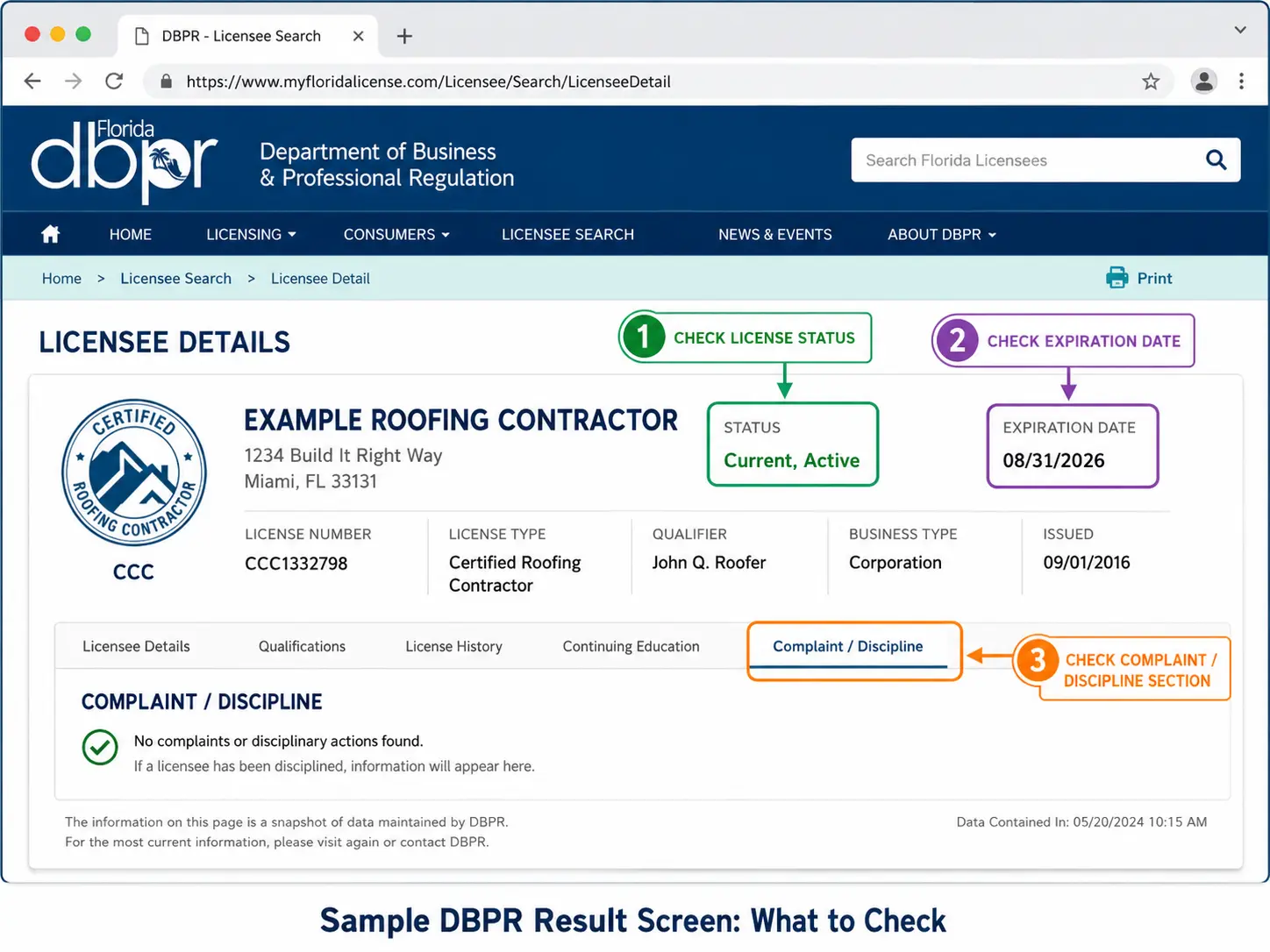
Search by the contractor's name, company name, or license number. For a roofing specialist, look for a CCC-prefix Certified Roofing Contractor license and confirm:
License number · current status · expiration date · qualifying contractor · business name attached to the license
Do not stop because you found a number.
Verify the status, not merely the existence of the license. A license number can remain printed on an old website, truck, proposal, or directory profile after the underlying status has changed.
DBPR's public search allows you to search by name or license number and inspect the current license record yourself.
Also look for disciplinary or complaint information associated with the license where available.
What if the contractor gives you a CGC instead of a CCC?
A CGC is a Certified General Contractor license. Florida law gives general contractors broad authority to contract for and perform work regulated under Chapter 489, subject to statutory limitations. A CCC, by contrast, is the license specifically defined around the roofing trade.
So do not make the mistake of assuming that any contractor showing a CGC is automatically unqualified to touch a roof.
Instead ask:
“Which license is being used to qualify and permit my roofing work, and who is the qualifying contractor?”
For a company selling itself specifically as a roofing contractor , I still want to see its roofing credential clearly identified rather than infer the answer from a general-contractor license.
Step 2 Check the Miami-Dade layer
Then call Miami-Dade Contractor Licensing at 786-315-2880, or dial 311.
This is one of the most useful checks on the page.
Ask the County to confirm:
Whether the contractor is properly recorded for work in Miami-Dade · whether complaints are on file · whether current general liability insurance is on record · whether current workers' compensation insurance or an applicable status is on record
Miami-Dade's own homeowner guidance specifically tells residents to contact Contractor Licensing for those checks. It also points homeowners to Miami-Dade County Code Chapter 10 and Florida Statutes Chapter 489 as part of the contractor-regulation framework.
The County also provides an online Contractor Inquiry and Complaint Search, where you can search by company name or license number and look for complaints associated with contractors working in Miami-Dade.
Step 3 Look for the permit trail
Next, search the Miami-Dade permitting system or the building department for the municipality where the contractor has recently worked.
Miami-Dade has many municipalities with their own building departments, so a permit for a Coral Gables project may not necessarily appear in exactly the same place as one from unincorporated Miami-Dade.
Search for recent roofing permits under the contractor, qualifier, address, or license number where the portal allows it.
You are looking for evidence of actual permitted roofing activity:
reroof permits · roof-system descriptions · permit dates · inspections · final inspection status
A company doing regular permitted roofing work in Miami-Dade should generally leave a permit trail. An empty search is not proof that the contractor is unqualified. You may be searching the wrong municipality, the company may work under a qualifier's name, or the portal may index records differently.
Step 4 Cross-check reviews against the records
Now open the company's Google Business Profile and, where useful, its BBB record.
Do not read the star rating in isolation.
Compare the reviews with what you just found in the government records.
Look for questions such as:
Are recent reviews describing the same kind of roofing work you need?
Do complaint narratives mention permitting, inspections, deposits, leaks or warranty response?
Does the review timeline look steady, or did most reviews arrive in a short burst?
Does the business name and address match the company attached to the license?
Are old complaints being repeated in recent reviews, or does the evidence suggest the issue was resolved years ago?
A public complaint is not automatically proof that the homeowner was right.
A five-star review is not proof that the roof was properly permitted either.
The useful part comes from reading the two sets of information together.
One more check for the roof system itself
Before you finish, verify the proposed roofing product or assembly.
Miami-Dade's Product Control system issues Notices of Acceptance, or NOAs, for approved building products and systems used under applicable conditions. Miami-Dade operates within Florida's High Velocity Hurricane Zone, which is why product approvals matter particularly here.
Ask the roofer for the exact approval associated with the proposed system.
Not:
“Is this Miami-Dade approved?”
Ask:
“What is the NOA or applicable product-approval number for the system in this proposal?”
Then look it up yourself.
Check the product name, manufacturer, expiration date, approved substrates, attachment requirements and limitations against what is actually being quoted for your roof
The 10-Minute Miami Roofer Verification Toolkit
Check
What to Use
What You're Verifying
State License
Florida DBPR Licensee Search
License number, status, qualifier, expiration and available
discipline information.
County Contractor Record
Miami-Dade Contractor Licensing
786-315-2880 or 311
County record, complaints, liability insurance and workers'
compensation.
County Complaints
Miami-Dade Contractor Inquiry & Complaint Search
Contractor and complaint records.
Permit History
Miami-Dade permitting records or the applicable municipal
building department
Recent permits, roofing work and inspection outcomes.
Roof-System Approval
Miami-Dade Product Control / NOA Search
Whether the proposed roof product or assembly has the approval
the contractor says it has.
Save these before you sign
For a serious reroof, I would keep five screenshots or PDFs in the project folder:
DBPR license record · Miami-Dade contractor check · two or three comparable permits · product approval/NOA · written insurance confirmation or certificate you have independently verified
That is ten minutes of work before a job that may cost $15,000, $30,000 or $50,000.
And it gives you something far more useful than a badge saying “recommended.”
It gives you records you can check yourself.
Red Flags in Miami Roofing
Miami roofing gets especially noisy after a major storm.
Urgency goes up. Legitimate contractors get busy. Homeowners are dealing with leaks, tarps, insurance calls and damaged interiors at the same time.
That is exactly when verification matters most.
Post-storm operators
A stranger knocking on the door after a hurricane is not automatically an unlicensed contractor.
But I would treat an unsolicited post-storm roofing pitch as a reason to stop the conversation and verify first.
Florida law makes it unlawful to act as, or advertise yourself as available to act as, a contractor without the required certification or registration. For an unlicensed person, a first violation can be a first-degree misdemeanor. If the violation occurs during a state of emergency declared by the Governor, Florida law elevates it to a third-degree felony.
Miami-Dade's own hiring guidance warns homeowners about unlicensed contractors and recommends checking the contractor's licensing, complaints, general liability insurance and workers' compensation before hiring.
Do not let storm urgency replace the normal checks. Before signing anything at the door, get the company name and license information and verify it independently.
Advertising is not licensing
A polished truck wrap, Google ad or social-media campaign tells you that someone paid for advertising.
It does not tell you that the person is properly licensed.
Florida Statute §489.127 specifically prohibits an unlicensed person from advertising themselves or a business as available to engage in contracting. Miami-Dade likewise warns that advertising construction services regulated by Chapter 10 or Chapter 489 without the required certification is unlawful.
So reverse the usual assumption.
Do not think:
“They're advertising roofing, so somebody must have checked the license.”
Think:
“They're advertising roofing. What license is qualifying this company?”
Then look it up yourself.
Quote and payment flags
The contract often tells you more about a roofing company than the salesperson does.
I would slow down when I see:
Cash-only payment demands.
A large deposit without a clear payment schedule tied to work milestones.
No written roof-system specification.
No estimated commencement or completion framework.
Verbal promises that do not appear in the written contract.
A permit described as “your responsibility” without a clear explanation of why.
Product names without approval numbers or installation specifications.
The more money involved, the less useful a one-page handwritten total becomes.
The permit should not be a mystery
Florida law prohibits commencing or performing work for which a building permit is required without that permit being in effect. Miami-Dade also states that permit applications are accepted from properly credentialed contractors for work within their respective fields and warns that work performed without required permits is treated as unsafe under the Florida Building Code.
Make the permit responsibility explicit in the proposal. I want to see: Who obtains it · what the permit costs · whether that cost is included in the contract price · who schedules inspections · who closes the permit
A permit does not necessarily need to appear as one particular accounting format on every contract. What matters is that it is clearly accounted for, rather than appearing as an unexpected charge after the job begins.
If a roofer tells you a reroof does not need a permit, verify that with the building department before accepting the explanation.
Product approval: ask for the exact system, not the phrase “Miami-Dade approved”
Miami-Dade is part of Florida's High Velocity Hurricane Zone, or HVHZ.
The County's Product Control Section reviews construction products and systems and issues Notices of Acceptance (NOAs) that establish approved uses, limitations and installation requirements. Roofing is one of the principal product categories it regulates.
But there is an important nuance here.
A Miami-Dade NOA is not the only approval number you may legitimately encounter. Florida also maintains a statewide Product Approval system, and individual Florida approvals state whether the product is approved for use in the HVHZ. For example, current Florida roofing approvals can explicitly say “Approved for use in HVHZ: Yes.”
So do not reject a proposal merely because it gives you an FL number instead of an NOA number.
Instead ask:
“Show me the approval for this exact product and confirm that its limits of use permit it in the HVHZ and on my proposed assembly.”
That is the check that matters.
Do this for the components that materially make up the proposed roof assembly not merely the visible roof covering.Depending on the system, that may include the: roof covering · underlayment · membrane/system assembly · attachment method · fasteners or plates · insulation and deck configuration where applicable
Frequently Asked Questions
Who is the best roofing company in Miami?
There isn't one answer.
The right contractor depends on your roof system, the property, project size, location within Miami-Dade, and timeline. A company with substantial clay-tile experience is not automatically the company I would choose for a TPO reroof, just as a contractor set up for large condo projects may not be the best fit for a small residential leak, and our tile vs. metal vs. flat roof comparison for Miami can help you figure out which system fits your property before you start comparing contractors.
That is why we have a Best By Roof Type section rather than declaring one company the universal winner.
Start there. Then verify the contractor and compare the actual written proposals.
How do I check if a roofer is licensed in Florida?
Start with the Florida Department of Business and Professional Regulation (DBPR) Licensee Search.
For a roofing contractor, look for the company's CCC Certified Roofing Contractor license, then check its current status, qualifier and expiration date. Do not stop because a license number appears on the company's website; confirm what DBPR says about it today. (myfloridalicense.com)
Then do the Miami-Dade check.
Call Miami-Dade Contractor Licensing at 786-315-2880 or 311 and ask about the contractor's county record, complaints, current general liability insurance and workers' compensation information. Miami-Dade specifically recommends checking these items before hiring a contractor. (miamidade.gov)
The full process is in Verify Any Miami Roofer in 10 Minutes above.
Does a general contractor license cover roofing?
This needs more nuance than a simple yes or no.
A CCC is Florida's Certified Roofing Contractor license, specifically defined around roofing work.
A CGC is a Certified General Contractor license with a broader statutory scope. Florida's definition of a a general contractor gives that license holder authority to contract for and perform work requiring licensure under Chapter 489, subject to the limits contained in the statute. (leg.state.fl.us)
So I would not reject a contractor simply because you see a CGC number.
Instead ask:
“Which license is qualifying and permitting my roofing work, and who is the qualifying contractor?”
If a business markets itself specifically as a roofing company, its roofing credential should be straightforward to identify and verify.
Are the “top rated” roofing lists on other sites paid placements?
Sometimes advertising or marketplace participation affects what you see, but it is too broad to assume that every “top rated” position was simply purchased.
A better test is to look for the methodology.
Ask:
Are the ranking criteria published? Are the criteria weighted? Can you reproduce the order? Are contractor license numbers provided? Is paid placement disclosed?
If you cannot find those things, treat the page as a directory or contractor-discovery tool rather than an independently documented ranking.
Some large home-service platforms make money from advertising and contractor leads while also applying eligibility requirements to participating businesses. Those facts can coexist. What matters is understanding what the order on the screen actually represents.
Apply the same test to this page. Our scoring criteria, commercial disclosures, verification dates and limitations are published so you can challenge them rather than take the word “best” on faith.
How much does a new roof cost in Miami?
For a full Miami-Dade reroof, roughly $15,000–$50,000 is a useful planning range for many residential projects, but it is not a quote.
A smaller shingle roof can fall below that range. A large clay-tile, premium metal, complicated low-slope or high-end residential roof can exceed it substantially.
Roof area is only the beginning. Tear-off, decking repairs, underlayment, roof geometry, material, access, permits, approved HVHZ system, insulation and flashing details can all change the final number.
For the detailed breakdown, see How Much Does a New Roof Cost in Miami? 2026 Prices, Code Costs & Quote Checklis
Do I need a permit to replace my roof in Miami-Dade?
For a reroof requiring building approval, yes expect a permit.
The building department handling it depends on where the property sits. Unincorporated Miami-Dade uses the County's permitting system, while municipalities within Miami-Dade can have their own building departments and permitting processes.
Miami-Dade warns that work performed without a required permit is treated as unsafe under the Florida Building Code and can lead to enforcement. (miamidade.gov)
Before signing, the proposal should make clear:
who obtains the permit · whether the permit cost is included · who schedules inspections · who is responsible for closing the permit
Do not leave those questions until the roof is already open.
What is a Miami-Dade Notice of Acceptance?
A Notice of Acceptance, or NOA, is a Miami-Dade Product Control approval documenting how a particular building product or system has been evaluated and the conditions under which it can be used.
That matters because Miami-Dade is within Florida's High Velocity Hurricane Zone (HVHZ).
Miami-Dade Product Control evaluates products including roofing materials and systems for use under the applicable building-code requirements. (miamidade.gov)
There is one important qualification: do not assume that only a Miami-Dade NOA can ever establish an acceptable product approval. Florida also maintains a statewide Product Approval system, and Florida approvals can specifically identify products as approved for HVHZ use.
Ask the contractor for the exact NOA or Florida Product Approval number applicable to the proposed product or system, then check its limits of use against your roof.
The approval number matters.
The approved assembly behind that number matters more.
 Thanksgiving in Miami 2026: Independent Restaurants, Bakeries and Takeout That Are Open
 Best Plumbers Near Little Haiti, Miami How to Choose One You Can Trust
 Different Types of Massage in Miami: How to Choose by Goal, Price and Licence
