
Search for the best general contractors in Miami and you can end up with a list that does not tell you whether the people on it are legally licensed for the work you are hiring them to perform.
One prominent national results page for Miami mixes contractors with painters, cleaners, pressure-washing services, plumbers, cabinet businesses, window companies, and handymen. Its Miami review section also reaches well outside Miami-Dade and includes reviews for work unrelated to general contracting, which is exactly the gap Miami Goes Local was built to close with Miami-Dade-verified listings.
That matters when the contract in front of you could be worth $75,000, $300,000, or more.
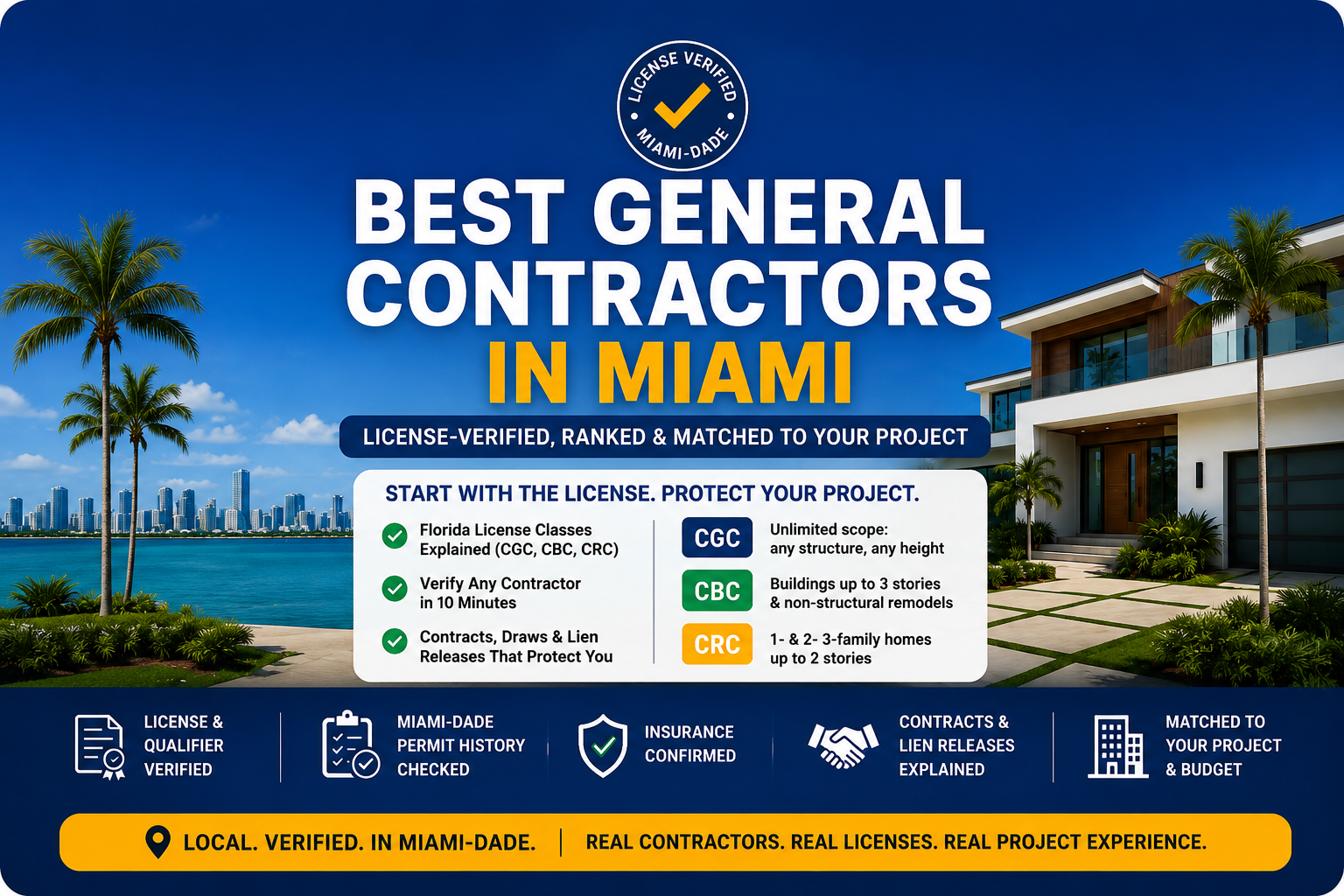
Florida does not treat every building contractor as interchangeable. State law defines three relevant Division I license scopes: general contractor, building contractor, and residential contractor. Their legal scopes are different.
And even a Certified General Contractor does not automatically have unrestricted authority to perform every specialty trade personally. Florida law generally requires general, building, and residential contractors to subcontract electrical, mechanical, plumbing, roofing, sheet-metal, swimming-pool, and air-conditioning work unless the contractor holds the required trade license or a statutory exception applies.
So this ranking starts with license class, not stars one piece of the larger process we walk through in our guide on how to hire a contractor in Miami.
First, we'll show you which Florida license class fits your project. Then you'll get the ranked contractors, with each company's license number, status, named qualifier the licensed individual responsible for the contracting activities of the business and verification date.
After that, we'll cover the paperwork that matters once the job starts: who pulls the permit, what you require at every draw, and which lien documents you obtain before final payment.
By the end, you should be able to answer three questions before signing:
- What license class does this project require?
- Does this contractor actually hold it?
- What must be in writing before money moves?
First Which License Class Does Your Project Need?
Before comparing contractors, match the license class to the work.Florida Statute §489.105(3) divides the main building-contractor licenses into three Division I classes: CGC, CBC, and CRC. Their scopes are not interchangeable.
CGC Certified General Contractor
A Certified General Contractor (CGC) has the broadest building scope. Florida defines a general contractor's services as unlimited as to the type of work the contractor may perform, subject to specific statutory restrictions.
Typical fit: large commercial work, high-rise structural renovations, major condominium projects, and projects that exceed CBC or CRC limits.
CBC Certified Building Contractor
A Certified Building Contractor (CBC) may construct commercial and residential buildings up to three stories, including associated accessory structures.
A CBC may also remodel, repair, or improve a building of any size when the work does not affect its structural members.
Typical fit: small commercial construction, many commercial tenant build-outs, and nonstructural renovations in larger buildings.
CRC Certified Residential Contractor
A Certified Residential Contractor (CRC) is limited to one-, two , and three-family residences of no more than two habitable stories above one uninhabitable story, plus associated accessory structures. CRC here means Certified Residential Contractor the definition used by DBPR and §489.105(3)(c).
Typical fit: qualifying single-family renovations, additions, and ground-up homes within that residential scope.
Match the Class to the Job
The same license check works for specialty trades, as our guides to choosing an HVAC contractor in Kendall and hiring a plumber near Little Haiti show.
The exact scope still matters. A condo renovation involving structural members in a high-rise, for example, is not the same licensing question as replacing cabinets, flooring, and finishes.
Do not assume a CGC license makes the company a roofing contractor. Florida generally requires general, building, and residential contractors to subcontract roofing unless they also hold the appropriate roofing certification or a specific statutory exception applies. Florida uses CCC for Certified Roofing Contractor, and our <a href="https://miamigoeslocal.com/blog/best-roofing-companies-in-miami" rel="noopener" target="_blank">ranked guide to the best roofing companies in Miami</a>
That distinction matters on whole-home projects. Your GC can manage the roofing portion of the contract, but the roofing work generally needs to be performed under the proper roofing license. Florida law also prohibits general, building, and residential contractors certified after 1973 from holding themselves out as roofing contractors without roofing certification or registration.
Match the license class before comparing price, reviews, or portfolios. A company can have excellent work behind it and still lack the legal scope required for your particular permit.
Best General Contractors in Miami: The Rankings
How We Scored
We used a 100-point model. The ranking order comes from the score, not from payment, directory status, or review stars.
License and permit evidence carry 65 of the 100 points. Reviews carry four.
That weighting is deliberate. A large review count cannot compensate for the wrong license, a short-lived qualifier relationship, unresolved discipline, or an inadequate permit trail.
The Inclusion Rule
A company does not enter this ranking merely because it serves Miami.
To qualify, we require:
- an active Florida contractor license appropriate to the work;
- a verifiable physical address in Miami-Dade County;
- a named licensed qualifier, meaning the individual whose license qualifies the contracting business;
- evidence of permitted work in Miami-Dade or one of its municipalities; and
- enough independent information to score the company without filling gaps from its own marketing copy.
Companies based elsewhere in South Florida are excluded even if they advertise heavily in Miami, though any Miami-Dade contractor who wants to be considered for a future ranking can start with a free business listing.
One Worked Scorecard
Here is why we do not calculate rankings from directory profiles alone.
Real Construction Group LLC & evaluation in progress
DBPR currently shows Rolando G. Gonzalez as a Certified General Contractor, CGC032803, Current/Active, originally licensed March 7, 1985, with the license expiring August 31, 2028. DBPR lists Real Construction Group LLC at 2897 SW 69 Court, Miami, and shows Gonzalez qualifying the business since June 13, 2008.
Florida corporate records independently show Real Construction Group LLC as active and at the same Miami address. A permit-history source also identifies substantial local work, including a reported $1.5 million new residence in Coral Gables.
We would not publish a score from this incomplete card. Missing evidence receives no assumed points, and the contractor does not receive a ranking position until the same checks have been completed for every company under consideration.
That same standard applies to number one.
What Every Ranked Entry Will Show
Each contractor below is presented in the same format:
Company Name Best for: [project type]
License: CGC/CBC/CRC · #[number] · Current/Active · expires [date] · verified on [date] · [DBPR Licensee Search]
Qualifier: [name] · qualifying this business since [date]
Operating history: [years] · Miami-Dade address: [verified address]
Project fit: [renovations/custom homes/commercial/etc.] · typical budget: [$X–$Y]
Work model: [self-performed scopes] · [major scopes subcontracted]
Reviews: [rating] from [count] reviews on [platform] · captured [date]
One limitation: [specific limitation relevant to choosing the company]
The budget band and limitation are mandatory. A contractor regularly building multimillion-dollar waterfront homes may be a poor fit for a $120,000 Kendall renovation. A renovation-focused firm may be equally unsuitable for a $3 million ground-up residence.
Those are different project matches, not different levels of quality.
Best By Project Type
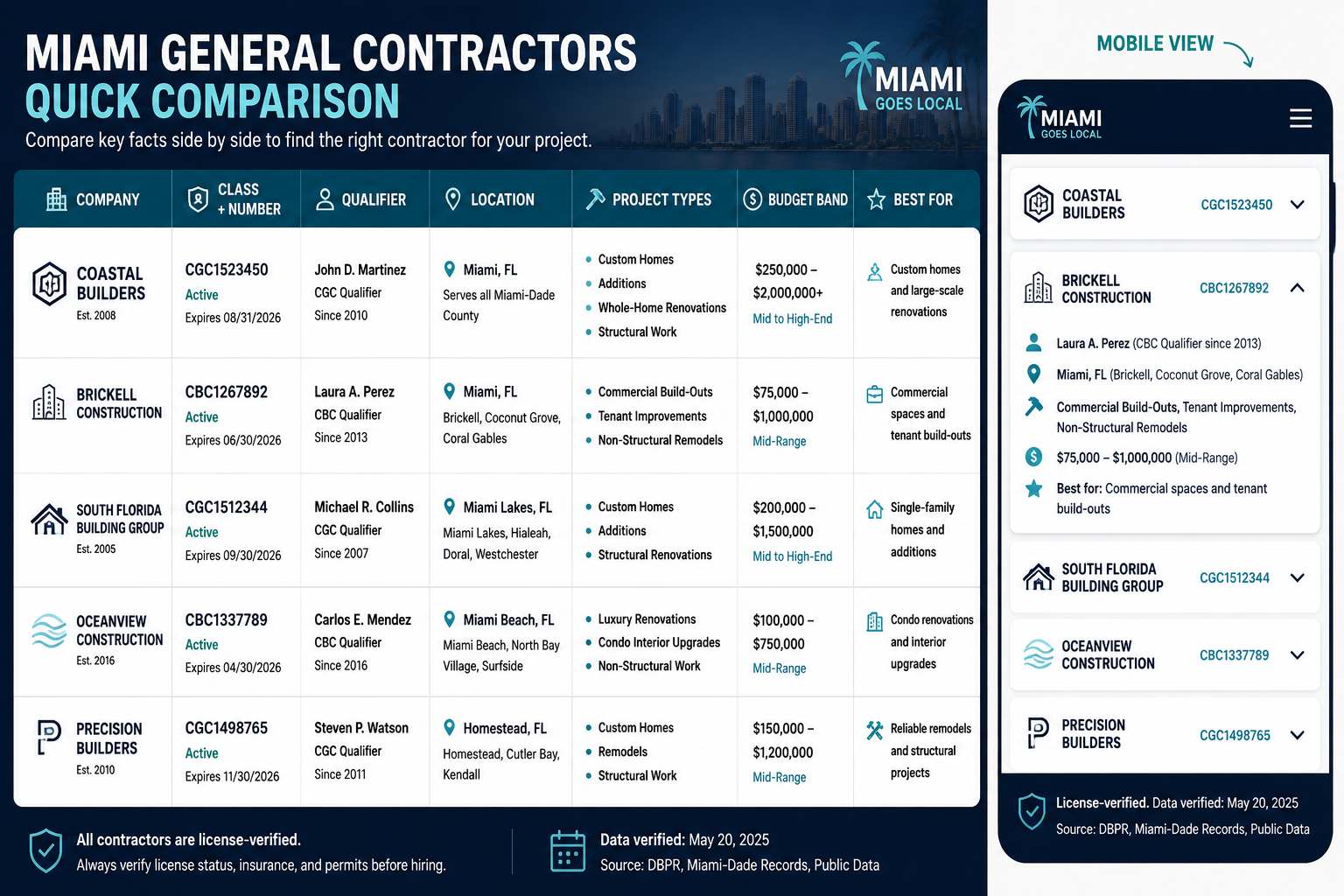
The right contractor depends on the work, not just the ranking position.
If the Work Touches the Building Envelope, Check HVHZ Experience
Miami-Dade is within Florida's High-Velocity Hurricane Zone (HVHZ). For building-envelope components such as roofing, windows, exterior doors, glazing, shutters and wall cladding, Miami-Dade operates a Product Control approval system and issues Notices of Acceptance for products and systems that meet applicable HVHZ requirements.
That also affects inspections. Miami-Dade publishes specific inspection categories for work including framing, roof sheathing, structural panels, window bucks and fasteners, roofing, electrical, plumbing and mechanical work.
[[tip If your project changes the roof, windows, exterior doors, cladding or another part of the building envelope, ask for recent Miami-Dade HVHZ projects, not simply Florida experience, and if the roofing material itself is still an open question, our tile vs. metal vs. flat roof comparison for Miami can help you decide before you start interviewing contractors. Ask for the permit numbers and the product approvals used so you can verify them yourself.]]
A contractor can have years of experience elsewhere in Florida and still have limited experience navigating Miami-Dade's product-approval and inspection requirements. For envelope-heavy work, that distinction belongs in the hiring decision.
Who Actually Holds the License
The company name is not the whole licensing story.
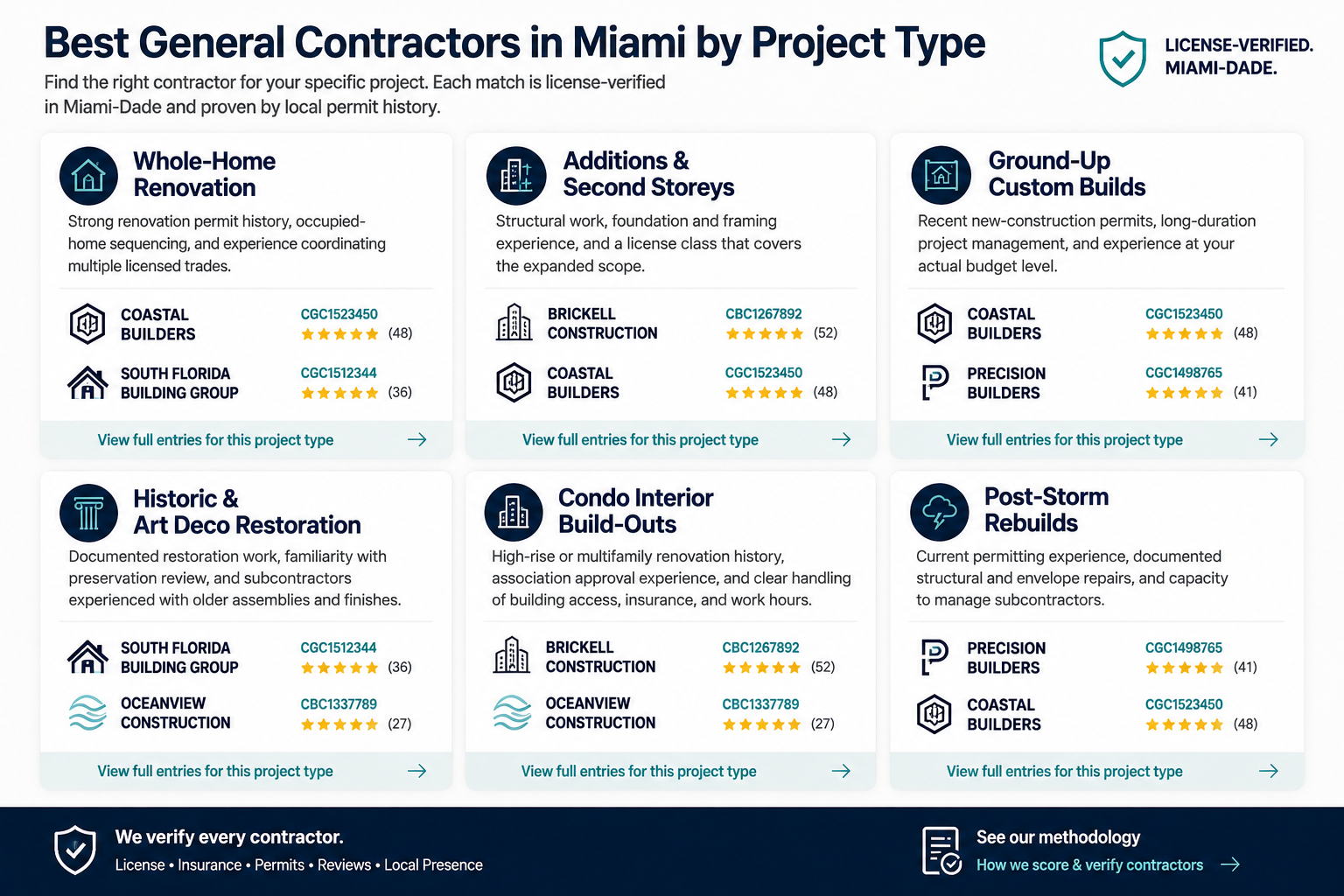
Florida requires a contracting business to operate through a qualifying agent, usually called the qualifier the licensed individual whose certification allows that business to perform work within that license class. Florida law makes the primary qualifier responsible for supervision of the business's construction operations and field work.
That is why every company entry in this ranking identifies the qualifier by name.
How to Read the DBPR Record
Check three things:
License class and number. Confirm that the qualifier holds the CGC, CBC, CRC or specialty license your scope requires.
Business relationship. Confirm that DBPR shows that individual qualifying the exact company named on your contract.
Qualification date. A long-standing qualifier relationship generally gives you more operating history to examine. A recent change is not automatically a problem, but it deserves a question.
Florida gives a business only a limited period to replace its sole qualifier after that person leaves, and the business generally cannot continue taking on contracting work without a qualifying agent except under narrow statutory provisions.
If the qualifier appears to have little visible involvement with the company, ask: Who supervises my project, and who will be listed as the contractor on the permit? Get the answer in writing.A license number printed on a website tells you very little unless the DBPR record connects that license to the business you are actually hiring.
Never Pull Your Own Permit for a Contractor
An owner-builder permit is for an owner who is acting as their own contractor. It is not a shortcut for a contractor who wants you to carry the permit.
Miami-Dade says this plainly: if a contractor tells you to obtain an owner-builder permit, you become legally responsible for the work performed under it. The county advises owners to ensure that hired contractors obtain their own permits and are properly licensed and insured.
As an owner-builder, you become the responsible party of record. Miami-Dade's disclosure also places responsibility on the owner for compliance with applicable laws, building codes and zoning requirements, and warns of potential liability involving hired labor and workers' compensation.
So if you have hired a general contractor to run the job, the permit should ordinarily identify that contractor rather than turn you into the owner-builder.
After the permit is issued, search the applicable permit portal yourself. Confirm the contractor shown on the permit matches the company and license you hired.Do that before substantial work begins, not after a failed inspection or dispute.
Contracts, Draws and Lien Releases
The contractor matters. The paperwork controls what happens after you hire them.
You Can Pay in Full and Still Be Liened
Florida's Construction Lien Law allows certain unpaid subcontractors and material suppliers to pursue a lien against the property even when the owner has already paid the general contractor in full. Florida's required residential contract notice says this explicitly.
A Notice to Owner is not automatically a warning that something has gone wrong. It identifies a subcontractor, supplier, or other lienor preserving rights under Chapter 713. Treat it as a record of who needs to be accounted for before money moves.
Expert tip: Require partial lien releases at every draw from the contractor and from parties who have served a Notice to Owner. Florida law expressly provides for partial releases tied to progress payments. Do not wait until final payment to start collecting them.
At final payment, require the contractor's final payment affidavit and resolve listed unpaid lienors before releasing the remaining contract balance. Section 713.06 requires the owner to retain final payment until that affidavit has been furnished.
This is general information about Florida's lien framework, not legal advice. For a large project or disputed payment, have a Florida construction attorney review the payment and release procedure.
The Draw Schedule
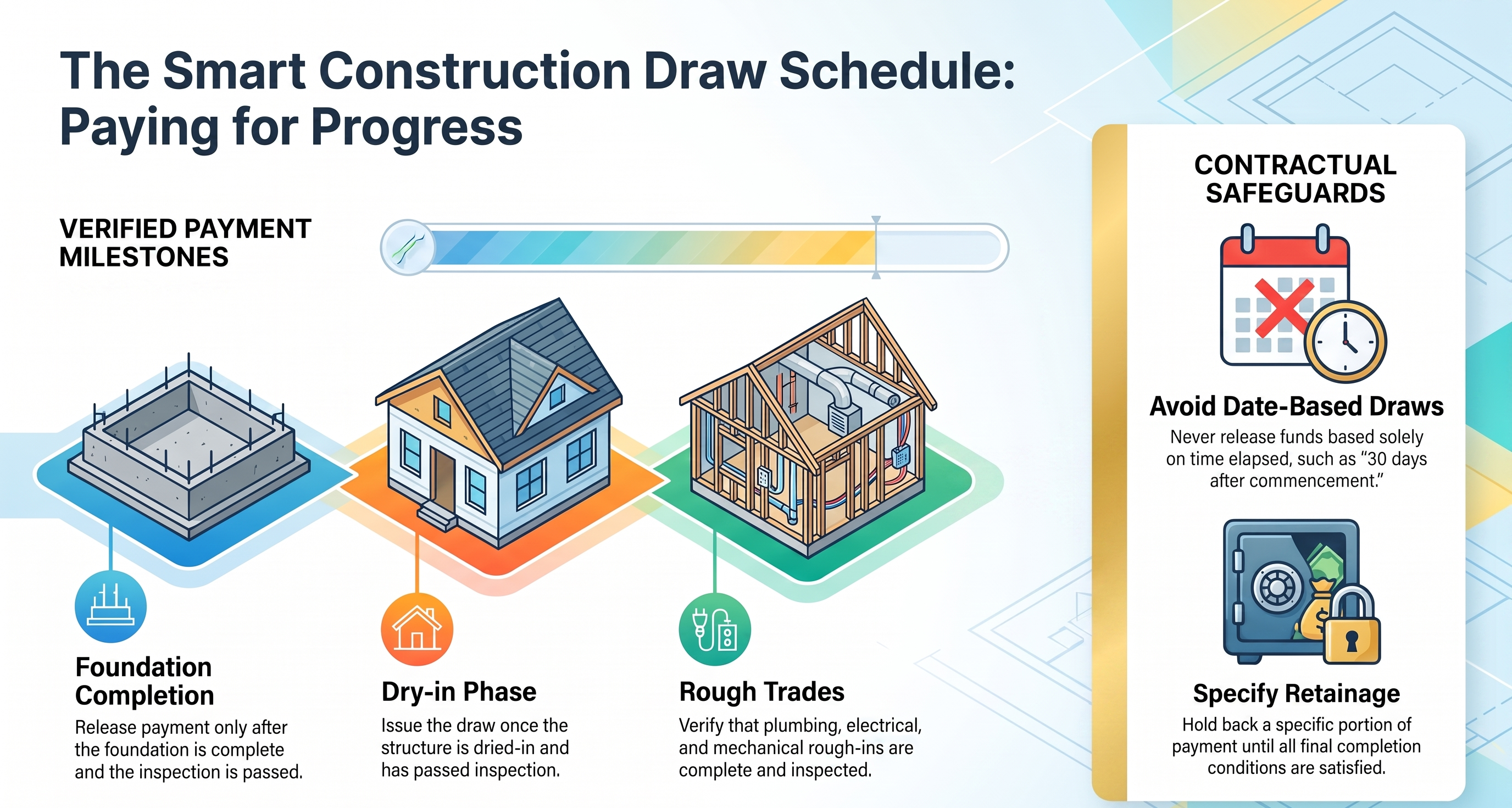
Tie payments to work you can verify.
A stronger schedule looks like:
foundation complete and inspection passed → draw
dry-in complete and inspection passed → draw
rough trades complete and inspections passed → draw
Avoid draws based only on dates such as "30 days after commencement."
Also specify retainage the portion held back until defined completion conditions are satisfied in the contract.
Treat a large upfront deposit as a negotiating point. Mobilization and specially ordered materials may justify an initial payment. Paying most of a six-figure contract before comparable value exists on the property removes much of your leverage.
Change Orders
Decide how changes will be priced before the first change happens.
The contract should state whether change orders use:
- a fixed agreed price;
- documented cost plus a stated contractor markup; or
- predetermined unit prices for defined work.
Require every change order in writing, with its price and schedule effect stated before the additional work proceeds whenever practicable.
The issue is not whether a project will change. It is whether the pricing method was agreed before either side had leverage over the other.
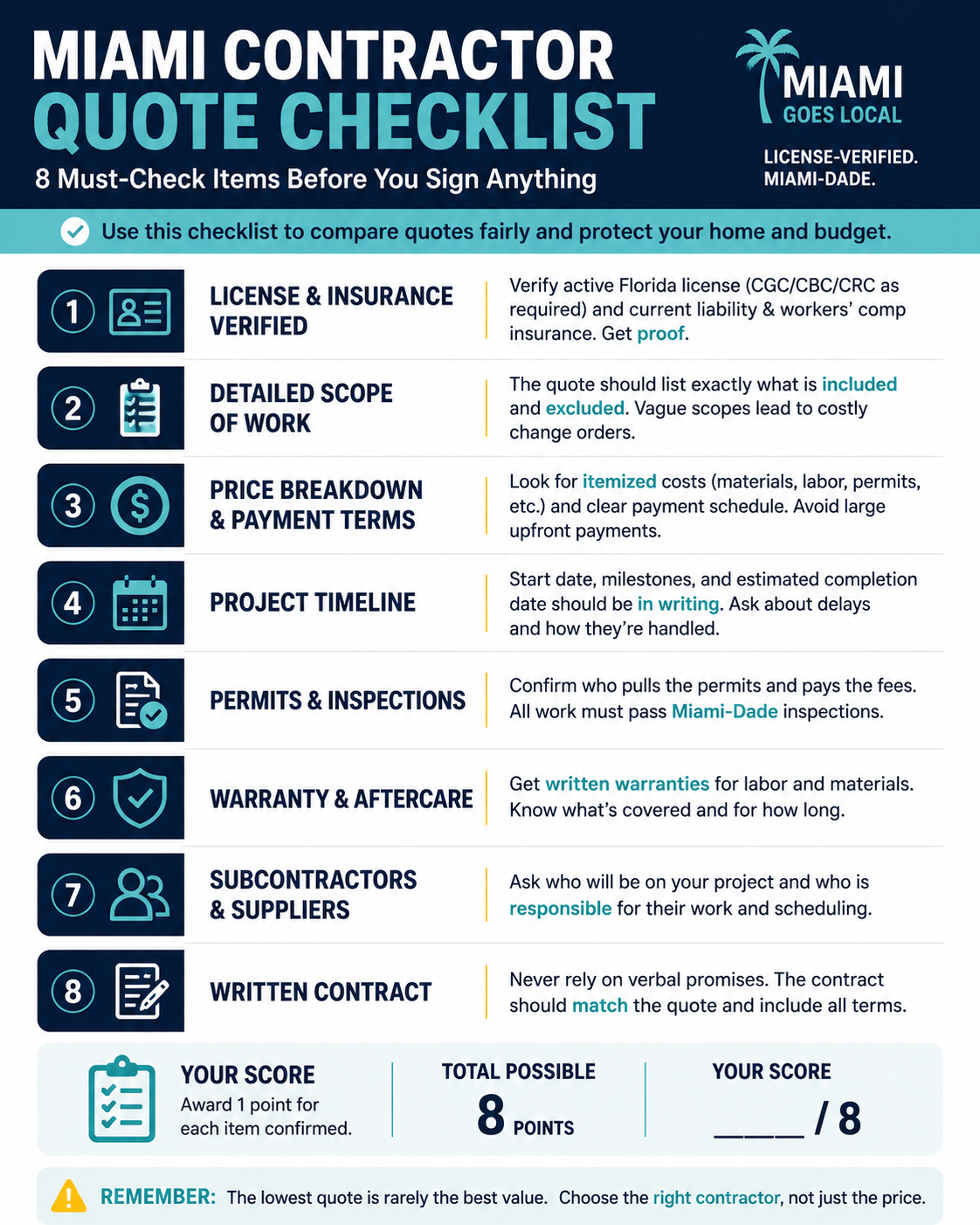
Contract Audit Checklist
- Contractor's legal business name matches the DBPR record
- Correct license class and license number appear in the contract
- Named qualifier has been verified
- Permit responsibility is assigned to the contractor
- Draws are tied to defined milestones and inspections
- Retainage is stated
- Partial lien releases are required at every draw
- Final payment affidavit and final releases are required before final payment
- Change-order pricing method is stated
- Completion date or completion standard is defined
- Delay and default remedies are stated
- Insurance requirements are written into the agreement
Portfolios are what contractors sell on. Contracts determine the outcome.
Design-Build vs. General Contracting vs. Construction Management
These terms are often used loosely in Miami marketing. The contract matters more than the label.
General contracting usually means you hire the architect or designer separately, then contract with the builder to construct the approved design. You keep a direct relationship with the designer, but design gaps and changes can create disputes over who owns the added cost.
Design-build puts design and construction under one contract. That can reduce handoffs and give you one point of responsibility, but it also means the designer may be working for the same organization responsible for construction. Pay particular attention to allowances, change-order pricing, and exactly what design services are included.
Construction management generally means a manager coordinates budget, scheduling, procurement, contractors, and construction. The important question is contractual: Is the construction manager merely your adviser, or is it also the contractor financially responsible for delivering the work? Florida law recognizes construction-management functions such as project scheduling and coordination, but required construction scopes must still be performed through appropriately licensed professionals.
A well-run firm may describe itself using all three terms. Do not choose based on the wording. Ask who holds the construction contract, who holds the design contract, who carries cost-overrun risk, and how change orders are priced.
Verify Any Miami General Contractor in 10 Minutes
Step 1 Check DBPR
Search the company and qualifier through Florida's Department of Business and Professional Regulation.
Confirm:
- license class;
- license number;
- Current/Active status;
- expiration date;
- named qualifier; and
- any available complaint or discipline history.
Florida defines CGC, CBC and CRC as different scopes under §489.105(3).
Expert tip: Verify the status, not merely that a license number exists. A suspended or revoked license is a stop signal.
Step 2 Verify Insurance
Request evidence of current general liability and workers' compensation coverage.
Do not rely only on a PDF handed to you by the contractor. Ask for verification from the insurer or authorized insurance agent, and confirm coverage extends through the expected project period.
Miami-Dade specifically advises consumers to verify current liability and workers' compensation insurance when checking a contractor.
Step 3 Check the Permit Trail
Search Miami-Dade's permit records or the building department for the municipality where the work occurred for recent projects comparable to yours.
Look beyond whether a permit exists. Check inspection history, open permits, outstanding requirements and project status where available. Miami-Dade's permit system provides searches for permit history, inspection history and contractor permit activity.
Three recent permitted kitchen remodels do not prove experience building a waterfront house. Match the permit trail to your project.
Step 4 Check Complaints and Enforcement
Miami-Dade still maintains contractor enforcement and complaint functions.
The County says its Consumer and Neighborhood Protection Division investigates complaints, unlicensed contracting, improper permitting and other violations.
The licensing landscape changed on July 1, 2025, when Florida preempted specified local specialty-license categories. That did not eliminate Miami-Dade's contractor enforcement and complaint role.
For a company you are considering, check both the state DBPR record and Miami-Dade's available contractor complaint information rather than assuming one database tells the whole story.
Step 5 Call Comparable References
Ask for three clients from the last two years whose projects were similar in both type and budget.
Then call them.
Ask whether the original price held, how change orders were handled, whether the same superintendent stayed on the project, whether inspections caused material delays, and whether the contractor finished the punch list after receiving most of the money.
Photos tell you what a contractor has built. References tell you what it was like while they were building it.
Contractor Verification Toolkit
DBPR Licensee Search license class, status, qualifier and state record
Florida Statute §489.105(3) legal scope of CGC, CBC and CRC licenses
Miami-Dade Permit Records permits, inspection history and project status
Miami-Dade Contractor Enforcement / Complaints complaints and unlicensed-activity enforcement
Do these checks before comparing proposals. They take less time than reviewing most contractor portfolios and tell you substantially more about who you are actually hiring.
Frequently Asked Questions
What's the difference between CGC, CBC and CRC?
Florida separates the main Division I contractor licenses by legal scope.A CGC, Certified General Contractor, has the broadest scope. A CBC, Certified Building Contractor, is generally limited to commercial and residential buildings of no more than three stories, plus nonstructural remodeling of larger buildings. A CRC, Certified Residential Contractor, is limited to qualifying one-, two-, and three-family residences. Florida Statute §489.105(3) defines all three.
Do I need a general contractor for a kitchen remodel?
It depends on the scope.A cosmetic kitchen replacement is different from a project moving walls, altering structural members, relocating major systems, or requiring multiple permitted trades. Match the contractor's license class to the actual permitted scope rather than assuming every kitchen remodel requires a CGC.
Can a general contractor do my roof?
Not simply because they hold a CGC. Florida generally requires general, building, and residential contractors to subcontract roofing unless they also hold the appropriate roofing certification or fall within a specific statutory exception. A contractor may manage the roofing portion of a larger project, but the roofing scope generally needs a properly licensed roofing contractor.
How do I check a contractor's license in Florida?
Search the business and individual at DBPR's Licensee Search.Confirm the license class, number, Current/Active status, expiration date, and the named qualifier. Then review any available complaint or disciplinary information instead of stopping when you find a license number.
What is a qualifier?
The qualifier is the licensed individual whose license qualifies the contracting business.Check that the qualifier shown in DBPR is connected to the exact legal entity named on your contract. If that relationship changed recently, ask who now supervises construction operations and who will appear on the permit.
Should I pull my own permit to save money?
Not when you have hired a contractor to perform the job.Miami-Dade says that if a contractor tells you to obtain an owner-builder permit, you become legally responsible for the work performed under it. The County instructs owners to make sure hired contractors obtain their own permits and are licensed and insured.
Can I be liened after paying my contractor in full?
Yes.Florida's Construction Lien Law warns that unpaid subcontractors and suppliers may pursue the property even when the owner has already paid the general contractor.Require partial lien releases at every draw, track every Notice to Owner, and obtain the required final-payment paperwork before releasing the remaining balance.
How much do general contractors charge in Miami?
There is no single defensible Miami percentage that applies across renovations, custom homes, construction management, and design-build work. You will commonly see contracts structured as a fixed price, cost-plus with a stated contractor fee or markup, or a construction-management fee, and if your project is specifically a roof replacement, our Miami roof replacement cost guide breaks down typical pricing by material and roof size.
Compare the pricing method, allowances, exclusions, contingency treatment, and change-order markup in writing rather than relying on an advertised percentage.
How long does a Miami-Dade permit take?
Miami-Dade currently says an initial plan review may take from 24 hours to 10 business days, depending on permit type and complexity. If corrections are required, each rework review may take another 24 hours to 10 business days.That is plan-review time, not a guarantee that a complete project permit will be issued within 10 days. Zoning, environmental, fire, utility, municipal, and other reviews can apply. Projects inside incorporated cities may also run through that municipality's building department rather than Miami-Dade's standard process.
What's the difference between design-build and general contracting?
With general contracting, you typically hold the design agreement separately from the construction agreement.With design-build, design and construction usually sit under one contractual team. Neither model is automatically better. The useful questions are who holds each contract, who bears design and cost risk, and how change orders are priced.See Design-Build vs. General Contracting vs. Construction Management above for the full distinction.
 Thanksgiving in Miami 2026: Independent Restaurants, Bakeries and Takeout That Are Open
 Best Plumbers Near Little Haiti, Miami How to Choose One You Can Trust
 Different Types of Massage in Miami: How to Choose by Goal, Price and Licence
