
The contractor promised the roof would be finished before the next storm. The Miami homeowner paid a large deposit, demolition began, and then the crew stopped showing up. Weeks later, the roof remains exposed, the permit record is unclear, and the name on the contract does not match an active Florida contractor’s licence.
Recovering the money may now require complaints, legal action, or both. The damage could have been prevented with a five-minute check.
Before you sign anything, before you hand over a deposit, before you even let someone on your roof, check the licence. It takes five minutes. It can save six figures.
Hiring a contractor in Miami is not the same as hiring one in most American cities. Projects must comply with Florida licensing law, local permitting requirements and the stricter standards of the High-Velocity Hurricane Zone, commonly called the HVHZ. Roofing systems, windows, exterior doors and other building-envelope products may require documented product approval and installation according to their approved specifications.
This guide walks you through the entire process: defining the job, choosing the correct contractor licence class, checking the contractor and qualifying agent, comparing estimates, reviewing materials, confirming permits, negotiating payments and signing a contract that protects your property.
You will also see realistic 2026 Miami cost ranges, including why two estimates for the same roof can differ by tens of thousands of dollars. By the end, you should know how to find, vet and hire a contractor based on records and written terms not promises, advertisements or a convincing sales presentation.
Key Takeaways
- Check the contractor’s licence first. Search the individual or business through the Florida DBPR licence portal. Confirm that the licence is current, covers your type of project and belongs to the person or company named in your contract.
- Miami-Dade projects face stricter wind requirements. Miami-Dade is within Florida’s High-Velocity Hurricane Zone. Applicable roofing, window, door and exterior products must have the correct approval for the proposed use, and installers must follow the approved system not merely use a product advertised as “hurricane-rated.”
- Know the price range before requesting estimates. Based on the Miami pricing reviewed for this guide, complete roof replacements may start around $14,000 for an architectural-shingle system, while larger or more complex tile roofs can exceed $70,000. Size, deck repairs, access, roof shape, demolition, fastening requirements and materials can materially change the final price.
- Make the contract specific. It should identify the exact scope, materials, permit responsibility, payment milestones, change-order process, estimated schedule and requirements for lien releases. Avoid paying far ahead of completed work. Florida law does not impose a universal maximum deposit, although an initial payment exceeding 10% triggers particular permit and commencement obligations under Florida Statutes $489.126.
- Use Miami Goes Local to build your shortlist. Start with contractors whose relevant licence records have been individually checked and show the verification date. Then repeat the DBPR check immediately before signing, because licence status, qualifiers and disciplinary records can change. the Miami Goes Local directory.
Understanding Miami’s Construction Landscape
Miami construction has its own rulebook. The hurricanes, licensing structure and local permit systems all affect who may perform the work, which products can be installed and how much the project will cost.
1. Miami-Dade is in the HVHZ
Miami-Dade County is part of Florida’s High-Velocity Hurricane Zone, or HVHZ. The Florida Building Code applies stricter wind-resistance requirements here than in most of the state.
For a homeowner, that affects three practical parts of a project:
- Products: Roofing systems, windows, exterior doors, shutters and other building-envelope components must carry an approval accepted for their intended use in the HVHZ. A contractor should be able to provide the relevant Miami-Dade Notice of Acceptance, commonly called an NOA, or other applicable approval documentation.
- Installation: An approved product is only compliant when installed according to its approval. Fastener type, spacing, deck attachment, adhesives and allowable design pressures can all matter. “Hurricane-rated” on a sales brochure is not enough.
- Water protection: Roof replacements may trigger specific underlayment and secondary-water-barrier requirements. The correct assembly depends on the roof, deck and applicable code provisions, so ask the roofer to identify the proposed system in writing.
These requirements are not paperwork for paperwork’s sake. They influence material selection, labour, inspections and price. Before approving a roofing, window or door product, search its approval and confirm that it remains current through Miami-Dade County Product Control. Miami-Dade also publishes HVHZ code-change guidance for contractors and design professionals.
2. “Florida licensed” does not always mean statewide
Florida separates contractors into two licensing routes:
- A certified contractor holds a state certificate of competency and may contract anywhere in Florida, provided the work falls within that licence class.
- A registered contractor qualified through a particular local jurisdiction and may work only in the jurisdiction or jurisdictions covered by that registration.
Florida law defines this distinction in Florida Statutes $489.105, which governs contractors regulated by the Construction Industry Licensing Board.
This matters when a contractor says, “I’m licensed in Florida.” Ask for the licence number and check whether it is certified or registered, where it is valid and whether its scope covers your project. A valid local registration in another part of Florida does not automatically authorize work in Miami-Dade.
3. State licensing and city registration are separate checks
A state licence does not automatically complete every local administrative requirement. The contractor may also need to register with the building department responsible for the property before applying for a permit.
For example, the City of Miami maintains its own building-contractor registration process. Miami Beach also requires contractors working through its permitting system to complete the applicable local registration and credential-verification process.
The practical rule is simple: identify the permitting jurisdiction from the property address, then confirm that the contractor can pull the permit there. Do not assume that “Miami,” unincorporated Miami-Dade, the City of Miami and Miami Beach use one interchangeable permit office.
These are the Miami rules. They determine which contractor can legally take the job, which products can pass review and inspection, and why a compliant estimate may cost more than a generic Florida estimate.
Step 1: Define Your Project Before You Call Anyone
The first step is not finding a contractor. It is deciding what you need the contractor to investigate, price and complete.
If you ask three contractors to “fix the roof,” you may receive three estimates covering three different jobs. One may quote a small repair, another may include replacing damaged decking, and the third may price an entire roof replacement. Those numbers cannot be compared until the scope is clear.
Repair or replacement?
A leak does not automatically mean the entire roof has failed. A targeted repair may be reasonable when the roof is otherwise serviceable and the failure is confined to a specific area, such as damaged flashing, a puncture, a small section of failed material or a problem around a roof penetration.
A competent repair can extend the useful life of an otherwise healthy roof. It is less likely to make sense when deterioration is widespread, the deck has extensive damage, repeated repairs have failed or the existing assembly cannot be repaired in compliance with applicable code.
Ask the contractor to explain:
- Where the failure is located
- What caused it
- Whether the damage is isolated or widespread
- What will be removed and replaced
- How long the proposed repair is reasonably expected to last
- Why replacement is necessary, if replacement is recommended
A contractor who recommends a complete roof replacement without walking the roof or using another appropriate inspection method and showing you photographs of the actual failure is a red flag. Ask for dated photos tied to specific roof locations before accepting the recommendation.
General contractor or specialty contractor?
The correct licence depends on the work.
A general contractor can coordinate a project involving several trades, such as a whole-home renovation that includes structural work, roofing, plumbing and electrical work. The general contractor manages the overall project and hires properly licensed subcontractors for regulated trades when required.
A specialty or trade contractor works within a defined scope. For example:
- Hire a properly licensed roofing contractor for roof repair or replacement.
- Hire an electrical contractor for panel, circuit or wiring work.
- Hire a plumbing contractor for regulated water, drain, sewer or gas-piping work; our guide to hiring a plumber near Little Haiti shows the same licence checks applied to that trade.
- Hire an appropriately licensed air-conditioning or mechanical contractor for HVAC work; see our guide to choosing an HVAC contractor in Kendall for that trade's checks.
Do not assume that one licence covers every trade. Florida law defines each contractor class by its permitted scope.
Write a one-page project description
You do not need architectural language. Write a short description that gives every contractor the same starting information.
Include the affected area, the known problem, the result you want, materials you are considering, your approximate budget and your desired timeline. Attach photographs and state whether plans, engineering reports, insurance documents or previous permits are available.
Send the same description to every bidder. You will receive estimates that are easier to compare and expose assumptions before they become change orders.
Project Definition Checklist
Copy or print this list before requesting estimates:
- Property address and permitting jurisdiction
- Rooms, structures or roof areas included in the project
- Known damage, symptoms or defects
- Repair, replacement or investigation requested
- Photographs of the existing condition
- Materials or product types being considered
- Approximate budget range
- Preferred start date and required completion date
- Likely permit, engineering or association-approval needs
- Questions each contractor must answer in writing
Your description does not need to diagnose the building. Its purpose is to ensure every contractor inspects and prices the same problem.
Step 2: Understand Miami’s Licensing and Permit Rules
A licence number printed on a truck, website or business card proves nothing by itself. Verify it against the state record before discussing a deposit.
Florida’s Construction Industry Licensing Board regulates general, building, residential, roofing and several other contractor classes. Two licensing routes matter when hiring in Miami: certified and registered.
Before signing: Verify the licence number, current status and named qualifier.
Florida Contractor Licence Types
Licence Type
Prefix
Valid Where
What It Means for You
Certified General Contractor
CGC
Statewide Florida
May perform work within the general-contractor scope throughout Florida.
Certified Roofing Contractor
CCC
Statewide Florida
May perform work within the roofing scope throughout Florida.
Registered General Contractor
RG
Authorized local jurisdiction only
May work only where the contractor’s registration is valid.
Registered Roofing Contractor
RC
Authorized local jurisdiction only
May perform roofing work only where the registration is valid.
Under Florida Statutes $489.105, a certified contractor may contract throughout Florida without satisfying another jurisdiction’s competency requirements. A registered contractor qualified through a local jurisdiction and may contract only in the jurisdiction or jurisdictions covered by that registration.
The prefix helps identify the licence class, but do not rely on the prefix alone. Verify the complete record and confirm that the scope matches your project.
How to verify a Florida contractor’s licence
Use the official Florida DBPR licence-search portal.
- Open the DBPR licence search.
- Select the construction-related profession or search all applicable licence types.
- Search by the contractor’s full name, business name or licence number.
- Open the matching record rather than relying on the results page.
- Confirm that the status is current and active.
- Confirm the licence class covers the proposed work.
- Check whether the licence is certified statewide or registered locally.
- Match the individual, business organization and address against the estimate and contract.
- Identify the qualifying agent the licensed person responsible for the business’s contracting activities.
- Review any available complaint or disciplinary information and save a dated copy of the record.
The name receiving your payment should make sense when compared with the licensed individual and qualified business shown by DBPR. If the salesperson gives you someone else’s licence number, stop.
Verify insurance directly
Ask for current certificates showing:
- Commercial general liability coverage
- Workers’ compensation coverage or a lawful exemption, where applicable
- The insured business name
- Policy numbers and coverage dates
- The insurance agent or carrier’s contact information
General liability coverage responds to certain claims involving bodily injury or property damage, subject to the policy’s terms and exclusions. Workers’ compensation addresses qualifying workplace injuries. Florida construction employers are subject to particularly strict workers’ compensation rules, although some qualifying business owners may hold exemptions.
A certificate is evidence, not a guarantee. Contact the agent or carrier and confirm that the policy is active. Make sure the insured name matches the company in your contract. An uninsured subcontractor can create a problem even when the main contractor provides its own certificate, so ask how subcontractor coverage is verified.
Confirm the correct permit office
“Miami” is not one permitting jurisdiction. The responsible building department may be Miami-Dade County, the City of Miami, Miami Beach or another municipality.
Use the project address to identify the correct authority. Then ask:
- Who will apply for the permit?
- In whose name will it be issued?
- Is the contractor registered with that building department?
- Are plans, engineering documents or product approvals required?
- Which inspections must occur before work is covered?
- Who will close the permit after final inspection?
The City of Miami maintains a separate contractor-registration process. Contractors using the Miami Beach permitting system must likewise satisfy its current registration and credential requirements before pulling applicable permits.
The permit should normally identify the contractor responsible for the work. Be cautious if a contractor asks you to obtain an owner-builder permit while the contractor actually controls the job. That arrangement can shift legal and financial responsibility to you.
The rule is simple: verify the state licence, verify the insurance and verify that the contractor can pull the required permit in the jurisdiction where your property is located. Do all three before signing or paying.
Check whether the business has engaged with the directory
After verifying the contractor’s licence and insurance, check whether the company has added or claimed its Miami Goes Local profile.
The directory’s add or claim a business listing process gives owners two routes:
- If the business is not listed, the owner can submit its business name, category, address, contact information, services and owner details. The Miami Goes Local team reviews the submission before publication.
- If a profile already exists, the owner can use the claim option to identify themselves and request control of that listing.
A claimed or owner-submitted listing shows that the business has actively engaged with the directory and provided a responsible contact. That adds a useful layer of accountability, but it does not replace the licence, insurance and permit checks described above. Always confirm the contractor’s current DBPR record immediately before signing.
Step 3: Find and Shortlist Contractors
Do not begin by calling the first contractor whose advertisement appears in search results. Build a shortlist of three to five candidates, then apply the same checks to each one.
Your final shortlist should contain only contractors whose licences are current, whose licence classes cover the proposed work and whose identities match the businesses providing the estimates.
Start with a Miami-specific directory
Begin with the Miami Goes Local Contractors & Construction directory. It currently brings together more than 2,725 local listings, giving you a broad starting pool across construction and related trades.
If your project is specifically a roof repair or replacement, use the narrower Miami roofing-contractor directory, which currently contains approximately 87 roofing listings.
These category pages help you discover businesses serving Miami, but directory inclusion alone should not be treated as proof of licensing, insurance or quality. Some directory profiles may be based on public business information or remain unclaimed. Apply the verification process from Step 2 before adding any company to your shortlist.
For a smaller research-based starting point, review Miami Goes Local’s guide to finding a licensed general contractor. For roof work, use the separate guide to choosing a licensed Miami roofing company. These editorial shortlists include licence checks recorded during the research process, but you should still repeat the DBPR search before signing because licence status can change.
Ask neighbours but verify the referral
A referral can tell you how a contractor behaved on a real project. Ask neighbours, condominium owners, local community groups and people who recently completed work similar to yours.
Do not ask only, “Were you happy?”
Ask:
- Was the final price close to the signed estimate?
- Who pulled the permit?
- Did the contractor attend inspections?
- How were change orders handled?
- Were subcontractors supervised?
- Was the site kept reasonably secure and clean?
- Did the contractor provide lien releases?
- Was the permit closed after final inspection?
- Would you hire the same company again for a project of this size?
A recommendation is evidence of one customer’s experience. It is not a licence check. Run every referred contractor through DBPR.
Evaluate the online record
A professional website and strong reviews can support your research, but neither proves that the company is qualified for your job.
Look for consistency across the contractor’s website, directory listing, DBPR record, estimate and insurance certificate. The business name, licence number, phone number and service area should make sense together.
When reading reviews:
- Check recent reviews as well as the overall rating.
- Look for projects similar in size and type to yours.
- Read low-rated reviews for repeated problems involving deposits, permits, delays or unfinished work.
- Be cautious of sudden clusters of vague five-star reviews.
- Give more weight to detailed reviews that describe the scope, timeline and result.
- Check how the business responds to specific complaints.
Project photographs also need context. Ask whether the company completed the entire project or only one part of it. Request recent examples in Miami-Dade and, where appropriate, ask for the permit number or a reference who can confirm the work.
Stock images, manufacturer photographs and dramatic before-and-after pictures are not evidence unless the contractor can connect them to an identifiable project it completed.
Narrow the list using licence verification
Take every candidate back through the Step 2 process. Remove a contractor if:
- The licence is inactive, expired or does not appear in DBPR.
- The licence class does not cover your project.
- A registered licence is not valid in your jurisdiction.
- The licence belongs to an unrelated person or company.
- The business cannot identify its qualifying agent.
- The estimate uses a different business name from the licensed entity.
- The contractor refuses to provide insurance information.
- The company asks you to pull an owner-builder permit for a contractor-controlled job.
Once these checks are complete, invite the strongest three to five candidates to inspect the property and provide written estimates based on the same project description.
Get at least three comparable quotes
Three quotes help reveal the likely market range and show which details one contractor may have omitted.
Do not automatically choose the cheapest.
A price far below the others often means the estimates are not covering the same job. The low quote may exclude permit fees, deck repairs, disposal, approved materials, required fastening, insurance costs, engineering or final inspections.
Place the estimates side by side and compare scope before price. If one number is dramatically lower, ask the contractor to explain the difference in writing.
Step 4: Get and Compare Quotes the Right Way
A total price at the bottom of one page is not a useful quote.
You need enough detail to determine what the contractor will install, what has been excluded and what can increase the price after work begins. If two contractors price different materials or include different amounts of deck repair, their totals are not directly comparable.
What a legitimate quote should include
Ask each contractor to provide a written, itemized quote covering:
- Scope of work: What will be inspected, removed, repaired, installed and cleaned up
- Quantities: Roof area, number of openings, linear footage or other relevant measurements
- Materials: Manufacturer, product line, model, grade, thickness, gauge, colour and applicable approval numbers
- Labour: Installation, supervision and any specialized trade work
- Preparation and repairs: Demolition, disposal, deck repair, structural work, protection and site cleanup
- Permits and inspections: Who applies, who pays and which fees are included
- Timeline: Estimated start date, working duration and factors that may cause delays
- Payment schedule: Deposit and milestone payments tied to identifiable progress
- Change-order process: How additional work will be priced and approved
- Warranties: Separate terms for workmanship and manufacturer coverage
- Exclusions: Anything the quoted price does not cover
For a Miami roof, the quote should identify the complete proposed system not just “metal roof” or “30-year shingles.” Ask for the roof covering, underlayment, flashing, fasteners, adhesives and relevant product approvals.
Ask every bidder to itemize the same scope
Give each contractor the one-page project description from Step 1. Ask them to price the same base scope and list optional work separately.
For example, roof decking cannot always be fully evaluated before tear-off. Instead of accepting “wood replacement as needed,” ask for:
- The amount of deck replacement included in the base price
- The unit price for additional sheets or square footage
- Who documents the damage
- Whether you must approve the additional work
- How the change will be recorded
Use one comparison sheet with a column for each contractor. Compare materials, quantities, permits, repair allowances, warranties and payment stages line by line before comparing the final totals.
If an item appears in only one quote, ask the other contractors whether they excluded it, overlooked it or consider it unnecessary.
2026 Miami roof-cost benchmarks
Cost ranges are useful for identifying estimates that require more explanation. They are not fixed prices or substitutes for a roof-specific inspection.
Based on published Miami contractor pricing reviewed for 2026, the following ranges provide a preliminary comparison point:
Use these figures for planning: obtain an itemised written quote for your specific roof.
Typical Miami Roofing Costs
Project Type
Typical 2026 Miami Range
What Moves the Price
Architectural-shingle roof replacement, approximately 2,000–2,800 sq. ft.
$14,000–$26,000
Tear-off layers, damaged decking, roof pitch, access and system specifications.
Standing-seam metal roof replacement
$30,000–$55,000
Metal gauge, panel profile, clips, roof geometry and flashing complexity.
Concrete- or clay-tile roof replacement
$35,000–$70,000+
Tile type, weight, structural work, underlayment and old-tile removal.
Flat or low-slope roof using TPO or modified bitumen
Priced by roofing square and system
Membrane or assembly type, insulation, drainage, deck condition and penetrations.
A roofing square means 100 square feet of roof surface. A per-square figure is incomplete unless it identifies the assembly, tear-off, insulation, flashing, disposal, permits and repair allowances included in that rate.
For a fuller breakdown by material and a line-by-line quote audit, read what a new roof costs in Miami.
These figures should be labelled with the date collected and checked against current local estimates before publication. Your actual price may fall outside the range because of roof size, geometry, access, deck condition, structural requirements, selected products and current permit or code requirements.

Quote red flags
Pause when a contractor provides:
- A scope described only as “replace roof” or “complete renovation”
- No material manufacturer, product line or specification
- No permit allowance or a claim that a permit is unnecessary without support
- A large “materials” charge with no quantities
- An unusually low price that cannot be reconciled with the other bids
- A payment schedule based on dates instead of completed milestones
- No written procedure for hidden damage or change orders
- No workmanship-warranty terms
- A price available only if you sign immediately
- A request for cash with no receipt
- A business name that differs from the licence or insurance documents
- Blank spaces or handwritten promises that are not incorporated into the signed agreement
An unusually low quote is not automatically a bargain. It may exclude permits, disposal, deck repairs, required product approvals, insurance costs, inspections or parts of the roofing assembly.
Ask the contractor to explain every major price difference in writing. If the explanation does not identify a genuine difference in scope, materials or overhead, remove that quote from consideration.
Step 5: Choose Your Roofing Material
In Miami, roofing material is not only an aesthetic decision. The system you choose affects installation cost, maintenance, wind-uplift resistance, roof weight, drainage and potentially the wind-mitigation features recognized by your insurer.
Four common options are architectural shingles, standing-seam metal, tile and low-slope membrane systems. For a more detailed examination of each assembly, read Miami Goes Local’s guide to comparing roofing materials in Miami.
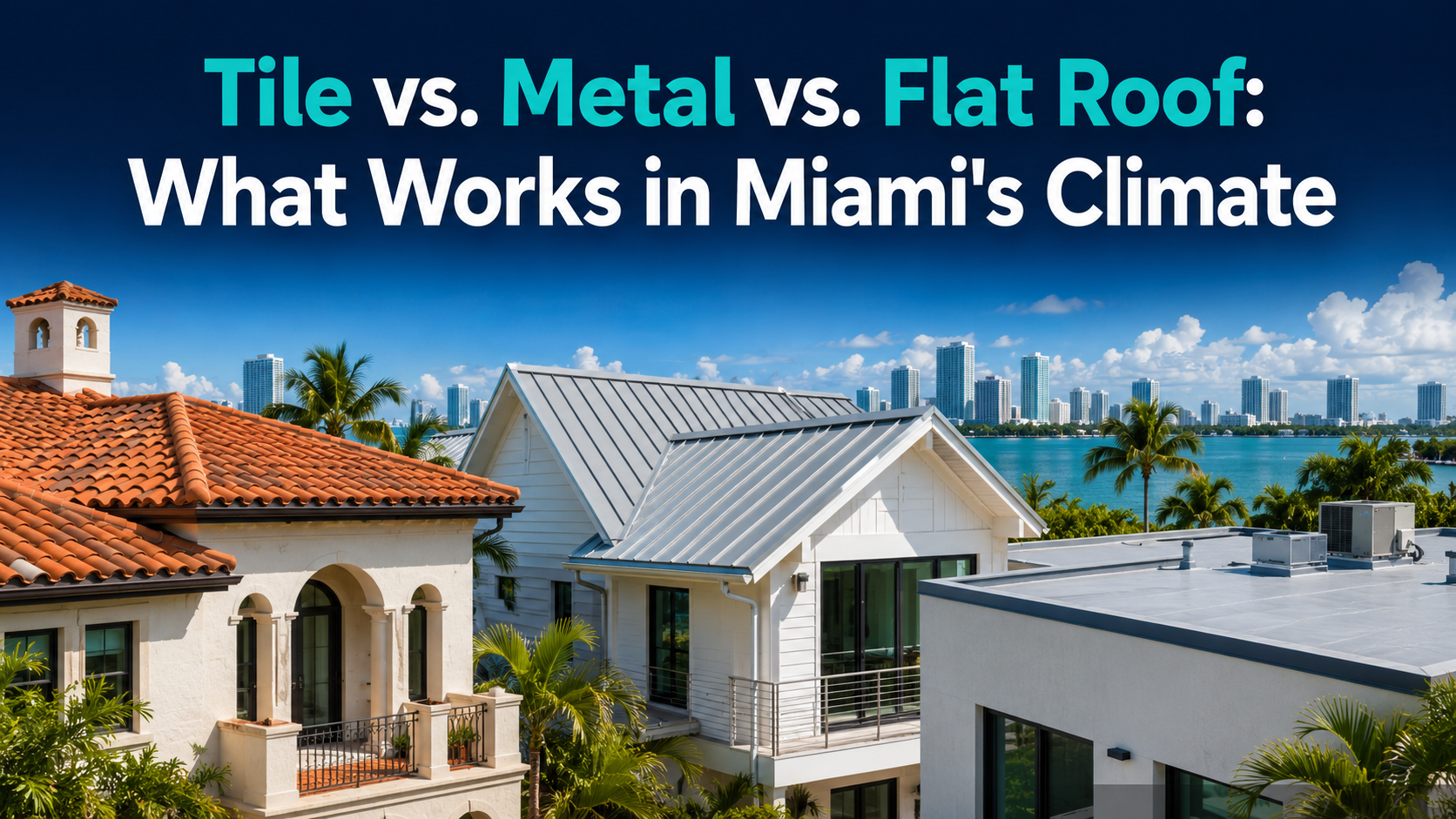
Miami Roofing Material Comparison
Material
Typical Cost in Miami (2026)
Typical Service Life
Hurricane Performance
Best For
Architectural shingle
$14,000–$26,000
Approximately 20–30 years
Good when the complete system is approved and installed to its HVHZ specifications
Homeowners prioritizing lower initial cost
Standing-seam metal
$30,000–$55,000
Approximately 40–50+ years
Strong wind-uplift performance when the panels, clips, fasteners and perimeter details form an approved system
Long-term ownership and modern architecture
Concrete or clay tile
$35,000–$70,000+
Approximately 50+ years
Strong when properly attached; individual tiles can still crack or become damaged
Mediterranean and Spanish-style homes
Flat or low-slope system, including TPO or modified bitumen
Usually priced by square and assembly
Approximately 15–30 years
Good when the assembly, attachment, flashing and drainage are correctly designed and installed
Flat-roof homes, additions and low-slope sections
These are planning ranges, not guaranteed prices or warranties. Actual service life depends on the selected system, installation, exposure, drainage and maintenance. Ask for the manufacturer’s published warranty and installation documentation for the exact product not a lifespan quoted from memory.
Architectural shingles
Architectural shingles generally have the lowest initial cost of the four options. They suit many sloped residential roofs and are widely available, which can make future repairs easier.
In the HVHZ, the contractor must select an accepted roof assembly and follow its fastening, underlayment, flashing and perimeter requirements. The shingle brand alone does not establish compliance.
Ask for:
- Manufacturer and exact product line
- Applicable product-approval or NOA documentation
- Wind-rating limitations
- Required fastening pattern
- Underlayment system
- Starter-strip and hip-and-ridge products
- Workmanship and manufacturer warranties
Shingles require periodic inspection for lifted, cracked or missing material and deterioration around penetrations and flashing. Their lower initial cost must be weighed against a generally shorter service life than metal or tile.
Standing-seam metal
Standing-seam metal can provide a long service life and strong resistance to wind uplift when the complete assembly is properly designed and installed. It also suits modern Miami homes and some low-slope applications.
Performance depends on more than the visible panels. Panel profile, metal thickness, clip spacing, fasteners, seams, edge details, substrate and design pressures all matter.
Ask whether panels will be factory formed or produced at the job site, and request the approval documentation covering the proposed panel and attachment system. Also ask how penetrations, valleys and dissimilar metals will be handled.
Maintenance commonly includes checking seams, sealants, flashings, fasteners, coatings and signs of corrosion. Coastal exposure can affect product selection, finishes and maintenance requirements.
Concrete and clay tile
Tile is closely associated with Miami’s Mediterranean and Spanish-style architecture. A properly designed and attached tile assembly can perform well in high-wind conditions and may provide a long service life.
Tile is heavy. Before changing from a lighter roof covering to tile, the contractor may need to confirm that the structure can carry the additional load. Attachment method, underlayment, mortar or adhesive, fasteners and perimeter detailing must match the approved assembly.
Tiles may crack from impact or foot traffic. Repairs can also become more difficult when the original profile or colour is discontinued. Ask whether replacement tiles are readily available and whether the warranty covers only the tile itself or the complete installed system.
Flat and low-slope systems
Many Miami homes have flat or low-slope roofs, including additions built onto otherwise sloped structures. Common options include TPO single-ply membranes and modified-bitumen assemblies.
For these roofs, drainage is critical. Ponding water, poorly detailed penetrations and failed transitions can shorten the system’s life even when the main membrane remains intact.
Ask the contractor to identify:
- The complete membrane or multi-layer assembly
- Insulation and cover-board specifications
- Attachment or adhesion method
- Drainage and slope plan
- Flashing around walls, curbs and penetrations
- Approved design pressures
- Maintenance and inspection requirements
Do not compare low-slope bids using the membrane name alone. Two “TPO roofs” may use different membrane thicknesses, insulation, attachment patterns and flashing systems.
Verify the complete system
Miami-Dade County’s Product Control Section evaluates building-envelope products and systems, including roofing. Use the official Miami-Dade Product Control Search to review the proposed approval.
Check:
- The exact manufacturer and product
- The system or assembly description
- Approved substrates
- Maximum design pressures
- Fastener or adhesive requirements
- Limitations and exclusions
- Approval and expiration dates
An approved component is not automatically approved in every combination. The contractor should show that the roof covering, underlayment, attachment and deck form a compatible assembly for your property.
Ask about insurance documentation
A new code-compliant roof does not automatically guarantee a lower insurance premium. Discounts depend on the insurer, policy and wind-mitigation features documented for the property.
After installation:
- Keep the signed contract, permit record, product approvals and paid invoices.
- Obtain photographs of the roof deck and attachment details before they are covered.
- Confirm that all required inspections passed and the permit was closed.
- Ask a properly qualified inspector to complete Florida’s current wind-mitigation inspection form.
- Submit the completed report to your insurance agent and request a written premium review.
Features such as roof-covering compliance, roof-deck attachment, roof-to-wall connections, roof geometry, secondary water resistance and opening protection may affect the wind portion of a policy. The savings vary, so avoid any contractor who promises a specific insurance reduction without reviewing the property and policy.
Step 6: Sign a Contract That Protects You
A detailed estimate is not enough. Before work starts, convert the accepted proposal into a signed contract that identifies the parties, property, complete scope and rules for payment and changes.
The goal is simple: if the contractor promises something important, put it in writing.
This section provides practical homeowner guidance, not legal advice. For a large, structural, custom or otherwise complex project, have a Florida construction attorney review the agreement before you sign.
What the contract should include
At minimum, the written agreement should identify:
- The homeowner and exact legal name of the contracting business
- Property address
- Contractor’s licence number
- Complete scope of work
- Materials by manufacturer, product line and specification
- Total contract price
- Deposit and milestone-payment schedule
- Estimated start and completion dates
- Permit and inspection responsibility
- Procedure for written change orders
- Workmanship and manufacturer warranties
- Requirements for partial and final lien releases
Attach the final quote, plans, specifications, product approvals and other referenced documents to the contract. Initial or sign each attachment. Do not rely on a brochure, text message or salesperson’s verbal assurance.
Keep the deposit proportionate
As a practical negotiating position, many homeowners aim to keep the initial deposit within 10% to 20% of the contract value. For a project involving ordinary mobilization rather than expensive custom materials, try to remain at or below 10%.
This is a risk-management guideline not a universal Florida deposit limit.
Under Florida Statutes §489.126, an initial payment exceeding 10% of the contract price for residential work triggers specific obligations. Unless an exception or written agreement applies, the contractor must apply for necessary permits within 30 days after receiving the payment and begin work within 90 days after the permits are issued.
Do not pay according to calendar dates alone. Tie later payments to work that can be seen, measured and documented, such as:
- Permit issued and approved materials delivered
- Demolition or tear-off completed
- Required deck or structural inspection passed
- Installation milestone completed
- Final inspection passed
- Permit closed and final documents delivered
The amount paid should remain reasonably aligned with the value of completed work and materials properly assigned to your project. Never allow the contractor to get far ahead financially.
Understand lien releases
Florida’s construction-lien system can allow unpaid subcontractors, labourers and material suppliers to pursue a lien against the improved property even when the homeowner has already paid the general contractor.
A lien release, sometimes called a lien waiver, is a signed document in which a contractor, subcontractor or supplier releases specified lien rights in exchange for or after receiving payment.
Florida’s statutory Notice to Owner warns that homeowners may need written releases when making payments. The relevant procedures appear in Florida Statutes $713.06, with release provisions in $713.20.
Require:
- Partial releases covering each progress payment
- Releases from subcontractors and suppliers who served a Notice to Owner
- A contractor’s final payment affidavit when applicable
- Final releases before the last payment is handed over
A partial release should identify the amount or work covered and the effective date. A final release should not be signed or treated as complete before the corresponding payment clears. Because release wording and payment procedures carry legal consequences, obtain professional advice when the amounts are substantial or a payment dispute exists.
Use written change orders
Unexpected damage can change the scope, especially after a roof covering or wall is opened. That does not justify blank-cheque billing.
Require a written change order before additional work begins. It should state:
- Why the change is needed
- The added or removed work
- Material and labour costs
- Effect on the completion date
- Revised contract total
- Signatures from both parties
Emergency work needed to prevent immediate damage should still be documented as soon as practical, with photographs and an itemized price.
Refuse to sign when you see these red flags
Stop if the contractor:
- Pressures you to sign immediately
- Leaves blank spaces in the contract
- Uses a business name that does not match the licence record
- Omits the licence number
- Promises materials or upgrades verbally but refuses to add them
- Will not identify who pulls the permit
- Asks you to use an owner-builder permit for a contractor-controlled job
- Demands a large cash deposit without a documented reason
- Makes most of the price due before measurable work is complete
- Provides no change-order process
- Excludes lien-release requirements
- Offers no written workmanship warranty
Do not sign with blanks remaining. Cross out unused spaces, record all agreed revisions and keep a complete copy signed by both parties.
Contract Checklist
Use this 12-item check before signing:
- The contractor’s legal business name and licence number match the DBPR record.
- The correct property address and contracting parties are listed.
- The full scope states what is included and excluded.
- Materials are identified by brand, product line and specification.
- The total price and all allowances are stated.
- The deposit is proportionate and its purpose is documented.
- Progress payments are tied to measurable milestones.
- Estimated start and completion dates are included.
- Permit, engineering and inspection responsibilities are assigned.
- All additional work requires a signed change order.
- Workmanship and manufacturer-warranty terms are attached.
- Partial and final lien releases are required before corresponding payments.
If the contractor says, “We do not normally put that in the contract,” treat that as the answer. Do not sign until the written agreement reflects the deal you were promised.
Step 7: Manage the Project Without Losing Your Mind
Once the contract is signed, your job is not to supervise every worker. Your job is to keep the project documented, confirm that required inspections occur and prevent payments from getting ahead of completed work.
Use one contractor representative as your main contact. Keep decisions in writing. Photograph everything.
Permits and inspections
The contractor should normally apply for the permit in the licensed business’s name, coordinate required inspections and close the permit after final approval.
The exact process depends on the property’s jurisdiction. A City of Miami property follows the City of Miami’s system. A Miami Beach property follows Miami Beach’s system. An address in unincorporated Miami-Dade generally falls under the county.
Before work begins, confirm:
- The permit number
- The contractor named on the permit
- The approved scope and plans
- Required product approvals
- Required inspection stages
- Who schedules each inspection
- How you will confirm the permit is closed
Some work must remain exposed until it passes inspection. Do not pressure the crew to cover roof-deck attachments, electrical work, structural connections or other concealed components before the appropriate inspection.
If the contractor says a permit is unnecessary, ask the relevant building department to confirm that position. Get the answer in writing when possible.
Keep communication controlled
Establish a simple communication routine before work starts:
- Use email or another written channel for decisions.
- Hold a short weekly check-in for longer projects.
- Record completed work, upcoming work and current delays.
- Require written change orders before additional work begins.
- Ask for photographs of concealed work before it is covered.
- Keep invoices, receipts, permits and approvals in one folder.
- Direct concerns to the project manager not individual subcontractors.
After every important phone call, send a short written summary: “This confirms what we agreed today.” If the contractor disagrees, resolve the disagreement before work continues.
Photograph the property before work starts, throughout construction and after completion. Include wide views, close-ups and date information. If a dispute develops, those images may become some of your clearest evidence.
What to do when something goes wrong
Start with the contract. Describe the problem in writing, identify the relevant contract term and state the correction you expect. Include photographs and give the contractor a reasonable deadline to respond when circumstances allow.
If the problem continues:
- Stop approving undocumented changes.
- Do not make a disputed payment merely because someone is pressuring you.
- Preserve contracts, messages, photos, invoices and permit records.
- Check the permit and inspection status with the building department.
- Send formal notices using any method required by the contract.
- File a complaint through the Florida DBPR complaint portal when the issue involves a licensed contractor or possible unlicensed activity.
- Consult a Florida construction attorney before terminating the contract, withholding a major payment or hiring another company to complete the work.
A DBPR complaint may lead to a licensing investigation or discipline, but it is not a substitute for a civil claim and does not guarantee reimbursement.
Can you make a claim against the contractor’s bond?
First confirm that a bond exists. Not every Florida contractor carries a payment or performance bond that protects an individual homeowner.
If your contract, permit documents or certificate identify a surety bond:
- Obtain the complete bond
- Identify the surety company and bond number
- Read who may make a claim
- Check notice requirements and deadlines
- Notify the surety promptly
- Keep evidence of the loss and all payments
Do not assume the bond covers poor workmanship, delay or every breach of contract. Coverage depends on the bond’s wording and applicable law. Have an attorney review a substantial claim before a deadline passes.
Some homeowners harmed by licensed contractors may also qualify for Florida’s Homeowners’ Construction Recovery Fund, subject to statutory eligibility, procedural and recovery limits. Treat it as a possible later remedy not a replacement for careful hiring and documentation.
Close out the project properly
Completion means more than the crew leaving.
Conduct a final walkthrough with the contractor and create a written punch list of unfinished, damaged or nonconforming items. Add photographs, responsible parties and completion dates.
Before releasing final payment, obtain and verify:
- Completed punch-list work
- Passed final inspection
- Closed permit, where applicable
- Final contractor affidavit, when required
- Final lien releases from the contractor and relevant subcontractors or suppliers
- Product information and approval documents
- Workmanship-warranty certificate
- Manufacturer-warranty registration
- Final paid invoice
- Keys, manuals, access codes and spare materials
- Wind-mitigation documentation relevant to the completed work
Do not describe a project as complete while the permit remains open or required releases are missing.
Common Mistakes Miami Homeowners Make
1. Hiring without verifying the licence
Problem: A roofer arrives after a storm, offers an immediate start and shows a licence number on a business card.
Consequence: The number may be inactive, belong to another company or cover the wrong type of work. When the contractor disappears, licensing enforcement, permits, insurance and recovery become more difficult.
Solution: Search DBPR yourself. Match the licence holder, qualifying agent, business name, status and licence class to the contract before paying anything.
2. Paying too much upfront
Problem: The contractor asks for a large deposit to “reserve materials” or secure a place in the schedule.
Consequence: Your money gets ahead of the work. If materials never arrive or the crew stops appearing, you have little financial leverage.
Solution: Keep the deposit proportionate, document its purpose and tie later payments to measurable milestones. Verify stored or delivered materials before paying for them.
3. Signing a vague contract
Problem: The agreement says “replace roof” without identifying the assembly, repair allowances, permits or completion standard.
Consequence: The contractor installs the cheapest interpretation, and every missing item becomes an added charge.
Solution: Put the complete scope, products, specifications, exclusions, payment stages, change-order rules and warranties in writing.
4. Choosing the cheapest quote
Problem: One Miami roofing estimate is thousands below the other bids.
Consequence: The quote may omit permits, disposal, approved underlayment, deck repair, flashing, engineering or required HVHZ installation details. The cheap price becomes expensive through change orders or failed inspections.
Solution: Compare itemized scopes line by line. Ask the low bidder to explain each major difference in writing.
5. Skipping the permit
Problem: The contractor offers a lower cash price if the work is completed without a permit.
Consequence: The work receives no required municipal inspection. An open violation or unpermitted alteration can create problems during insurance claims, refinancing or sale.
Solution: Confirm permit requirements directly with the correct building department. The contractor should pull the permit in the appropriate licensed name and close it after final inspection.
6. Ignoring HVHZ requirements
Problem: The contractor proposes a roof product commonly used elsewhere in Florida but cannot provide the applicable approval or system details for the Miami-Dade HVHZ.
Consequence: The product or installation may fail plan review or inspection or perform below the approved design because the wrong fastening, underlayment or perimeter details were used.
Solution: Verify the complete roofing assembly through Miami-Dade Product Control. Match the installed products and methods to the approval documents and approved plans.
7. Failing to collect lien releases
Problem: You pay the general contractor in full and assume everyone else was paid.
Consequence: An unpaid subcontractor or supplier may pursue a construction lien against your property, subject to Florida’s lien-law requirements. You could face the risk of paying twice.
Solution: Track every Notice to Owner. Require appropriate partial releases at every draw, a final contractor affidavit when applicable and final lien releases before releasing the last payment.
The pattern behind these mistakes is consistent: the homeowner relied on a promise where a record or document was available. Check the licence. Check the permit. Put every change in writing. Match each payment to completed work.
FAQ
How do I verify a contractor's license in Florida?
Go to the Florida DBPR website at myfloridalicense.com, click "Verify a Licensee," and search by the contractor's name or license number. Confirm the license is active, in good standing, and matches the contractor's name and business. A license number on a business card or website means nothing until you verify it yourself.
What is the difference between a certified and a registered contractor in Florida?
A certified contractor (prefix CGC for general, CCC for roofing) passed the state exam and can work anywhere in Florida. A registered contractor (prefix RG or RC) is only authorized to work in the local jurisdiction where they registered. For Miami projects, either can be valid, but always verify the license covers your specific location.
How much does a roof replacement cost in Miami in 2026?
For a typical single-family home of 2,000 to 2,800 square feet of roof area, architectural shingle runs $14,000 to $26,000, standing-seam metal runs $30,000 to $55,000, and concrete or clay tile runs $35,000 to $70,000 or more. These are turnkey numbers including tear-off, permits, and inspection. Flat or low-slope roofs are priced separately by the square.
What is the HVHZ and why does it matter for my project?
The High-Velocity Hurricane Zone is a special building code designation for Miami-Dade and Broward counties. It requires stricter product approvals (NOA-approved materials), enhanced fastening patterns, and secondary water barriers on roofs. Any contractor working in Miami must follow HVHZ rules, and using non-compliant materials can void your insurance and fail inspection.
How much should I pay upfront to a contractor?
Never pay more than 10 to 20 percent upfront. Tie remaining payments to completed milestones, and hold back the final 10 percent until the project passes final inspection and you receive a lien release. A contractor who demands 50 percent or more upfront is a red flag.
Do I need a permit for my roofing or construction project in Miami?
Yes, almost all roofing and construction projects in Miami require a permit. Your contractor should handle the permit application and inspections as part of the job. If a contractor suggests skipping the permit to save money, walk away. Unpermitted work can fail inspection, void your insurance, and create problems when you sell the home.
Conclusion
Before reading this guide, you were one unchecked licence, vague estimate or oversized deposit away from a costly problem.
Now you have a repeatable process:
- Define the project before requesting bids.
- Verify the contractor, qualifying agent, licence class and insurance.
- Confirm the products and installation system meet Miami-Dade’s HVHZ requirements.
- Compare itemized quotes against realistic 2026 Miami cost ranges.
- Put the scope, materials, payments, permits and change-order process in writing.
- Collect lien releases and close the permit before making final payment.
The foundation is licence verification. Miami’s HVHZ requirements are non-negotiable. Local costs are knowable when you compare equivalent scopes. A detailed contract protects you when memories and verbal promises differ.
The bridge between uncertainty and a defensible hiring decision is the process in this guide: check the records, demand written details and pay only as documented work progresses.
Start your search through the Miami Goes Local directory, then use this guide to verify every candidate before signing. Directory profiles help you find local contractors, while Miami Goes Local’s editorial contractor shortlists include dated licence checks where specifically stated. Because licence status can change, repeat the official DBPR check yourself before hiring.
 Thanksgiving in Miami 2026: Independent Restaurants, Bakeries and Takeout That Are Open
 Best Plumbers Near Little Haiti, Miami How to Choose One You Can Trust
 Different Types of Massage in Miami: How to Choose by Goal, Price and Licence
