
Every laser clinic in Doral seems to offer the same starting point: treatment for multiple skin tones and a free consultation. Neither tells you what the full course will cost or whether the equipment is appropriate for your skin.
That matters in Doral, where many clients fall within Fitzpatrick skin types III–V. “We treat all skin tones” is a claim about the clinic’s equipment, the wavelength being used and the operator’s training. It becomes checkable only when the clinic answers one direct question:
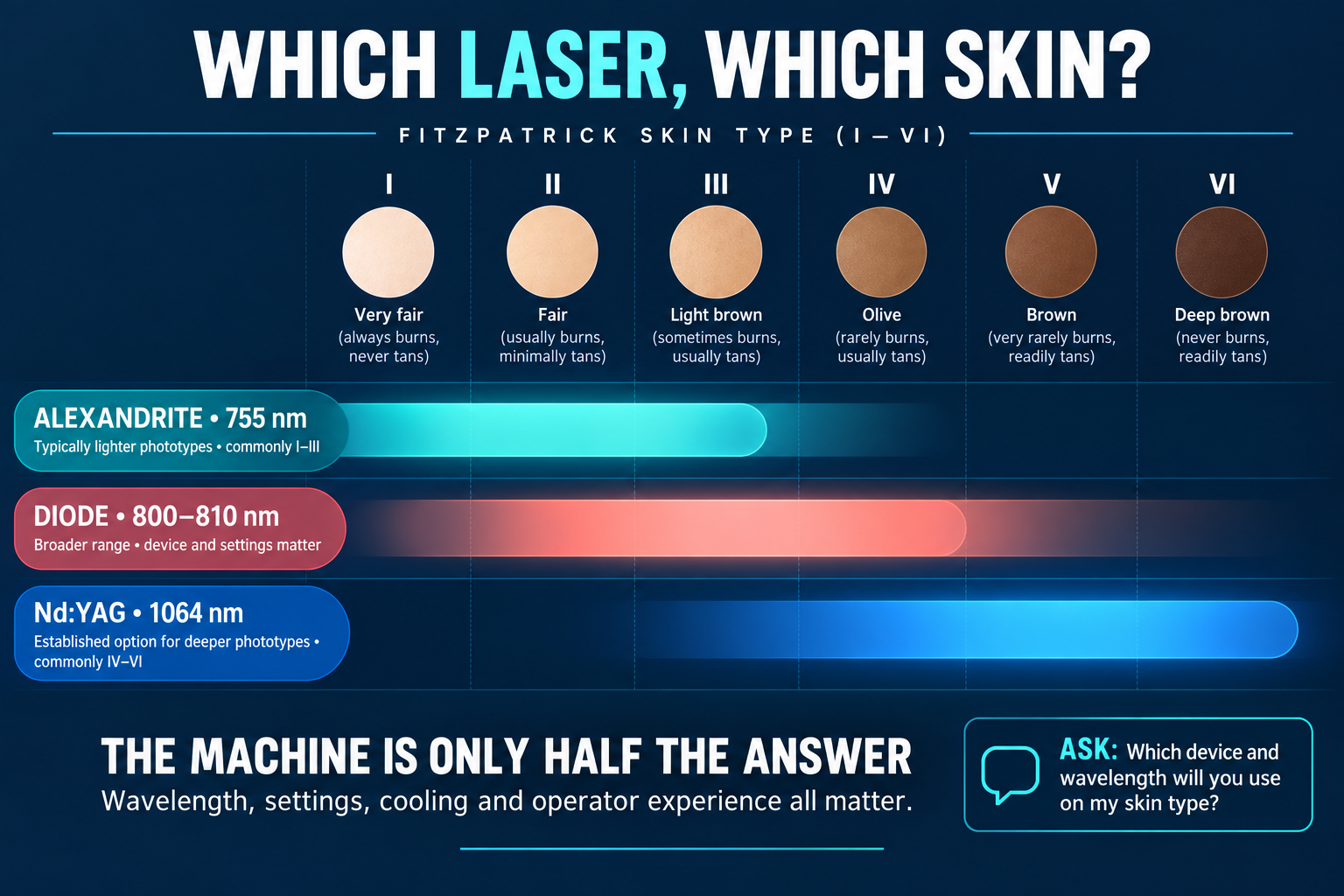
Which device and wavelength will you use for my skin type?
As verified on September 9, 2026, not every local provider hides its technology. IdeaLaser identifies Candela GentleYAG and Lumenis LightSheer systems on its rendered website. However, its main page does not state the numerical wavelengths or explain which system it would select for an individual Fitzpatrick skin type. That choice still needs to be discussed before booking.
The language around results also deserves attention. Laser marketing frequently shifts between “removal,” “permanent results” and “reduction.” Those terms are not interchangeable. The FDA-cleared indication is permanent hair reduction, meaning a stable, long-term decrease in the number of hairs that regrow not a promise that every hair will disappear permanently.
Price comparisons present another problem. Many Doral providers disclose the cost only after a free consultation the same opacity we found when pricing injectables and devices for our Best Med Spas in Brickell guide.
A discount percentage, monthly payment or low introductory rate does not reveal what you will pay for the full course. Comparing three providers can therefore mean attending three consultations and requesting three written quotes.
The prices above provide a starting point. The rest of this guide explains which wavelengths are commonly considered for different skin types, what a realistic treatment course may involve, who Florida permits to perform laser hair removal, how to verify the relevant licences and which five questions to bring to your consultation.
You should finish with a clearer idea of what an informed answer sounds like, what requires further checking and what the entire recommended course not merely the first session could cost.
Disclosure:<a href="https://miamigoeslocal.com/" rel="noopener" target="_blank"><strong>Miami Goes Local</strong></a> is an independent business directory and sells no laser treatments. Paid placement cannot purchase inclusion or position in this guide. This article provides general consumer information, not medical advice; treatment suitability should be discussed with an appropriately qualified professional.
The Question That Actually Matters Which Laser, Which Skin?
Every clinic can say it treats all skin tones. The claim becomes useful only when the clinic explains which device and wavelength it plans to use on your skin and why.
For many Doral clients with Fitzpatrick III–V skin, that is not a specialist question. It is the basic question to ask before booking:
What is the manufacturer, model and wavelength of the laser you would use on my skin type?
A useful answer names the device and wavelength, explains why they suit your skin and hair, and describes the starting approach or test patch. “Our machine works on everyone” is not enough.
How the laser finds the hair
Laser hair reduction depends on melanin the pigment that gives hair and skin their colour. The laser sends light into the skin, and pigment in the hair absorbs that energy. The resulting heat affects the follicle’s ability to produce hair.
Contrast helps. Dark hair against lighter skin gives the device a clearer target. When the surrounding skin contains more melanin, it can also absorb some of the energy. That does not automatically exclude deeper skin tones, but it makes the choice of wavelength, settings, cooling and operator experience more important.
Hair colour matters too. Because the process depends on pigment, blond, white, grey and some red hair may respond poorly regardless of skin type. A competent consultation should assess both skin tone and hair colour, not only the treatment area the same kind of skin assessment that opens a good facial appointment, covered in our Best Facials in Miami guide.
Alexandrite, diode and Nd:YAG in plain language
A wavelength is simply the type of laser light a device produces, measured in nanometres (nm). The three names most commonly encountered are:
| Laser type | Wavelength | Commonly considered for | What a Doral client should know |
|---|---|---|---|
| Alexandrite | 755 nm | Usually lighter phototypes, commonly I–III; selected use may extend beyond this with appropriate equipment and settings. | Melanin absorbs this wavelength relatively strongly. That can help it target dark hair, but it also requires greater caution when the surrounding skin contains more pigment or is recently tanned. |
| Diode | Approximately 800–810 nm | A broader range of phototypes, depending on the particular device, settings and operator. | “Diode” alone is not a complete answer. Ask for the manufacturer, model and wavelength because diode systems are not identical. |
| Long-pulsed Nd:YAG | 1064 nm | Commonly used for Fitzpatrick IV–VI. | Its longer wavelength penetrates more deeply and is absorbed less readily by melanin near the skin’s surface. This generally makes it the established starting consideration for deeper phototypes, although correct settings and qualified operation still matter. |
Clinical research has specifically evaluated long-pulsed 1064 nm Nd:YAG treatment in Fitzpatrick IV–VI skin. That evidence supports its role as an established option, but it does not mean every Nd:YAG treatment is automatically appropriate or risk-free. Device settings, recent sun exposure, hair characteristics and operator judgement remain important. Study of long-pulsed Nd:YAG in Fitzpatrick IV–VI skin
If you are Fitzpatrick IV–VI, ask directly:
“Do you have a long-pulsed Nd:YAG 1064 nm laser, and is that the wavelength you would use on me?”
The answer does not have to be yes in every individual case. It should, however, include a clear technical explanation. A clinic with only one machine has fewer options if that device or wavelength is not the best match for you.
What “we treat all skin tones” should mean
“All skin tones” is not a special property shared by every laser. It should mean that the clinic has suitable equipment, can choose between appropriate wavelengths and has an operator trained to adjust the treatment for different phototypes.
Ask for the device’s:
- Manufacturer
- Exact model
- Wavelength
- FDA-cleared indication
- Proposed approach for your Fitzpatrick type
- Cooling method
Then search the manufacturer and model in the FDA 510(k) Premarket Notification database. Open the relevant clearance summary and confirm that the named model and not merely a similar-sounding device is cleared for hair reduction. A 510(k) record means the FDA cleared the device through the applicable pathway; “FDA approved” is not the correct description for a device cleared through 510(k).
Ask for a test patch
Before the first full treatment, ask whether the provider will perform a test patch, particularly if you have a deeper phototype, recent tanning or a history of pigment changes.
Also ask:
What settings are you starting with, and why are those appropriate for my skin and hair?
You do not need to judge the numbers yourself. Listen for an explanation tied to your skin type, hair thickness, treatment area, sun exposure and response to the test patch. A vague statement that the machine “automatically knows” your skin tone does not replace an individual assessment.
The goal is not to choose a wavelength from an article. It is to determine whether the person treating you can identify the equipment, explain the choice and show that the claim “we treat all skin tones” rests on more than marketing.
Laser and Darker Skin: Why the Old Advice Is Wrong
The old advice that laser hair removal “does not work on darker skin” came from a real technical limitation but it is no longer a complete description of the available options.
Early hair-removal systems relied heavily on shorter wavelengths that were readily absorbed by melanin. On lighter skin with dark hair, the device could distinguish the pigmented hair from the surrounding skin more easily. On deeper phototypes, melanin in the skin competed with melanin in the hair for the laser’s energy. That narrowed the margin between heating the follicle and overheating the skin.
The technology changed. Longer-wavelength systems particularly long-pulsed Nd:YAG at 1064 nm penetrate more deeply and interact less with pigment near the skin’s surface. Longer pulse durations, epidermal cooling and adjustable settings also give trained operators more control. Dermatological literature now documents laser hair reduction in Fitzpatrick IV–VI skin, while continuing to emphasize careful device selection and conservative operation. Review of laser therapy in ethnic populations, study of long-pulsed Nd:YAG in Fitzpatrick IV–VI skin
The updated answer is therefore not laser is unsuitable for darker skin, nor is it every modern laser is safe for everyone. It is:
Deeper phototypes can be treated, but the wavelength, settings, cooling and operator experience all have to match the skin being treated.
What post-inflammatory hyperpigmentation means
Post-inflammatory hyperpigmentation, or PIH, is a dark mark that appears after the skin has been irritated or injured the same risk worth understanding before booking a different skin-penetrating treatment, which our microneedling in Miami guide covers in more depth. In plain terms, the skin responds to inflammation by producing or distributing additional pigment in the affected area.
Laser heat can trigger that response if too much energy reaches the surrounding skin. Other possible laser-related complications include burns, blistering, lighter patches and scarring. The FDA identifies skin-colour changes and scarring among the potential risks of medical-laser procedures.
PIH is not inevitable, and deeper skin should not be described as inherently unsuitable for treatment. The point is that pigment must be planned for. An appropriate wavelength, conservative starting parameters, effective cooling and a test patch can help the operator assess how the skin responds before treating a large area.
A test patch is not a guarantee against a later reaction. It is evidence that the clinic is willing to test its assumptions on a small area first.
Why the operator matters as much as the machine
Buying the appropriate wavelength is a clinic decision. Selecting the fluence, pulse duration, spot size and cooling approach is an operator decision.
You do not need to understand each number. You need to know whether the person operating the device routinely works with skin like yours and can explain how the settings will be selected.
Ask:
How many clients with my Fitzpatrick skin type do you treat, and who specifically will perform my sessions?
Then ask whether that same person will assess your skin, choose the settings and monitor its response. A clinic can own a suitable laser and still use it poorly. Conversely, an experienced operator cannot create a missing wavelength on a machine that does not offer it. Both the equipment and the operator must be appropriate.
Sun exposure changes the starting point
A tan is additional melanin in the skin. That gives the laser more surface pigment to absorb and can change the settings that may be appropriate on the day of treatment.
This is especially relevant in Doral, where incidental sun exposure is easy to underestimate. Driving, outdoor lunches, sports and weekends at the beach can affect exposed areas even when you did not intend to tan.
Tell the provider about recent sun exposure before the device is switched on. Do not assume that the skin assessment from your consultation still applies if you have tanned since then. Ask how long the clinic requires you to avoid direct sun before and after treatment, and follow the device- and provider-specific instructions you receive.
Self-tanner matters for a related reason: it adds colour to the skin’s surface and can interfere with an accurate assessment. Disclose spray tans, gradual tanning lotions and tinted body products. Ask how completely they must fade before your session rather than guessing at a universal waiting period.
Ask before you book
For Fitzpatrick III–V clients the everyday Doral market the most useful consultation questions are:
- Which device and wavelength will you use on me?
- Why is that choice appropriate for my skin and hair?
- How many clients with my Fitzpatrick type do you personally treat?
- Will you perform a test patch before the first full session?
- What should I do if my skin becomes darker, lighter, blistered or unusually painful afterward?
The old rule treated skin tone as a reason to exclude someone. The more accurate rule treats it as information that must shape the equipment, settings and operator choice.
How Many Sessions, and What Permanent Actually Means
Laser hair removal is sold by the session, but it works as a course. One appointment cannot treat every follicle because hairs in the same area are not all at the same stage of growth.
Hair grows in cycles
Laser is most useful when a hair is in its active growth phase and remains connected to the follicle. Other hairs may be resting, transitioning or shedding when the session takes place. Those follicles may become suitable targets later, which is why appointments are separated rather than scheduled on consecutive days.
A reasonable planning range is:
| Treatment stage | Typical expectation |
|---|---|
| Initial course | Approximately 4–8 sessions |
| Common spacing | Several weeks between sessions |
| Face | Often around 4–6 weeks |
| Underarms, bikini, back and chest | Often around 6–8 weeks |
| Legs and arms | May require longer intervals, especially later in the course |
| After the initial course | Occasional maintenance may be needed |
These are planning ranges, not a treatment prescription. The correct interval depends on the area, visible regrowth, device, hair characteristics and the provider’s assessment. Mayo Clinic advises that most people need four to eight treatments, scheduled several weeks apart, and that follow-up treatments may be needed.
Be cautious if a provider promises the same session count and schedule for every person and every area.
Reduction, not removal
The most reliable description is permanent hair reduction, not guaranteed elimination of every hair.
The distinction is visible in the industry’s own language. When checked on September 9, 2026, one national provider’s main page promoted “permanent results” and being “hair-free forever.” Its footer then clarified:
“Permanent results does not necessarily imply the elimination of all hairs in the treatment area.”
The same disclaimer defines the intended result as a stable, long-term or permanent reduction in regrowth and states that individual results vary. Milan Laser Hair Removal
Read that fine print before signing a package agreement. Ask what the clinic means by “permanent,” whether maintenance is included and what happens if meaningful regrowth occurs after the initial course.
What affects your result
Dark, coarse hair generally supplies the laser with more pigment to target. Blond, grey, white and some red hair contain less suitable pigment and may respond poorly. Fine hair can also be harder to treat.
The body area matters because hair cycles and hormonal sensitivity vary. Hormonal changes or conditions can contribute to continued or new growth; laser can reduce the hair present, but it does not treat the underlying hormonal cause.
Keep your own treatment record containing:
- Session dates
- Areas treated
- Device manufacturer and model
- Wavelength
- Settings, if the provider will supply them
- Skin reaction and visible progress
- Maintenance recommendations
If you change clinics, that record gives the next operator more than your memory and an unfinished package receipt.
Before, During and After a Session
Before
Follow the clinic’s written preparation instructions. Common guidance is to shave the area shortly before treatment often the day before but not wax, pluck or thread it for several weeks beforehand. Those methods remove the hair from the follicle, leaving the laser with less pigment to target.
Tell the provider about medications, skin conditions, recent procedures and any tendency to develop dark or light marks after irritation. Do not omit recent sun exposure because the skin “looks normal” again.
Avoid tanning and self-tanner before and between sessions. Recently darkened skin changes how light may be absorbed and can cause the provider to postpone treatment or use more conservative settings. Ask for the clinic’s required avoidance period because it can vary by device and individual circumstances.
During
You should receive wavelength-appropriate eye protection before the device is activated. Do not accept treatment near the eyes without it.
The sensation is often described as brief heat, snapping or stinging. Cooling may come from the handpiece, cold air, contact cooling or cryogen spray. Small facial areas or underarms may take only minutes; full legs, back or multi-area appointments take longer. Timing varies with the device, spot size and treatment plan.
The operator should reassess your skin at every visit, particularly if you have tanned or reacted after the previous session.
After
Temporary redness and swelling around follicles can occur, and some clients ask about a professional lymphatic session for post-treatment puffiness see our manual lymphatic drainage guide for what that service can and can't do.
Follow the provider’s instructions on cooling, products, exercise, heat and sun protection.
Treated hairs may appear to grow before loosening and shedding over the following days or weeks. That can be the treated shaft moving out of the follicle rather than immediate new growth. Do not wax or pluck it; ask whether gentle shaving is permitted.
Contact the clinic promptly about blistering, severe or increasing pain, crusting, spreading redness, or skin that becomes noticeably darker or lighter. Ask before leaving how urgent concerns are handled after hours and who reviews possible complications.
Who Is Legally Allowed to Do This in Florida
Florida regulates laser and light-based hair removal specifically. A general cosmetology, facial-specialist or beauty credential alone is not the qualification described in the state’s laser-hair-removal rule.
The requirements below were checked against the current text of Rule 64B8-56.002, Florida Administrative Code, and the Florida Department of Health’s Electrolysis Council information on September 9, 2026. The rule page identifies the latest adopted version as effective March 11, 2021. Rule 64B8-56.002, F.A.C.
The electrologist’s credential
A licensed electrologist may use an FDA-cleared laser or light-based device for hair removal or reduction only after completing the required training and examination route.
The electrologist must also use only devices on which they have been trained. A person’s experience with one system does not automatically establish training on every laser in the clinic.
Who will operate the device, and may I verify that person’s Florida electrologist licence?
Florida's Department of Health provides an online licence-verification search a different agency and portal from the DBPR salon-licensing system that covers nail salons, which our guide on how to choose a nail salon in Miami walks through.
Search the individual’s name and check that the licence is current and whether disciplinary information appears.
Physicians and certain other medical practitioners may operate under the authority of their own professional licences. The Department of Health identifies medical doctors, osteopathic physicians, physician assistants and advanced registered nurse practitioners as practitioners for whom an electrologist’s protocol is not required when they themselves perform the procedure.
The physician-supervision requirement
When a licensed electrologist performs laser or light-based hair removal, the rule requires direct supervision and responsibility by a physician who is properly trained in hair removal and licensed under:
- Chapter 458, Florida Statutes an MD; or
- Chapter 459, Florida Statutes a DO.
The physician may be physically present at the premises. Alternatively, the physician may supervise through telehealth if the physician is within 150 miles of the electrologist and the arrangement permits continuous, synchronous communication. In practical terms, that means live, two-way communication not an unanswered telephone number or messages reviewed later.
Is the supervising physician on the premises or supervising by telehealth, and what is the physician’s full name?”
If supervision is remote, ask how continuous audio-video contact is maintained during treatment and what happens if the physician needs to evaluate a problem.
A physician may supervise no more than four electrologists at one time, whether supervision is in person, remote or a combination of both. This limit appears in the current rule; it is not merely an industry recommendation.
A physician assistant or advanced registered nurse practitioner may perform electrolysis under their own applicable authority, but the Department of Health says neither may serve as the supervising practitioner for an electrologist. If the only clinical name supplied is an NP or PA, ask who the supervising MD or DO is.
The initial medical assessment
The jointly written protocol must require each patient’s initial consultation to include an examination and assessment by a Chapter 458 or 459 physician.
That is a useful verification question:
Which MD or DO performs the required initial examination and assessment, and will it happen on premises or by telehealth?
Do not assume that completing an online intake form or speaking only with a salesperson satisfies the physician-assessment requirement for an electrologist’s protocol.
The written protocols
The supervising physician and electrologist must jointly prepare written protocols addressing:
- The medical conditions under which someone may receive treatment
- Conditions requiring direct physician evaluation or consultation
- Management of routine minor problems
- Conditions that make telehealth supervision inappropriate
- Safety limits for remote supervision
- Detailed emergency procedures, including emergencies during telehealth supervision
The protocols must be signed, dated and kept readily available at the premises. Copies must also be maintained by the physician and filed with the Department of Health.
The Department’s consumer-facing electrologist guidance says the protocols must be displayed in the electrologist’s working area. The current rule itself uses the more precise requirement “maintained in a readily available location.” For publication, it is safer to follow the rule’s wording rather than claim the document must literally be posted on a wall.
Ask to see the protocol. Pay particular attention to the supervising physician’s name, the date and the emergency section.
The physician must review the electrologist’s techniques, procedures and equipment when supervision begins and every six months afterward. The physician must also ensure that the electrologist receives semiannual training in infection control, sterilisation and emergency procedures.
If the clinic also offers tattoo removal
Rule 64B8-56.002 authorizes qualifying electrologists to use covered devices for hair removal or reduction. It does not extend that authorization to laser tattoo removal, and the licensing checks for getting a tattoo in the first place are a separate question we cover in our guide on how to choose a tattoo shop in Miami.
The permitted sources for this section do not establish the complete Florida credential pathway for tattoo removal, so this article should not make a broader legal conclusion about who may perform it for the original service itself, browse our directory of Miami tattoo and piercing shops.
It can, however, give the reader the correct question:
“Who performs the laser hair removal, who performs the tattoo removal, and under which Florida licence does each person provide that service?”
Do not accept a single general answer such as “our laser technician.” Ask for the name and credential attached to each procedure, then verify those credentials separately.
Verify a Doral Provider in Five Minutes
Florida’s public records let you check the facility, operator, supervising physician and device before paying for a package. You need the clinic’s legal name, the treating person’s full name, the supervising physician’s full name and the laser’s manufacturer and model.
Step 1 Check the facility
Open Florida’s MQA Licence Verification portal and search for the business under Electrolysis Facility.
Confirm:
- Licence status is current and active
- The facility address matches the Doral treatment location
- The business or responsible entity matches the clinic
- The licence has not expired
The Florida Department of Health says an electrologist must ensure they are working in an actively licensed electrolysis facility. There is, however, an important exception: certain facilities operated by, and electrologists employed by, Chapter 458 or 459 physicians may be exempt from separate electrology-facility licensing. A missing facility result is therefore a reason to ask for clarification not proof that the clinic is operating unlawfully.
Ask:
“What is the facility’s legal name and Florida licence number, or under which physician-owned facility exemption does it operate?”
Step 2 Check the person treating you
Search the same MQA portal for the full name of the person who will operate the laser.
If that person is presented as an electrologist, look for an active Florida electrologist licence and confirm:
- Full name
- Profession
- Licence number
- Current status
- Expiration date
- Any discipline shown on the record
Do not verify only the clinic owner or person who conducted the sales consultation. Verify the individual scheduled to perform your treatment.
Also ask which laser devices that person has been trained to use. Rule 64B8-56.002 permits an electrologist to use only the laser and light-based hair-reduction devices on which they have been trained.
Step 3 Check the supervising physician
If an electrologist will perform the treatment, ask for the supervising physician’s full name and whether supervision will be provided on premises or by telehealth.
Search that name in the MQA portal and confirm:
- The person is an MD or DO
- The Florida licence is active
- The name matches the one supplied by the clinic
- Any disciplinary documents or public actions attached to the record
The applicable rule requires supervision by a physician licensed under Chapter 458 or 459. An NP or PA may have separate authority to perform services, but the Department of Health says neither can serve as the supervising physician for an electrologist.
For telehealth supervision, ask whether the physician is within 150 miles and how continuous, synchronous communication is maintained during treatment. Rule 64B8-56.002, F.A.C.
Step 4 Check the device
Ask the clinic for the laser’s:
- Manufacturer
- Exact model
- Wavelength
- FDA 510(k) number, if available
Enter the manufacturer or device name in the FDA 510(k) Premarket Notification database.
Open the matching record and its clearance summary. Confirm that the exact model or the system configuration identified by the clinic has a clearance covering hair removal or hair reduction. Do not rely on “FDA registered,” “medical grade” or “FDA approved” as substitutes for a matching clearance record and indication.
If multiple models have similar names, ask the clinic for the 510(k) number. That is faster and more reliable than guessing.
If the clinic does not appear
A failed search under the storefront name proves very little. The facility may use a corporation name, owner’s name, former name or physician-office exemption.
Try the licence number before drawing a conclusion. A well-run clinic should be able to provide it or clearly explain why the facility is exempt and identify the person treating you and the supervising physician.
Silence, repeated name changes or refusal to provide verifiable details are more informative than one unsuccessful database search.
Local Laser Hair-Removal Providers in Doral
The table below is a pre-publication research record, not a ranking or endorsement. It compares what each provider disclosed publicly as of September 9, 2026.
Provider outreach has not yet been completed. Information shown as “not published” may be available by telephone or during a consultation. Non-disclosure or non-response is not evidence of improper practice.
| Provider and Doral Location | Device and Wavelength Disclosed | Named MD/DO Disclosed | Pricing Model | Prices Published | Financing Disclosed |
|---|---|---|---|---|---|
|
IdeaLaser Cosmetic Center 9550 NW 41st Street |
Partial: Candela GentleYAG and Lumenis LightSheer. Main page does not state numerical wavelengths. | Not found on reviewed page | Custom packages | Price-list link appears, but comparable hair-removal prices were not available in the reviewed page text | Cherry financing link displayed |
|
Semper Laser 8300 NW 36th Street, Unit 111 |
No manufacturer, model or wavelength found on the Doral page | Not found on reviewed page | 8- and 12-session plans with continuing coverage advertised | Yes: monthly starting payments published by area; total payable not disclosed | Monthly-payment model advertised; terms require confirmation |
|
Touch Laser Medical Spa 2614 NW 97th Avenue |
Yes: Candela GentleMax Pro; 755 nm Alexandrite and 1064 nm Nd:YAG | No MD/DO named on reviewed page; page states “APRN supervision” | Per session, six-session packages and monthly memberships | Yes: selected areas from $55–$150 per session; memberships from $99.99 monthly | Klarna, Affirm, Afterpay, CareCredit and Cherry listed |
|
LaserAway Miami–Doral 3737 NW 87th Avenue, Suite 106 |
No manufacturer, model or wavelength found on the local page | Not found on reviewed local page | Treatment bundles | No base price; percentage promotion displayed | Financing referenced |
|
FaceBeauty Med Spa Doral |
Partial: “Candela Gentle Pro” named; wavelength not published in the reviewed material | Not found in reviewed material | Six-session packages | Yes: $149 x-small, $179 small, $229 medium, $449 large and $1,800 full body | Not established |
|
KC Medical Aesthetics Doral |
No manufacturer, model or wavelength found on the reviewed service page | Not found on reviewed page | Not clearly disclosed | No | Not established |
|
The Laser Studio & Beauty Clinic Doral |
Not established from the reviewed page | Not found in reviewed material | Packages and bundles advertised | No comparable area pricing found | CareCredit and Cherry advertised |
How Unlimited and Lifetime Packages Compare
An unlimited plan can be useful when it covers additional sessions and future maintenance without another treatment charge. It also transfers some uncertainty about session count from the customer to the provider.
The word “unlimited,” however, does not reveal the price or contract terms. A monthly payment cannot be compared with a per-session package until the clinic supplies:
- Total cash price
- Total financed amount
- Repayment period
- APR and fees
- Included treatment areas
- Maintenance eligibility
- Transfer rules
- Cancellation and refund terms
What happens if the location closesSome national providers advertise lifetime or continuing coverage while withholding the total price until consultation a pricing pattern common enough across Miami's medical spa category that it's worth asking about at any provider offering package deals.
That makes a responsible cost comparison impossible from the public website alone.
For example, a six-session package has a defined end point but may leave the customer paying separately for maintenance. A lifetime plan may cover future sessions but cost substantially more at the beginning. Neither is automatically better.
Ask:
“Is this plan valid at every location, does it transfer if I move out of Florida, and what happens to my coverage if this location closes?”
Also ask whether “lifetime” is tied to your lifetime, the company’s continued operation, one franchise location or a contract with exclusions. The value of the guarantee depends on those written answers not the word used in the advertisement.
The Money Packages, Plans and Financing
Laser hair removal in Doral is sold through three main models. None can be compared fairly using only the advertised monthly payment or first-session price.
| Pricing Model | How It Works | Realistic Cost Calculation | Main Term to Check |
|---|---|---|---|
| Per session | You pay after each treatment | Session price × initial sessions, plus maintenance | Whether the rate changes between visits |
| Fixed package | A defined number of sessions is purchased together | Package price + additional sessions + future maintenance | Expiration, refund and unused-session rules |
| Unlimited or lifetime plan | One area receives continuing treatments under the contract | Cash price or total financed payments, including fees | What “unlimited” covers and how long the promise survives |
Compare the full course
A $60 session is not cheaper than a $450 package merely because $60 is the smaller displayed number.
For example, eight $60 sessions cost $480 before maintenance. A six-session package priced at $300 costs less initially, but the comparison changes if two additional sessions and future touch-ups are charged separately.
Use this calculation:
Realistic full-course cost = initial course + additional sessions + expected maintenance + financing costs + mandatory fees
For an unlimited plan, replace the session calculation with the plan’s cash price or total of payments. Then decide whether the additional cost is worth the continued coverage.
Ask each clinic to put the following on one written quote:
- Recommended number of initial sessions
- Cash price for the complete course
- Included treatment areas
- Price of additional sessions
- Maintenance cost
- Package-expiration date
- Refund and cancellation rules
- Taxes or mandatory fees
Financing can help but the payment is not the price
Financing spreads a larger upfront cost across smaller payments. That can make a full course accessible without paying the entire amount at once.
Before accepting it, compare the cash price with the total of payments. Ask for:
- Amount financed
- Down payment
- Annual percentage rate
- Finance charge
- Repayment term
- Number and amount of payments
- Late fees
- Total of payments
- Any deferred-interest condition
The APR expresses the cost of credit as an annual rate, while the finance charge gives the cost of credit in dollars. Federal disclosure rules define the total of payments as the amount paid after all scheduled payments have been made.
A “0%” promotion may be useful, but confirm whether it is true zero-interest financing or deferred interest. With some deferred-interest arrangements, failing to clear the balance by the deadline can result in interest being charged under the agreement’s terms.
Claims such as “everyone approved” or “guaranteed approval” describe access to a financing product. They do not tell you its APR, fees or total cost.
Ask what happens if the course stops
The treatment contract and credit agreement may be separate. Stopping treatment does not necessarily cancel the loan.
Before signing, ask in writing what happens if:
- You move away
- The Doral location closes
- You become medically unable to continue
- The provider recommends stopping treatment
- You are dissatisfied partway through
- You cancel with unused sessions
- You financed an unlimited plan that is no longer available locally
Ask who issues any refund, how it is calculated and whether it goes to you or directly toward the financing balance. Payment plans can be useful; the terms simply need to be visible before commitment.
Frequently Asked Questions
How much does laser hair removal cost in Doral?
Published prices captured on September 9, 2026, included selected areas at approximately $55–$150 per session and six-session packages ranging from $149 for an extra-small area to $1,800 for full body. These figures came from provider websites not telephone quotes and area definitions vary; several other Doral providers still require a consultation or publish only monthly starting payments.
How many sessions will I need?
A realistic initial planning range is approximately four to eight sessions, although some people and treatment areas require more. Sessions are normally several weeks apart, with the interval adjusted to the area and visible regrowth; occasional maintenance may be needed afterward.
Does laser hair removal work on dark skin?
Yes, deeper phototypes can be treated when the wavelength, device settings, cooling and operator experience are appropriate. Long-pulsed Nd:YAG at 1064 nm is an established option for Fitzpatrick IV–VI because it is less readily absorbed by surface melanin than shorter wavelengths; see Laser and Darker Skin: Why the Old Advice Is Wrong.
Which laser is best for my skin type?
Alexandrite at 755 nm is commonly considered for lighter phototypes, diode systems around 800–810 nm may cover a broader range, and long-pulsed Nd:YAG at 1064 nm is commonly considered for deeper phototypes. There is no responsible one-line choice for an individual, so ask: Which device and wavelength will you use on my skin type, and why?”
Is laser hair removal permanent?
The defensible claim is permanent hair reduction, not guaranteed elimination of every hair. Check the exact device and its cleared indication in the FDA 510(k) database, and read the provider’s contract for maintenance terms and exclusions.
Does laser hair removal hurt?
People commonly describe the sensation as brief heat, stinging or a rubber-band-like snap. Discomfort varies by treatment area, device, settings and individual sensitivity; professional systems may use contact cooling, cold air or cryogen spray to protect the skin and improve comfort.
Who can legally perform laser hair removal in Florida?
A qualifying Florida-licensed electrologist may use an FDA-cleared laser or light-based hair-reduction device after completing the required training and only on devices on which they were trained. When an electrologist performs the procedure, Rule 64B8-56.002 requires supervision by a properly trained Florida MD or DO, either on premises or through qualifying telehealth under the rule’s conditions; certain medical practitioners may perform under their own professional authority. Rule 64B8-56.002, F.A.C., Florida DOH electrologist guidance
How do I check whether a Doral clinic is licensed?
Search the clinic, treating electrologist and supervising physician through Florida’s MQA Licence Verification portal. Confirm each record’s status, address, expiration and available disciplinary information; if the storefront name returns no result, request the legal entity name and licence number, or ask whether a physician-office exemption applies.
Can I shave between sessions?
Usually, yes shaving leaves the hair root available for the laser to target. Waxing, plucking and threading remove hair from the follicle and are generally avoided before and between sessions; follow the timing provided by the treating professional.
Is laser hair removal safe during pregnancy?
Safety data for cosmetic laser hair removal during pregnancy are limited, and dermatology reviews generally recommend postponing it for that reason. If you are pregnant, might be pregnant or become pregnant during a package, tell the clinic and discuss the decision with your obstetric or healthcare provider; this guide cannot determine individual safety.
 Miami Book Fair 2026: Where to Eat, Park and Stay Near the Wolfson Campus
 Miami Art Week 2026: A Local’s Guide to Eating, Parking and Shopping Around Wynwood and Miami Beach
 Thanksgiving in Miami 2026: Independent Restaurants, Bakeries and Takeout That Are Open
