

Search for the “best facials in Miami,” and you will mostly find spas describing their own treatments, booking pages, and directories mixing advertised placements with ordinary results. What is harder to find is a useful comparison of what those treatments actually include.
Miami spa menus do not make that easy. A “Signature Facial” at one spa and a “Custom Facial” at another may be the same 60-minute cleanse, exfoliation, extractions and mask at a $40 difference and neither menu will necessarily tell you that. Add names such as Express, Deluxe and brand-specific facials, and comparing prices becomes even harder. Some menus also group chemical peels, microneedling and other procedures under “facials,” although the underlying treatment and the qualifications required to perform it may be different.
This guide translates those names into plain treatment categories, and once you know what you're looking for, our full beauty and personal care directory covers Miami providers across every category, not just facials. It explains typical Miami prices in 2026, what you are paying for, how to check the spa and individual practitioner, and what to discuss during intake particularly if you have sensitive skin, use retinoids or are booking before an important event.
By the end, you should be able to compare two menus honestly, check before you book and avoid choosing a treatment based on its name alone.
The Facial Types That Actually Exist
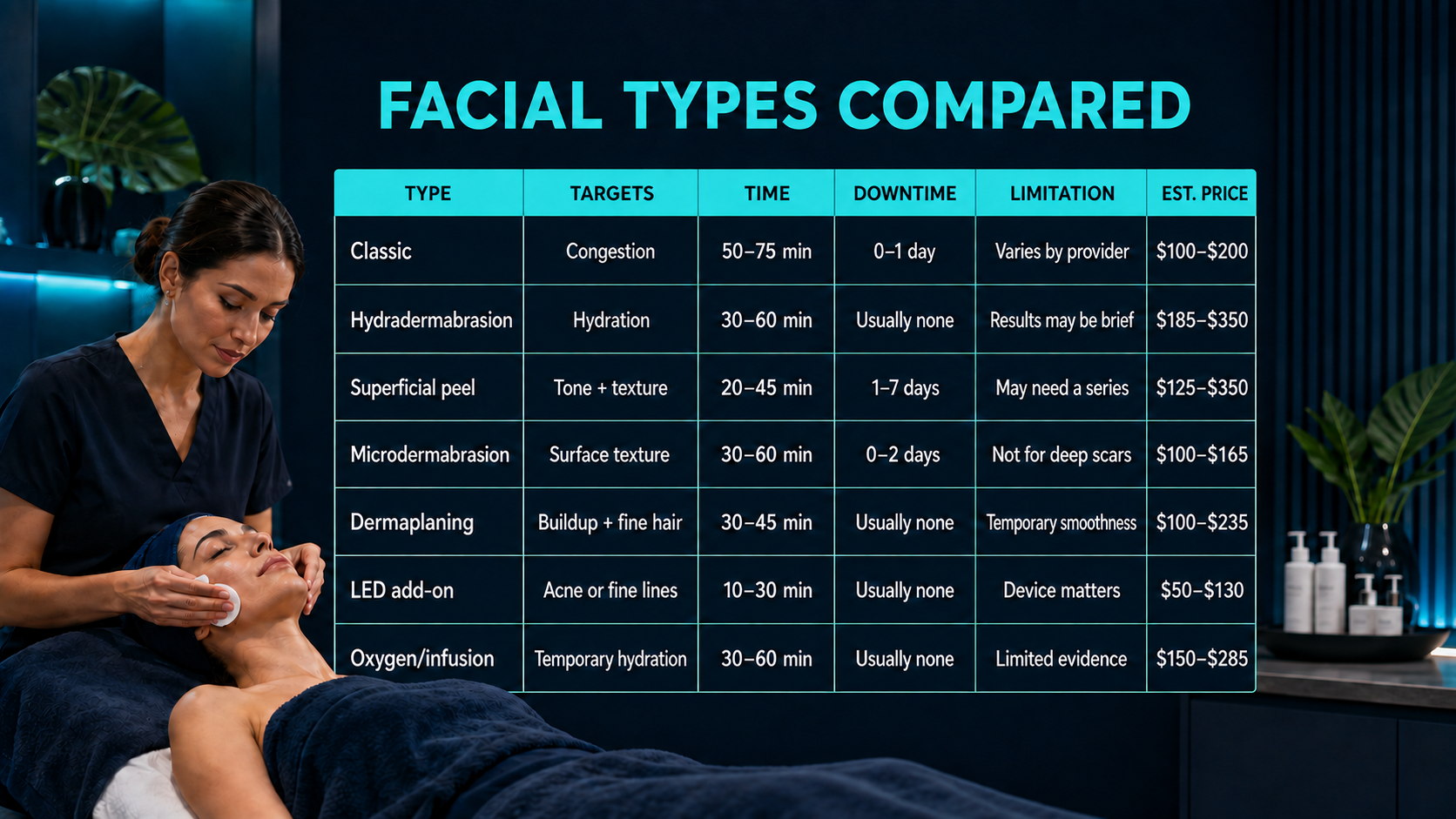
Ignore the branded name for a moment. Most Miami facial menus are variations of the treatment categories below, sometimes combined with an add-on or a particular skincare product line.
| Treatment type | Typically targets | Typical time | Downtime | Honest limitation |
|---|---|---|---|---|
| Classic facial with extractions | Congestion, surface dryness and routine maintenance | 50–75 minutes | None to one day of redness | Results depend heavily on the products and extraction technique |
| Hydradermabrasion | Surface debris, mild congestion and temporary hydration | 30–60 minutes | Usually none | Published evidence for lasting improvement remains limited |
| Superficial chemical peel | Uneven tone, mild acne and rough texture | 20–45 minutes | None to about seven days | One treatment rarely produces a major change |
| Microdermabrasion | Dullness and uneven surface texture | 30–60 minutes | Usually none to two days | Cannot address deeper scars or pigmentation |
| Dermaplaning | Surface buildup and fine facial hair | 30–45 minutes | Usually none | The smooth feel is temporary |
| LED treatment | Mild inflammatory acne or the appearance of fine lines, depending on the device | 10–30 minutes | Usually none | Device, wavelength and treatment schedule matter |
| Oxygen or infusion facial | Temporary hydration and a smoother surface appearance | 30–60 minutes | Usually none | Marketing claims often run ahead of the evidence |
| Acne programme | Recurring congestion and acne managed over several visits | Commonly 45–75 minutes per visit | Varies by treatment | Requires time, repeat visits and home-care spending |
Times and recovery periods are typical ranges, not promises. The exact products, device settings and condition of your skin can change both.
Classic cleansing facial with extractions
This is the baseline treatment beneath many “Signature,” “Custom” and “European” facial names. It usually includes cleansing, exfoliation, steam or warm towels, manual extractions, a mask, facial massage and finishing products.
It generally feels relaxing, apart from extractions, which can create pressure or brief discomfort. Most appointments last 50 to 75 minutes. There is usually no real downtime, although recently extracted areas may remain pink or tender for the rest of the day.
Its limitation is inconsistency. Two spas can use the same name while providing different amounts of extraction time, different exfoliants and very different products. Ask what is actually in it and whether extractions are included or charged separately.
Hydradermabrasion-style treatments
Hydradermabrasion uses a handheld device to exfoliate the surface while moving liquid across the skin and collecting loosened debris. Depending on the system, the treatment may also include suction-based extraction and the application of hydrating solutions.
HydraFacial is the best-known device family, but it is not the name of the entire treatment category. Other manufacturers make devices built around similar cleanse, exfoliate, extract and infuse steps. Ask for the device name if the menu uses a generic description such as “hydro facial.”
A session typically lasts 30 to 60 minutes and feels wet, cool and mildly suctioning rather than abrasive. Downtime is usually minimal, which helps explain its popularity before events.
The honest limitation is that the immediate polished or hydrated appearance may not tell you how long the result will last. Published research is still limited; one small acne study involved only 20 participants receiving six branded treatments rather than a single facial. That is not strong evidence for every claim made about the category.
Chemical exfoliation and peels
Chemical exfoliation uses an acid solution to loosen or remove layers of skin. What matters is not the spa’s name for the peel but its ingredients, strength, application time and intended depth.
A superficial peel may produce tingling, warmth and several days of dryness or flaking. A medium-depth peel reaches further into the skin, creates more visible peeling and requires substantially more recovery. It should not be treated as an ordinary facial add-on simply because it appears on the same menu.
The main limitation is that stronger does not automatically mean better. A peel that is too aggressive for your skin, current medications or recent sun exposure can cause prolonged irritation or pigment changes.
Peel strength not the brand printed on the menu determines much of your downtime. Ask which acid is being used, its concentration, the intended peel depth and how many days of visible flaking you should expect. Do that before booking anything in the week before an event.
Microdermabrasion and dermaplaning
Both mechanically exfoliate, but they do different things.
Microdermabrasion uses an abrasive tip or fine crystals, usually combined with suction, to remove superficial dead skin cells. It can make the surface feel smoother and may help mild unevenness over a series of treatments. A session typically takes 30 to 60 minutes and can feel scratchy or vacuum-like. Mild pinkness or sensitivity may last a day or two. The American Academy of Dermatology describes it as gentle, non-invasive exfoliation and notes that improvement is generally assessed over a series rather than from one visit. (American Academy of Dermatology)
Dermaplaning uses a sterile blade to remove superficial buildup and fine vellus hair. It usually takes 30 to 45 minutes and feels like light scraping. There is normally little downtime, although sensitive skin may feel tight afterward. Its main benefit is a temporarily smoother surface; it does not treat deep acne scars, and removing facial hair does not permanently change how that hair grows for a longer-term reduction, laser hair removal works on a different principle entirely.
LED and light-based add-ons
LED sessions expose the skin to selected wavelengths of light. Blue light may be used for mild to moderate inflammatory acne, while certain red-light devices are cleared for treating full-face wrinkles. Those are device-specific indications, not evidence that every multicolour lamp on a spa menu does the same thing.
Treatment commonly lasts 10 to 30 minutes and feels warm or produces little sensation at all. There is usually no downtime. At many spas, LED is added after another facial rather than booked as a full treatment.
Its limitation is that a short add-on may not match the schedule used to support a device’s intended results. Ask for the manufacturer, wavelength, session length and recommended number of treatments not simply whether the light is “medical-grade.”
Oxygen and infusion treatments
This category may involve spraying pressurised oxygen with a serum, applying products through a device, or using a completely different “oxygenating” process. The name alone does not identify what is being done.
These treatments typically last 30 to 60 minutes, feel cool and gentle, and require little or no downtime. Hydrating products can temporarily make the skin appear smoother or fuller.
Be cautious with claims that the treatment detoxifies skin, permanently increases collagen or delivers oxygen deep into living tissue. Reviews of topical oxygen applications describe promising but limited evidence and call for larger studies; evidence from wound care should not automatically be treated as proof of cosmetic facial results. (Dermatology review)
The limitation, then, is durability and evidence. Ask what is actually being applied and which part of the result is expected to last beyond the day of treatment.
Acne-protocol programmes
An acne programme is not simply a deep-cleansing facial booked repeatedly. It is usually a structured course involving regular appointments, a home-care regimen and adjustments based on how the skin responds. Individual visits may include cleansing, extractions, superficial exfoliation, LED or another treatment appropriate to the programme.
Appointments commonly last 45 to 75 minutes, while the programme itself may run for several months. Sensitivity or flaking depends on the products and procedures used.
The limitation is the commitment. The advertised session price may exclude required products, consultations or follow-up visits. It is also important to distinguish cosmetic support from medical treatment: persistent, painful, cystic or scarring acne may require assessment by a licensed medical professional.
If you are treating acne rather than maintaining your skin, compare the total course cost, required products and expected duration not just the price of one session. Ask what happens if your skin does not improve on the proposed schedule.
The Menu Decoder
A facial’s name tells you surprisingly little. Miami menus use “Signature,” “Custom” and “Deluxe” for everything from a conventional cleansing facial to a multi-device treatment.
Start with the protocol: what will touch your skin, which device or exfoliant will be used, what is included and how long each step lasts.
Marketing words with no regulatory meaning
Words such as “medical-grade,” “clinical,” “advanced,” “luxury” and “professional-grade” do not identify a standardized facial or guarantee a particular level of treatment.
They may describe the product line, setting, price or intended positioning. They do not, by themselves, tell you:
- Which procedure will be performed
- How strong an exfoliant will be
- Whether a device will be used
- What licence the practitioner holds
- Whether the treatment is suitable for your skin
The FDA does not recognize even “cosmeceutical” as a legal product category. Products are regulated according to their intended use as cosmetics, drugs or both not according to upscale wording on a menu. (FDA)
Ask what the underlying treatment is, not what the spa calls it. A “Signature Facial” at one spa and a “Custom Facial” at another may be the same 60-minute cleanse, exfoliation, mask and massage at a $40 difference.
Brand names versus treatment categories
Some facials are named after the skincare line used during the appointment. That is not necessarily misleading: the name can tell you which cleansers, exfoliants and serums to expect. It still does not tell you what the practitioner will actually do.
A brand-named service might be a classic facial, a superficial peel or a hydradermabrasion treatment with branded products added. Compare the steps, treatment time and add-ons not the product logo alone.
When a facial is named after a skincare brand, you are partly choosing a product line. Ask for the protocol underneath it, because that is what determines whether the treatment addresses your concern.
Translate the name before comparing the price
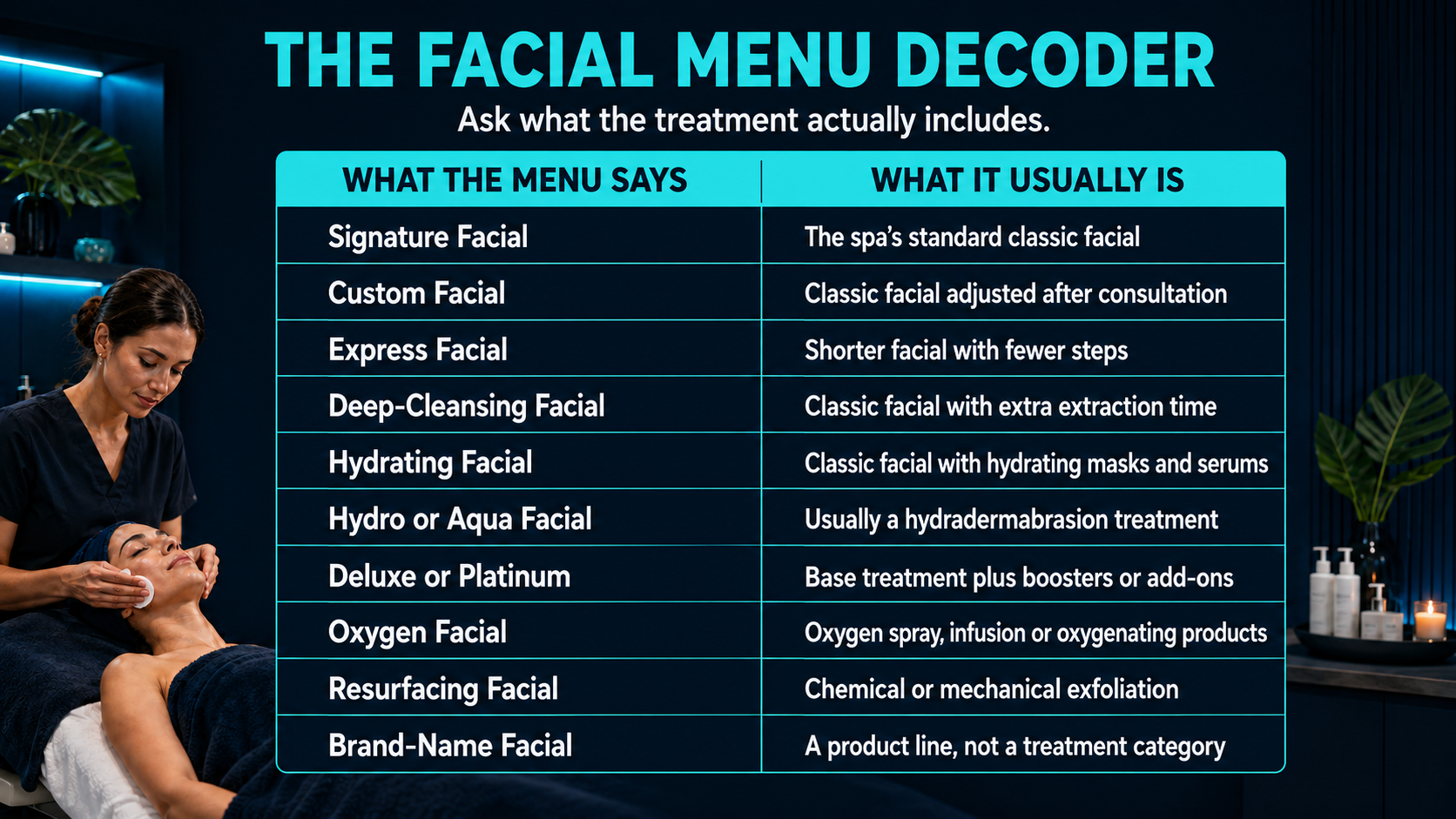
| If the menu says… | The underlying treatment is probably… |
|---|---|
| Classic Facial | A conventional cleanse, exfoliation, mask and finishing products; extractions may or may not be included |
| Signature Facial | Usually the spa’s standard classic facial, but the name does not define its steps |
| Custom or Customized Facial | A classic facial with products or exfoliation selected after consultation |
| Express Facial or Express Glow | A shortened classic facial, often without massage, lengthy extractions or multiple masks |
| Deep-Cleansing Facial | A classic facial with more attention to congestion and manual extractions |
| Hydrating Facial | Usually a classic facial using hydration-focused masks and serums; it does not necessarily involve a device |
| Rejuvenating or Age-Defying Facial | Often a classic facial with massage, exfoliation or an add-on; ask which one |
| Men’s Facial | Usually a classic or deep-cleansing facial marketed to men, sometimes adjusted for facial hair or shaving irritation |
| Teen Facial | Commonly a shorter cleansing and extraction treatment; it is not automatically an acne programme |
| Acne Facial | May be one deep-cleansing visit or part of a multi-session acne protocol; ask which |
| Hydro Facial or Aqua Facial | Usually hydradermabrasion, although the device and solutions vary |
| HydraFacial | Hydradermabrasion performed with the specific HydraFacial device family |
| Signature HydraFacial | The base branded hydradermabrasion protocol |
| Deluxe or Platinum HydraFacial | The base protocol plus some combination of boosters, LED, lymphatic drainage or additional treatment time |
| Oxygen Facial or Oxygenating Facial | Could mean sprayed oxygen, serum infusion or an oxygenating product reaction; ask how it works |
| Microdermabrasion Facial | Mechanical exfoliation followed by some or all of a classic facial |
| Dermaplaning Facial | Blade-based surface exfoliation, usually followed by a mask or hydrating products |
| Microcurrent Facial | A facial incorporating low-level electrical stimulation; this is not the same treatment as LED |
| LED Facial | Light exposure that may be standalone but is more commonly attached to another facial |
| Resurfacing Facial | Usually chemical or mechanical exfoliation; the name does not reveal its intensity |
| Power Peel, Pro Peel or Brightening Peel | A chemical exfoliation treatment; ask for the acid, concentration and intended depth |
| Brand-name Facial | A protocol using that company’s products; the underlying treatment could still be classic, hydrating, exfoliating or device-based |
| MediSpa or Multi-Technology Facial | A bundle of several possible steps, such as hydradermabrasion, oxygen infusion, microcurrent or LED |
| Back Facial | A cleanse, exfoliation and possible extractions performed on the back rather than the face |
“Probably” matters in this table. There is no universal protocol behind most of these names. For example, one Miami Beach menu uses “Deluxe” and “Platinum” for longer HydraFacial packages with added steps, while a Coral Gables “Custom Facial” is a product-based cleanse, exfoliation, mask, serum and massage. In North Miami, “Signature,” “Hydrating,” “Oxygen” and brand-named acne treatments appear as separate services even though several share the same 50- to 60-minute format.
Before comparing prices, ask each spa for five details:
- What are the treatment steps?
- Are extractions included?
- Is exfoliation mechanical, chemical or device-based?
- Which add-ons are included in the listed price?
- How many minutes are hands-on treatment time?
What Facials Cost in Miami in 2026
For this comparison, Miami Goes Local reviewed publicly listed prices from 10 facial providers on September 4, 2026. The sample covered Brickell, Miami Beach, North Miami, Coral Gables, Doral, Kendall, Midtown and Sunny Isles Beach.
These are advertised prices, not citywide averages. Membership rates, introductory offers, mandatory hotel-spa service charges, gratuity and retail products can change the final amount.
| Tier | What it usually includes | Time | Observed price |
|---|---|---|---|
| Express | Cleanse, light exfoliation, mask and finishing products; limited or no extractions | 30–45 minutes | $80–$109 |
| Standard | Full cleanse, exfoliation, extractions where appropriate, mask and massage | 50–75 minutes | $95–$200 |
| Specialty or acne protocol | Dermaplaning, hydradermabrasion, oxygen infusion, microcurrent, acne-focused treatment or a structured programme | 45–90 minutes | $125–$350 per visit, or about $199 per month for one published acne programme |
| Medical-adjacent | Stronger peels, microneedling, microchanneling, radiofrequency or combined-device procedures | 45–105 minutes | $175–$450+ |
What moves the price within each band
A $100 facial is not automatically worse than a $190 one. The difference may reflect the protocol, but it may also
What Facials Cost in Miami in 2026
For this comparison, Miami Goes Local reviewed published menus from 10 facial providers on September 4, 2026. The sample covered Brickell, Miami Beach, Coral Gables, Midtown, Doral, Kendall, West Kendall, North Miami and Sunny Isles Beach.
These are advertised prices, not quotes. Membership discounts, promotional offers, resort surcharges, gratuities and required products can change the final amount.
| Tier | What it usually includes | Observed Miami price |
|---|---|---|
| Express | About 30–45 minutes; cleansing, light exfoliation, mask and finishing products | $80–$110 |
| Standard | About 50–75 minutes; cleansing, exfoliation, possible extractions, mask and massage | $100–$200 |
| Specialty or acne protocol | Hydradermabrasion, dermaplaning, stronger exfoliation, LED or structured acne visits | $125–$350 per visit |
| Medical-adjacent | Microneedling, microchanneling, radiofrequency combinations or deeper resurfacing procedures | $284–$450+ per visit |
What moves the price inside a band
A higher price does not necessarily mean a stronger or more appropriate treatment. It may reflect:
- A longer appointment
- More practitioner experience
- A hotel or high-rent location
- A particular skincare line
- Use of a branded device
- Longer extraction time
- Included LED, masks, boosters or infusions
- Access to resort facilities
- A mandatory service charge
- Complimentary follow-up or skin analysis
Neighbourhood contributes to the price, but inclusions can matter more. A $160 facial with extractions and LED included may cost less overall than a $130 facial that itemises both.
Check the advertised duration carefully, too. Some businesses count consultation, changing or checkout time within the appointment. A “60-minute service” does not always mean 60 minutes of hands-on facial treatment.
Where a Facial Stops and a Medical Procedure Begins
A classic facial stays on the surface: cleansing, cosmetic exfoliation, masks, massage and permitted extraction work. A menu can also place microneedling, injectables and stronger peels beside those services, but sharing a menu does not put them in the same regulatory category.
Two different regulatory worlds
Florida regulates facial services through the Department of Business and Professional Regulation and the Board of Cosmetology. A Facial Specialist is a registered skincare professional under Chapter 477. That registration covers permitted cosmetic skin services; it is not a general medical credential.
The important microneedling question can now be answered directly. Florida Administrative Code Rule 61G5-18.00015 defines microneedling as using a multi-needle device to create channels approximately 0.25 to 2.5 millimetres deep. The rule states that piercing the skin this way is beyond the scope of a Florida cosmetologist and a registered Full or Facial Specialist.
That means a Facial Specialist registration alone does not authorize someone to perform microneedling. Calling it a “microneedling facial,” “collagen facial” or “advanced facial” does not change that.
Microneedling with pigment, dye or ink is treated separately as tattooing, so if that's the service you're actually comparing, our guide on how to choose a tattoo shop in Miami covers the licensing checks specific to that industry.
Florida’s Department of Health says it requires a tattoo artist licence and must be performed in a licensed tattoo establishment
Injectables also should not be compared with ordinary facials. If a service involves injecting a substance, ask which licensed healthcare professional will perform it and under whose medical authority our Best Med Spas in Brickell guide covers exactly this kind of vetting for medical-adjacent treatments.
Chemical peels are less tidy because the word “peel” covers treatments of very different strengths and depths. Do not assume that every peel belongs within or outside a Facial Specialist’s scope from the menu name alone. Ask for the acid, concentration, intended depth and the practitioner’s licence before booking.
What to ask when a menu blurs the line
If a treatment involves needles, an injectable substance, deliberate skin penetration or a peel intended to work beyond superficial exfoliation, ask:
- Who will personally perform the procedure?
- What is that person’s full name and licence type?
- Under which Florida licence is this procedure being provided?
- Does the procedure pierce the skin?
- Who provides the required medical supervision, if any?
- What recovery should I expect from this exact protocol?
A well-run business should be able to answer those questions without hesitation. “Licensed professional,” “certified technician” and “medical-grade provider” are not sufficiently specific answers. You need the licence type and the name under which you can verify it.
If something on a facial menu involves needles, injectables or a deeper peel, ask who performs it and under what licence. The service’s position on the menu does not determine its legal scope.
If microneedling is the treatment you are considering, use <a href="https://miamigoeslocal.com/blog/microneedling-miami-costs-guide" rel="noopener" target="_blank">our separate Microneedling in Miami guide</a> for costs, provider checks, skin-of-colour considerations and questions to ask before booking.
Read the Wall: The Two Licences Your Spa Must Display
Florida treats the business and the person providing your facial as two separate licensing questions.
The establishment needs a current cosmetology salon or specialty salon licence from the Florida Department of Business and Professional Regulation. The practitioner needs their own current individual licence or specialist registration. One does not substitute for the other.
A spa can therefore have a valid establishment licence while the person treating you has an expired registration or employ a properly registered practitioner at a location whose establishment licence is not current.
Two licences, not one
Florida Administrative Code Rule 61G5-20.004 requires a salon to display its current establishment licence conspicuously where customers can see it upon entering. It must also display its most recent inspection sheet.
The same rule requires each practising cosmetologist or specialist to display their current individual licence or registration at their workstation while providing services. These requirements were checked against the current rule on September 4, 2026. (Florida Administrative Code, Rule 61G5-20.004)
Look at the wall when you arrive. You should be able to see the establishment licence and recent inspection sheet, while the practitioner’s credential should be displayed at their workstation. If you cannot find them, it is fair to ask where they are.
Check that the name on the individual credential belongs to the person who will actually treat you. A licence held by the owner, medical director or another employee does not automatically cover everyone working inside the business.
How Florida salon inspections work
Florida law authorizes the Board of Cosmetology to establish periodic inspections of licensed cosmetology and specialty salons.
One point in the original outline requires correction: a conventional salon does not necessarily pass its first DBPR inspection before its establishment licence is issued. DBPR’s current guidance says the salon may open after receiving its licence, with an initial unannounced inspection generally conducted within approximately 90 days.
Inspection records from January 2016 onward can be accessed through DBPR’s public licence system. An inspection record can show whether the department visited, the result recorded and whether problems required follow-up. It is useful evidence, but it is not a review of treatment quality or customer satisfaction.
What a Facial Specialist registration tells you
Florida requires an applicant for Facial Specialist registration to complete:
- 220 school hours in a Florida facial-specialty programme
- An initial HIV/AIDS course lasting at least four hours, completed within the two years before applying
- The registration application requirements
Florida does not require a state cosmetology examination for this particular registration. These requirements were verified through DBPR on September 4, 2026.
That credential establishes a legal and educational floor. It does not tell you how many years someone has practised, whether they regularly treat your skin concern or how carefully they perform extractions.
Many excellent Miami estheticians complete considerably more education than the minimum and develop their skill over years of supervised practice, product training and repeated work with different skin types. Evaluate the person rather than either dismissing the registration or treating it as proof of expertise.
Useful questions include:
- How long have you performed this particular treatment?
- Do you regularly work with my skin type or concern?
- Who will perform the service if my usual practitioner is unavailable?
- Which parts of the protocol will you adjust after examining my skin?
- What should make us postpone or change the treatment?
Ask who specifically will perform your facial when you book. A spa’s reviews may largely describe one popular esthetician, and that person may not be working on your appointment date.
Check a Miami spa before you book
Individual practitioner: Use the DBPR licence search and search by the person’s name or licence number.
Salon or specialty salon: Use the same DBPR licence search, selecting the relevant establishment licence type. Match the licence-location address to the place you will visit.
Inspection history: Open the establishment’s DBPR record and review the available inspection results. DBPR explains its inspection-record system here.
Medical practitioner: If the treatment crosses into medical scope, verify the named healthcare professional through the Florida Department of Health practitioner search. Our guide on how to choose a med spa in Miami explains what to check before booking medical-adjacent services.
Check the status, expiration date and any publicly listed discipline. A screenshot of a certificate on the spa’s website is not a substitute for the current state record.
Sponsored, Not Recommended: Reading Spa Listings Anywhere
A listing near the top of a directory is not necessarily a recommendation. First establish whether it is an advertisement, an organic search result or an editorial selection made using published criteria.
As of September 4, 2026, Yelp’s own support material says advertisements or sponsored results are typically shown before its numbered search results. Yelp’s advertising page also describes placements in “Sponsored Results” sections above and below organic listings. That supports one narrow conclusion: sponsored position is paid placement. It does not tell us how Yelp orders every unpaid Miami result, and we will not speculate about an unpublished formula. (Yelp Support, Yelp for Brands)
Automated access to Yelp’s live Miami search page was blocked when checked, so we could not independently verify its exact current visual layout. Look for the word “Sponsored” on the page you are using rather than relying on a screenshot or description that may become outdated.
Treat a sponsored listing as advertising. Payment bought the placement; it did not establish that the business was independently assessed or better suited to your skin.
Watch for category mixing
A search for facials may combine day spas,medspas, hotel spas, nail salons, beauty salons and independent estheticians. Live Miami booking pages reviewed for this guide also mixed ordinary facials with injectables, laser resurfacing, chemical peels and other services.
That does not make the businesses unsuitable. It means the list is organizing businesses around a search term, not confirming that every provider has the same regulatory scope.
Review counts need similar restraint. A large number shows that many reviews have been attached to the profile. It does not, by itself, verify the reviewer’s treatment, the practitioner’s licence or the quality of the facial you are considering. Read recent reviews for the exact service and, where possible, the person who will perform it.
The same scrutiny should be applied to Miami Goes Local. Paid placement on this directory is advertising and does not buy editorial inclusion, a higher rating or a recommendation. Our Listing Standards explain what we verify, what we do not verify and how paid status is disclosed.
What Actually Happens in a Facial
A first appointment should begin with a conversation. The practitioner may ask about your current routine, allergies, medications, recent sun exposure, previous reactions and what you want to address. This is the time to mention retinoids, exfoliating acids, acne medication, pregnancy, an upcoming event or anything that has recently irritated your skin.
After examining your skin, the practitioner will usually cleanse it and remove makeup or sunscreen. Exfoliation comes next. That may involve an enzyme, a mild acid, a scrub or a device, so ask which method is being used if it was not explained during consultation.
Steam or warm towels may then be used before extractions. Extractions involve controlled pressure around clogged pores. They can feel uncomfortable especially around the nose and chin but should not feel like prolonged digging. Tell the practitioner if the pressure becomes painful. More aggressive extraction is not automatically more effective.
The treatment may continue with a mask chosen for hydration, congestion or sensitivity. Massage of the face, neck, shoulders or scalp is common but not universal, particularly during express or acne-focused treatments, and if drainage and puffiness are your main concern, a dedicated manual lymphatic drainage massage session may address it more directly than a facial add-on.
Serums, moisturizer and sunscreen usually finish the appointment. If you want to pair your facial with a longer body treatment, our guide to the different types of massage in Miami shows how to choose by goal, price and licence.
Immediately afterward, your skin may look more hydrated and feel smoother. Mild pinkness around extracted areas is common and often settles within several hours. Some people remain sensitive or notice small irritated areas during the following 24–48 hours, particularly after extractions or exfoliation. Visible peeling should not be assumed unless a peel was intentionally part of the protocol.
Before leaving, ask what was used, what to avoid that evening and when to restart retinoids or exfoliating products. If you develop significant swelling, blistering, worsening pain or another unexpected reaction, contact the provider promptly and seek appropriate medical advice.
Book a first appointment at a quieter time if you can. A useful first facial includes a real conversation about your skin, and that conversation can become shorter when the schedule is full.
Booking Guide
Time it around important events
For a first facial or any treatment involving extractions, a peel or unfamiliar products book approximately two weeks before a wedding, photography session or other important event. That gives unexpected redness, dryness or irritation time to settle.
The original 72-hour rule is useful as a minimum caution, but it should not be presented as a guarantee. Even superficial chemical peels can produce redness and scaling for one to seven days, while medium peels may require seven to 14 days of healing.
“Purging” is not an inevitable or universally normal facial outcome. New congestion after treatment could reflect several things, including irritation or a reaction to a product. Ask the provider what is expected from the exact protocol rather than assuming every breakout is beneficial.
Do not try extractions, a peel or aggressive exfoliation for the first time within 72 hours of an event. Two weeks is the safer window when you do not yet know how your skin responds.
How often should you get a facial?
For general maintenance, spas commonly suggest an appointment every four to six weeks. That is a scheduling convention, not a requirement for healthy skin. Your appropriate frequency depends on the treatment, your goals, your skin’s response and what you already use at home.
Acne programmes operate differently. They may schedule visits every two to four weeks so the practitioner can monitor progress, perform appropriate treatments and adjust the home-care routine. Compare the complete programme cost and duration rather than assuming an indefinite monthly schedule is necessary.
Peels have their own timing. The American Academy of Dermatology notes that some superficial peels are repeated every two to five weeks, while deeper peels require longer recovery and medical guidance.
Facial Membership Cost Calculator
See what each facial really costs based on the visits you expect to use.
Effective cost per facial = (membership payments + required fees − discounts actually used) ÷ realistic visits
Read the cancellation and expiration terms before paying. Short notice windows and forfeited prepaid visits can erase the saving quickly.
What to disclose during intake
Tell the practitioner about:
- Prescription or over-the-counter retinoids
- Isotretinoin and other acne medication
- Exfoliating acids or benzoyl peroxide
- Allergies and previous product reactions
- Eczema, rosacea, active cold sores or broken skin
- Recent sunburn or heavy sun exposure
- Recent waxing, laser treatment, peels or microneedling
- Recent injectables
- Pregnancy or breastfeeding, where relevant
- An event taking place shortly after the appointment
These details can change whether the practitioner proceeds, changes the exfoliation method, skips an ingredient or recommends postponing the service. Do not stop prescribed medication solely because a spa tells you to; ask the prescribing healthcare professional when a medication question affects treatment.
Expert tip: A competent intake should involve more than “What facial would you like?” If the practitioner does not ask about medications, allergies, reactions and recent procedures, volunteer the information before treatment begins.
Arrival, makeup and tipping
Arrive about 10–15 minutes early for a first visit so you can complete the intake without losing treatment time. Ask whether the advertised duration includes consultation and changing.
You may arrive wearing makeup; cleansing is normally part of a facial. Going without heavy or waterproof makeup can leave more appointment time for the treatment itself. Bring a list or photographs of the products you use if you cannot remember their names.
For a traditional spa facial, an optional gratuity of around 15–20% is common. Resort spas may automatically add an 18–20% service charge, so check the receipt before tipping again. Medical procedures are different, and some practices do not accept gratuities for them. Ask about the business’s policy rather than guessing.
Finally, read the cancellation terms before entering your card details. Miami policies commonly require 24–48 hours’ notice and may charge part or all of the service price for a late cancellation or no-show. If you are booking through a marketplace, check both the marketplace rules and the spa’s own policy.
Frequently Asked Questions
How much does a facial cost in Miami?
In our 10-provider sample, captured September 4, 2026, express treatments were approximately $80–$110, standard facials $100–$200, specialty treatments $125–$350, and medical-adjacent procedures $284–$450 or more. The difference usually reflects duration, products, devices and included add-ons not necessarily the quality of the spa.
How often should I get a facial?
For general maintenance, every four to six weeks is a common schedule, but it is not necessary for everyone. Acne programmes, peels and other treatment protocols may use shorter or longer intervals depending on the procedure and how your skin responds.
Do extractions hurt?
Extractions can feel uncomfortable, particularly around the nose, chin and inflamed areas. You may feel firm pressure or brief pinching, but prolonged digging or significant pain is a reason to ask the practitioner to stop or change technique.
What is the best facial for acne?
There is no single facial that is best for every type of acne. If you are trying to manage recurring acne rather than occasional congestion, compare structured programmes by total cost, duration, required products and progress checks; painful, cystic or scarring acne should be assessed by a licensed medical professional.
What is the difference between a regular facial and a HydraFacial?
A regular facial is mainly manual and typically combines cleansing, exfoliation, possible extractions, a mask and massage. HydraFacial is a specific device family within the broader hydradermabrasion category, using a handheld tip and liquid flow to exfoliate, extract and apply solutions; comparable devices are also made by other manufacturers.
Can I wear makeup after a facial?
After a gentle facial, makeup may be possible later the same day, although waiting can reduce additional rubbing and product exposure while the skin is sensitive. After extractions or a peel, follow the practitioner’s specific instructions the American Academy of Dermatology notes that makeup timing after a chemical peel depends on its depth. (American Academy of Dermatology)
Should I get a facial before a wedding?
Yes, but schedule a first-time facial, extractions or significant exfoliation about two weeks before the event. Avoid trying those treatments during the final 72 hours because redness, dryness or an unexpected reaction may still be visible; see the timing guidance above.
Is a spa membership worth it?
It depends on how many visits you will actually use. Divide the total annual payments and required fees by your realistic number of appointments, then compare that effective price with the ordinary single-visit rate and check whether unused credits expire when you pause or cancel.
How do I check whether my esthetician is licensed?
Ask for the practitioner’s full name, then search it through the DBPR licence portal and confirm the status and expiration date. Check the establishment separately using its business name or address: Florida requires the current salon licence and recent inspection sheet to be displayed conspicuously, while each practitioner’s credential must appear at their workstation. (Florida Administrative Code, Rule 61G5-20.004)
What should I tell my esthetician before treatment starts?
Disclose retinoids, acne medications, exfoliating products, allergies, previous reactions, recent sun exposure, active skin conditions and recent waxing, injectables, laser treatment, peels or microneedling. Also mention pregnancy or breastfeeding where relevant and tell the practitioner if you have an important event approaching.
 Miami Book Fair 2026: Where to Eat, Park and Stay Near the Wolfson Campus
 Miami Art Week 2026: A Local’s Guide to Eating, Parking and Shopping Around Wynwood and Miami Beach
 Thanksgiving in Miami 2026: Independent Restaurants, Bakeries and Takeout That Are Open
