
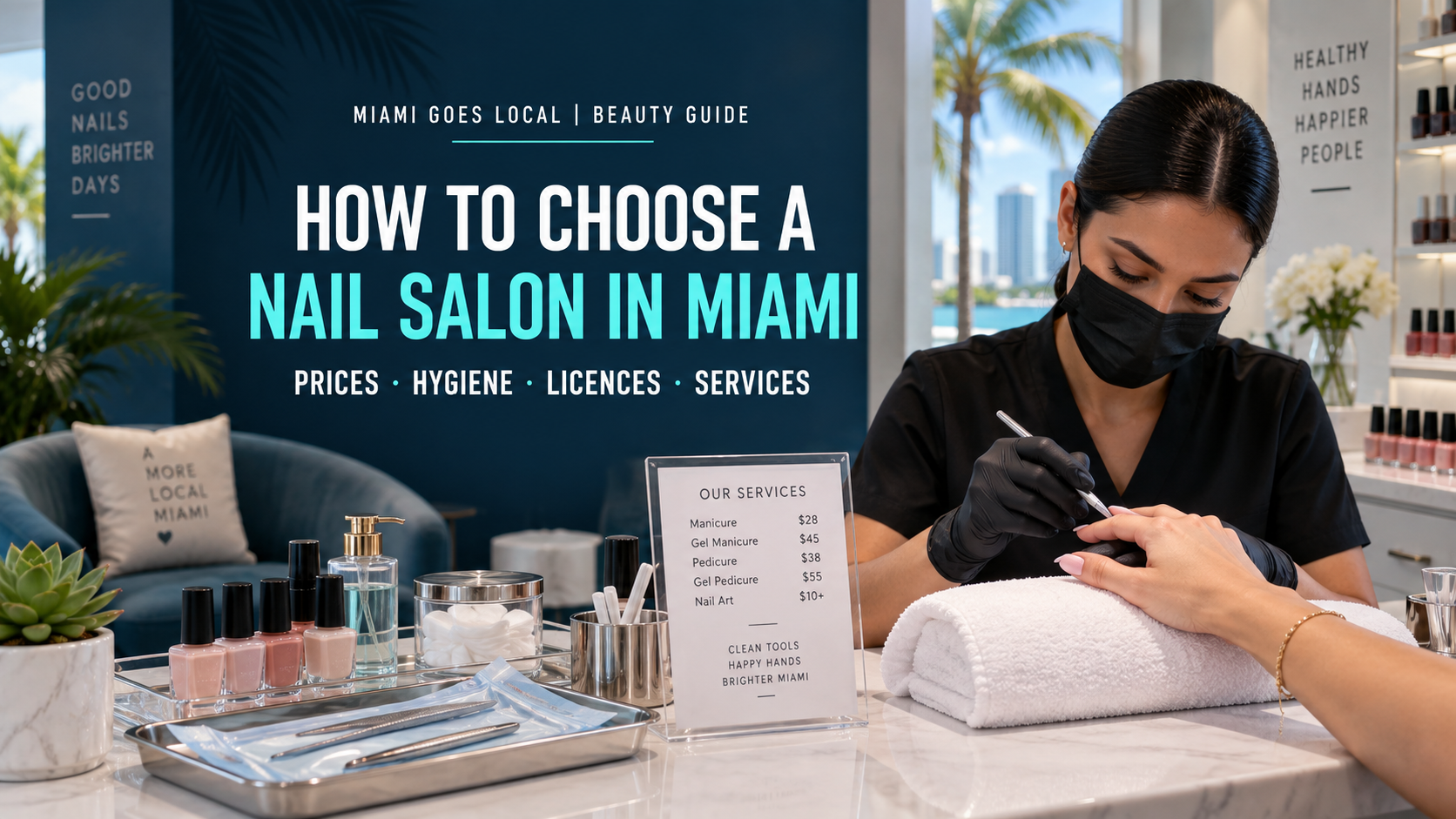
Three Things to Check When You Walk In
You do not need to know anything about nails to do this. All three of these are physical, they are required by Florida law, and you can check them before you sit down.
1. The notice at the footbath
Florida requires every licensed cosmetology or specialty salon to display a Consumer Protection Notice about footbath sanitation and safety at each footbath. Not at the front desk. At the footbath.
Look for it from the pedicure chair. It is the easiest compliance check in the building, and if it is not there, you have learned something without asking anyone a question.
2. The licence at the station
Florida also requires every individual working in a salon to display their current licence at their work station, at all times while they are working. The rule is specific: the certificate has to be permanently laminated and carry a two-inch-square photograph taken within the previous two years.
Look at the photo and check it is the person working on you. That is the whole check. It takes five seconds.
3. Where the tools come from
Metal implements should come out of a sealed sterilisation pouch, opened in front of you the same standard we walk through for skin-piercing equipment in our guide on how to choose a tattoo shop in Miami. Not out of a drawer, not out of a jar of blue liquid, not off a tray.
Files, buffers, wooden pushers and toe separators cannot be disinfected. They should be new, or they should be yours.
Why this guide exists
Almost every "how to choose a nail salon in Miami" article is written by a nail salon.
One of the best-ranked ones states it openly in its own page description: it will explain what to look for in hygiene, service and technician expertise, and why that particular salon is the top-rated choice. Another article ranking for this search is published by a business whose own service menu contains no nail services at all. It offers hair, lashes, brows, waxing, facials and body wraps, and its six-step advice ends with "trust your instincts."
The result is advice that arrives pre-cooked. Check their hygiene standards, it says, without telling you what to look at. Be wary of prices that seem too good to be true, it says, which is convenient guidance from a salon at the upper end of the market.
Meanwhile the information that would genuinely protect you is published by the State of Florida and by almost nobody in this industry. There is a nail monomer that has been illegal here since 2004 and is a criminal offence to even possess. There is a safety notice legally required at every footbath. There is a licence that must sit at your technician's station with a current photograph. And there is a phone number you can call if any of it is wrong.
This guide covers all of it, plus what gel and dip and acrylic actually do to your nails, what you are entitled to decline, what Miami really charges, and what to do if you have a reaction.
One thing to say plainly at the start, because the rest of this guide depends on it: price is not a safety signal in this city. A $25 manicure in a well-run neighbourhood salon can be safer than an $80 one. Rent and location drive Miami's price spread at least as much as practice does. Every check in this guide works at every price point, which is exactly why they are worth using.
Disclosure: <a href="https://miamigoeslocal.com/" rel="noopener" target="_blank"><strong>Miami Goes Local</strong></a> is a business directory. We do not do nails, and paid placement cannot buy inclusion or position in anything recommended here.
Florida licensing two licences, two lookups
This is the part no salon-written guide mentions. There are two separate licences involved in your appointment, and both are publicly verifiable in under a minute.
The individual registration
Florida registers nail technicians as Nail Specialists (NS). A Full Specialist (FS) registration covers both nails and facials. Licensed cosmetologists can also perform nail services.
If you are booking nails and a facial at the same place, it is worth asking whether your technician holds a Full Specialist registration or whether a second person does the facial our Best Facials in Miami guide covers what that facial credential should actually authorize.
They are different registrations covering different work.
The salon establishment licence
The salon itself holds its own licence, separate from any individual's. Florida requires nail and pedicure services to be performed in a licensed salon.
Verify both before a first visit the same two-lookup habit worth carrying into a more invasive procedure like the one covered in our microneedling in Miami guide. Search the technician's registration and the salon's establishment licence at myfloridalicense.com. They are two different lookups, both free.
One honest caveat about "licensed and inspected"
Florida's own materials describe a licensed salon as an inspected facility, and the state also issues self-inspection notices to salons. So "licensed" is a meaningful, checkable fact, and it is worth knowing that it does not necessarily mean a state inspector walked through last month. Treat the licence as a floor you can verify rather than a guarantee of current conditions, which is precisely why the ninety-second physical checks above matter.

Sanitation: what actually matters, and what is theatre
Credit where it is due. Of the salon-authored guides competing for this search, Aurora Nail Bar's is the strongest on hygiene, and it is right about the things that matter most: autoclave sterilisation for metal implements, single-use implements that clients can take home, air extraction at each station, and asking whether products are free of formaldehyde, toluene and dibutyl phthalate. That is better than most consumer content on this topic. Its conflict of interest is structural, not factual.
Here is what to add to it.
An autoclave sterilises. A blue box does not.
Ask whether metal implements are autoclaved. An autoclave uses pressurised steam and is the genuine standard.
A UV cabinet is a storage box. Seeing tools sitting inside one is not evidence they were sterilised, and a lot of salons use them as though it were.
Single-use means single-use
Files, buffers, wooden pushers and foam toe separators are porous. They cannot be properly disinfected, and they should be discarded after one client.
Bring your own file and buffer if you want certainty the same instinct worth applying anywhere skin gets broken, including when browsing our directory of tattoo and piercing shops.
They cost a few dollars, most salons are entirely relaxed about it, and it removes the item that gets reused more often than anything else.
Footbaths
There are two different obligations: cleaning between clients, and a fuller disinfection at the end of the day. Pipeless basins are easier to clean thoroughly than jetted whirlpool tubs, because there is less internal plumbing for residue to sit in.
Do not shave your legs the day before a pedicure, and skip the appointment entirely if you have an open cut, bite or scratch below the knee. Micro-abrasions plus shared water is how footbath infections start, and it is the single most preventable risk in the whole service.
Products and air
Ask whether products are free of formaldehyde, toluene and dibutyl phthalate. It is a specific, answerable question, and a technician who knows the answer immediately has told you something useful about how the salon is run.
Good ventilation is not a luxury feature. It protects the technicians who breathe it eight hours a day considerably more than it protects you for one.
MMA: the banned monomer, and how to recognise it
Not one of the salon guides competing for this search mentions MMA. It is the most important thing on this page.
What it is and why it is illegal here
Methyl methacrylate is a liquid nail monomer used in some artificial nail products. Florida's Department of Business and Professional Regulation describes it as a poisonous and harmful ingredient, and links its use to serious nail damage or loss, soreness, and in some cases infection.
Florida banned it in 2004. Under Section 477.0265(1)(h), Florida Statutes, it is unlawful for anyone practising cosmetology to use or possess a product containing any trace of MMA. Possession alone is enough. A violation is a second-degree misdemeanour, which makes it a criminal matter rather than only an administrative one, and DBPR can also pursue fines and licence action.
It persists because it is cheap and because it grips aggressively, which is appealing on a low-margin acrylic service.
Commonly reported signs
These are the signs widely reported in the industry. They are indicators worth asking about rather than a diagnosis:
- An unusually strong, sickly-sweet chemical smell, noticeably harsher than standard acrylic
- Product that will not soak off in acetone
- Extensions that are unusually hard and resist filing
- Removal that requires heavy drilling rather than soaking
If any of these apply, it is reasonable to ask what monomer is being used. Because the law prohibits possessing it, not just applying it, it is a fair question and a well-run salon will answer it without difficulty.
How to report it
DBPR's Division of Regulation publishes a number for exactly this purpose: 850.488.6603. You can also file a complaint online at myfloridalicense.com. The state provides that route specifically so that consumers can use it.
Gel vs. dip vs. acrylic
Most Miami salon menus list these three side by side with no explanation, so people choose by price or by whatever the technician suggests. They behave very differently.
| Comparison | Gel polish | Dip powder | Acrylic |
|---|---|---|---|
| What it is | Polish-like gel cured under a lamp | Resin plus coloured powder, layered | Liquid monomer plus polymer powder, hand-sculpted |
| Adds length? | No, unless combined with an extension | Overlay or with tips | Yes, sculpted or with tips |
| How it sets | UV or LED lamp | Air-cures via activator | Air-cures chemically |
| Typical wear | 2 to 3 weeks | 3 to 4 weeks | 3 to 4 weeks, then a fill |
| Removal | Acetone soak | Acetone soak, longer | Acetone soak, longest |
| Main risk | Over-filing at removal; lamp exposure | Shared-jar contact if dipped | Damage from drilling, not from the product |
The specific things to ask about
Dip: ask whether the powder is poured over your nail or whether your finger goes into a communal jar. Pouring uses a little more product and eliminates a shared-container route entirely. Plenty of Miami salons already pour by default.
Gel: the curing lamp emits UVA, a much lower-intensity light source than the lasers discussed in our laser hair removal in Doral guide, but the same principle of asking what a device actually emits applies.
Exposure per session is brief, but if you have gel every three weeks for years it accumulates. Fingerless UV gloves or sunscreen on the backs of your hands are the standard mitigations, and they cost almost nothing.
Acrylic: the durability of an acrylic set depends far more on how carefully your natural nail was prepped than on which product line the salon uses. Aggressive drilling is a way to save time on prep, not a technical requirement.
Removal is where the damage happens
This is the part almost nobody tells you. Most of the nail thinning, peeling and white patchiness that people blame on gel or acrylic itself comes from removal, not from wear.
A proper soak-off takes time. Time is the thing that gets compressed when a salon is busy. Ask what removal involves and what it costs before you commit to a set, because it is usually a separate charge and it is where the real difference between salons shows up.

What you are allowed to decline
The barrier here is social, not informational. People know they are uncomfortable and do not know that saying no is completely ordinary. So here is the actual wording.
Cuticle cutting. The cuticle is a seal that keeps bacteria out of the nail matrix. It is not a cosmetic flaw. Pushing it back is the safer practice.
"Could you push them back rather than cut them?"
Callus blades. Credo shavers and blades on the feet remove living tissue and can draw blood.
"I'd rather not have the blade. Could you use a file or pumice?"
The drill on your natural nail. An electric file has legitimate uses on product. Used on the natural nail plate, it thins it and generates heat.
"Could you keep the drill on the product and not on my natural nail?"
Aggressive scraping at removal. If product is not lifting, the correct answer is to re-soak, not to scrape harder.
"Can we soak it a bit longer instead?"
None of these will cause a scene. Good technicians accommodate all four without comment, and several will tell you they wish more clients asked.
What nail services actually cost in Miami
None of the competing guides publishes a single figure. Here is what published price lists at four Miami salons showed in mid-2026, across Brickell, Downtown, Coral Way and West Miami.
| Service | Typical Miami range |
|---|---|
| Basic manicure | $25 |
| Gel manicure | $40–$41 |
| Polish change (hands) | $15–$16 |
| Basic pedicure | $35 |
| Gel pedicure | $50–$55 |
| Deluxe or spa pedicure | $50–$75 |
| Acrylic full set | $45–$70+ |
| Acrylic fill | $40–$60+ |
| Dip powder | $55–$65+ |
| Dip full set with tips | $75+ |
| Gel-X or poly gel | $65–$75+ |
| Hard gel/liquid gel set | $75–$85+ |
| Gel polish removal | $10 |
| Enhancement removal | $15 |
| Nail repair | $5–$10 per nail |
| Nail art | $5–$10+ per nail |
Sourced from published salon price lists, mid-2026. Prices move; confirm before booking.
Read that spread carefully
An acrylic full set ran $45 at one Miami salon and $70 and up at another, for a nominally identical service. That is a 55 percent difference.
Some of that reflects skill and product. A great deal of it reflects rent, foot traffic and how close the salon sits to a hotel. It is not a reliable indicator of sanitation, licensing or technique, in either direction.
Also notice that removal is a separate line item almost everywhere. If you are comparing two salons, compare the set plus the removal, because that is what you will actually pay across a cycle.
Reading reviews and award badges
Not all badges mean the same thing, and the difference is worth thirty seconds of your time.
Editorial and reader-poll awards from established local publications are one kind of signal, the same distinction we picked apart in more depth in our Best Med Spas in Brickell guide, where a badge can mean even less.
Platform partner awards from booking apps are another. Pay-to-enter "best of" contests, where the organiser also sells winners plaques and magazine placements, are a third. All three appear on Miami salon websites, often side by side.
Find the awarding body's own methodology page. If the criteria are not published anywhere, treat the badge as a popularity signal at best.
On reviews, two habits are worth more than the star rating:
Read for the technician, not the salon. Most nail salon reviews are really reviews of one person. Note the name and ask for them when you book.
Read how the salon replies to its bad reviews. On a service this personal and this repeat-driven, the reply tells you more about how you will be treated than the average rating does.
If something goes wrong
No competing guide addresses this at all, which is strange, because it is the moment people most need instructions.
Reaction or infection?
An allergic reaction to gel or acrylic tends to show up as itching, redness, small bumps or peeling on the skin around the nail, sometimes on the eyelids or neck where you have touched. It usually appears within a day or two and often after several uneventful services, because sensitisation builds.
Signs pointing towards infection include increasing pain, swelling, warmth, pus, a spreading rash, or red streaking away from the nail ordinary post-service puffiness is a different thing entirely, and not one a manual lymphatic drainage session is meant to treat if infection is actually present.
Either way, see a doctor rather than going back to the salon. A technician cannot diagnose or treat this, and anything worsening or spreading needs a clinician. This guide is general information, not medical advice.
Gather this before you do anything else
- Photograph it, in good light, on the day
- Keep the receipt
- Write down the technician's name and the date of service
- Note what was used, if you know
A week later this is very hard to reconstruct, and it is exactly what a complaint needs.
Filing a complaint
Complaints about nail salons, unlicensed practice, sanitation, or suspected MMA use go to DBPR's Division of Regulation, by phone on 850.488.6603 or through the complaint form at myfloridalicense.com.
Filing is free. You do not need to have been physically harmed to report a licensing or sanitation problem, and complaints are part of how the state decides where to look.
Frequently asked questions
How much does a manicure cost in Miami?
Around $25 for a basic manicure and $40 to $41 for gel, based on published Miami price lists in mid-2026. Acrylic full sets ranged from $45 to $70 and up. The spread across neighbourhoods reflects rent and location as much as anything else.
Is gel or dip better for your nails?
Neither is inherently better. Removal technique matters far more than which product you choose. A carelessly removed gel manicure will damage your nails more than a carefully removed dip set.
How do I check if a nail salon is licensed in Florida?
Search myfloridalicense.com twice: once for the salon's establishment licence and once for your technician's Nail Specialist or Full Specialist registration. Both are free and take under a minute.
What is MMA and why does it matter?
Methyl methacrylate is a nail monomer that Florida banned in 2004. Section 477.0265(1)(h), Florida Statutes makes it unlawful to use or possess any product containing a trace of it, and DBPR links it to serious nail damage or loss, soreness and infection. Report suspected use on 850.488.6603.
How do I report a nail salon in Florida?
DBPR's Division of Regulation, on 850.488.6603 or via the online complaint form. Photograph any injury, keep your receipt, and note the technician's name and the service date.
Can I get a fungal infection from a pedicure?
It is possible, which is why footbath hygiene matters. Reduce the risk substantially by not shaving your legs the day before and by skipping the appointment if you have any open cut or scratch below the knee. See a clinician for anything active.
Is it safe to cut cuticles?
The cuticle seals the nail against bacteria, so cutting it creates an entry point. Ask for them to be pushed back instead. It is a normal request.
How often should I take a break from gel or acrylic?
Periodically, and let how your nails look guide you rather than a fixed rule. A technician who suggests a break instead of an immediate reapplication is one worth keeping.
What should I bring to a nail appointment?
Nothing is required. Your own file and buffer if you want certainty on the single-use items, since those are the ones most often reused.
Do I tip on top of the service price?
Yes, tipping is standard in Miami salons, and cash is generally appreciated. Note that removal, nail art, repairs and length upgrades are usually separate charges, so ask for the full total before you agree to a set.
Does a more expensive salon mean a safer one?
No. Price in Miami tracks rent, location and positioning at least as much as it tracks practice. A well-run salon at $25 can be safer than a poorly run one at $80, and the checks in this guide work at both.
 Miami Book Fair 2026: Where to Eat, Park and Stay Near the Wolfson Campus
 Miami Art Week 2026: A Local’s Guide to Eating, Parking and Shopping Around Wynwood and Miami Beach
 Thanksgiving in Miami 2026: Independent Restaurants, Bakeries and Takeout That Are Open
