
Three Miami providers can quote three very different prices for something all three call microneedling.
One Miami clinic currently lists conventional microneedling at roughly $200–$700 per session. Another local provider lists standard SkinPen microneedling from about $300–$600, while RF microneedling with Morpheus8 runs roughly $650–$1,250, depending on the treatment area. Miami Skin & Vein publishes a flat $900 per microneedling session.
Those prices are not automatically evidence that one clinic is cheap and another is expensive. They may be describing materially different procedures.
“Microneedling” can mean conventional mechanical microneedling, microneedling combined with platelet-rich plasma or other add-ons, or radiofrequency microneedling, in which needles also deliver RF energy into the tissue. Treatment area, device, provider type, added products, numbing, consultation fees and whether the quote covers one session or a package can all change the number you see on a price page.
That makes the first question surprisingly simple: which modality are you actually being quoted for?
The second question matters more: who will actually hold the device?
Florida does not treat skin-penetrating microneedling as an ordinary facial service. The Florida Board of Cosmetology has described microneedling as using a multi-needle device to create microchannels approximately 0.25 to 2.5 mm deep and states that piercing the skin in this way is beyond the scope of a Florida cosmetology licence or a Full Specialist or Facial Specialist registration. Florida’s own licensing portal describes a Facial Specialist’s ordinary scope as facial services involving treatment of the face or scalp with preparations such as oils, creams and lotions.
So seeing the words “licensed esthetician” or “Facial Specialist” on a clinic page is not, by itself, enough to establish that the person performing a skin-penetrating microneedling procedure is working within the authority of that credential.
Before booking, ask for the full name and professional licence type of the person who will perform your procedure, which device will be used, and which microneedling modality you are receiving. Then verify the licence yourself rather than relying on a staff bio or booking page.
That is particularly worth doing if you have Fitzpatrick IV–VI skin, a history of post-inflammatory hyperpigmentation, active acne, a tendency to form keloids, take medications that affect healing or bleeding, or are being offered RF microneedling, PRP or another combination treatment. A competent consultation should screen for factors that change the risk-benefit calculation rather than moving directly to package pricing.
Disclosure: Miami Goes Local is a business directory. We do not provide medical services and do not recommend any procedure or provider. This page is general consumer information and is not medical advice.
This guide explains what you are actually buying at each microneedling price tier, what Miami providers are charging in 2026, how provider credentials work in Florida, how to verify a licence yourself in about five minutes, and the questions worth asking before you pay a deposit.
By the end, you should be able to compare quotes that initially look incomparable and know what information should be provided before anyone begins a procedure.
First There Are Three Different Procedures Called “Microneedling”
Before comparing prices, establish which modality you are being quoted for.
A clinic may use the word “microneedling” for a standard mechanical treatment, for microneedling combined with platelet-rich plasma or another product, or for radiofrequency microneedling. Those procedures use different equipment, require different amounts of staff time, and do not carry identical risks.
That is why a $300 quote and a $1,400 quote can both be plausible without representing the same service.
1. Standard mechanical microneedling
Standard microneedling uses a device fitted with multiple small needles that repeatedly enter and leave the skin, creating many controlled punctures. Depending on the device, the practitioner may be able to adjust the depth and speed of needle penetration. The FDA describes these devices as rollers, stamps or, more commonly in clinical settings, motorized pen-shaped instruments.
This is usually the lowest-priced of the three categories discussed here because there is no blood-processing step and no radiofrequency system involved.
The FDA has authorized specific microneedling devices for particular indications, including improving the appearance of facial acne scars, facial wrinkles and certain abdominal scars in adults 22 and older. That does not mean every device marketed as a microneedling pen has been reviewed by the FDA, so ask your provider for the exact device name rather than accepting “medical-grade microneedling” as the description.
2. Microneedling with PRP or another added product
Microneedling with platelet-rich plasma, or PRP, begins with the same basic skin-needling procedure but adds a blood-processing step.
A small amount of the patient's blood is drawn and placed in a centrifuge to separate a platelet-rich portion. The American Academy of Dermatology describes PRP as something dermatologists may use alongside microneedling, including in treatment plans for acne scarring.
That extra blood draw, centrifugation, preparation and clinical handling helps explain why PRP packages generally sit above basic microneedling on a price list.
There is an important regulatory distinction to understand, however. The FDA states that it has not authorized microneedling devices specifically for delivering PRP, drugs, vitamin solutions, creams or other products into the skin. In other words, a microneedling device being FDA-cleared does not automatically mean the particular microneedling-plus-product combination a clinic offers has itself been FDA-reviewed for that use.
If a clinic offers “growth factors,” exosomes, serums or another infusion, ask exactly what product is being used, whether it is applied topically or injected, and what evidence supports combining it with microneedling.
Do not treat all add-ons as interchangeable simply because they occupy the same place on a treatment menu.
3. Radiofrequency microneedling
RF microneedling is a different category. The needles or microneedle electrodes enter the skin and deliver radiofrequency energy, which produces controlled heating in tissue. The American Academy of Dermatology describes RF microneedling as microneedling with added heat, while the FDA describes the devices as arrays of small electrodes that deliver RF energy at specific depths within or beneath the skin. Common device families you may see advertised include Morpheus8, Potenza, Profound RF, Secret RF and Genius. Those names identify equipment platforms, not evidence that one clinic will produce a better result than another.
RF treatments are typically priced above standard mechanical microneedling because the equipment is more complex and the treatment is an energy-based medical procedure rather than needling alone.
They also deserve a separate risk discussion.In October 2025, the FDA warned that serious complications had been reported with certain uses of RF microneedling, including burns, scarring, fat loss, nerve damage and disfigurement, sometimes requiring medical or surgical treatment. The FDA specifically advises patients considering RF microneedling to seek a licensed health care provider with training and experience using these devices and to ask which device will be used.
That warning does not mean everyone who undergoes RF microneedling will experience a serious complication. It does mean RF microneedling should not be treated as simply a more expensive version of an ordinary facial.
Why this decides the price
When you compare Miami quotes, compare like with like.
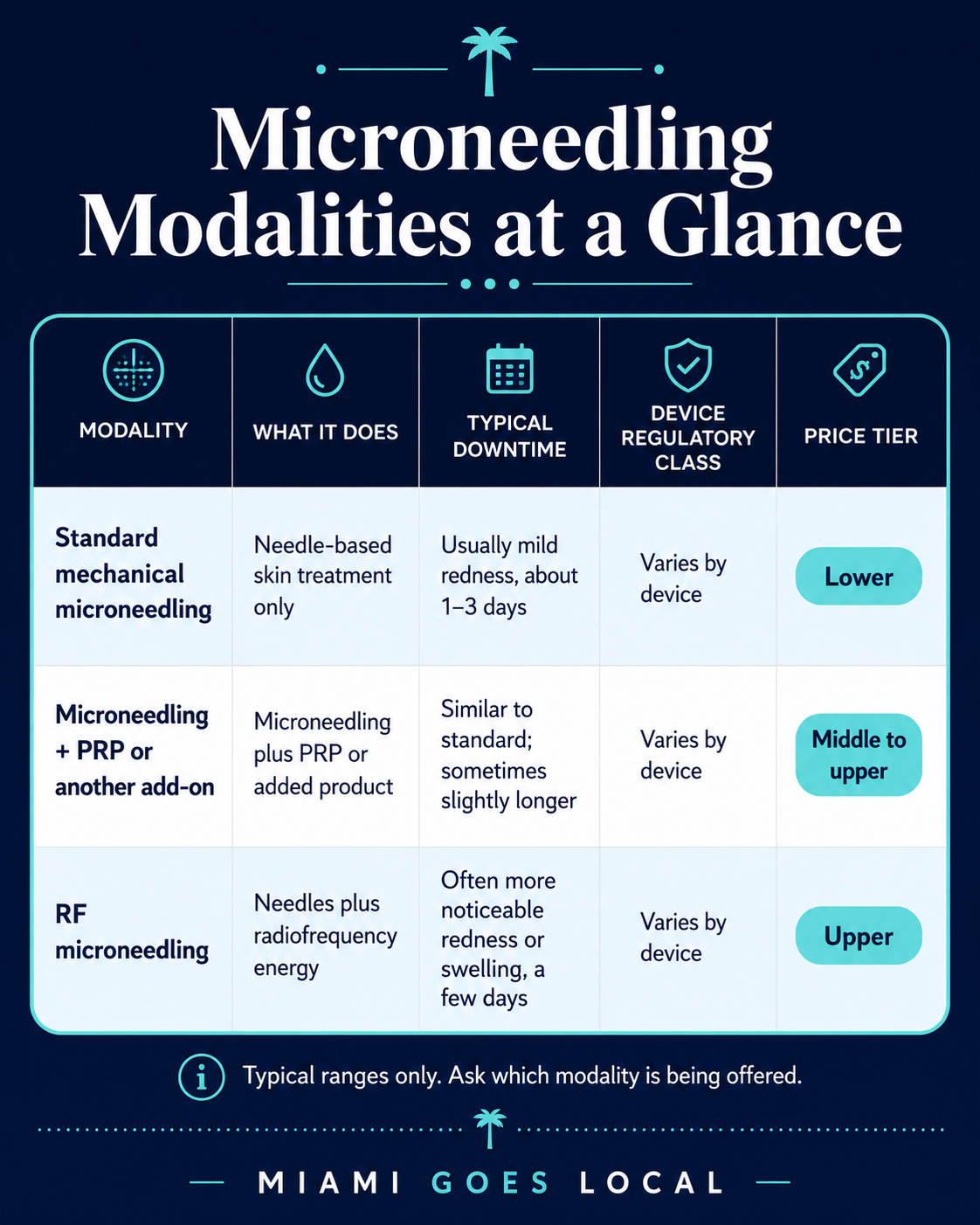
| What the clinic is quoting | What is being added | Typical position on a price menu |
|---|---|---|
| Standard mechanical microneedling | Needle-based skin treatment only | Lower |
| Microneedling + PRP or another add-on | Blood draw, preparation or added product | Middle to upper |
| RF microneedling | Needle penetration plus radiofrequency energy | Upper |
Ask, “Which microneedling modality is this quote for?” before discussing packages, discounts or financing.
A $300 treatment and a $1,400 treatment may not be competing versions of the same procedure at all. One may be standard mechanical microneedling while the other uses RF energy, treats a larger area, includes additional clinical steps or bundles more than one service.
The lower-priced option may be entirely appropriate for the concern being treated. The higher-priced option may also be reasonable. Price alone does not tell you which is appropriate.
The useful comparison begins only after you know the device, modality, treatment area, provider type and what is actually included in the quoted amount.
What Microneedling Costs in Miami in 2026
There is no useful single answer to “How much does microneedling cost in Miami?”
The price changes first with the modality, then with the treatment area, device, add-ons and number of sessions. A standard SkinPen treatment and an RF treatment such as Morpheus8 should not be averaged together simply because both appear under “microneedling” on clinic websites.
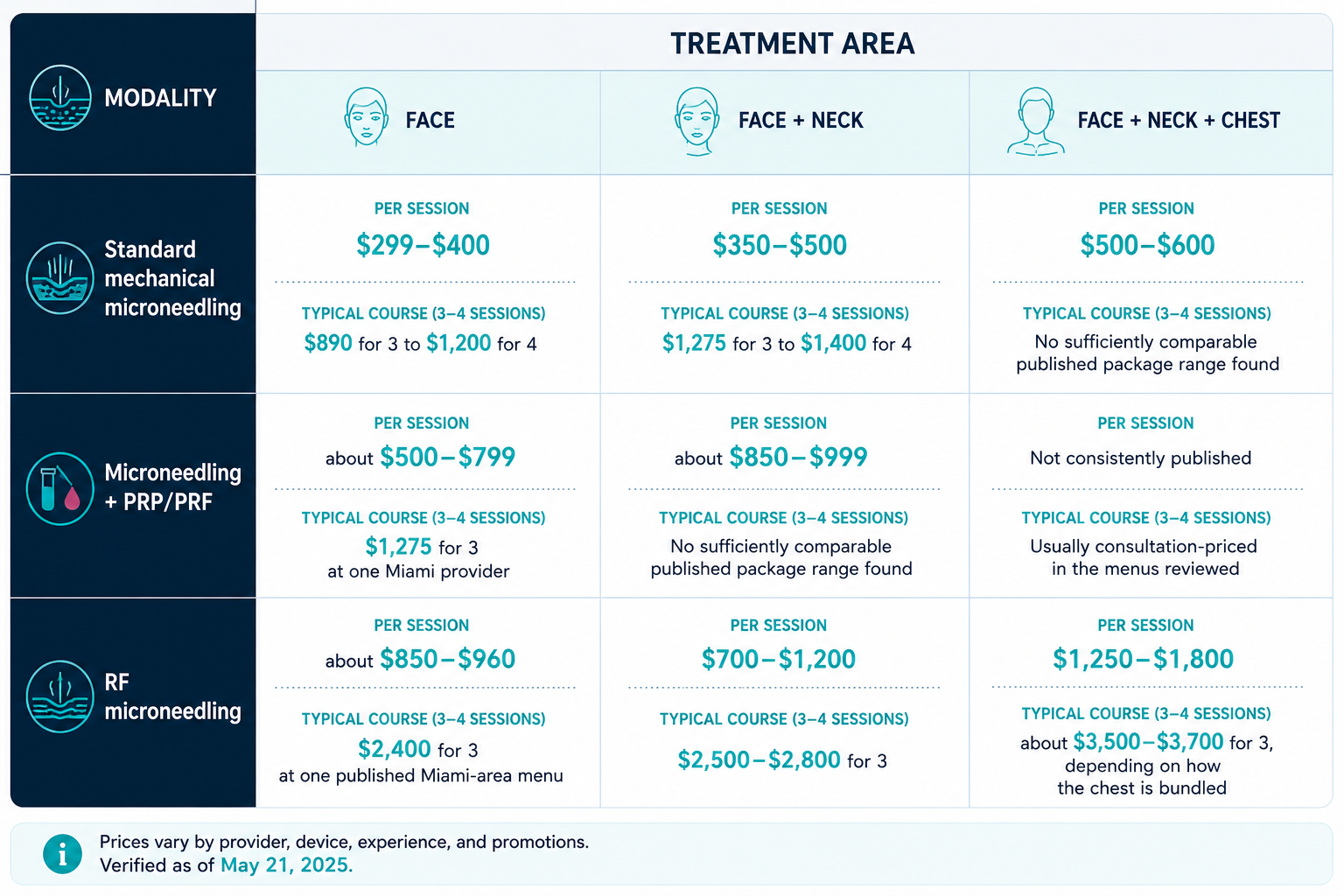
The figures below are planning ranges drawn from currently published Miami-area provider menus, not quotes and not a citywide average.
Miami microneedling prices by modality and treatment area
| Modality | Treatment area | Published single-session planning range | Published course/package examples |
|---|---|---|---|
| Standard mechanical microneedling | Face | $299–$400 | $890 for 3 to $1,200 for 4 |
| Face + neck | $350–$500 | $1,275 for 3 to $1,400 for 4 | |
| Face + neck + chest | $500–$600 | No sufficiently comparable published package range found | |
| Microneedling + PRP/PRF | Face | about $500–$799 | $1,275 for 3 at one Miami provider |
| Face + neck | about $850–$999 | No sufficiently comparable published package range found | |
| Face + neck + chest | Not consistently published | Usually consultation-priced in the menus reviewed | |
| RF microneedling | Face | about $850–$960 | $2,400 for 3 at one published Miami-area menu |
| Face + neck | $700–$1,200 | $2,500–$2,800 for 3 | |
| Face + neck + chest | $1,250–$1,800 | about $3,500–$3,700 for 3, depending on how the chest is bundled |
Sources and capture date: Provider pricing reviewed August 28, 2026. Standard microneedling figures include published menus from Miami Skin Spa, AMMA Aesthetics, Nex Med Aesthetics, White Coat Glam and Glow Lounge. Miami Skin Spa lists SkinPen at $400 for the face, $500 for face and neck, and $600 for face, neck and chest; AMMA publishes $350 for the face and $500 for face and neck, including three-session packages of $890 and $1,275 respectively.
For PRP/PRF combinations, AMMA publishes microneedling with PRP/PRF at $500 per treatment or $1,275 for three, Monaco Medical Spa currently advertises $799 for the face and $999 for face and neck with PRP, PDGF or PDRN, and Miami Aesthetic Specialists publishes a $850 PRP microneedling treatment. These offerings are not identical, which is why they are presented as reference points rather than averaged into one Miami price.
For RF microneedling, Miami Skin Spa currently publishes Morpheus8 at $975 for face and neck and $1,250 for face, neck and chest. Amason Aesthetics publishes $960 for a full face, $1,200 for face and neck and $1,800 for face, neck and chest, with three-session packages of $2,400, $2,800 and $3,500 respectively. Med Aesthetics Miami publishes $1,000 for face and neck or $2,500 for three sessions, while Nex Med Aesthetics starts face-and-neck Morpheus8 at $700.
These numbers are useful for budgeting. They are not a substitute for an individualized price. Only the practice evaluating you can tell you the actual treatment area, modality, number of sessions and total amount it proposes charging. If you are building a shortlist of clinics to request quotes from, you can compare options in our guide to med spas in Brickell.
Why the ranges widen so quickly
The treatment area is only part of the difference.
With standard microneedling, expanding from the face to the neck and chest mainly adds treatment time and surface area. Miami Skin Spa, for example, currently moves from $400 for a face treatment to $600 for the face, neck and chest.
PRP changes the service more substantially because it adds a blood draw, processing and preparation. Some clinics also place PRP, PRF, PDRN, exosomes and other products beside one another on the same menu even though they are not interchangeable treatments.
RF pricing varies again because the clinic is charging for an energy-based device, the area treated and its own treatment protocol. Even within one device family, published Miami pricing differs substantially.
This is why “microneedling — $350” tells you very little by itself.
Ask which modality, which device, what area is included and exactly what is being applied or delivered during the treatment.
The Costs That May Not Be in the Headline Price
Consultation fees
Do not assume the consultation is complimentary.
Some Miami practices include the assessment with treatment. Others charge separately.
Miami Skin & Vein currently publishes a $200 cosmetic evaluation fee, credited toward treatment if treatment is purchased within 30 days.
Lumini Medical Spa in Aventura states that its consultations are complimentary with same-day treatment but otherwise cost $200.
Skincare by Amy Peterson in Miami Beach also lists a $200 consultation, with the fee acting as a deposit if treatment is subsequently booked.
Those are three different policies attached to the same $200 headline number.
Before booking a consultation, ask:
“Is there a consultation fee, and if I proceed with treatment, exactly how and for how long is that fee credited?”
Get the answer in writing.
Numbing may or may not be included
Topical anesthetic is commonly used before clinical microneedling, but whether it is included in the listed price should be confirmed.
For example, Med Aesthetics Miami states that its Morpheus8 face-and-neck price includes a pre-treatment assessment, topical numbing and written aftercare.
A different clinic's advertised number may cover only the procedure itself.
Ask whether numbing is included before comparing the two prices.
Add-on products can move the bill considerably
Additional topical or biologic products are another source of price differences.
Miami Skin Spa currently lists an exosome add-on of $300 to Morpheus8, while its standard SkinPen pricing is separate.
South Florida Face and Body publishes SkinPen at $400 per treatment area and lists PDRN and exosome add-ons at $200 each.
White Coat Glam lists standard face microneedling at $350, PRP microneedling at $650 and PDRN at $799.
Do not ask only, “Are there add-ons?”
Ask:
“What exactly will be put on or into my skin during this procedure, what does each addition cost, and is it optional?”
That matters because PRP, PRF, PDRN, peptides, exosomes and ordinary post-treatment skincare are different products or preparations with different evidence and regulatory considerations.
Post-treatment products
A clinic may recommend cleansers, moisturizers, sun protection or a procedure-specific aftercare kit.
Whether those are medically necessary for the clinic's protocol, optional retail products or already included in your fee should be clear before you pay.
Ask for the post-treatment instructions and any required product costs before the procedure, not at checkout afterward.
The Per-Session Price Is Usually the Wrong Number to Compare
If a provider recommends a series, the more useful question is:
“What will the entire treatment plan cost me?”
Published Miami packages illustrate why.
AMMA currently lists face microneedling at $350 individually but $890 for three. Miami Skin Spa publishes a three-treatment Morpheus8 face-and-neck package for $2,500. Amason Aesthetics lists three face-and-neck Morpheus8 sessions for $2,800.
Depending on the concern, device and treatment plan, providers may recommend multiple sessions commonly separated by roughly four to six weeks. The correct interval and number of sessions are clinical decisions rather than something to infer from the cheapest package on a website. Miami Skin Spa, for example, describes one to three Morpheus8 sessions at four-to-six-week intervals, while AMMA describes microneedling series of three to six sessions.
Expert tip: Before paying, ask the provider to put the entire proposed plan in writing:
- modality and exact device;
- areas being treated;
- number of sessions;
- price of each session;
- package price, if different;
- consultation fee;
- numbing;
- PRP, PRF or other add-ons;
- required post-treatment products; and
- estimated total cost.
A "$400 microneedling treatment" can become a very different purchasing decision once three sessions, a consultation and optional add-ons are included.
Read the Package Terms Before You Prepay
Packages are common in this category, but a discounted per-session price comes with another question: what happens if you do not use every session?
Look for the expiration date, refund policy, cancellation terms and whether unused sessions can be transferred.
Miami Skin Spa states that its multi-session packages must be redeemed within 12 months. Monaco Medical Spa states that gift certificates for services and products expire after one year. Collagen Project publishes its own package rules, including conditions regarding unused sessions.
Policies vary by practice.
Before prepaying for three or six treatments, ask for the package's refund, cancellation and expiration terms in writing. A lower package price is useful only if the treatment remains appropriate for you and you can actually use what you purchased.
Is This Page Actually About Miami?
A page can have “Miami” in the title without its pricing being based on Miami transactions.
That matters in aesthetics because cost pages are often built from repeatable city templates. The structure, treatment assumptions and price ranges may be reused across markets with only modest adjustments.
There is a simple way to check.
Search the exact page title again with another city name. Then compare the modality ranges, recommended session counts and example treatment totals.
As of August 28, 2026, Charette Cosmetics publishes separate pages titled “Cost of Microneedling in Miami” and “Cost of Microneedling in Dallas.” The company operates locations in both markets.
The two pages use the same overall structure and many of the same assumptions.
| Published item | Miami page | Dallas page |
|---|---|---|
| Standard microneedling, face | $325–$650 | $325–$650 |
| PRP microneedling, face | $750–$1,300 | $750–$1,300 |
| Typical course | 3–6 sessions | 3–6 sessions |
| Typical spacing | About 4 weeks | About 4 weeks |
| Standard acne-scar example | $1,300–$3,900 | $1,300–$3,900 |
| PRP acne-scar example | $3,000–$7,800 | $3,000–$7,800 |
| Small-scar example | $975–$1,950 | $975–$1,950 |
The pages are not completely identical.
For example, the Miami page places RF microneedling for the face at $1,100–$1,700, compared with $1,100–$1,600 on the Dallas page. Face-and-neck standard microneedling is listed at $500–$900 in Miami and $500–$850 in Dallas. Miami's larger RF treatment ranges are also somewhat higher.
That does not establish that the figures are wrong.
It establishes something narrower and more useful: the existence of a Miami-labelled page is not, by itself, evidence that every number was derived independently from the Miami market.
The same test works beyond microneedling.
If you land on a page titled “Average Cost of [Procedure] in Miami,” search for:
“Average Cost of [Procedure] in Dallas”
or Atlanta, Orlando, Houston or another city.
Then compare:
- the low and high price ranges;
- recommended number of sessions;
- treatment intervals;
- worked examples;
- package totals; and
- wording around what drives the price.
If nearly everything remains the same, treat the page as a general budgeting guide with a city label, unless it explains where its local figures came from.
For this guide, that is why we prefer prices published by identifiable Miami-area practices for specific services and treatment areas, record the date we checked them, and avoid turning them into one artificial “Miami average.”
A genuinely useful local cost page should make it possible to answer:
Which Miami provider published this number, for which modality, for which treatment area, and when was it checked?
If you cannot answer those four questions, use the figure as a rough planning number rather than evidence of what the Miami market actually charges.
Who Is Legally Allowed to Perform Microneedling in Florida?
This is where the word “microneedling” stops being only a pricing problem.
In Florida, the licence held by the person performing the procedure matters because a Facial Specialist registration does not authorize skin-piercing microneedling of the kind most people mean when they book a clinical treatment.
The safest consumer question is not, “Is this person an esthetician?”
It is:
“What Florida licence authorizes this person to perform this specific procedure?”
First, be careful with the idea of a universal “depth line”
You will sometimes see claims that the FDA treats microneedling up to about 0.3 mm as cosmetic and anything deeper as a Class II medical device.
That is too simple to publish as a federal rule.
The FDA's current guidance does not establish one universal needle-depth cutoff that decides whether every microneedling product is a medical device.
Instead, the FDA looks at factors including whether the product penetrates living layers of skin and what the manufacturer claims the product is intended to do.
Products with short or blunt projections that do not penetrate living skin and are marketed only for superficial exfoliation or improving appearance may fall outside medical-device regulation. By contrast, powered devices intended to mechanically puncture and injure skin tissue for aesthetic purposes are regulated as Class II microneedling devices under 21 CFR 878.4430.
That distinction matters because most professional microneedling treatments are not simply exfoliating the dead outermost layer of skin.
The FDA describes cleared powered devices as penetrating skin to affect underlying tissue and advises consumers to choose a health care provider with specific microneedling training.
For RF microneedling, the position is even clearer: the FDA states that RF microneedling is a medical procedure, not a cosmetic treatment.
Florida's Facial Specialist licence has a limited scope
Florida does not use “esthetician” as the formal licence title most consumers expect.
The relevant DBPR credential is Facial Specialist.
Under Florida Statutes §477.013, a facial specialty covers treatments of the face or scalp with oils, creams, lotions or other preparations, along with skin-care services. DBPR currently requires 220 hours of approved training for Facial Specialist registration.
DBPR also states that facial-specialty services must be performed within the scope of that registration and in a licensed salon. Those ordinary facial services, and what they typically cost, are covered in our guide to Miami facial types and prices.
The critical distinction comes from the Florida Board of Cosmetology.
In its published microneedling language, the Board describes microneedling as using a multi-needle device to create microchannels approximately 0.25–2.5 mm deep and states that this piercing of the skin is beyond the scope of a Florida cosmetology licence or a Full Specialist or Facial Specialist registration.
So if someone tells you:
“I'm allowed to do this because I'm a licensed Facial Specialist,”
that credential alone does not answer the question for skin-piercing microneedling.
What about physicians, PAs, APRNs and nurses?
Florida law treats physicians and registered nurses differently from cosmetology licensees.
Chapter 477 expressly exempts physicians and registered nurses from the cosmetology chapter when they are acting within their professional responsibilities and duties.
That does not, by itself, mean that every RN, PA or APRN may perform every form of microneedling in every setting.
Scope can depend on the practitioner's own professional licence, the nature of the procedure, physician orders or protocols where applicable, training, delegation arrangements and the setting in which care is provided.
We did not find a Florida Board of Medicine rule that says, in one sentence, “medical microneedling may always be delegated to an RN, PA or APRN.”
For that reason, this guide does not make that blanket claim.
If the person performing your treatment is not a physician, ask:
“What licence do you hold, and under what Florida scope, protocol or delegation arrangement are you performing this procedure?”
A competent practice should be able to answer that without improvising.
A Facial Specialist working inside a medical practice does not automatically gain a medical scope
This is an important distinction.
Working inside a med spa, dermatology office or physician-owned practice does not change what a DBPR Facial Specialist registration authorizes.
The Board of Cosmetology's published position is about the scope of the credential itself. Skin-piercing microneedling in the 0.25–2.5 mm range is outside that cosmetology and Facial Specialist scope.
If a practice has a Facial Specialist performing such treatment, it is reasonable to ask what other professional authority, if any, permits that individual to do it.
Do not accept “the doctor supervises us” as the entire explanation.
Ask who the doctor is, what licence the person holding the device has, and what arrangement specifically covers the procedure being offered.
Does Every Florida Med Spa Need a Medical Director?
No single blanket rule supports saying that every business calling itself a “med spa” must have an AHCA medical director.
Florida's Health Care Clinic Act, §§400.990–400.995, regulates entities that meet the statutory definition of a health care clinic. Licensed clinics must comply with clinic-director requirements, and AHCA maintains licensing and medical/clinic-director records for those facilities.
But the statute also contains substantial exemptions.
For example, certain practices that are wholly owned and supervised by qualifying licensed physicians or other licensed health care practitioners can fall outside AHCA clinic licensure under §400.9905.
AHCA also operates a formal Certificate of Exemption from Health Care Clinic Licensure process for qualifying entities.
So the useful consumer question is not:
“Are all med spas required to register with AHCA?”
The answer is more complicated.
Ask instead:
“Is this practice licensed by AHCA as a health care clinic, operating under an AHCA exemption, or exempt under another provision of Florida law?”
If the practice says it is an AHCA-licensed clinic, you can verify the facility through AHCA's records.
What a clinic director requirement actually means
For an entity that is required to hold an AHCA health care-clinic licence, Florida law defines a medical director as a physician employed by or under contract with the clinic who holds a full and unencumbered Florida physician licence under the specified professional chapters.
The statute also allows a qualifying nonphysician health care practitioner to serve as a clinic director in certain circumstances where the clinic does not provide services under the physician practice acts — but the practitioner cannot direct services beyond the scope of his or her own licence.
That is another reason to avoid reducing Florida compliance to the phrase “every med spa needs a doctor as medical director.” For the wider checklist beyond microneedling, see our guide on how to choose a med spa in Miami.
The ownership, facility classification, services provided and professional licences involved all matter.
What This Means Before You Book
You do not need to become an expert in Florida professional regulation.
You need enough information to verify the people who will actually treat you.
Ask who will perform the procedure.
Get the person's full name and exact Florida licence type — not simply “esthetician,” “provider” or “microneedling specialist.”
Then ask:
“Is that the same person doing my consultation?”
Sometimes the person evaluating you and the person holding the device are different.
That is not automatically a problem, but you should know before paying.
Ask which device and modality will be used.
Standard mechanical microneedling and RF microneedling are not interchangeable from a regulatory or risk standpoint. For RF specifically, the FDA recommends seeking a licensed health care provider with training and experience using RF microneedling devices.
If the person is a Facial Specialist, ask what authority covers skin-piercing treatment.
Florida's published cosmetology guidance says skin-piercing microneedling in the described 0.25–2.5 mm range is outside that credential's scope.
A reasonable question is:
“Do you hold another Florida health care licence that authorizes this procedure?”
Ask how the practice itself is structured.
You can ask:
“Who is the physician or clinical professional responsible for medical procedures here?”
and:
“Is this location an AHCA-licensed health care clinic, does it hold an AHCA exemption, or is it exempt from clinic licensure under another provision?”
A front desk employee may need to check. That is fine.
What matters is whether the practice can eventually give you a clear, verifiable answer rather than treating the question as unusual.
The five details worth writing down
Before booking a medical-depth or RF microneedling procedure, get these five pieces of information:
- Full name of the person performing it
- Exact Florida professional licence type
- Exact microneedling device and modality
- Name of the physician or clinical professional responsible for the medical service, where applicable
- The practice's AHCA licence or exemption status, if the Health Care Clinic Act applies
Then verify the licence rather than relying only on the clinic website.
That takes a few minutes and tells you considerably more than a badge saying “certified microneedling provider.”
How to Verify Your Provider in Five Minutes
You do not need to understand every Florida licensing statute before booking microneedling.
You do need four pieces of information:
the provider's full name, exact licence type, facility status where applicable, and the make and model of the device.
With those details, most of the basic verification can be done yourself in a few minutes.
Step 1 — Check the medical licence
If the person performing your treatment says they are an MD, DO, APRN, PA or RN, start with Florida's Department of Health licensing records.
Florida's Division of Medical Quality Assurance provides public tools to verify health-care licences, search disciplinary and administrative actions, and view practitioner profiles.
Search the provider by name and confirm:
- the profession matches what the clinic told you;
- the licence is active, not merely present in the database;
- the licence number;
- expiration or renewal information shown on the record; and
- any disciplinary or administrative history available through the state's search tools.
Expert tip: Finding someone's name is not the same thing as verifying their licence.
Look at the current status and disciplinary record.
If the clinic says your treatment will be performed by “a nurse,” ask whether that means an RN, APRN or another credential and get the person's full name before searching.
Step 2 — Check a Facial Specialist licence separately
If the person identifies themselves as an esthetician or Facial Specialist, use Florida's Department of Business and Professional Regulation — DBPR — Licensee Search.
DBPR allows searches by name, licence number, city or county, and licence type.
Confirm:
- the person's exact credential;
- whether it is current; and
- that the name matches the person who will actually perform your treatment.
Then remember what this credential does not establish.
As discussed above, the Florida Board of Cosmetology has stated that skin-piercing microneedling in the approximately 0.25–2.5 mm range it describes falls outside the scope of a Facial Specialist, Full Specialist or cosmetology credential.
So an active Facial Specialist registration confirms that the person is properly registered for that profession. It does not, by itself, establish authority to perform dermal microneedling.
If that is the credential you find, ask:
“Do you hold another Florida health-care licence that authorizes the microneedling procedure you will perform on me?”
Step 3 — Check the facility
Next, determine how the practice itself is regulated.
Florida's Agency for Health Care Administration — AHCA — maintains public information for licensed health-care clinics and health-care clinic exemptions. Its online licensing system specifically includes both categories.
AHCA also states that certificates of exemption from health-care clinic licensure must be renewed biennially, and their expiration information is available through its facility/provider records.
Search the business name and address.
If it appears as a licensed health-care clinic, confirm that you have the correct location and review the available facility information.
If it appears as a health-care clinic exemption, check that record instead.
If you cannot find either, do not automatically conclude that the business is operating unlawfully. Florida law contains exemptions under which some practitioner-owned practices do not require AHCA clinic licensure.
Ask the practice:
“Are you an AHCA-licensed health-care clinic, do you hold an AHCA certificate of exemption, or are you exempt from clinic licensure under another provision?”
That is more accurate than assuming every med spa should appear under exactly the same AHCA category.
AHCA's records also provide inspection, regulatory and final-order information for facilities where those records apply.
Step 4 — Check the device
Ask the clinic for the manufacturer and exact model of the microneedling device.
Do not settle for:
“SkinPen-type device,”
“medical-grade pen,”
“RF microneedling machine,” or
“FDA approved technology.”
You need the actual name.
The FDA says that it has legally authorized only a limited number of microneedling medical devices for specific uses and areas of the body. It tells health-care providers to verify devices in its De Novo or 510(k) databases.
For conventional powered microneedling devices, you can search the FDA's 510(k) database by:
- device name;
- manufacturer;
- 510(k) number; or
- product code.
The FDA's powered microneedling category uses product code QAI under regulation 21 CFR 878.4430. Current cleared examples in the database show exactly this classification.
For RF microneedling, the FDA specifically states that these are Class II medical devices and recommends searching the 510(k) database by device name or manufacturer.
What to look for in the FDA record
Finding the device name is only the first step.
Open the clearance summary and check:
The manufacturer.
Make sure it matches what the clinic told you.
The exact model.
A brand may sell several generations or configurations.
The indication for use.
FDA authorization applies to particular intended uses. It does not mean every possible use of the device has been reviewed.
The treatment area.
The FDA explicitly notes that a microneedling device may not have been reviewed for every part of the body on which a clinic offers to use it.
The clearance pathway.
You may see a 510(k) number or, for some devices, a De Novo authorization.
One useful terminology point: clinics frequently say a device is “FDA approved.”
For many microneedling devices, the more precise term is FDA-cleared or FDA-authorized, depending on the regulatory pathway.
Five-Minute Verification Toolkit
| What you're checking | Official source | What to verify |
|---|---|---|
| MD, DO, APRN, PA or RN | Florida Department of Health / MQA | Licence type, current status, practitioner profile, discipline |
| Facial Specialist | Florida DBPR Licensee Search | Exact credential and current status |
| Clinic or exemption | Florida AHCA Facility/Provider records | Correct business/location, licence or exemption status where applicable |
| Microneedling device | FDA Devices@FDA / 510(k) / De Novo databases | Exact device, manufacturer, authorization and intended use |
Florida's licensing portals are useful because they let you verify the information independently of the clinic's marketing page.
The FDA's Devices@FDA database similarly lets you search cleared and approved medical-device information and review manufacturer, clearance and summary information.
The fastest version
If you only have five minutes before booking, ask the clinic for this sentence's worth of information:
“Please send me the full name and Florida licence type of the person performing my treatment, the exact device make and model, and the legal name of the practice.”
Then check those three names against the appropriate state and federal databases.
If the records agree with what you were told, you have cleared the most basic verification step.
If they do not agree, stop comparing prices and resolve the discrepancy first.
What Actually Happens, and How Long It Takes
Microneedling is usually an outpatient procedure, but the appointment is longer than the needling itself.
The exact experience depends on the treatment area, device, modality and whether PRP, RF or another treatment is being added.
The session
A standard appointment typically begins with cleansing and a topical numbing medication. The numbing period may take longer than the actual needling.
During conventional microneedling, a powered device fitted with small needles is passed over the treatment area to create controlled punctures. The American Academy of Dermatology describes the treatment as creating tiny punctures that trigger the body's wound-healing response and collagen production.
The needling portion itself can be relatively short. The AAD notes that a small area may take only a few minutes, while larger areas can require roughly 15 to 30 minutes of microneedling time. That does not include check-in, numbing, cleansing, photography, preparation or aftercare instructions.
Immediately afterward, lighter skin may look red. On darker skin, the treated area may instead appear temporarily darker. The skin can feel warm, tight, tender or similar to a mild sunburn, and minor swelling or burning can occur. These reactions generally settle over several days, although the AAD notes that visible changes can sometimes last up to a week.
RF microneedling should not be assumed to have the same recovery pattern as standard mechanical microneedling. Ask the provider what downtime is typical for the specific device and settings being proposed.
The First 72 Hours
Aftercare instructions should come from the person treating you because they can vary by device and treatment intensity.
There are, however, a few useful reference points.
First 24 hours
Expect the skin to look and feel recently treated rather than immediately “finished.”
The AAD recommends waiting at least 24 hours before applying makeup after microneedling.
Your provider may also recommend a simple post-procedure moisturizer or other aftercare product. Follow those written instructions rather than adding active skincare products on your own.
The next two to three days
Redness, temporary darkening, mild swelling, tenderness or a sunburn-like sensation should generally be moving in the right direction rather than worsening.
Sun exposure deserves particular attention. Ultraviolet exposure can aggravate pigment changes after inflammation, especially in skin that is prone to post-inflammatory hyperpigmentation. Dermatological literature consistently identifies photoprotection as an important part of preventing or limiting PIH.
Ask your provider when to restart:
- retinoids;
- exfoliating acids;
- benzoyl peroxide;
- vitamin C or other potentially irritating actives;
- strenuous exercise;
- swimming, saunas or steam rooms; and
- any prescription skin treatments.
Do not rely on a universal social-media aftercare schedule. The appropriate interval can depend on how aggressively the skin was treated and what else was used during the procedure.
If pain, swelling, blistering, drainage or discoloration is increasing rather than settling, contact the treating medical provider.
The Realistic Timeline
Microneedling is not a procedure where the appearance immediately after treatment tells you the final result.
The biological response develops gradually.
The AAD explains that microneedling works by stimulating new collagen as the skin repairs the controlled punctures. That process occurs over time rather than during the appointment itself.
For concerns such as acne scarring, providers commonly recommend a series rather than one treatment. A course of roughly three to six sessions spaced about four weeks apart is common in practice, but the appropriate number and interval depend on the concern, device, treatment intensity and individual response.
That is why before-and-after photographs need context.
Expert tip: Treat a before-and-after gallery as marketing until you know four things:
- which microneedling modality was used;
- how many sessions the patient received;
- how far apart those sessions were; and
- whether PRP, RF, laser, peel, filler or another treatment was used alongside it.
Without those facts, the photographs are not directly comparable to the treatment you are being quoted.
Microneedling and Skin of Colour
For Miami readers, this deserves its own section rather than a footnote.
People with Fitzpatrick IV–VI skin can undergo microneedling, and the AAD describes microneedling as suitable across skin tones. Dermatology literature has also identified microneedling as a useful resurfacing option in skin of colour, in part because traditional resurfacing procedures such as dermabrasion, chemical peels and some laser treatments can carry greater concerns about dyspigmentation and scarring in darker phototypes.
That does not mean pigmentation risk disappears.
What post-inflammatory hyperpigmentation means
Post-inflammatory hyperpigmentation, or PIH, is darkening that develops after the skin has been inflamed or injured.
The inflammation stimulates pigment-producing cells, leaving an area darker than the surrounding skin after the original irritation has settled.
PIH can occur in any skin tone, but it tends to be more noticeable, more persistent and more common in darker phototypes. A 2024 systematic review focusing on skin of colour found that PIH remains particularly relevant in Fitzpatrick III–VI skin and can be difficult to treat once established.
Because microneedling deliberately creates controlled injury, pigmentation history belongs in the consultation.
Why microneedling is often considered for deeper phototypes
Traditional ablative resurfacing removes or thermally damages more of the skin surface.
Microneedling creates controlled needle injuries without using the same form of broad ablative resurfacing. A review in the Journal of the American Academy of Dermatology concluded that microneedling may offer a more favourable complication profile for Fitzpatrick IV–VI skin compared with more conventional resurfacing approaches.
That should not be translated into “microneedling cannot cause pigmentation.”
Long-lasting skin discoloration is a recognized possible complication, particularly when treatment is poorly performed. The AAD specifically warns that infection, scarring and persistent discoloration become more likely when microneedling is performed by someone without appropriate medical training and knowledge of the skin.
Preparation matters
A provider treating Fitzpatrick IV–VI skin should ask about more than whether you have had microneedling before.
Relevant questions include:
- previous post-inflammatory hyperpigmentation;
- melasma or other pigment disorders;
- recent tanning or significant sun exposure;
- current acne or inflammation;
- history of keloids or raised scars;
- recent irritating skincare treatments; and
- medications that could change healing or skin sensitivity.
The AAD advises postponing treatment when there is recent tanning or sun exposure, active skin infection, certain inflamed acne lesions or other conditions that make treatment inappropriate at that time.
Sun protection is particularly important. Recent systematic-review evidence on prevention of PIH in skin of colour found sunscreen to be the most consistently supported preventive measure among the strategies studied, although much of that literature concerns procedures beyond microneedling itself.
What about device settings?
There is no single needle depth or RF setting that is correct for every person with Fitzpatrick IV, V or VI skin.
Treatment intensity should be matched to the concern, anatomical area, device and individual skin response.
That makes provider experience more useful than a promise that a particular machine is “good for all skin tones.”
For RF microneedling specifically, a systematic review covering Fitzpatrick III–VI patients found that the procedure has been used successfully in skin of colour, while transient PIH was still reported in several included studies.
The practical lesson is not that RF microneedling is inherently unsuitable for darker skin. It is that settings and patient selection still matter.
If you have Fitzpatrick IV–VI skin, ask:What is my risk of post-inflammatory hyperpigmentation, what preparation do you recommend before treatment, and how often do you treat patients with my skin type?
Then ask what the provider would change about the treatment if you have a history of pigmentation after acne, waxing, peels, lasers or other skin injuries.
Experience with deeper phototypes is a real clinical skill. A competent answer should involve your history, treatment modality and planned settings — not simply “this device is safe for everyone.”
Safety, Sterility and What a Good Consultation Screens For
Microneedling works by deliberately creating multiple small punctures in the skin.
That makes sterility, device handling and patient screening part of the procedure itself, not optional extras.
Confirm the cartridge is sterile and single-use
Powered microneedling devices typically use a removable needle cartridge or tip.
Ask your provider whether the cartridge is sterile and single-use, and whether it will be opened immediately before your treatment.
The FDA specifically warns that reusing microneedling cartridges can transmit infectious disease and states that cartridges should not be reused. It also advises patients to ask whether a new cartridge is used for each treatment and each patient.
You can ask to see the sealed cartridge before it is opened.That is not an unreasonable request on a procedure that breaches the skin barrier. The same principle applies to gloves, blood handling when PRP is involved, and anything that directly contacts freshly treated skin.A lower price does not justify lower infection-control standards.
What a competent consultation should ask you
The consultation should involve more than identifying whether you want treatment for acne scars, texture or another concern.
The AAD and FDA both identify medical history and current skin condition as relevant to whether microneedling is appropriate or should be postponed.
A provider should typically ask about issues such as:
- active acne, open lesions or skin infection in the treatment area;
- a history of keloids or unusually raised scars;
- recent or current isotretinoin use;
- medications that affect bleeding or clotting, including anticoagulants;
- pregnancy or breastfeeding where relevant to the proposed treatment or added products;
- recent radiation treatment;
- immune-system conditions or medications that affect healing;
- previous reactions to microneedling, lasers, peels or other procedures; and
- recent sun exposure, tanning or significant irritation.
Not every “yes” means you cannot have microneedling.
Some answers may mean wait, change the treatment plan, obtain medical clearance or choose another modality.
The useful consumer test is whether the clinic asks in the first place.
Treat the consultation as a diagnostic for the practice. If the intake consists only of “What are your goals?” and “Which package would you like?”, important screening may be missing.
Questions about medications, scarring history, current inflammation and healing exist because they can materially change the risk of treatment.
Isotretinoin deserves a real question, not a memorized rule
Older cosmetic-procedure advice often treated recent isotretinoin use as an automatic reason to delay many procedures for months.
More recent dermatological literature has questioned blanket waiting periods for some procedures, so this should not be reduced to one universal rule.
If you currently take isotretinoin or stopped recently, tell the provider and ask how that changes their recommendation for your specific modality and treatment intensity.
Do not leave it off the intake form because you assume enough time has passed.
Anticoagulants and medications that affect bleeding
Microneedling can cause pinpoint bleeding, depending on treatment depth and device.
If you take warfarin, apixaban, rivaroxaban, clopidogrel, aspirin or another medication or supplement that affects bleeding, disclose it before treatment.
Do not stop a prescribed medication because a spa tells you to.
Ask whether the treating clinician wants clearance from the health-care professional who prescribed it.
Keloid history matters
A keloid is an excessive raised scar that grows beyond the original area of injury.
Because microneedling intentionally creates repeated skin injuries, a history of keloid formation is relevant to treatment planning. The AAD identifies a tendency to form keloids as one of the circumstances in which microneedling may not be appropriate.
A competent provider should ask about previous scars — not simply look at the treatment area and proceed.
Active acne and infection
Microneedling should not be performed indiscriminately over actively infected or significantly inflamed skin.
The AAD advises waiting when there is an active skin infection and identifies certain painful, pus-filled or deep acne lesions as reasons microneedling may need to be delayed.
If your skin has changed between the consultation and the appointment, tell the provider before treatment begins.
PRP adds another layer of infection control
If your treatment includes PRP, blood is being drawn, processed and reapplied or otherwise used during the procedure.
That introduces additional handling requirements beyond ordinary mechanical microneedling.
“Is my blood processed entirely here, how is the equipment handled between patients, and what single-use components are involved?”
This is particularly important because infection outbreaks linked to improperly handled “vampire facial” procedures have occurred in the United States. CDC investigations have documented HIV transmission associated with unsafe infection-control practices at an unlicensed spa offering PRP microneedling procedures.
That incident should not be generalized to properly operated clinics.
It demonstrates why blood handling and infection control are legitimate questions.
What About At-Home Microneedling Devices?
At-home rollers and pens are not equivalent to a professionally performed treatment.
The FDA distinguishes between products that merely contact or superficially affect the outer skin and medical microneedling devices intended to penetrate living tissue. It also warns that improper microneedling can lead to infection, scarring, pigment changes and other complications.
The practical difference is not simply needle length.
Professional treatment involves patient screening, device selection, sterile or single-use components, controlled technique and aftercare.
At-home use removes much of that oversight.
If you are comparing a $30–$100 home roller with a $300–$1,000 professional session, you are not comparing two prices for the same service.
You are comparing a self-administered skin-injury device with a clinical procedure.
That is a separate decision from the Miami provider and pricing comparisons in this guide.
Before You Leave the Consultation
You should be able to answer these questions:
- Who will perform the treatment?
- What licence do they hold?
- Which device and modality will be used?
- Is the needle cartridge sterile and single-use?
- What products, if any, will be applied or delivered?
- What in your medical or skin history could change the plan?
- What symptoms after treatment should prompt you to call the practice?
- Who handles complications if one occurs?
A competent consultation should make those answers clearer, not less clear. The same licence and device questions apply to other device-based treatments, such as laser hair removal; our guide to laser hair removal in Doral shows what to ask there.
Medical-information note: Miami Goes Local does not provide medical care or determine whether microneedling is appropriate for an individual. This section is general consumer information. Discuss your medical history, medications and procedure-specific risks with a qualified health-care professional before treatment.
Frequently Asked Questions
How much does microneedling cost in Miami?
Published Miami-area prices in August 2026 range from roughly $300–$600 for standard mechanical microneedling, about $500–$1,000+ when PRP or other add-ons are involved, and roughly $700–$1,800 for RF microneedling, depending on treatment area and device. Those ranges reflect different procedures and areas, not clinic quality, so compare the modality, device, area and what's included before comparing price.
How many microneedling sessions will I need?
For acne scars, the American Academy of Dermatology says patients may need about 3–5 treatments spaced 2–4 weeks apart; other concerns and devices may require a different plan. A three-to-six-session course is common in published practice protocols, but only an individual consultation can tell you what is appropriate for your concern.
Does microneedling hurt?
Topical numbing medication is typically applied before professional microneedling to reduce discomfort. During and afterward, people may experience tenderness, burning, tightness or a sunburn-like sensation, but the intensity depends on the treatment area, device and settings used.
What's the downtime after microneedling?
After standard microneedling, redness or temporary darkening, mild swelling and discomfort commonly settle over several days and sometimes take up to a week; the AAD recommends waiting at least 24 hours before applying makeup. RF microneedling is a different energy-based procedure and should not be assumed to have the same recovery pattern; ask about downtime for the exact device and settings being proposed.
Can an esthetician do microneedling in Florida?
Florida formally licenses this category as a Facial Specialist. The Florida Board of Cosmetology has stated that microneedling creating approximately 0.25–2.5 mm microchannels pierces the skin and is beyond the scope of a Florida cosmetologist, Full Specialist or Facial Specialist credential.
If a person performing dermal microneedling identifies primarily as an esthetician or Facial Specialist, ask what additional Florida health-care licence or other legal authority covers that specific procedure rather than assuming the Facial Specialist registration is sufficient.
Is microneedling safe for dark skin?
The AAD describes microneedling as usable across skin tones and specifically discusses its use in darker skin. That does not mean pigmentation risk is zero: hyperpigmentation or hypopigmentation are recognized possible complications, so people with Fitzpatrick IV–VI skin should ask about prior pigmentation, treatment settings and the provider's experience treating similar skin types.
What's the difference between microneedling and Morpheus8?
Microneedling is the broader procedure category. Morpheus8 is one brand of RF microneedling device, meaning needles penetrate the skin while radiofrequency energy produces controlled heating in tissue; other RF device families exist as well.
The FDA treats RF microneedling as a medical procedure and has reported serious complications with certain uses, including burns, scarring, fat loss and nerve damage.
Is microneedling worth it for acne scars?
The evidence supports microneedling as one treatment option for atrophic acne scars, the indented scars caused by loss of tissue. The AAD explains that the controlled punctures stimulate collagen and can make acne scars less noticeable, but response varies and combination treatments may sometimes be used.
Whether it is worthwhile for you depends on scar type, severity, skin type, treatment plan, cost and alternatives; before-and-after images are not a substitute for that assessment.
Can I do microneedling at home?
At-home rollers are not equivalent to professional medical microneedling. The FDA says medical microneedling devices that penetrate living tissue have not been authorized for over-the-counter sale, while superficial home products generally work only at or near the outermost skin layer.
Improper use can still contribute to infection or skin injury, and devices should never be shared. RF microneedling devices specifically should not be used at home, according to the FDA.
How do I check if my microneedling provider is licensed?
Get the provider's full name and exact credential first. Check MD, DO, APRN, PA and RN credentials through Florida Department of Health records; check Facial Specialist credentials through DBPR; then confirm the practice's AHCA status where applicable and the exact device through the FDA database.
See the “How to Verify Your Provider in Five Minutes” section above for the step-by-step process. An active licence and a clear match between the person's credential and the procedure being offered are more useful than a clinic bio that simply says “certified.”
 Miami Book Fair 2026: Where to Eat, Park and Stay Near the Wolfson Campus
 Miami Art Week 2026: A Local’s Guide to Eating, Parking and Shopping Around Wynwood and Miami Beach
 Thanksgiving in Miami 2026: Independent Restaurants, Bakeries and Takeout That Are Open
