
Five Florida Licensing and Safety Checks to Make Before Getting Tattooed
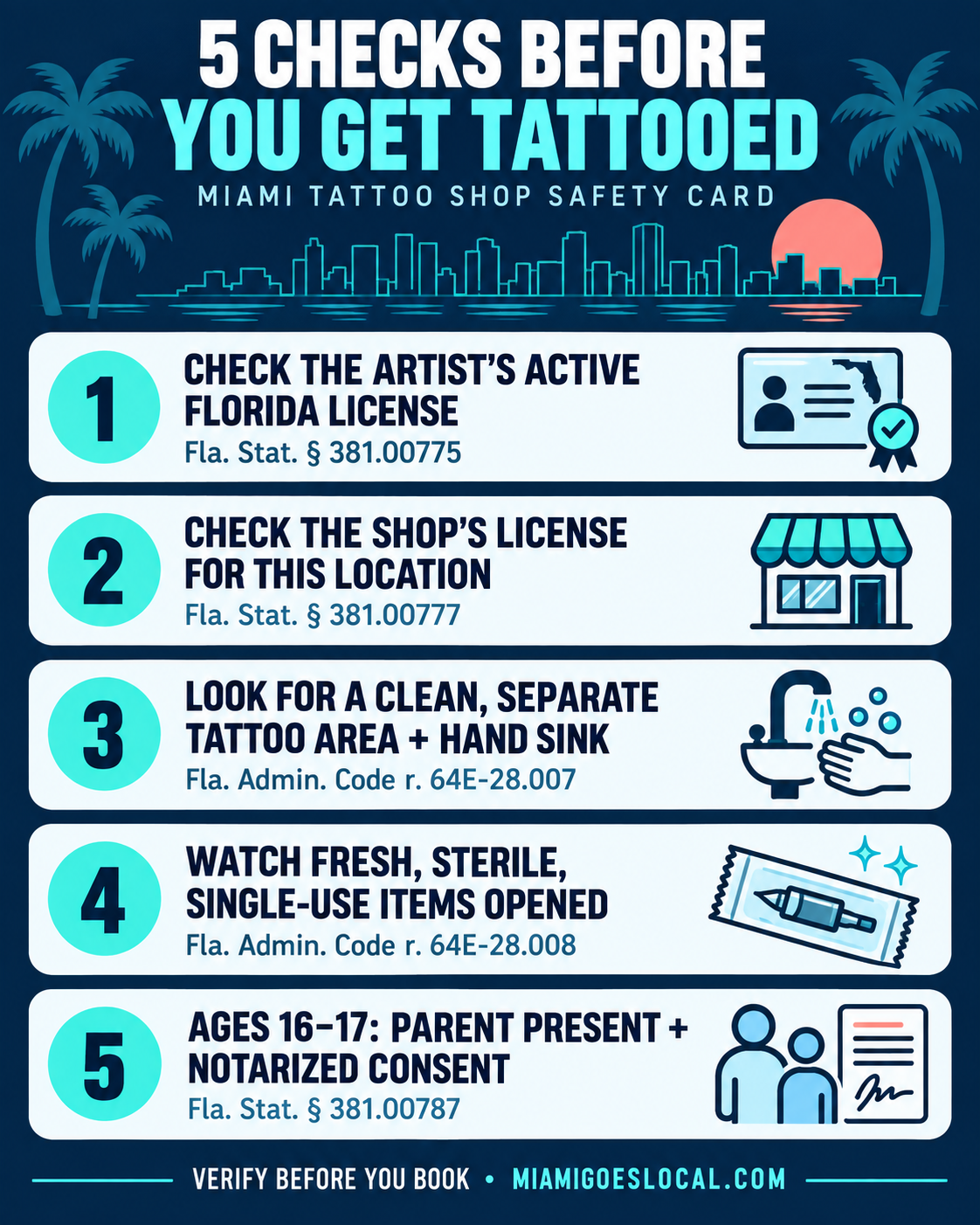
Before anything else, here is what you are entitled to see in a Miami tattoo shop. Every one of these comes from Florida law, and none of them requires you to know anything about tattooing.
1. The artist's licence, on the wall
Florida requires a tattoo artist to display their active licence in a manner that is easily visible to the public at all times while they are practising tattooing. You should not have to ask for it, and you should not have to go looking in a back office.
Florida also requires an artist to practise tattooing exclusively at a licensed establishment. A licensed artist working out of a kitchen or a hotel room is not operating legally, no matter how good their portfolio looks.
2. The establishment's own licence
The shop holds a licence separate from any individual artist's. Both are required. A business can have excellent artists and still not hold a current establishment licence, which is why this is a second check rather than the same one twice.
3. Annual state inspection
Florida requires tattoo establishments to allow the Department of Health to inspect at minimum annually. That is a stronger baseline than most personal-service industries face in this state.
Ask when the last inspection was. It is a completely ordinary question, the shop knows the answer, and how comfortably they answer it tells you something in itself.
4. Autoclave and sterilisation records
Florida requires establishments to maintain autoclave sterilisation and maintenance records, along with documentation of the sterilisation method used by the manufacturer for pre-sterilised items. Because the records must exist, you can ask to see them.
5. Written aftercare
Florida's standards of practice require a tattoo artist to provide aftercare information to the customer both verbally and in writing. A shop that talks you through it and hands you nothing has missed a legal standard of practice, not just been casual about paperwork.
Why this guide exists
The clearest, most honest guide to choosing a tattoo shop currently online is written by a studio on Venice Boulevard in Los Angeles. It is genuinely good. It never once pitches its own studio, its advice on portfolios is better than most independent coverage, and it is bylined to a named artist who works there.
It also tells you to check for a California Body Art Practitioner Licence and annual California bloodborne pathogen certification. If you walk into a shop in Wynwood and ask for those documents by those names, you will get a blank look, because Florida does not issue them.
The most thorough tattoo pricing guide online is published by a company that sells tattoo machines to beginners. It gives national US averages, its only geographic distinction is that LA, New York and London run above $200 an hour while small towns run $100 to $150, and it lists two different prices for the same tattoo size in two separate tables on the same page.
Miami is neither LA nor a small town, and its actual spread is wider than either guide suggests. You can get a walk-in piece in Wynwood for $20 cash, or book an experienced artist at $400 an hour. Nobody explains what separates those two things.
And nobody mentions the one fact that changes how a Miami reader should plan: a healing tattoo cannot go in the ocean.
This guide covers what tattoos actually cost here, what the styles are and how each one ages, how to read a portfolio properly, how to time a tattoo around a city built on beaches, what Florida law says about aftercare and about minors, what changes when a guest artist is doing your work, and what it costs to undo.
[[Disclosure: Miami Goes Local is a business directory. We have no tattoo to sell and no equipment to move. Listed shops may hold free or paid listings, and paid placement cannot buy inclusion or position in anything recommended on this page. See our advertising and editorial disclosure.]]
What a Tattoo Actually Costs in Miami
How pricing works before we get to numbers
There are four models, and shops mix them:
- Shop minimum. The lowest amount any tattoo can cost, regardless of size.
- Hourly rate. Standard for larger custom work and anything requiring interpretation.
- Flat rate per piece. Common for flash designs and predictable work.
- Day rate. Used for long single-sitting sessions.
The shop minimum is the one people misunderstand most. It exists because every appointment carries real cost before the needle touches skin: sterile single-use supplies, machine setup, stencil prep, barrier coverings, and the full cleanup and sterilisation cycle afterwards. Industry cost analysis puts a working artist's booth rent or studio overhead at roughly $800 to $1,500 a month with another $200 to $400 in supplies, which is the arithmetic behind why a twenty-minute tattoo cannot cost five dollars.
The minimum applies per person, not per appointment. If five friends come in for matching dots, each of them pays it. This surprises people constantly and it is the most common source of front-desk friction in Miami shops.
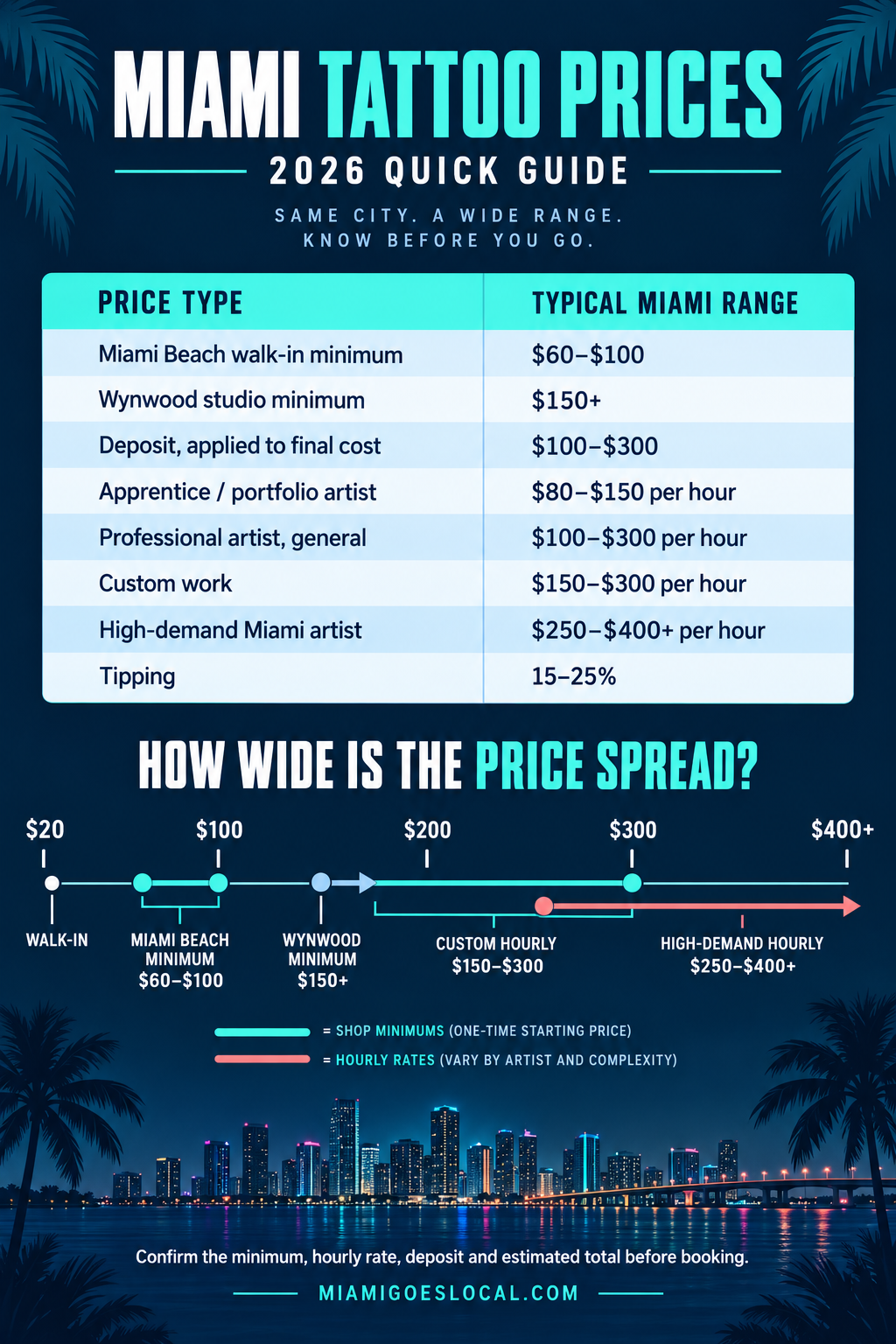
| Service or Pricing Type | Typical Miami Range |
|---|---|
| Shop minimum, Miami Beach walk-in shops | $60–$100 |
| Shop minimum, Wynwood studios | $150+ |
| Deposit (applied to final cost) | $100–$300 |
| Apprentice or portfolio-building artist | $80–$150 per hour |
| Professional artist, general | $100–$300 per hour |
| Custom work | $150–$300 per hour |
| Experienced or high-demand Miami artist | $250–$400+ per hour |
| Tipping | 15–25% |
These figures were compiled from published shop minimums, local editorial coverage of Miami studios, industry rate analysis current to 2026, and advertised walk-in pricing, captured in August 2026. The Miami Beach minimum range comes from a Miami Beach studio's own published guidance and is the oldest figure here, so treat it as indicative. Prices move. Ask each shop directly.
One verified anchor worth knowing: a well-regarded Wynwood fine-line studio publishes a $150 shop minimum, and local editorial coverage described that as impressively low for Wynwood which tells you the neighbourhood's baseline sits above it.
What drives your specific quote
- Size, though not in a straight line. A tiny, exacting design can take as long as a large simple one.
- Placement. Ribs, sternum, neck, hands, feet and knees are harder to tattoo and usually cost more. Forearms and outer arms are the easiest.
- Detail density. Photorealism and dense shading are slow. Bold outline work is fast.
- Colour versus black and grey. Colour packing takes longer and often needs more sessions.
- Artist demand. A specialist with a six-month waitlist does not price like someone building a portfolio.
- Neighbourhood. Wynwood, South Beach and the Design District carry higher overhead than Little Havana or the northwest corridor, and rent shows up in the rate.
- Session count. Sleeves, backs and chest pieces are quoted across multiple appointments.
Reading the spread honestly
At the bottom of the Miami market you can find $20 walk-in tattoos, half sleeves advertised from $280, and eight-hour sessions for $600. That last one works out to about $75 an hour, in a city where experienced artists charge $250 to $400.
Treat unusually cheap hourly work as a different product, not a discount on the same product. At $75 an hour, something has to give time spent per piece, the depth of the design process, or the artist's experience level. That is an economic observation, not an accusation.
Two things are worth saying plainly here. First, high-volume walk-in shops serve a real market, plenty of them are properly licensed and clean, and a simple piece from a fast shop can be perfectly good work. Second, and more importantly: the five licence and sterilisation checks at the top of this page apply identically at every price point. A $20 tattoo from a licensed artist in an inspected shop is a different proposition from a $20 tattoo from someone whose licence is not on the wall. The price is not the safety signal. The licence is.
One related note. Cash-only pricing is common at the walk-in end and is not illegal. But paying cash removes your paper trail, and Florida requires establishments to maintain customer records regardless of how you paid. If something goes wrong, a receipt makes a complaint considerably easier to file.
Tattoo Styles, Explained
Both of the guides competing for this topic tell you to match the artist to the style. Neither explains what the styles are. Here they are, with the column nobody publishes: how each one looks in fifteen years.
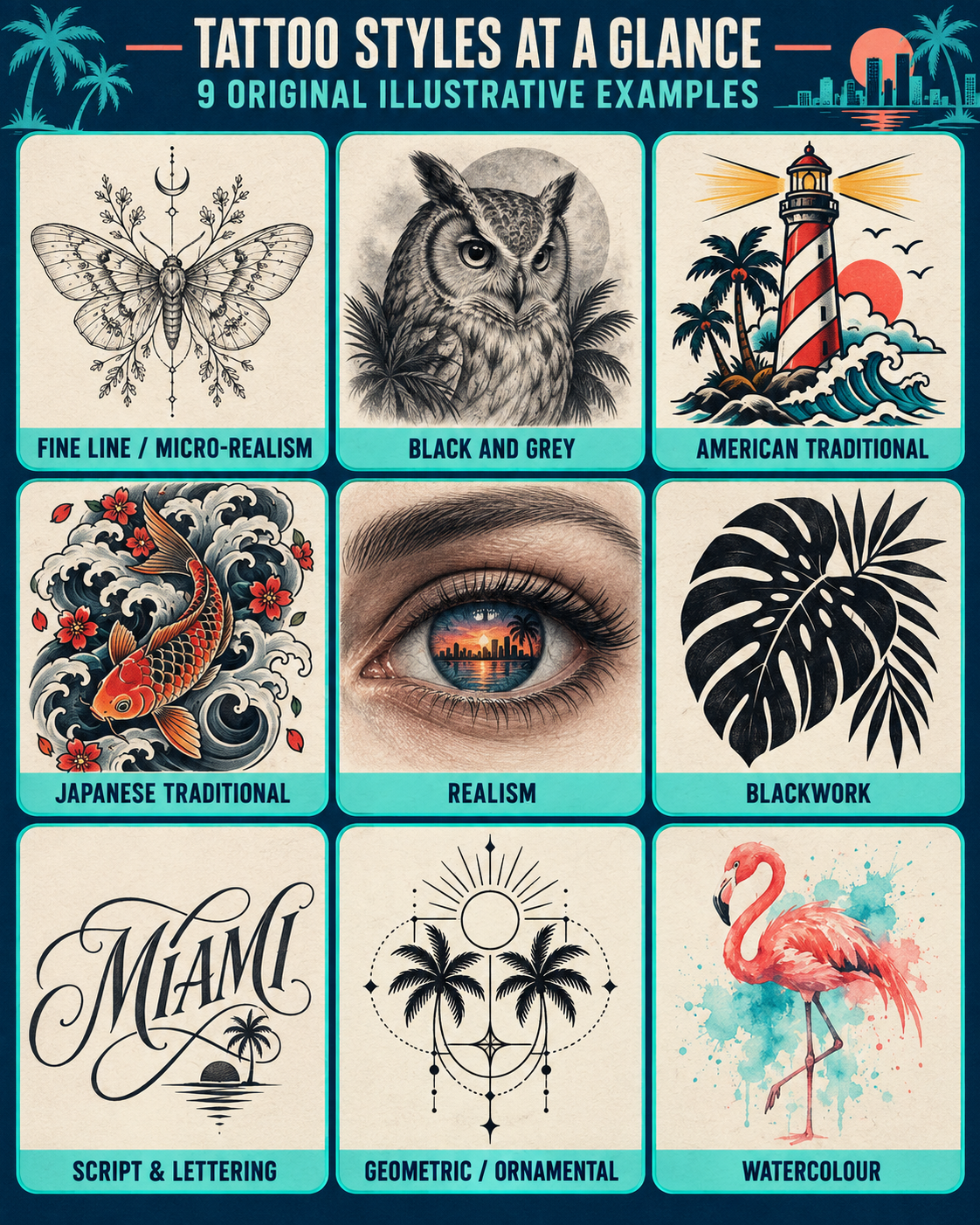
| Style | What It Is | Relative Cost | How It Ages | Portfolio Red Flag |
|---|---|---|---|---|
| Fine line / micro-realism | Delicate, small-scale and highly detailed | Mid to high | Fine lines can soften and blur; high-movement and high-sun areas age fastest | Only fresh photos are shown, with no healed work |
| Black and grey | Shading without colour | Mid | Ages well; smooth gradients generally hold | Muddy mid-tones or blown-out shading |
| American traditional | Bold outlines with a limited palette | Low to mid | Designed for longevity and generally ages very well | Wobbly lines or inconsistent line weight |
| Japanese traditional | Large-scale, whole-panel composition | High—often multi-session | Excellent when designed and executed as one composition | Only isolated motifs, with no complete compositions |
| Realism | Photographic imagery | Highest per square inch | Can age well when expertly executed, but mistakes are unforgiving | Flat, lifeless eyes or unnatural skin tones |
| Blackwork | Solid black fills and patterns | Mid | Generally very durable | Patchy saturation or visible banding |
| Script and lettering | Words, lettering and calligraphy | Low to mid | Very fine scripts may close up over time | Uneven spacing or inconsistent stroke weight |
| Geometric / ornamental | Precision lines and symmetry | Mid to high | Holds well when the linework is clean and properly spaced | Lines that do not meet or broken symmetry |
| Watercolour | Soft, painterly and often edgeless | Mid | Softer edges and lighter pigments may fade sooner | No healed examples more than one year old |
Where styles cluster in Miami
Wynwood's studios lean noticeably toward fine line, micro-realism, botanical, ornamental and lettering work, and the neighbourhood's pricing reflects that specialism. Traditional and black and grey work is well represented across the older Miami shops and the Little Havana and Calle Ocho corridor. These are tendencies, not rules, and the right way to check is to look at portfolios rather than reputations.
Choose the artist by style specialism, not by proximity. A superb realism artist is the wrong choice for American traditional, and a good one will tell you so rather than take the booking. An artist declining your project because it is not their style is a positive signal.
How to Read a Portfolio
The best portfolio guidance on this topic comes from Rabble Rouser Tattoo's own guide, bylined to Alayna Magnan, one of the shop's artists. Its advice on healed work and its warning about purchased followers and stolen or AI-generated portfolio images are sharper than most independent coverage, and the guide is unusually free of self-promotion for something published by a shop. It is a good guide written for the wrong state. The points below build on it.
Ask for photographs of healed work, not just fresh tattoos. Fresh ink always looks crisp the lines are swollen, the contrast is at its peak, and the skin is still reacting. Healed work six months on is what tells you how that artist's lines and shading actually settle. Most experienced artists have hundreds of photos they have never posted, and a good one will happily show you.
Look for the artist's work on skin tones close to yours. Ink reads differently across skin tones, and colour choices and contrast that work on one do not automatically translate. A portfolio showing only one skin tone is telling you something about the artist's range. In a city as diverse as Miami this matters more than almost anywhere.
Treat follower counts as meaningless. Followers can be bought, and accounts can be filled with stolen or AI-generated images. Cross-check against the shop's own website and its Google Business profile, where the work is more likely to be genuinely theirs and where reviews are attached to named artists.
Beyond that:
- Check line consistency at small scale. Enlarge the photo. Lines should be clean and of even weight where they are meant to be.
- Ask to see work in your specific style even if it is not posted. Absence from a public portfolio can mean preference, or it can mean inexperience, and you are entitled to know which.
- Look for composition on the body, not just a design in isolation. A good tattoo sits with the muscle and limb it is on.
Ask about the artist's process during the consultation how they will approach your design, what they will change and why, what machine and needle configuration they favour for that style. A confident artist enjoys this conversation. Feeling rushed at consultation is the single most reliable early warning sign there is. Consultation is also your opportunity to find out whether you can spend four hours in a room with this person, which matters more than people expect.
Timing a Tattoo Around Miami
This is the section no tattoo guide writes, and in Miami it is the one that will actually change your plans.
A healing tattoo cannot go in the water
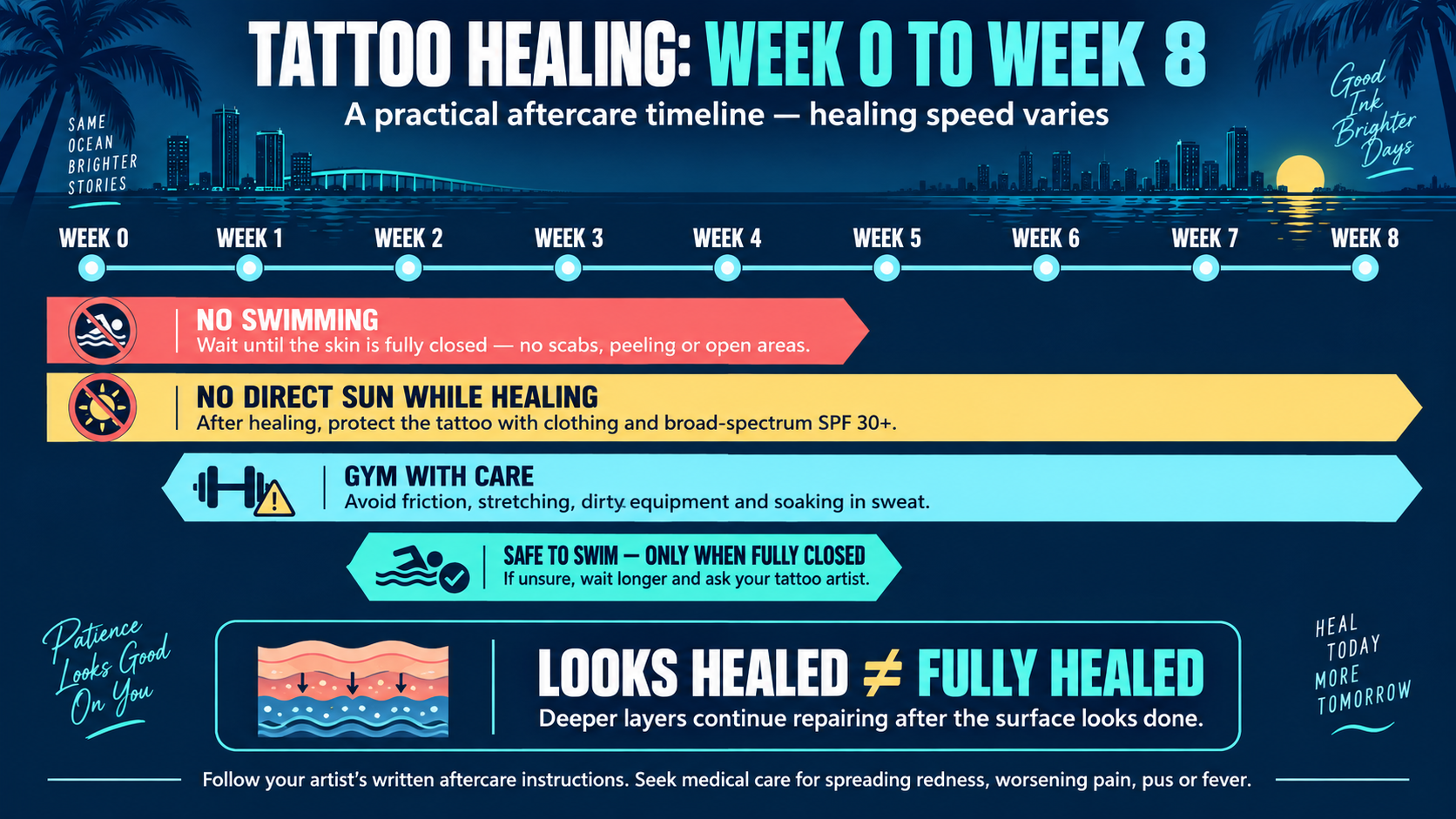
Not the ocean. Not a pool. Not a hot tub. Not the bay. Submerging a healing tattoo risks infection and can pull ink out of unhealed skin. Surface healing takes a couple of weeks; the deeper layers take considerably longer.
Do not book a tattoo before a beach trip, a cruise, or a pool weekend. In most cities that is a minor scheduling note. In Miami, where the beach is the default weekend and Port Miami is the busiest cruise port in the world, it rules out more of your calendar than you would expect. Book two to four weeks clear of anything aquatic, and if you have a cruise booked, get the tattoo after, not before.
Sun, sweat and summer
Direct sun on a healing tattoo is a problem in its own right, and Miami has a great deal of sun year round. Heat and heavy sweating also complicate healing more here than in temperate cities, particularly on areas covered by clothing that traps moisture.
Sun exposure is the primary reason tattoos fade. Keep a healing tattoo covered and out of direct sun entirely, then use sun protection on it for the rest of its life. A ten-year-old tattoo on a shoulder that has lived in Miami sun without protection looks materially older than the same tattoo on a thigh.
Placement and the clothes you actually wear
Think about what you wear in this climate, not what is in your wardrobe. Placement visibility works differently in a city where you are in short sleeves ten months of the year and swimwear regularly. A piece you imagined as "coverable" may be visible far more often than you planned.
Workplace visibility is a personal calculation and Miami's norms vary enormously by industry. It is worth thinking about once, before you book, rather than after.
Aftercare, Touch-Ups and What the Law Requires
Your artist's instructions override anything written here, and Florida requires them to give you those instructions. In general terms: keep the area clean, wash gently with unscented soap, apply a thin layer of whatever your artist recommends, do not pick or scratch, avoid tight clothing over the area, and stay out of water and sun.
Normal healing involves some redness, mild swelling, tenderness and flaking. What is not normal is increasing pain after the first few days, spreading redness, heat, swelling that worsens, pus, foul smell, red streaking away from the tattoo, or fever.
Expect written aftercare instructions, not just a verbal rundown at the door. Florida's standards of practice require a tattoo artist to provide aftercare information both verbally and in writing. If you leave with neither, that is a compliance failure and a reasonable thing to raise.
Signs of infection need a clinician, not a return visit to the shop. A tattoo artist cannot diagnose or treat an infection, and delay is the thing that turns a minor problem into a serious one. This guide is general information, not medical advice.
Touch-ups and deposits
Touch-up policies vary widely and are worth reading before you book. One Miami shop offers free touch-ups on any tattoo booked within three months of the original appointment, but explicitly excludes tattoos that became infected or healed poorly because aftercare instructions were not followed.
Ask what voids the touch-up policy, not just whether one exists. Aftercare non-compliance is the usual exclusion, which is another reason to keep the written instructions you were given rather than binning them on the way out.
Never pay a deposit until you are certain about both the design and the artist. Tattoo deposits typically $100 to $300, usually applied to the final cost are almost universally non-refundable. That is standard industry practice rather than a red flag: the artist has often spent hours designing before you arrive, and a cancelled slot is rarely refillable at short notice.
Get your quote in writing, covering size, placement, style, estimated number of sessions, whether it is hourly or flat, the deposit amount and how it applies if you reschedule, and the touch-up terms. That is what makes two Miami shops genuinely comparable when one quotes you a minimum and the other quotes a day rate.
Age and Consent in Florida
Florida's rules here are specific, and they matter to parents as much as to teenagers.
No Florida establishment may tattoo anyone under 16. Not with a parent's permission, not with a parent in the room. A minor in Florida is anyone who has not turned 18.
For 16- and 17-year-olds, tattooing is permitted only with written, notarised consent from a parent or legal guardian, on Florida form DH 4146 "Written Notarized Consent For Tattooing of a Minor Child, Age 16 through 17 Years Old." The parent or guardian must also submit proof that they are the parent or legal guardian. The form is available from the environmental health section of the county health department. The governing provision is Section 381.00787, Florida Statutes.
Notarised means notarised. Turning up with a signed handwritten note will not satisfy the requirement, and a shop that accepts one is telling you how seriously it treats its other legal obligations. If a shop is willing to bend this rule, consider what else it is willing to bend.
Guest Artists and Conventions: What's Different
Miami draws visiting artists and hosts conventions, and the rules for both are distinct from a permanent shop's.
Guest artists
Florida issues a guest tattoo artist registration, valid for up to 14 consecutive days, as a separate credential from a full artist licence. A guest artist may re-register. To qualify, they generally hold an active licence from another jurisdiction with comparable standards, or have completed a Department of Health-approved education course and passed an approved examination.
If a visiting artist is doing your work, ask about their guest registration. In a shop that hosts guests regularly this is a completely routine question and the answer should come immediately. A guest artist is still required to display their credential visibly while working.
Conventions and temporary establishments
Temporary establishment licences are issued in connection with a convention or similar event and cannot exceed 14 consecutive days. A temporary establishment must meet the same operational requirements as a permanent shop, including handsinks, rigid walls, floors and ceiling, and non-absorbent easily cleanable flooring in the tattooing and sterilisation areas. The Department of Health conducts an initial inspection before the event.
If an artist sterilised their equipment in advance of a convention rather than on site, Florida requires spore test results confirmed by an independent laboratory to be available for inspection. Asking about that at a convention booth is entirely fair, and it is exactly the kind of question a properly prepared artist has an answer ready for.
What It Costs to Undo
This is not here to frighten anyone. It is here because permanence is the real reason to take the rest of this guide seriously, and a number on the undo cost is more persuasive than any amount of advice to slow down.
Laser tattoo removal typically requires multiple sessions spaced weeks apart, and a full course commonly costs a multiple of what the original tattoo cost. How removable a piece is depends on:
- Colour. Black responds best. Greens, blues and some yellows are considerably more stubborn.
- Ink density and depth. Heavy saturation and blackwork take more sessions.
- Age. Older tattoos have usually faded somewhat and can respond faster.
- Location on the body. Areas with better circulation clear ink more efficiently.
Some tattoos realistically can only be covered rather than removed, and a good cover-up artist will tell you what is and is not possible with what you already have.
Expert Tip: Price the undo before you commit. If the removal cost makes you hesitate, that is useful information about the decision rather than about the tattoo. An extra week of thinking is free.
Florida regulates who may perform laser procedures, and the rules differ by procedure type. Before booking removal, ask who will be operating the laser, what licence they hold, and who is supervising — and verify it, the same way you would verify a tattoo artist. See our guide to laser hair removal in Doral for how Florida's laser licensing framework works and how to check it.
Frequently Asked Questions
How much does a tattoo cost in Miami?
Shop minimums run roughly $60 to $100 at Miami Beach walk-in shops and $150 or more at Wynwood studios. Hourly rates run about $80 to $150 for artists building a portfolio, $150 to $300 for custom work generally, and $250 to $400 or more for experienced high-demand Miami artists. Figures captured August 2026; confirm with each shop.
What is a shop minimum and why is it so high?
It is the lowest price any tattoo can be, regardless of size, and it covers sterile single-use supplies, machine and stencil setup, and the full cleanup and sterilisation cycle. It applies per person, so a group each pays it.
How do I check if a tattoo artist is licensed in Florida?
Look at the wall Florida requires the artist's active licence to be displayed visibly to the public while they are tattooing. Check the establishment's licence too, since both are required. Both can be verified through the Florida Department of Health, and DOH–Miami-Dade County Environmental Health handles tattoo establishment licensing and inspection locally.
Can I get a tattoo at 16 in Florida?
Yes, but only with written notarised consent from a parent or legal guardian on Florida form DH 4146, plus proof of guardianship. No Florida establishment may tattoo anyone under 16 at all.
How long before I can swim after a tattoo?
Keep it out of the ocean, pools and hot tubs until it has fully surface-healed, which generally means a few weeks rather than a few days. Follow your artist's specific instructions, and plan around any trip rather than the other way round.
Do tattoos fade faster in Florida?
Sun exposure is the main cause of tattoo fading, and Miami has a lot of it year round. A tattoo that lives in direct sun without protection will look older sooner than the same tattoo on a covered area. Sun protection on healed tattoos is the single most effective thing you can do for longevity.
How much is a tattoo deposit?
Commonly $100 to $300, applied toward the final cost, and almost always non-refundable. Ask specifically how it is treated if you need to reschedule rather than cancel.
What tattoo style should I get?
That depends on what you want it to look like in twenty years, not just next week. Use the ageing column in the styles table above, and pick the artist by specialism once you have narrowed the style.
Where are the best tattoo shops in Wynwood?
Wynwood has a deep concentration of fine-line and micro-realism studios, and a higher pricing baseline to match. Rather than name a winner, work through the five licence checks, compare healed portfolios in your specific style, and look at where the artist you want actually works. You can browse Miami tattoo shops in our directory and verify each one yourself.
What does tattoo removal cost?
A full course of laser removal usually takes multiple sessions over several months and commonly costs a multiple of the original tattoo. Colour, ink density and age all affect how many sessions are needed.
Do I tip a tattoo artist?
Yes, tipping is customary, generally in the range of 15 to 25 percent. On long multi-session work, some people tip per session and others at the end. It is never legally required but it is culturally expected.
 Miami Book Fair 2026: Where to Eat, Park and Stay Near the Wolfson Campus
 Miami Art Week 2026: A Local’s Guide to Eating, Parking and Shopping Around Wynwood and Miami Beach
 Thanksgiving in Miami 2026: Independent Restaurants, Bakeries and Takeout That Are Open
