
Search for “lymphatic drainage massage” and you will find two very different services sharing one name.
Cancer centres describe manual lymphatic drainage, or MLD, as a gentle clinical technique used within the management of conditions such as lymphedema. Spas and wellness studios use the same phrase for sessions marketed for relaxation, temporary de-puffing or body contouring often alongside claims about “detoxing” or “flushing toxins.”
Both can describe a real service. The problem is that provider pages rarely make clear which service you are buying.
That distinction matters because the right route depends on why you are booking. Someone managing diagnosed lymphedema has different needs from a person recovering from liposuction, a BBL or a tummy tuck. Both have different considerations from someone seeking a relaxing wellness massage.
Qualifications can be equally difficult to interpret. A Florida massage-therapy licence establishes permission to practise massage; it does not, by itself, demonstrate specialist education in manual lymphatic drainage or lymphedema care. Terms such as “lymphatic specialist” and “certified” therefore need a follow-up question:
Certified in what, and by whom?
This guide will help you:
- Identify which type of lymphatic treatment fits your situation
- Understand the difference between CMLDT, CLT and CLT-LANA credentials
- Check a practitioner through two free public directories
- Separate supported outcomes from marketing language
- Approach post-operative massage in Miami with the right questions
- Know when clearance from your surgeon or care team should come first
By the end, you should know which route is yours, what to ask at intake and where to verify the answer, and our full beauty and personal care directory covers every other Miami service category with the same verification approach.
Miami Goes Local is a business directory and does not provide medical services. This article offers general information only and is not medical advice, diagnosis or an individual treatment recommendation.
If you have lymphedema, persistent or unexplained swelling, or swelling related to cancer treatment, your own care team is the appropriate authority. For clinical guidance, defer to specialist medical resources such as MD Anderson Cancer Center and the Cleveland Clinic. The value of this guide is narrower: helping you understand the names, credentials and verification steps you will encounter when choosing a service.
Brows Personal and Beauty care
Two Treatments, One Name
“Lymphatic drainage” is used for two services with different purposes, providers and standards. The shared name makes them sound interchangeable. They are not.
Clinical manual lymph drainage
Clinical manual lymph drainage, usually shortened to MLD, is a specialised technique used in the management of diagnosed conditions such as lymphedema. It is generally delivered as one part of Complete Decongestive Therapy (CDT), alongside compression, exercise and skin care.
MD Anderson makes an important distinction: its physical therapists describe MLD as a therapy technique that is sometimes mistakenly called massage. They work from a repertoire of 18 steps, selecting only those appropriate for the individual patient. In other words, clinical MLD is not a standard sequence applied identically to everyone. The treatment plan depends on the condition, the affected area and the person’s clinical history.
For someone with lymphedema, MLD manages the condition rather than cures it. It should sit within a plan developed with the patient’s healthcare team not replace medical assessment or the other components of lymphedema care.
Aesthetic and wellness lymphatic massage
If a med spa is the one offering it, our guide on how to choose a med spa in Miami explains what to verify before you book. People commonly book it for relaxation, temporary de-puffing, perceived fluid retention, post-operative comfort or a short-term change in contour appearance.
This is a legitimate wellness category that many clients enjoy and report feeling better after, similar to how a standard facial fits into a relaxation routine our Best Facials in Miami guide covers that comparison in the same way.
The issue is not that the service exists. The issue is that terms such as “detox lymphatic drainage” can make a spa treatment sound like clinical lymphedema therapy.
A wellness session may also include oils, tools, compression devices, wood therapy or other add-ons that are not part of clinical MLD, a reminder that's just as relevant when comparing device-based treatments like laser hair removal, where the underlying equipment matters more than the marketing name. That does not automatically make the service poor or unsafe, but it does mean the provider should explain exactly what will be done and why.
If the service is advertised using words such as “detox,” “flush,” “sculpt” or “cleanse,” treat those as marketing descriptions not as evidence that the provider is qualified to manage a diagnosed lymphatic condition.
Clinical MLD versus wellness lymphatic massage
Swipe horizontally to view the complete comparison
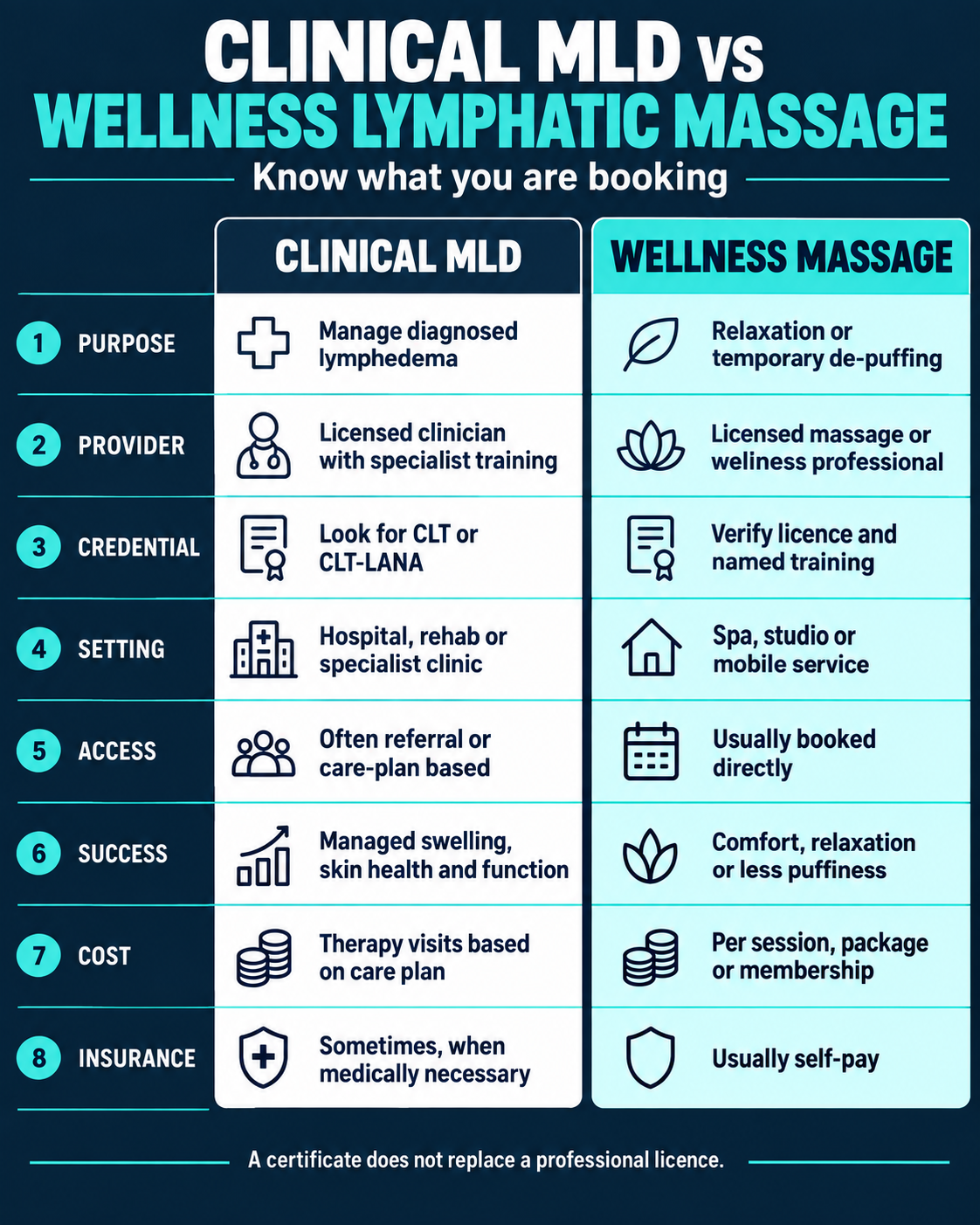
| Point of comparison | Clinical manual lymph drainage | Aesthetic or wellness lymphatic massage |
|---|---|---|
| Primary purpose | Helps manage lymphedema or another diagnosed clinical need as part of an individual care plan. | Commonly booked for relaxation, temporary de-puffing, perceived fluid retention, post-operative comfort or appearance. |
| Typical provider | A physical therapist, occupational therapist, nurse or massage therapist with recognised lymphedema education appropriate to their professional scope. | A licensed massage therapist or another appropriately licensed professional working within their legal scope. |
| Credential to look for | For lymphedema care, look for substantial specialist training such as CLT; CLT-LANA adds independent national certification. The underlying professional licence still matters. | Florida licensure relevant to the service is the starting point. “Certified” alone does not identify the course, training hours, certifying organisation or clinical competence. |
| Typical setting | Rehabilitation clinic, hospital, cancer centre, physical-therapy practice or specialist lymphedema clinic. | Spa, med spa, massage studio, wellness practice or mobile service. |
| How you access it | Often through a physician, surgeon or rehabilitation referral, although access rules vary by provider and insurance plan. | Usually booked directly by the client. |
| What success looks like | Progress toward goals set by the care team, such as managing swelling, discomfort, skin health or function. | A satisfactory experience, relaxation, improved comfort or a temporary reduction in puffiness. |
| Typical cost structure | Commonly billed as rehabilitation or therapy visits; frequency depends on the treatment plan. | Usually priced per session or sold in packages, memberships or post-operative bundles. |
| Can insurance be involved? | Sometimes. Coverage may be available when treatment is medically necessary and delivered by an eligible provider, but benefits, referrals and authorisation requirements vary. | Usually self-pay. A spa or wellness booking is generally not treated as covered lymphedema rehabilitation. |
Decide which of these two services you need before comparing prices or provider reviews. If you have diagnosed lymphedema, unexplained swelling or a clinical referral, begin with your care team and a lymphedema-trained professional. If your goal is relaxation or temporary de-puffing, a wellness provider may be the appropriate route but still ask at intake: “Certified in what, and by whom?”
Which One Do You Actually Need?
Use this section as a routing guide, not as a way to diagnose the cause of swelling. The correct route depends on why you are considering treatment.
Route 1 You have lymphedema or swelling after cancer treatment or lymph-node removal
Start with your care team, not a spa menu.
Ask whether you need a referral for lymphedema evaluation or treatment. If manual lymph drainage is appropriate, look for a Certified Lymphedema Therapist (CLT) whose underlying professional licence fits the care you need. A therapist holding the additional CLT-LANA credential has also met the Lymphology Association of North America’s eligibility requirements and passed its national certification examination.
CLT-LANA is a particularly useful verification signal, but it is not the only evidence of legitimate training. Later in this guide, we will show you how to check both the certification and the person’s active Florida licence.
Tell your care team before booking any spa-based lymphatic service. MD Anderson advises addressing possible lymphedema early because it is easier to manage in its earlier stages; after it advances, some tissue changes may become irreversible. New, persistent or worsening swelling deserves clinical assessment rather than self-selection from a massage menu.
Your next step: Contact your physician, oncology team or rehabilitation provider and ask:
“Should I be evaluated for lymphedema, and what type of licensed therapist should I see?”
Route 2 You are recovering from surgery
If you are recovering from a BBL, liposuction, a tummy tuck or another operation, begin with surgeon clearance in writing.
Ask when hands-on treatment may begin, which areas may be treated, which must be avoided and whether your surgeon recommends a particular technique. Then look for a properly licensed practitioner with verifiable lymphatic education and specific experience working with patients after your type of procedure.
“Post-op specialist” is a marketing description, not enough information by itself. Ask about the person’s underlying Florida licence, lymphatic qualification, post-surgical training and procedure-specific experience.
Do not treat a package sold before surgery as a substitute for your surgeon’s instructions. Timing and restrictions can differ between patients, even when they had the same procedure.
Your next step: Get written clearance, then continue to Post-Operative Lymphatic Massage in Miami.
Route 3 Your goal is wellness or temporary de-puffing
If you feel well and are booking for relaxation or a temporary reduction in ordinary puffiness, a spa or wellness lymphatic massage can be a reasonable choice.
Expect a light-touch session whose format varies by provider. Some businesses combine manual work with oils, tools, compression devices or other add-ons. If you are still deciding between lymphatic work and other styles, our guide to the different types of massage in Miami compares them by goal, price and licence.
You may experience relaxation, improved comfort or a temporary change in puffiness. Do not expect the session to cure a condition, produce lasting weight loss or deliver promises described as “detoxing,” “flushing toxins,” “boosting immunity” or permanently changing body shape. Those are marketing claims, not a reliable description of what the evidence supports.
If “fluid retention” is persistent, unexplained, painful, one-sided or accompanied by other symptoms, do not automatically place yourself on the wellness route. Ask a healthcare professional to assess the cause first.
Browse Beauty and Personal Care
| Your situation | Start here |
|---|---|
| Diagnosed lymphedema or swelling after cancer treatment or node removal | Your care team, followed by a qualified lymphedema therapist |
| Recovery after cosmetic or other surgery | Written surgeon clearance, followed by a licensed, appropriately trained post-operative provider |
| Relaxation or temporary de-puffing with no concerning or unexplained swelling | A licensed wellness provider, after checking what the service actually includes |
How the Lymphatic System Works Briefly
The lymphatic system collects excess fluid from tissues and returns it to the bloodstream. Lymph also carries immune cells and passes through lymph nodes, where unwanted material is filtered. Unlike the circulatory system, it has no central organ like the heart continuously pumping fluid around the body. Movement, breathing, nearby muscle contractions and the lymphatic vessels themselves help keep it moving.
Cleveland Clinic explains that lymph travels through a defined network of vessels containing one-way valves. Those pathways matter during clinical MLD. A therapist does not simply rub the swollen area: the sequence and direction of the strokes are selected to encourage fluid toward functioning drainage routes.
MD Anderson offers a useful example: fluid collected near a fingertip travels up the arm toward a terminus near the neck. It then re-enters the circulation and may eventually reach the kidneys for excretion.
That is why stroke direction and treatment sequence are not decorative details. It also explains why correct MLD uses light, controlled pressure. Many lymphatic vessels lie close to the skin, so more force does not necessarily mean a more effective treatment. Clinical MLD should not feel like a deep-tissue massage.
The Credential Ladder: Who Is Actually Qualified?
“Certified lymphatic therapist” is not one universal qualification. It may describe a short technique course, full lymphedema training or independent board certification.
The useful question is:
Certified in what, by whom, and after how many hours of training?
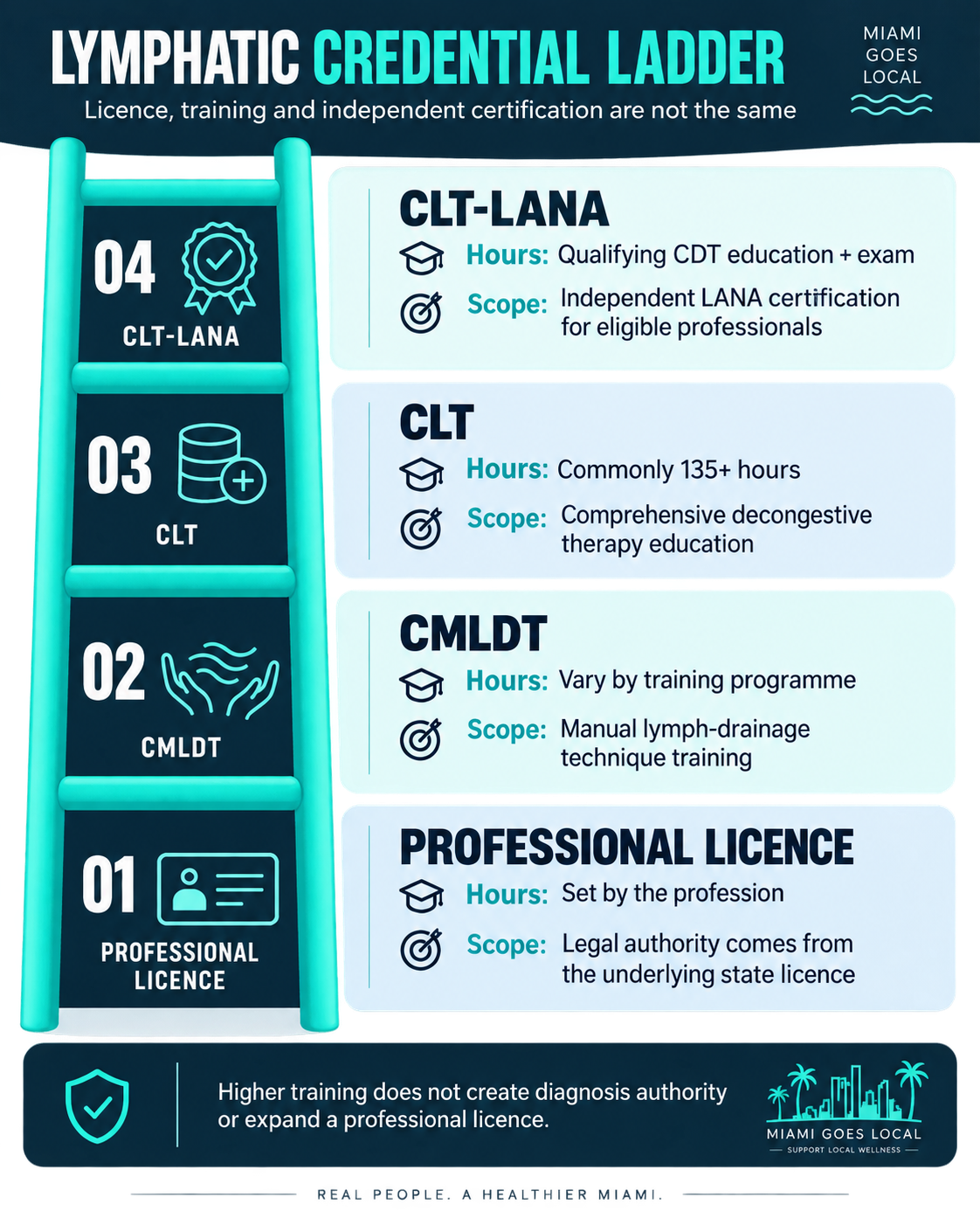
| Level | What it establishes | What it does not establish |
|---|---|---|
| Florida professional licence | The person holds a state licence relevant to the service they provide. | Specialist education in lymphatic drainage or lymphedema. |
| CMLDT | Training in manual lymph-drainage technique through the named school or programme. | Full training in every component of lymphedema management. |
| CLT | Completion of a substantial Complete Decongestive Therapy course, commonly 135 hours. | Independent national board certification; standards still depend on the school. |
| CLT-LANA | Eligible professional licence, qualifying CDT education and passage of LANA’s independent examination. | A medical degree, diagnosis authority or automatic suitability for every patient. |
The baseline: a Florida professional licence
For a massage-based service, the starting point is an active Florida massage-therapy licence. If the treatment is offered through an establishment that must be licensed, check the establishment as well.
This licence is the floor, not a lymphatic credential. Florida does not issue a separate "lymphatic massage therapist" licence, the same kind of licensing gap worth checking for before booking any service that touches the skin, including at a shop covered in our guide on how to choose a tattoo shop in Miami. A massage therapist’s active state licence therefore does not tell you whether that person completed a weekend introduction, a full CDT programme or no lymphatic-specific course at all.
Verify the underlying licence through the Florida Department of Health’s practitioner search and the relevant business or establishment record through Florida DBPR.
CMLDT Certified Manual Lymph Drainage Therapist
CMLDT generally means Certified Manual Lymph Drainage Therapist. The training concentrates on the hands-on drainage technique itself.
This can be relevant for wellness work and may add useful skill within a practitioner’s legal scope. However, CMLDT is not one nationally standardised qualification. Course length, practical assessment and admission requirements can vary between schools.
Ask for:
- The full name of the school
- The course title
- The number of training hours
- Whether practical skills were assessed in person
- Whether the school maintains a graduate directory
CMLDT should not automatically be treated as equivalent to full lymphedema certification.
CLT Certified Lymphedema Therapist
CLT usually indicates completion of a comprehensive course in Complete Decongestive Therapy. A qualifying programme commonly includes at least 135 hours covering manual lymph drainage and the other elements of CDT: compression, exercise, skin care and patient self-management.
Depending on the programme, training may also address limb measurement, bandaging, garment selection, infection precautions, wound considerations and treatment planning.
The important difference is breadth. A CMLDT course teaches a drainage technique. A full CLT programme prepares an eligible professional to work across the components used to manage lymphedema, within that person’s underlying professional scope.
CLT is normally awarded by the training school. Verify it with that school rather than relying on letters printed after a provider’s name.
CLT-LANA independent certification
CLT-LANA means the professional has met the Lymphology Association of North America’s eligibility requirements and passed its independent certification examination.
Current LANA materials require:
- A current, unrestricted professional licence or registration in an eligible discipline
- Completion of qualifying 135-hour CDT coursework
- A required distribution of theoretical and practical instruction
- An in-person assessment of manual and bandaging skills
- College-level science prerequisites where applicable
- A passing score on the CLT-LANA examination
LANA’s current published criteria do not list one year of post-course clinical experience as a universal prerequisite. That claim appears in some secondary descriptions but should not be repeated as a current requirement without direct confirmation from LANA.
LANA describes its credential as demonstrating that a therapist has gone beyond course completion to pass an accredited certification examination. That makes it a strong, independently verifiable credential. It should not, however, be described as part of a universal ranking topped only by a “physician lymphologist.” Lymphology involves different licensed professions, and suitability still depends on the patient’s needs and the practitioner’s legal scope and experience.
Readers can verify the credential through the LANA therapist directory.
Who can qualify for CLT-LANA?
LANA’s published eligibility list includes:
- Registered nurses
- Physical therapists and physical therapist assistants
- Occupational therapists and certified occupational therapy assistants
- Medical and osteopathic physicians
- Chiropractors
- Registered or otherwise qualifying massage therapists
- Certified athletic trainers
Massage therapists without a qualifying state registration must meet LANA’s alternative requirements, which include recognised national certification or documented completion of at least 500 hours of soft-tissue massage education. Some applicants must also document college-level anatomy, physiology or pathology coursework.
A nursing, physical-therapy or massage licence does not itself include specialist lymphatic training. If a post-operative provider leads with “nurse,” “physical therapist” or “licensed massage therapist,” ask what lymphatic qualification they hold in addition to that licence. Well-trained practitioners should be able to name the programme, school and credential clearly.
Recognised training programmes
LANA currently publishes a list of 14 lymphology training programmes, not approximately ten:
- Academy of Lymphatic Studies
- American Academy of Lymphatic and Wound Management
- Brennan School of Innovative Lymphatic Studies
- Chikly Health Institute
- Dr. Vodder International School
- International Lymphedema & Wound Training Institute
- Klose Training
- Lincoln Lymphedema
- LymphEd
- Monarch Continuing Education
- Norton School of Lymphatic Therapy
- E-HIS Clinician Courses
- O.ED.E.M.A. Academy
- University of Wisconsin
LANA cautions that its training-programme list is not exhaustive and that not every course offered by a listed organisation meets LANA’s eligibility requirements. Verify the exact course, not merely the school’s name. When available, use the school’s graduate directory to confirm a provider’s claimed CLT or CMLDT qualification.
“Certified” The Question That Settles It
The word “certified” is common across Miami’s lymphatic-massage market. On its own, however, it cannot be verified.
That does not necessarily make the claim false. It means the provider has left out the information needed to assess it: the qualification, the training organisation and the record confirming it.
Ask these three questions:
- Certified in what?
- Which school or organisation issued the certification?
- Is there a public directory where I can verify it?
If asking feels uncomfortable, use this exact script:
“Before I book, could you tell me the full name of the lymphatic certification held by the person who will treat me, which school issued it and whether I can verify it in a public directory?”
For post-operative care, add:
“Has this therapist completed training specifically for post-surgical work, and do you require written clearance from my surgeon?”
A statement such as “our certified specialists are trained by our founder” may describe serious, practical in-house education. In-house training is not automatically a red flag. The limitation is that the business is both providing and validating the training, so an outsider cannot independently check its standard.
External qualifications are easier to verify because a named school or certifying body can confirm them. Start with these free public resources:
- LANA Certified Lymphedema Therapist Directory verifies current CLT-LANA credential holders.
- LE&RN’s Find a Lymphedema Therapist resource explains what to look for and links to directories maintained by recognised training schools and lymphatic organisations.
Read the Licence, Then Ask About the Certification
A safe credential check has two parts. One lookup confirms legal licensure. The other confirms specialist lymphatic education.
Neither replaces the other.
Check 1 Verify the Florida licence
For massage services in Florida, check both:
- The individual massage therapist licence, commonly beginning with MA
- The massage establishment licence for the location, commonly beginning with MM
Use the Florida Department of Health's official licence-verification tool a different state licensing system from the DBPR salon records covered in our guide on how to choose a nail salon in Miami.
Search using the provider’s full name or licence number, then confirm:
- Licence type
- Current status
- Expiration date
- Name attached to the record
- Address, when shown
- Any available discipline or public-record information
The establishment lookup answers whether the premises holds the relevant state licence. It does not identify the lymphatic education of the individual who will treat you. Ask for that person’s full name and individual licence number separately.
Current official Florida sources place massage therapists and massage establishments under the Florida Board of Massage Therapy within the Department of Health, so the DOH verification portal is the correct tool for these records not the general DBPR search.
What good disclosure looks like
Lux MedSpa Brickell provides a useful example by publishing its Florida massage-establishment licence number, MM44530, in its online materials, and it appears among the businesses we profile in our Best Med Spas in Brickell guide.
Making the number visible gives clients something concrete to check through the state database.
That is better practice than using “licensed facility” without identifying the licence. It should still be treated as the beginning of verification, not the end: confirm that the record is current and ask for the individual therapist’s licence as well.
Check 2 Verify the lymphatic qualification
Now run a separate check for the claimed lymphatic certification.
What MLD Can and Cannot Do
Manual lymph drainage has a defined clinical purpose. It redirects excess fluid away from a swollen area toward parts of the body where it can be processed and returned to circulation.
That is meaningful, but narrower than many commercial descriptions suggest.
What the clinical sources support
For appropriately assessed patients, clinical MLD may help:
- Redirect excess fluid through functioning lymphatic pathways
- Reduce swelling and feelings of heaviness or tightness
- Improve comfort and movement
- Support symptom control as one part of a broader lymphedema-management programme
- Provide a gentle, relaxing treatment experience
MD Anderson describes MLD as a physical-therapy tool that moves excess fluid from swollen limbs toward unaffected areas where it can be filtered and excreted. For lymphedema, it is normally used alongside measures such as compression, exercise, skin care and self-management not as a stand-alone cure.
Results are individual. The appropriate sequence, treatment area and expected outcome depend on the cause of the swelling and the condition of the person’s lymphatic system.
What the clinical sources do not support
MD Anderson senior physical therapist Marc Miller draws a clear line between clinical MLD and the popular multipoint service marketed in wellness settings:
“That is a non-medical self-care offering that’s become trendy in Hollywood. Allegedly, it flushes toxins out of the body.”
He goes on to explain that this popular service is not designed to treat lymphedema, is not offered at MD Anderson and is more likely to be found at a spa.
That does not mean a wellness session has no value. Relaxation, comfort and temporary changes in puffiness may still matter to the person booking it. It means those outcomes should not be presented as treatment for a diagnosed lymphatic condition.
Across commercial lymphatic pages, it is common to see claims involving:
- “Detoxification” or toxin removal
- Immune-system boosting
- Collagen stimulation
- Lasting body contouring
- Weight loss
- Treatment or prevention of medical conditions
These claims go beyond the mechanism described by the clinical sources. A change in fluid distribution can temporarily affect swelling or appearance; it should not be converted into a promise of fat loss, permanent reshaping or removal of vaguely defined “toxins.”
Treat “detox” and “immune boost” as marketing framing rather than an explanation of how the treatment works. Fluid movement and reduced swelling are the clinically recognised objectives. Those are real and potentially valuable benefits without adding unsupported promises.
On lymphedema specifically
Lymphedema is a chronic condition to be managed, not something a massage session fixes.
MD Anderson states plainly that once the lymphatic system has been damaged, the damage is permanent: it does not repair or regenerate itself in the way some organs can. Exercise and MLD can help manage lymphedema, but they cannot restore the damaged system.
That distinction does not make management unimportant. Quite the opposite. Appropriate care can reduce symptoms, support function, protect the skin and help prevent the condition from progressing. MD Anderson also notes that untreated lymphedema can lead to permanent swelling and tissue hardening, which is why early assessment matters.
The accurate promise is therefore not a cure. It is an individual management plan that may include MLD, compression, movement, skin care and patient education, directed by qualified professionals and adjusted over time.
Lymphedema: Warning Signs and Why Early Matters
Possible early signs of lymphedema can be subtle. According to MD Anderson, they include:
- Heaviness in an arm or leg
- A limb feeling swollen even when no swelling is visible
- Visible swelling
- Clothing fitting differently on one side
- Rings no longer fitting comfortably
- Needing to loosen a watch band or add links
Not everyone who has lymph nodes removed develops lymphedema. MD Anderson explains that the lymphatic system has reserve capacity and may compensate for some loss. Symptoms begin when the body’s needs exceed that remaining capacity.
If you notice these changes after cancer treatment, radiation or lymph-node removal, tell your care team promptly rather than booking a spa appointment. Lymphedema is substantially easier to manage in its earlier stages, while advanced disease may involve irreversible tissue changes.
Drinking more water does not make lymphedema worse, according to MD Anderson. Deliberately rationing fluids is not generally necessary and adequate hydration remains important. Follow any different fluid instructions given by your own care team for another health condition.
Post-Operative Lymphatic Massage in Miami
Miami has a large post-operative recovery industry serving local patients and people who travel to the city for liposuction, BBLs, tummy tucks and other procedures.
Many patients describe properly timed, gentle post-operative massage as helpful for comfort and swelling. Most sessions are uneventful. The important questions are not whether every patient should avoid it, but when it should begin, what technique is appropriate and who should make that decision.
Clearance comes first
Get surgeon clearance in writing before the first session.
Ask your surgeon:
- When may hands-on treatment begin?
- How often, if at all, should it be performed?
- Which technique do you recommend?
- Which areas must be avoided?
- May the therapist work near incisions or drains?
- Are compression garments required before or after treatment?
- Which symptoms mean I should stop and contact you?
A clinic may describe its service as “medically aware,” “doctor recommended” or “post-op certified.” Those phrases do not tell you whether your own surgeon has cleared treatment for your body at this stage of healing.
Florida’s current Massage Therapy Practice Act requires massage therapists and applicable massage establishments to be licensed. However, a review of Chapter 480 and the Florida Board of Massage Therapy rules did not identify a surgery-specific statewide rule prescribing when post-operative massage must begin or universally requiring written surgeon clearance.
That absence is not a medical green light. Florida licensure does not allow a therapist to determine whether healing tissue is ready for manipulation. Your surgeon knows the procedure performed, the incision locations, whether drains remain and whether complications are developing. Their instructions should control the timing.
Why post-operative tissue is different
After surgery, the treatment area may contain:
- Healing incisions
- Internal sutures
- Surgical drains
- Bruising and inflammation
- Areas of altered sensation
- Temporary fluid accumulation
- Tissue planes changed by the procedure
Two people can have procedures with the same name and receive different instructions. One may have drains while another does not. One may be cleared for gentle manual work while another needs to wait.
Post-operative treatment should therefore not be a fixed spa sequence applied to every patient.
What to ask the therapist
Before buying a package, ask:
- What is your full professional licence number?
- What lymphatic and post-operative training have you completed?
- How much experience do you have with my specific procedure?
- Do you require written surgeon clearance?
- Will you follow instructions sent directly by my surgeon?
- What do you change when a client has drains, open incisions or altered sensation?
- What findings would make you stop the session and refer me back to the surgeon?
- Who will actually perform each appointment?
A provider who coordinates with surgeons, documents clearance and explains their limits is giving you more useful information than one who relies only on “post-op specialist” in a biography.
What belongs with the surgeon, not the therapist
Contact your surgeon promptly if you develop:
- Increasing rather than improving pain
- Spreading redness or warmth
- Fever
- Foul-smelling, cloudy or otherwise concerning drainage
- An incision that opens
- Sudden or rapidly increasing swelling
- A firm or expanding fluid pocket
- Any symptom your discharge instructions identify as urgent
A seroma is a pocket of clear fluid that can collect beneath the skin after surgery. Small seromas may resolve, while others need assessment or drainage by the surgical team. A massage therapist should not diagnose, puncture or independently manage one.
If a concerning change appears during a session, the correct next step is to stop and contact the surgeon. Massage should never be used to test whether a possible complication “works itself out.”
Keep your surgeon’s written instructions available at every appointment, especially if you are using a separate Miami recovery provider. When the surgeon and therapist give different directions, pause treatment and ask the surgeon to resolve the difference.
Contraindications, Side Effects and What to Disclose
A competent intake should ask about more than your preferred pressure and appointment length. It should identify health conditions that may make MLD inappropriate, require modification or need clearance from a healthcare professional.
What a competent intake asks about
Before treatment, disclose:
- An active infection, cellulitis or fever
- A current or suspected blood clot or deep-vein thrombosis
- Congestive heart failure or another significant heart condition
- Kidney disease or kidney failure
- Active cancer, untreated cancer or previous cancer treatment
- Acute inflammation
- Recent surgery, incisions or drains
- High blood pressure
- Pregnancy
- Radiation-damaged, broken or infected skin
- Any new, unexplained or worsening swelling
This is a disclosure list, not a universal list of permanent exclusions. Suitability depends on the condition, treatment area and guidance from the person’s care team. Cancer is not a reason to claim that nobody can receive MLD, but MD Anderson says providers do not perform lymphatic drainage directly over cancerous tissue or skin damaged by radiation.
Someone with active or recently treated cancer should involve their oncology team in the decision.
Use the intake as a test of the provider. If it does not ask about infections, blood clots, heart or kidney conditions, cancer history, pregnancy, medications or recent surgery, it is skipping screening that exists for a reason.
The side effects people are rarely told about
Most people do not have a serious negative reaction to properly selected lymphatic treatment. Cleveland Clinic notes that some people experience fatigue, headache or nausea and advises reporting these effects to their healthcare provider.
MD Anderson identifies another common effect: increased urination, particularly during the first 24 to 48 hours. MLD redirects fluid toward functioning pathways and back into circulation, where some of it may reach the kidneys for excretion. You may therefore need to urinate more frequently after treatment.
That effect should not be described as “toxins leaving the body.” It is fluid being processed through normal circulation and kidney function.
If you have hypertension, disclose it before treatment. MD Anderson notes that moving more fluid into circulation may temporarily increase blood pressure in some people.
Self-care between sessions
For clinical lymphedema management, education is part of good care. Ask whether the therapist can teach you an appropriate home technique, explain your compression instructions and show you which changes should be reported.
A provider who teaches safe self-management is giving you something more durable than another appointment. Reviews describing clear home-care instruction can therefore be a positive market signal, although they do not replace credential verification.
MD Anderson does teach selected patients to perform self-drainage. Its guidance is equally clear that these instructions are highly customised: there is no universal sequence suitable for everyone.
For that reason, this guide does not provide a step-by-step home protocol. Ask a qualified professional to demonstrate the sequence for your condition, treatment area and medical history.
This information is general education, not medical advice. Ask your healthcare provider whether MLD is appropriate for you, particularly if you have a diagnosed condition, recent surgery, pregnancy or unexplained swelling.
What It Costs and How Many Sessions
There is no single meaningful “Miami price” for lymphatic drainage because the name covers clinical rehabilitation, post-operative treatment and wellness massage.
Instead of comparing headline prices, first identify what each price includes.
How pricing is usually structured
Miami providers commonly organise services through:
- Short, standard and extended appointment lengths
- A base manual lymphatic session
- Post-operative appointments or recovery packages
- Multipoint or full-body protocols
- Add-ons such as compression devices, wood tools or other body treatments
- Bundles containing several appointments
- Membership or mobile-service fees
These are not directly comparable. A short wellness appointment, a home visit after surgery and an evaluation by a lymphedema therapist are different services even when all three use “lymphatic drainage” in the title.
Ask for the price of the base hands-on session before discussing add-ons. Some menus make supplementary services easy to price while leaving the standard appointment unclear, which prevents a fair comparison.
How many sessions will you need?
There is no universal session count.
For diagnosed lymphedema, frequency should come from an individual treatment plan. It may change as swelling, compression needs and self-management improve.
For post-operative treatment, the surgeon should determine whether massage is appropriate and when it may begin. The therapist may then propose a schedule within those written instructions.
For wellness or de-puffing, session frequency is a preference rather than a clinical prescription. If a provider recommends two or three sessions each week for several weeks, ask:
- How many appointments does that mean in total?
- What is the complete cost?
- What outcome is being monitored?
- When will progress be reviewed?
- What is the recommendation based on?
- What happens if I stop after one or two sessions?
A frequent schedule may be a reasonable protocol. Asking for its basis and total cost is not an accusation of upselling; it is ordinary informed purchasing.
Will insurance cover it?
A spa or wellness lymphatic massage is generally self-pay.
Clinically indicated lymphedema care may have a different reimbursement path when delivered by an eligible healthcare professional, but coverage depends on the insurance plan, diagnosis, referral, provider network and billing codes.
Before treatment, ask both the provider and insurer:
- Is this provider in network?
- Is a referral or prior authorisation required?
- How is the evaluation billed?
- Are MLD and the other components of CDT covered?
- Are compression garments or bandaging supplies covered?
- What deductible, copayment or visit limit applies?
Do not assume that “medical,” “therapeutic” or “insurance eligible” on a provider page guarantees reimbursement. Confirm coverage directly with your plan before committing to a course of treatment.
Frequently Asked Questions
What is manual lymphatic drainage?
Manual lymphatic drainage, or MLD, is a gentle clinical technique that redirects excess fluid from swollen tissue toward functioning lymphatic pathways. Cleveland Clinic describes it as a method using light pressure and strategic movements, while MD Anderson calls it a physical-therapy tool that is sometimes mistakenly described simply as massage.
Is lymphatic drainage massage the same as a regular massage?
No. Regular massage may focus on muscles, tension or relaxation, while clinical MLD uses light, rhythmic movements performed in a planned sequence and direction to move fluid toward working lymphatic pathways. Light pressure is intentional, not evidence of an incomplete or weak massage.
Does lymphatic drainage actually remove toxins?
MD Anderson describes claims that trendy multipoint massage “flushes toxins” as alleged and distinguishes that spa service from clinical MLD. What its clinical guidance supports is redirecting excess fluid into areas where it can return to circulation and be processed normally.
How do I find a certified lymphatic therapist?
Search the free LANA Certified Therapist Directory for professionals holding the CLT-LANA credential. You can also use LE&RN’s therapist-finding resource, which links to directories maintained by recognised training schools, and then verify the person’s underlying Florida professional licence separately.
How much does lymphatic drainage massage cost in Miami?
Pricing depends on whether you are buying clinical lymphedema care, post-operative treatment, a mobile appointment or a wellness session. Ask for the base hands-on session price, appointment length and complete cost of any recommended package including assessments, travel fees, required add-ons, supplies and cancellation terms.
How many sessions will I need?
It depends on which of the three routes applies to you. Lymphedema treatment follows an individual clinical plan, post-operative timing comes from the surgeon, and wellness sessions are elective; if several weekly appointments are recommended, ask for the total session count, total cost and basis for that schedule.
Can manual lymphatic drainage cure lymphedema?
No. MD Anderson states that once the lymphatic system is damaged, it does not repair or regenerate itself; MLD and exercise can help manage lymphedema but cannot fix the underlying damage. Management can still be valuable for controlling swelling, symptoms and function.
Is lymphatic drainage massage safe after surgery?
It may be appropriate for some patients, but your surgeon should decide when treatment can begin and which areas or techniques are permitted. Obtain surgeon clearance in writing before booking and read the post-operative section for the questions to ask.
Can I perform lymphatic drainage at home?
Sometimes, after individual instruction. MD Anderson teaches selected patients self-drainage but stresses that its techniques are highly customised and that there is no universal sequence appropriate for everyone, which is why this guide does not publish a home protocol.
What does manual lymphatic drainage feel like?
Clinical MLD typically feels light, slow and rhythmic rather than forceful. Cleveland Clinic explains that providers use light pressure and strategic movements, so it should not feel like deep-tissue massage.
Does insurance cover manual lymphatic drainage?
Coverage depends on the medical indication, provider type, referral or authorisation requirements, network status and insurance plan. Clinically indicated lymphedema rehabilitation may be covered differently from a self-pay spa service, so ask your insurer about MLD, Complete Decongestive Therapy, visit limits and compression supplies before treatment begins.
 Miami Book Fair 2026: Where to Eat, Park and Stay Near the Wolfson Campus
 Miami Art Week 2026: A Local’s Guide to Eating, Parking and Shopping Around Wynwood and Miami Beach
 Thanksgiving in Miami 2026: Independent Restaurants, Bakeries and Takeout That Are Open
