
Typical tire-service price ranges before choosing a Miami tire shop.
National range per tire for a plug-and-patch combination. Run-flat or
low-profile tires may cost approximately $40–$75.
Generally considered a temporary fix, rather than a
complete permanent repair.
Approximate cost per tire depending on size and brand, plus Florida’s
$1 new-tire fee and applicable Miami-Dade sales tax.
Prices are approximate and may vary by vehicle, tire type, damage, shop and
additional services.
Repair or Replace?
Proper Repair
Plug Only
Tire Replacement
A nail in your tire costs about $30 to fix properly. The same nail an inch further out costs you a new tire.
Most drivers don't know where that line is, so “it's in the shoulder, you'll need a new one” can sound like an upsell. Meanwhile a $15 roadside plug feels finished when it isn't. The national cost pages don't give Miami figures, and the most detailed one shows a “real customer” price table on its tire-patch page that, as of this writing, listed nothing but ignition coil jobs    more on that below, as a reading skill rather than an accusation. None of them mention that Florida adds a $1 fee to every new tire sold, or that free Road Rangers will help with a flat on several of Miami's expressways.
This guide starts with the industry's own repair rule, then prices every option    plug, proper repair, special tires, replacement, and the add-ons that show up on the bill    and covers used tires, which are a large, legal part of the Miami market.
You'll leave knowing whether your tire can be saved, what a real repair should include, roughly what it should cost, and how to check a used tire before you buy one.
Miami Goes Local is a business directory. We repair no tires, sell no insurance, and paid placement cannot buy inclusion or position in anything recommended here.
Can Your Tire Be Repaired? The Rule in Four Checks
This is not a judgment call. The U.S. Tire Manufacturers Association (USTMA) publishes the industry standard “Puncture Repair Procedures for Passenger and Light Truck Tires”  and reputable shops follow it. This is general guidance; a technician's inspection of the inside of your actual tire is the final word.
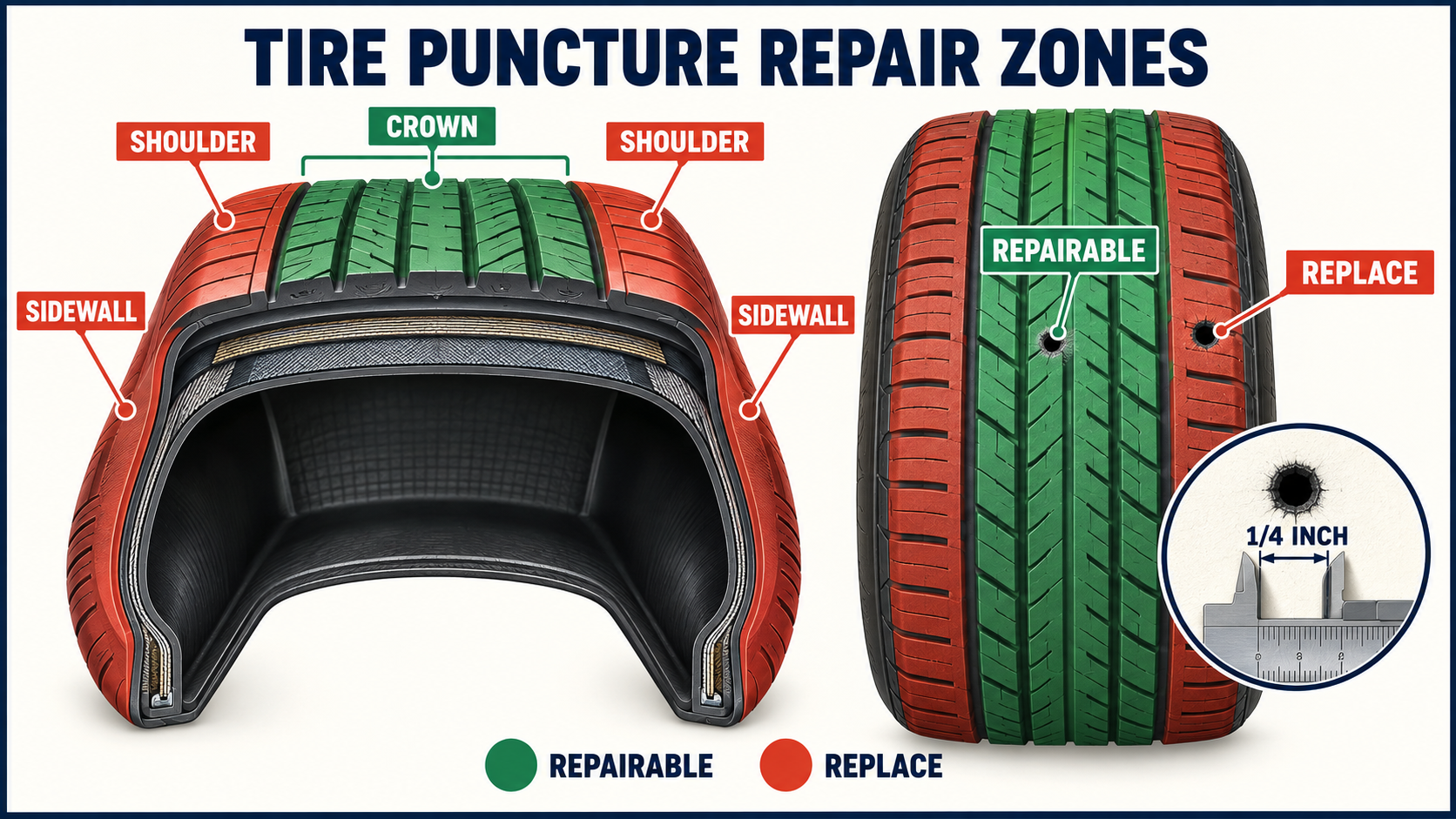
1. Is it in the crown?
The crown is the central tread that touches the road, bounded roughly by the first major groove on each side. USTMA limits repairs to that area: damage in the shoulder, where the tread curves toward the sidewall, or in the sidewall itself, is not repairable full stop, regardless of size. If there's any question the injury extends into the shoulder or belt-edge area, USTMA's own guidance is that the tire must be taken out of service.
Check where the puncture is before you accept any answer. If it's in the crown, it's usually repairable; if it's in the shoulder or sidewall, it isn't no repair method changes that.
2. Is it 1/4 inch or smaller?
USTMA's limit is a puncture injury no greater than 1/4 inch (6mm) in diameter. Above that, in any location, the tire isn't repairable to standard.
3. Does it overlap an earlier repair?
USTMA is explicit: repairs cannot overlap, and a tire with an existing improper repair (a plug-only or patch-only job, for instance) must be scrapped rather than repaired again.
An ASE-certified technician who contributes to one of the national cost guides described pulling a tire off a customer's car for a routine plug job and finding three earlier plugs clustered close together. Each one had stopped its own leak individually, but stacking that many repairs into one tire had already weakened the surrounding rubber the recommended replacement instead of a fourth patch, precisely because USTMA's no-overlap rule exists for a reason like that one.
4. Was it driven flat?
Running a tire at or near zero pressure, even briefly, can cook and separate the inner liner in ways that aren't visible from outside and a liner that's been damaged that way isn't safely repairable even if the puncture itself would have qualified.
Don't drive on a flat to reach a shop. Running at zero pressure can destroy the inner liner and turn a $30 repair into a $250 tire.
What Tire Repair Costs in Miami
A national cost aggregator's own guidance notes that urban and coastal markets often add $5–$20 to its baseline figures. No shop's website in Miami publishes a comparable, machine-readable price list Howie's Tire Wheel, a Miami shop in business since 1963, lists tire repair among its services but doesn't post pricing online so nobody currently gives you Miami-specific numbers to check a quote against.
National figures are attributed to Jerry (auto repair cost estimates) and TireAgent, accessed September 2026. No Miami sample is shown here pricing a representative spread of Miami shops (independent, chain, and used-tire outlets) wasn't done for this edition, so rather than estimate a local range, it's left out. Treat the national figures as a floor for comparison and confirm against a written quote.
Ask whether the quote includes dismount, the combination repair, and rebalancing. Those three are the repair; a price that leaves one out is quoting a different service.
Plug vs. Patch vs. Combination: What You're Buying
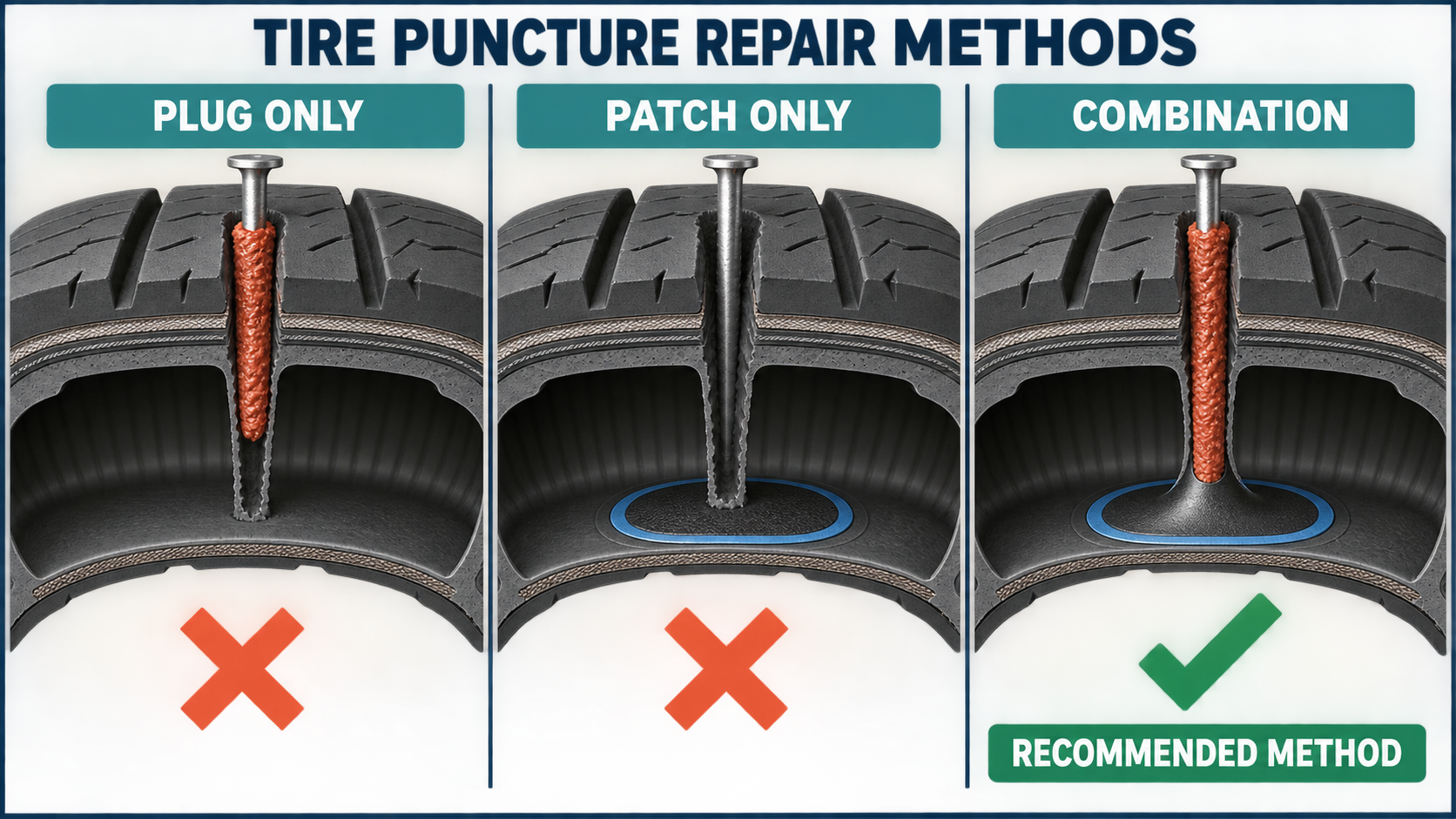
Plug only
A rubber strip pushed in from outside the tire, without removing it from the wheel. Quick, cheap, temporary.
Patch only
Seals the inner liner from the inside but leaves the puncture channel itself open, which lets moisture reach the steel belts inside the tire over time corrosion that's invisible from outside and doesn't improve with time.
Plug-and-patch combination
The industry standard. The tire comes off the wheel, the inside is inspected, the puncture channel is filled and the inner liner is sealed usually with a one-piece combination unit that does both jobs at once.
Ask whether the tire will actually be taken off the wheel. A repair done from outside skips the internal inspection that finds hidden damage USTMA calls this an “outside-in” repair and says never to perform one.
When Replace It Is the Right Answer
Most replacement calls are correct. The goal here is understanding why, not doubting them.
•       Shoulder or sidewall damage
•       Holes larger than 1/4 inch
•       Overlapping or clustered repairs
•       Damage from being driven flat
•       An existing improper repair
•       Tread worn to the legal minimum
•       An aged tire
Some shops decline to repair tires under roughly 3/32 to 4/32 inch of remaining tread, or older than about 6 to 8 years, even where the puncture itself would otherwise qualify. That's shop policy layered on top of the USTMA standard a reasonable one not the standard itself, and it's worth knowing the difference when a shop explains its reasoning.
If a shop says it's unrepairable, ask: “Can you show me where it is and why it's outside the repair zone?” A good technician will show you, often from inside the tire.
Run-Flat, Low-Profile and Speed-Rated Tires
Miami has a high share of luxury and performance vehicles on the road, and these tire types carry different rules than a standard passenger tire.
•Run-flats: engineered to be driven briefly without air, but that use still damages the internal structure. They're often not repairable, and many shops decline to repair them at all.
•Low-profile: harder to dismount and remount without damage, which is part of why the repair range runs higher.
•Speed-rated: USTMA directs technicians to check the tire manufacturer's own policy on whether the speed rating is retained after a repair it isn't automatic.
What Else Ends Up on the Bill
Re-balance: Needed whenever the tire comes off the wheel.
Expert Tip: Ask whether rebalancing is included in the quoted repair price.
TPMS service kit a small valve-stem or sensor-seal component, often replaced any time the tire is dismounted.
Expert Tip: Ask about it before the work starts. It's a small, legitimate charge that helps prevent slow leaks afterward, but it should be disclosed up front, not added as a surprise line.
Sealant cleanup Extra labor if a can of Fix-a-Flat or similar sealant was used before the shop visit.
Expert Tip: Tell the shop if you used Fix-a-Flat or Slime. It may add a cleanup charge and can affect the TPMS sensor if it gets inside.
Florida's $1 new-tire fee imposed under Florida Statute $403.718 on every new motor vehicle tire sold at retail in the state, required to be stated as a separate line on the invoice, and included in the base subject to sales tax. It does not apply to recapped tires.
Expert Tip: Look for it as a separate line on any new-tire purchase. It's a legitimate, statutorily required fee not padding.
Sales tax Miami-Dade County's combined sales tax rate is 7% (Florida's 6% state rate plus the county's 1% surtax), applied to both tires and most repair labor.
Written estimate Florida's Motor Vehicle Repair Act requires a shop to prepare a written estimate before starting work whenever the repair is expected to exceed $150 (Fla. Stat. §559.905    note this threshold was raised from $100 to $150 by a 2024 statutory update). Most single tire repairs won't reach that; most replacements, especially of more than one tire, likely will.
This is general information about Florida law, not legal advice. See Chapter 559, Part IX, Florida Statutes, and FDACS's own guidance on motor vehicle repair estimate and invoice requirements for the complete rules.
Buying Used Tires in Miami
Used tires are a large, legal, and often sensible part of the Miami market. The job here is teaching you to check one before you buy it, not talking you out of considering them.
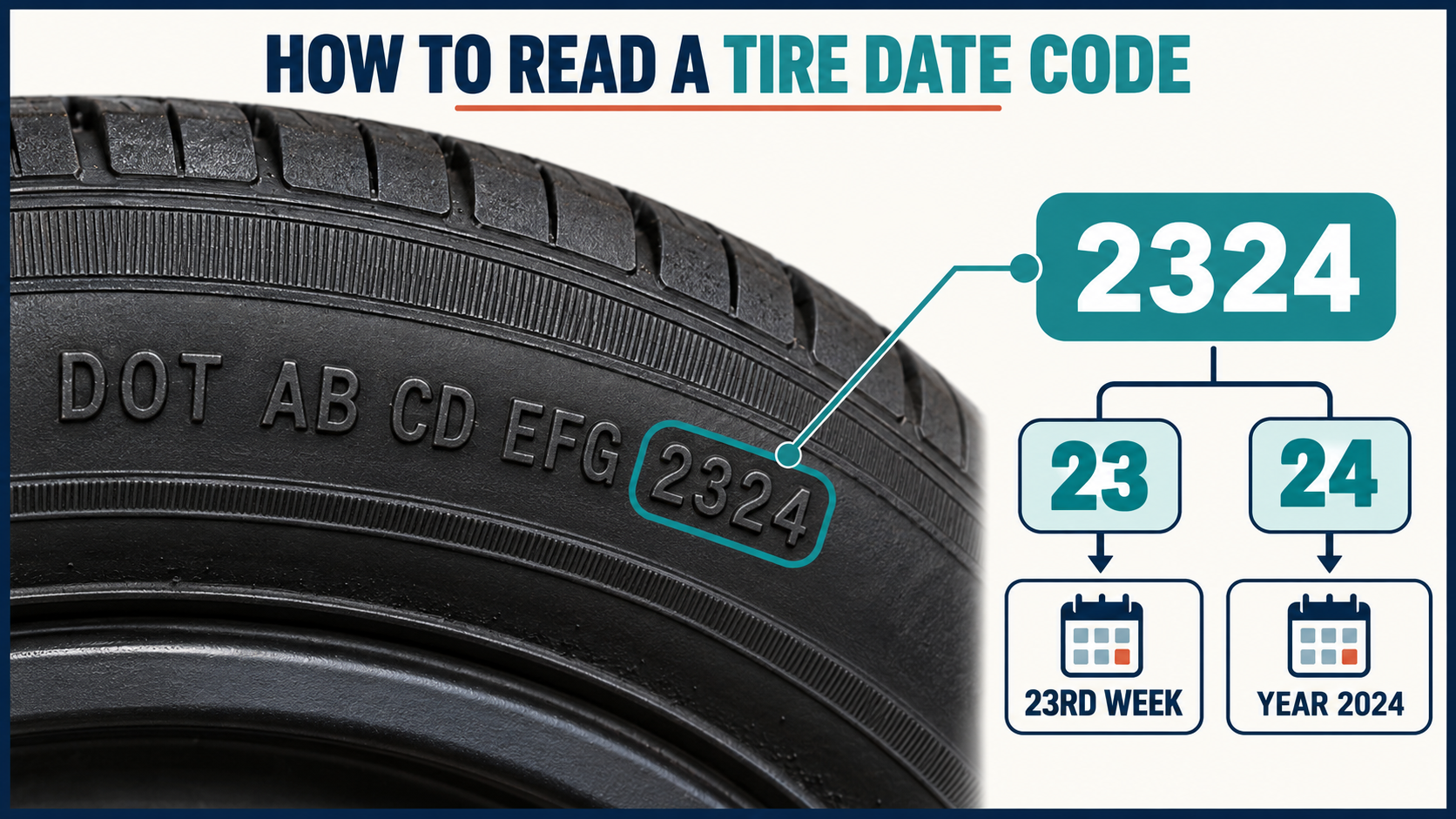
Read the DOT code
Expert Tip: The last four digits of the DOT code on the sidewall are the week and year the tire was made “2419” means the 24th week of 2019. A tire with plenty of visible tread can still be too old to trust.
What to look for
Expert Tip: Walk away from any used tire with old plugs clustered close together, or a repair near the shoulder. Tires with improper repairs should have been scrapped under the industry standard, not resold.
•Uneven wear across the tread
•Sidewall cracking (a sign of age even on low-mileage tires)
•Bulges or bubbles, which indicate internal structural damage
•Mismatched brands or sizes across a set
AWD vehicles
On an all-wheel-drive vehicle, ask whether a single replacement tire will match the others closely enough in tread depth and circumference. You may need to buy a pair rather than one.
Flat on the Highway in Miami: Free Help
Neither national reference mentions that Florida runs free roadside programs covering exactly the highways a Miami driver is most likely to be stranded on.
•FDOT Road Rangers: free highway assistance on Florida's major highways dial *347 from a mobile phone.
•Greater Miami Expressway Agency (GMX) Road Rangers: patrol the Dolphin (SR 836), Airport (SR 112), Don Shula (SR 874), Snapper Creek (SR 878), and Gratigny (SR 924) expressways around the clock, and list flat tires among the situations they assist with.
Save *347 in your phone now. Changing a tire on a narrow Miami shoulder is dangerous let a Road Ranger help, or get the car to a wider, safer spot first.
Does This Price Table Match the Service?
A transferable skill, not a complaint about any one publisher.
•Check that example jobs are for the service you're pricing. As of this writing, one national tire-patch cost page's “real customers” example table was populated entirely with ignition coil replacement jobs apparently a template or data-feed mismatch on that specific page.
•Check that locations match your market. That same table's only two Florida rows were New Port Richey and Winter Park    neither is Miami-Dade.
•Check whether the figures are real or modeled. That page's own footnote states the estimates are modeled based on real vehicle and location data, with names changed useful directional data, not verified individual transactions.
To be fair to that page: it also does several things well worth crediting a named ASE-certified co-author, a named editor, a visibly recent update date, and a clear line-item breakdown of what typically shows up on a tire-repair bill. The mismatched table looks like a rendering or template issue on one specific page, not a sign the underlying cost guidance is unreliable. Read the numbers, but check that the example rows actually match what you're pricing before you trust them.
Frequently Asked Questions
How much does it cost to patch a tire in Miami?
Nationally, a proper plug-and-patch combination repair runs about $20 to $45 per tire, or $40 to $75 for run-flat or low-profile tires. No Miami-specific shop sample is available in this edition    use the national range as a starting point and confirm with a written quote.
Is a tire plug safe?
As a temporary measure to get you to a shop, yes. USTMA does not consider a plug alone a complete or safe permanent repair    it must be paired with an internal patch to seal the liner.
Can a tire be plugged near the sidewall?
No. USTMA limits repairs to the crown, the central tread area. Shoulder and sidewall damage cannot be repaired regardless of size or method.
How many patches can a tire have?
Repairs cannot overlap, per USTMA. A tire with multiple punctures clustered close together, or an existing improper repair, should be replaced rather than patched again.
Does Fix-a-Flat ruin a tire?
Not always, but it can add a cleanup charge at the shop and may affect the TPMS sensor if sealant gets inside it. Tell the technician you used it before they start.
Can a run-flat tire be repaired?
Sometimes, but often not    the brief zero-pressure driving that run-flats are designed for still damages the internal structure. Many shops decline to repair run-flats at all; ask before you assume.
How old is too old for a tire?
Read the DOT code on the sidewall for the manufacture date. Beyond that, some shops set their own policy declining repairs on tires older than roughly 6 to 8 years, separate from the USTMA repairability standard itself.
Why was I charged a $1 tire fee?
Florida imposes a $1 waste tire fee on every new motor vehicle tire sold at retail in the state, under Florida Statute §403.718. It must appear as its own line on the invoice and is subject to sales tax; it doesn't apply to recapped tires.
Do Road Rangers help with flat tires?
Yes, on covered highways. Dial *347 for FDOT's Road Rangers on major highways, or reach GMX's Road Rangers on the Dolphin, Airport, Don Shula, Snapper Creek, and Gratigny expressways, where they patrol around the clock.
How do I know a used tire is safe?
Check the DOT code for its manufacture date, look for uneven wear, sidewall cracking, or bulges, and walk away from any tire with old repairs clustered together or located near the shoulder.
