
What to Do Right Now When Your Car Overheats
Overheating Right Now? Start Here
Follow these steps to reduce the risk of engine damage and get safely
away from moving traffic.
Switching off the air conditioning reduces the load placed on the
engine.
Set the heater to maximum and the fan to full. This can temporarily
pull some heat away from the engine.
Alert surrounding drivers and immediately begin looking for a safe
place to stop.
Pull completely away from moving traffic—not just partially onto the
shoulder.
Once you are safely stopped, shut down the engine to prevent
additional heat and possible damage.
Keep clear of steam or leaking fluid and allow the engine to cool
before approaching the cooling system.
Dial
*347.
Tell the operator your road, direction of travel and nearest exit or
mile marker.
Do not pour water onto the engine or touch the radiator cap while the
cooling system is hot or pressurized.
What to Do If Your Car Is Overheating
If you're reading this from the shoulder, the steps are above. Everything below is for once you're safe.
Here's what's strange about the guides that rank for this search. The two best ones, from AAA(American Automobile Association) and Firestone, are both mechanically sound, and both bury the emergency instructions beneath a long explanation of how a cooling system works. Neither publishes a single dollar figure, despite cost being half of what people are actually asking. And neither mentions that Florida runs three separate free roadside assistance programs covering the exact highways a Miami driver is most likely to break down on.
They also contradict each other on the two decisions that matter most: whether to top off coolant and keep driving, and whether to get out of the car or stay in it. This guide walks through both contradictions honestly instead of picking a side and pretending it's settled.
What follows covers the free help and how to reach it, where you can and can't safely stop in this city, why Miami produces this failure more than most places, how to tell a cheap repair from an expensive one before the shop tells you, what each repair actually costs, and what your rights are on the bill once your car has been towed somewhere you didn't choose. By the end, you'll know who to call for free, what's probably wrong, roughly what it should cost, and what the shop legally owes you in writing.
Miami Goes Local is a business directory. We perform no repairs, sell no memberships, and paid placement cannot buy inclusion or position in anything recommended here. That's worth naming because it's the whole reason this page looks different from the two it's competing with: AAA's guide resolves into AAA roadside assistance, AAA membership, and AAA Approved Auto Repair facilities. Firestone's resolves into a Firestone inspection appointment. Both give sound advice. Neither has any reason to tell you a free state program exists.
Free Roadside Help in Miami: Three Programs, Three Coverage Areas
Neither AAA's guide nor Firestone's mentions any of these. AAA's resolves every scenario into calling AAA a paid membership service. This is the headline differentiator on this page, and it's also the most shareable thing here: three separate agencies will come get you off a Miami highway for free, and one phone number reaches all three.
FDOT Road Rangers *347
The Florida Department of Transportation runs free, no-cost highway assistance on the state's interstates, state highways, and Florida's Turnpike, sponsored by GEICO. Drivers get flat tire changes, jump starts, emergency fuel, water, and two free local calls, and the Road Ranger will clear a disabled vehicle out of the travel lane. Response is typically 15 to 30 minutes, per FDOT's own program FAQ, unless the truck is tied up at a crash.
Save *347 in your phone now. It is the number you will not be able to look up calmly while stranded, and it costs nothing to call.
If your mobile carrier doesn't support the *347 shortcode, FDOT routes you instead to the Florida Highway Patrol's regional communication centers worth checking before you're actually stuck.
Greater Miami Expressway Agency (GMX) Road Rangers   the expressways
GMX (the agency formerly known as the Miami-Dade Expressway Authority) patrols the Dolphin (836), Airport (112), Don Shula (874), Snapper Creek (878), and Gratigny (924) expressways 24 hours a day, seven days a week. You reach them the same way   dial *347   but GMX's Traffic Management Center also watches these five roads by camera, so a Road Ranger is sometimes already en route before your call connects. Local reporting on the program puts typical response on these expressways at under 15 minutes
Know which program covers your commute. If you drive the Dolphin or the Gratigny daily, you're getting a second layer of camera-based dispatch that the interstates don't have one more reason *347 should already be in your phone.
GMX's own guidance for these five roads is specific: put your hazards on, pull outside the travel lanes, lock your doors, and stay inside the vehicle until the marked Road Ranger arrives.
Florida's Turnpike Road Rangers Safety Patrol
A third, separately administered patrol covers the Turnpike mainline and its extensions, also reached at *347, with calls routed through the Florida Highway Patrol. Don't confuse it with STARR (Specialty Towing And Roadside Repair)   a related but paid Turnpike service, also dispatched via *347, that handles tows, tire changes, gas, and lockouts for a fee the operator discloses upfront on a fee sheet.
What "free" actually covers: Road Rangers will try to get you moving, or move your vehicle clear of the travel lane. The tow itself, once it's needed, is a paid service either through STARR or a shop you choose. Knowing that in advance stops the disappointment from becoming a delay.
FDOT, GMX, and Florida's Turnpike Enterprise are the sources behind every claim in this section  on a page whose main asset is a phone number, that number has to come from the agencies that run it.
Where to Pull Over in Miami  and Where You Can't
"Pull over safely" is the standard instruction, and it is not simple advice in this city. It's also absent from every competing guide.
Some of Miami's barrier-separated express lanes and narrower causeway crossings offer no usable shoulder at all, which means the nearest safe stop can be further away than the nearest stop. Rather than naming specific segments   getting that wrong could send someone to a worse place to stop than where they started   the categories worth watching for are barrier-separated express lanes, bridge spans, and narrow causeway crossings. If your gauge allows it, keep moving to the next exit or the next wide shoulder rather than stopping in one of these.
Get completely out of the travel lane, not mostly out. Road Rangers have been struck and killed working Florida shoulders, and Florida's Move Over law exists because shoulders are genuinely dangerous places to stand. This is not a formality.
If the temperature gauge allows it, a parking lot, a wide shoulder, or a surface street beats stopping on a bridge or in an express lane  but weigh that against the damage risk of continuing to drive. With the AC off and the heater blasting, you usually have a short window before that trade-off flips.
Stay in the Car or Get Out?
This is a genuine, citable conflict between two authoritative sources that nobody has reconciled   and it's worth showing the fork rather than pretending it's settled.
AAA's general roadside guidance says that if you can't get your vehicle to a location away from traffic, or you're uncertain about your safety and think you could be struck from behind, you should get out of the vehicle and move away from the road to a safer location   exiting, if possible, through the side facing away from traffic. FDOT's own Road Ranger FAQ says the opposite for a stalled vehicle already clear of the travel lane: stay inside your vehicle and wait for help to arrive. GMX goes further for its five Miami expressways specifically, instructing drivers to lock the doors and remain in the vehicle until a marked Road Ranger arrives.
Both positions are credible, the disagreement is real, and the right call is situational rather than universal. What should decide it: shoulder width, traffic speed, whether a barrier separates you from the travel lane, whether there's shade, and how long help is likely to take. A stalled car with a wide, barrier-separated shoulder and a five-minute wait is a very different situation from a narrow shoulder on a fast, undivided road.
There's a Miami-specific factor neither source weighs: heat. Watch for dizziness, nausea, headache, confusion, or sweating that suddenly stops   that last one, according to the CDC, is a sign the body is losing its ability to cool itself and can signal the shift from heat exhaustion toward heat stroke. A car with no AC in August heat is not a neutral place to wait. If there's shade nearby and the shoulder is wide and safe, getting out may matter more than staying in.
: If you or a passenger show anything resembling confusion, hot dry skin, or a stopped sweating response in the heat, treat it as an emergency and call 911 that's a heat stroke warning sign, not something to wait out.
Why Miami Overheats Cars
AAA notes, correctly, that stop-and-go traffic stresses an engine more than highway driving because the engine idles more. In a city that's mostly stop-and-go, that's most of the story   but Miami adds a few things neither national guide accounts for.
Your AC is fighting your radiator
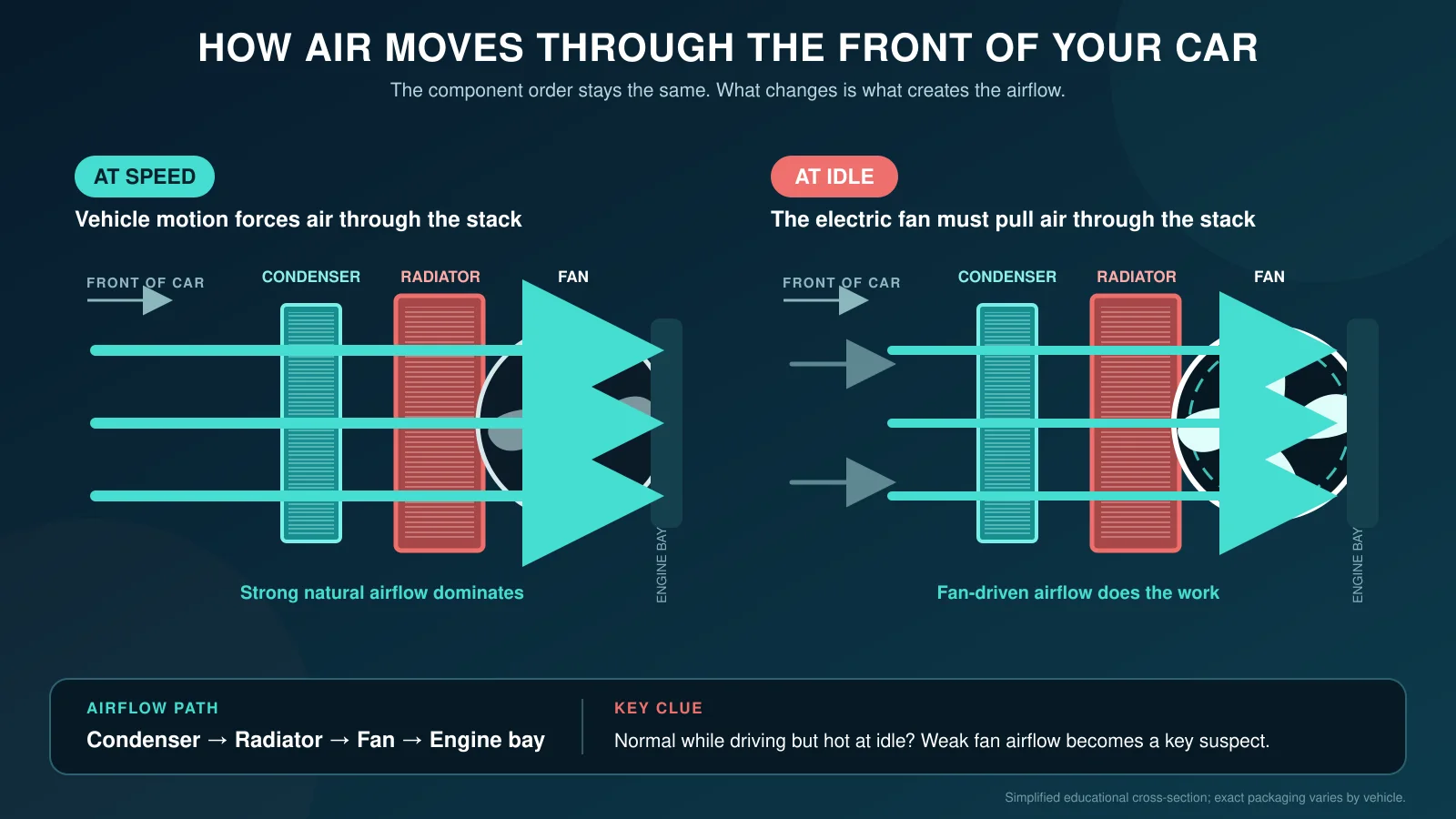
The AC condenser sits mounted directly in front of the radiator, so running the AC adds heat load at exactly the moment airflow is lowest   sitting still, in traffic, in August.
: If the gauge is climbing, turn the AC off first, before anything else. In Miami this feels like the wrong instinct. It's the right move.
Idling produces less airflow than driving
At speed, air is forced through the radiator by the car's own motion. At a standstill, only the cooling fan is doing that work   which is exactly why fan failures tend to show up in traffic and nowhere else.
Portions of the Palmetto Expressway (SR 826) carry more than 250,000 vehicles a day, according to FDOT's traffic count data   a lot of idling, a lot of AC compressors running, a lot of engines relying entirely on a fan that has to work.
Sustained heat narrows the margin
A cooling system engineered with headroom has less of it to spare when the ambient temperature is already high for months at a stretch, rather than for a few weeks a year.
Salt and humidity
Replace radiator hoses and clamps on age rather than appearance. Heat and humidity degrade rubber from the inside, and a hose that looks fine can be weeks from failing. Coastal air also attacks clamps, radiator fins, and the cap.
When It Overheats Tells You What's Wrong
This is a diagnostic frame neither competing guide offers   presented as vocabulary for talking to a shop, not as a substitute for one.
| When It Happens | What It Points Toward | Rough Cost Tier |
|---|---|---|
| Only at idle or in slow traffic | Airflow issue: cooling fan, fan clutch, blocked condenser or radiator fins | Lower |
| At highway speed | Coolant-flow issue: thermostat, water pump, blockage or low coolant | Low to mid |
| Both, gradually worsening | Coolant loss from a leak: hoses, radiator or water-pump seal | Mid |
| Fast onset, disappearing coolant, no visible leak or white exhaust | Possible head-gasket failure | Highest |
Important: These symptoms are general diagnostic clues, not a confirmed diagnosis. Stop driving if the temperature warning appears or the gauge enters the red zone, and have the vehicle inspected.
Note when it overheats before you call anyone. "Only in traffic" versus "at 70 on the Turnpike" narrows the diagnosis immediately and will make your conversation with a shop twice as productive.
Credit where it's due: AAA's list of eight causes and Firestone's list of seven signs are both accurate and thorough, and the component explanations above build on that same mechanical groundwork. What this table adds is the when, not the what.
Overheating While Sitting in Miami Traffic
This is the most common local version of the problem, and the one neither national guide addresses directly.
What's actually happening on the Palmetto at 6pm
Heat load is high, airflow is near zero, and the AC compressor is running the whole time. The gauge often recovers once you start moving again   which is itself diagnostic. If it drops back down as soon as air starts moving, airflow was the problem, not a leak.
If you're boxed in and can't pull over
Shift to neutral and raise the engine speed briefly. It moves more coolant and more air through the radiator than idling does. This is a stopgap to buy you the distance to an exit, not a fix.
Where recovery ends and damage begins
Continuing to drive an overheating engine can warp cylinder heads and crack the block. The line between "it recovered" and "it's ruined" is roughly the line between the needle easing back toward normal and the needle staying pinned in the red.
The evacuation case
Hurricane evacuation gridlock deserves its own mention here, briefly and seriously. Hours of idling in stationary traffic in summer heat is a predictable overheating scenario   and a genuinely dangerous one, because the roadside options are worse and help is slower with everyone else trying to leave at the same time. That's the argument for a pre-season cooling system check, not a post-storm repair bill.
The Coolant Question: Top Off and Drive, or Call a Tow?
This is the second real contradiction between the competing guides, and the most consequential decision on this page.
Firestone's published guidance is specific: once the engine has fully cooled   the gauge reads cool, not normal   you can carefully top off the coolant reservoir, then restart and drive to the nearest repair shop while watching the gauge, pulling over again if it climbs. AAA's broader safety guidance is more conservative: it treats an overheated engine as something to shut down and get help for rather than something to nurse to a shop, and standard mechanical safety practice backs that caution   a hot cooling system can cause real burns, and driving on with insufficient coolant can turn a hose replacement into thousands of dollars of engine damage.
Both positions have real reasoning behind them, and the honest answer is situational rather than settled.
What It Costs to Fix
Neither AAA's guide nor Firestone's publishes a single dollar figure, on a topic whose entire premise includes cost. The numbers below are current national averages from RepairPal, accessed September 2026; a Miami-specific column isn't included here because it wasn't sampled across local shops for this piece   treat the national ranges as a floor for the conversation, then get an itemized local quote before you agree to anything.
| Repair | National Average RepairPal, accessed September 2026 |
|---|---|
| Cooling-system pressure test | $40–$170 |
| Coolant flush or exchange | $437–$508 |
| Radiator cap | $10–$40 Part cost; often bundled into a pressure test |
| Thermostat replacement | $609–$709 |
| Radiator hoses and clamps | $150–$700+ Varies by vehicle and the number of hoses replaced |
| Cooling fan or fan clutch | $350–$1,300+ Depends on whether the motor, clutch or full assembly is replaced |
| Water-pump replacement | $885–$1,134 |
| Radiator replacement | $1,368–$1,550 |
| Head-gasket replacement | $2,572–$3,386 |
Source: RepairPal national-average estimates, accessed September 2026. Actual Miami repair prices may vary by vehicle, labor rate, parts selection, diagnostic findings and taxes.
Ask specifically whether the diagnosis is the thermostat, the fan, the water pump, or the head gasket, and what the cost difference is between them. Those four answers span roughly an order of magnitude, and the word "overheating" on an invoice tells you nothing on its own.
These are national averages, not Miami quotes  the two should never be merged into one number. If a future update to this page adds a local sample, it'll be labeled separately, the same way this one is.
After the Tow: Your Rights on the Repair Bill
An overheating breakdown is the classic pressured repair decision: your car is at a shop you didn't choose, you're not standing there, and the quote arrives by phone. Neither competing guide mentions consumer rights at all   and Florida's Motor Vehicle Repair Act (Chapter 559, Part IX, Florida Statutes) gives you more leverage here than most drivers realize.
•       A written estimate. Florida requires one for any repair expected to exceed $150, presented as a conspicuous, blocked disclosure you're asked to read and sign ($ 559.905). That threshold was raised from $100 in a 2024 update to the statute, so if you've seen the older figure elsewhere, this is the current one.
•       You can't be made to waive it. A shop may not require you to give up that right as a condition of doing the work ($ 559.907).
•       They must call before exceeding it. If the actual cost will run more than $10 or 10 percent over the written estimate, whichever is greater, the shop has to notify you before doing the extra work; unlawful charges are prohibited, and refusing to return your vehicle over a billing dispute is prohibited (§ 559.909).
•       An itemized invoice, with each replacement part identified as used, rebuilt, or reconditioned ($ 559.911).
Ask for the written estimate before authorizing anything, even over the phone. A breakdown is exactly the situation where that protection is worth using, and exactly the situation where people skip it.
This is general information about Florida law, not legal advice  for a serious dispute, a consultation with a Florida consumer or contract attorney is worth the hour.
Frequently Asked Questions
Can I drive my car if it's overheating?
It depends on whether coolant is disappearing. Firestone's guidance allows a careful drive to the nearest shop after a full cool-down and a coolant top-off, watching the gauge the whole way; AAA's broader safety guidance leans toward stopping and calling for help rather than continuing on. If the system is actively losing coolant, treat it as a tow situation   driving on a leak is how a cheap repair becomes an expensive one.
Who do I call for free roadside help in Miami?
Dial *347. It reaches FDOT's Road Rangers on interstates and state highways, GMX's Road Rangers on the Dolphin, Airport, Don Shula, Snapper Creek, and Gratigny expressways, and Florida's Turnpike Road Rangers on the Turnpike system. The roadside assistance itself is free; a tow beyond that point is a paid service.
How long should I wait before opening the hood?
At least 15 to 30 minutes, and only once the gauge reads cool rather than normal. Never open the radiator cap while the system is still hot.
Can I add water instead of coolant?
In a genuine emergency, plain water can buy you distance to a shop, but never pour it onto a hot engine   thermal shock can crack components. Get the coolant mixture corrected properly as soon as you can; water alone doesn't protect against freezing or corrosion the way a proper coolant mix does.
Why does my car overheat in traffic but not on the highway?
Airflow. At speed, air is forced through the radiator by the car's motion; at a standstill, only the cooling fan does that work. See the diagnostic table above   idle-only overheating usually points toward the fan or a blocked radiator, not a leak.
Does running the AC cause overheating?
It contributes. The AC condenser sits directly in front of the radiator, so the AC adds heat load at exactly the moment   sitting still, in traffic   when airflow is already at its lowest.
How much does it cost to fix an overheating car?
It depends entirely on the diagnosis. A cooling system pressure test runs roughly $40 to $170; a thermostat or coolant flush is generally under $700; a full radiator or water pump replacement runs into four figures; a head gasket is the most expensive common diagnosis, typically $2,500 to $3,400. See the cost table above for current national averages.
Is my head gasket blown?
Fast-onset overheating, disappearing coolant with no visible leak, and white exhaust smoke are the classic indicators   but this is a "ask a shop to test for it" situation, not a self-diagnosis. A pressure test and a combustion leak check will confirm it either way.
Should I use coolant stop-leak products?
Use caution. They can temporarily slow a small leak, but they can also clog narrow passages elsewhere in the system and complicate a proper repair later. If you use one as an emergency measure, tell the shop exactly what you added before they diagnose anything.
How do I know if the shop's estimate is fair?
Ask for the written estimate Florida law entitles you to for any repair over $150, compare it against the national cost ranges above, and get a second quote if the car is still drivable enough to move it.
