
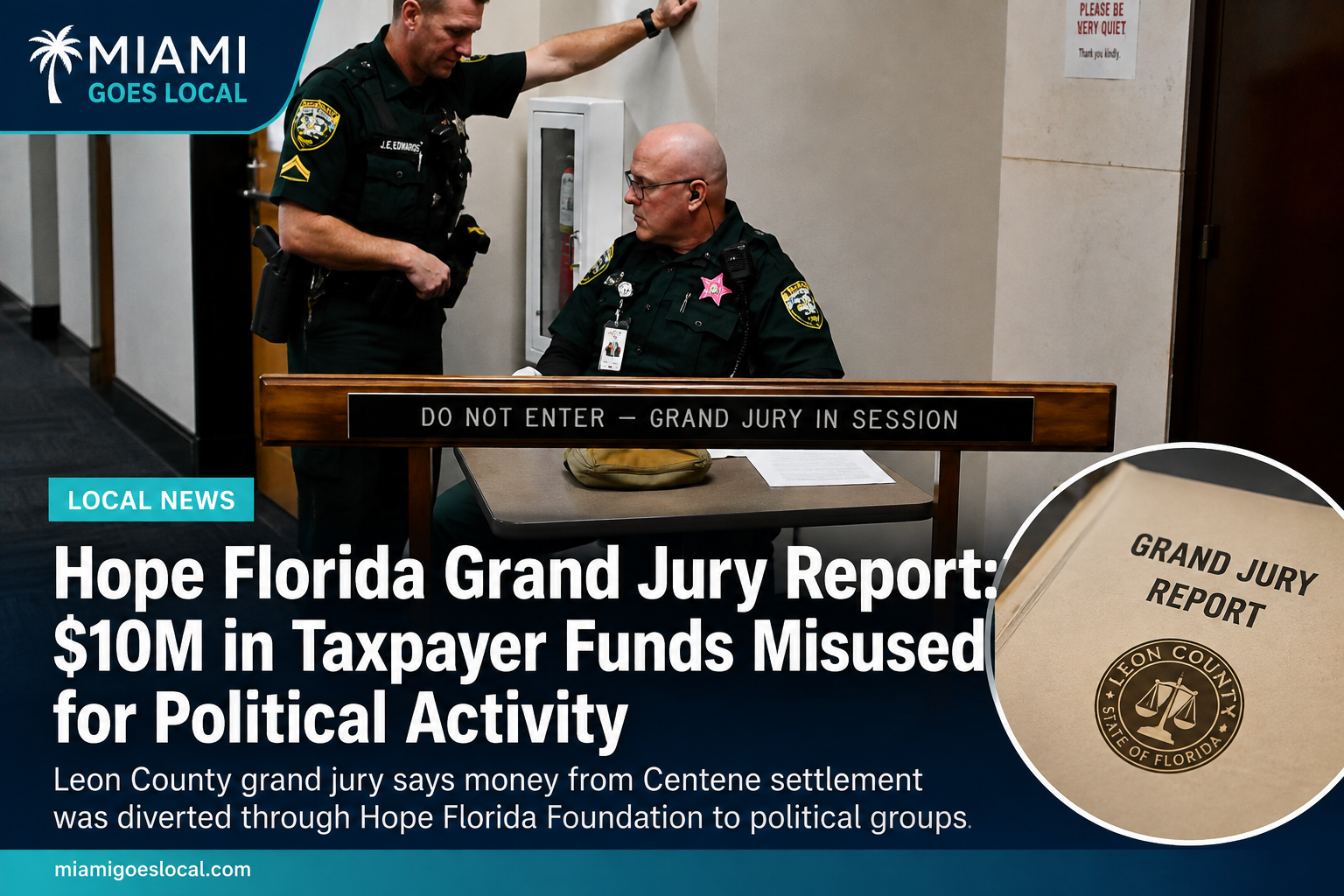
The Leon County grand jury found that $10 million tied to a Medicaid settlement was improperly redirected through the Hope Florida Foundation and ultimately used for political activity, though jurors said they lacked enough evidence to bring criminal charges.
A Leon County grand jury has concluded that $10 million connected to a major Medicaid settlement was misappropriated after being diverted from state coffers to the Hope Florida Foundation and later routed through nonprofit groups into political activity.
The sealed report, made public Wednesday night by CBS Miami, examined how part of a $67 million settlement with healthcare contractor Centene moved through the state-backed charity and eventually helped finance efforts opposing Florida's 2024 recreational marijuana amendment.
The grand jury said it could identify misuse of taxpayer money but could not determine who was legally responsible for the original decision.
“While we can’t prove who is responsible, we can plainly see that taxpayer money was misused for political purposes,” jurors wrote, while also calling for changes aimed at preventing a similar situation in the future.
How the $10 Million Moved
The case centers on a $67 million settlement involving Centene, a healthcare contractor accused of overbilling taxpayers for medications.
According to the grand jury report, negotiations over that settlement accelerated in September 2024 after years of limited movement.
Government officials and attorneys changed the agreement so that $10 million would go to the Hope Florida Foundation instead of being returned directly to the state.
Hope Florida was created by the DeSantis administration as part of an initiative associated with First Lady Casey DeSantis and designed to connect struggling Floridians with private and community-based assistance rather than government benefits.
The foundation held the $10 million only briefly before distributing it in two $5 million grants.
Those grants went to:
- Secure Florida’s Future
- Save Our Society from Drugs
The grand jury found that most of that money eventually went to a political committee controlled by James Uthmeier, who was serving as Gov. Ron DeSantis’ chief of staff at the time.
The funds were then used as part of the campaign against Amendment 3, the 2024 ballot initiative that would have legalized recreational marijuana in Florida.
Grand Jury Calls Initial Transfer the “Original Misappropriation”
Jurors focused heavily on the decision to carve $10 million out of the settlement and direct it to Hope Florida.
The report described that decision as the “original misappropriation.”
Among the questions the grand jury examined were who changed the settlement, why the money was redirected and whether any public officials committed criminal or otherwise improper acts in the process.
Jurors said the explanation given for choosing Hope Florida did not hold up under scrutiny.
They were told the foundation was selected because the Centene settlement involved money connected to healthcare services for low-income children and Hope Florida's mission included helping people in need.
But the grand jury said witnesses lacked a clear understanding of how the foundation operated, where it existed organizationally or what role it would actually play.
The report also noted that the money remained in Hope Florida's account for only a matter of days before being transferred elsewhere.
Settlement Was Rushed, Report Says
The grand jury also questioned how quickly the settlement came together.
According to the report, negotiations that had been largely inactive for years suddenly advanced rapidly in the fall of 2024.
Jurors also noted that the administration did not publicly highlight the recovery of tens of millions of dollars for taxpayers and that the Florida Legislature was not informed about the arrangement.
The agreement contained no restrictions directing how the $10 million donated to Hope Florida had to be spent.
That allowed the foundation to distribute the entire amount to two organizations without a competitive bidding process, according to the report.
Why No Criminal Charges Were Filed
Despite its findings, the grand jury said it did not have enough evidence to charge an individual with a crime.
A major obstacle was establishing who actually made the decision to send $10 million from the settlement to Hope Florida.
According to the report, no witness accepted responsibility for that decision, and witnesses repeatedly said they could not remember who originated the change.
Jurors also noted that many of the people involved were attorneys who said they were acting based on legal advice from other attorneys, complicating the possibility of a criminal prosecution.
James Uthmeier’s Role Examined
The grand jury report also examined the role of James Uthmeier.
Uthmeier, who later became Florida attorney general, had authority over officials involved in the settlement while serving as DeSantis' chief of staff, according to the report.
Jurors said he also played a role in directing the money after it reached Hope Florida.
Text messages cited in the report show that Uthmeier encouraged one of the nonprofit groups to apply for a $5 million grant from the foundation.
His Keep Florida Clean political committee ultimately received most of the money connected to the original $10 million, according to the grand jury.
Uthmeier was not interviewed by the grand jury.
Grand Jury Says the Full $67 Million Belonged to Taxpayers
One of the central disputes was whether the final $10 million should be considered taxpayer money.
The DeSantis administration had argued that the amount was effectively an additional payment and did not have to be returned to the state.
The grand jury rejected that argument.
Jurors concluded that the entire $67 million settlement represented money owed to Florida taxpayers as compensation for damages connected to Centene's overbilling.
That meant the final $10 million should also have been treated as taxpayer funds, according to the report.
Officials Criticized for Lack of Due Diligence
The report found that several officials who approved or handled the agreement failed to sufficiently scrutinize how the money would be used.
Then-Chief Deputy Attorney General John Guard and Florida Department of Health Chief of Staff Cassandra Pasley signed the settlement agreement, but jurors said they did not adequately ensure that taxpayer money would be properly appropriated.
Guard has since been appointed by DeSantis to serve as a judge on Florida's Second District Court of Appeal.
The grand jury also examined former Hope Florida Foundation chairman Joshua Hay.
Jurors noted that the foundation received a $10 million contribution roughly 100 times larger than any previous donation it had handled.
Soon afterward, the board approved transferring the full amount to the two organizations that applied for grants.
Some Witness Testimony Raised Concerns
The report differentiated sharply between witnesses it considered credible and those whose testimony raised concerns.
Jurors described Hay's testimony as transparent and credible.
By contrast, they questioned the credibility of Jeff Aaron, an attorney who advised the Hope Florida Foundation board and who the report said had personal and professional relationships with Uthmeier and DeSantis.
Hay testified that Aaron informed him the foundation would receive the $10 million.
Aaron, however, told the grand jury he was unaware of the Centene settlement when reviewing the first $5 million grant application.
The report also criticized testimony from Katie Strickland, a deputy chief of staff in the governor's office who reported to Uthmeier.
Jurors described Strickland as the least informative witness and said she recalled little about the settlement.
The grand jury also rejected several explanations offered by Jason Weida, who led settlement negotiations in 2024 as head of Florida's Agency for Health Care Administration and is now the governor's chief of staff.
Grand Jury Says Grant Applications Did Not Match How Money Was Used
Jurors also found that the two nonprofit organizations receiving the $5 million grants mischaracterized how they planned to use the money.
Secure Florida’s Future said in its application that the grant would be used to promote awareness of Hope Florida among private-sector businesses and recruit business partners.
Save Our Society from Drugs said its funding would support efforts such as preventing drug use, expanding access to care and promoting recovery.
Instead, the grand jury found that the rapid movement of the funds ultimately supported political activity.
Taken together, jurors described the process as a “sophisticated scheme to fund political activities.”
Key Details / What You Need to Know:
- The case involved a $67 million settlement with healthcare contractor Centene over allegations involving medication overbilling.
- The grand jury found that $10 million was redirected to the Hope Florida Foundation instead of returning directly to the state.
- Hope Florida then issued two $5 million grants to nonprofit organizations.
- Much of the money eventually reached a political committee tied to James Uthmeier and was used to oppose Florida Amendment 3 in 2024.
- Jurors concluded that the entire $67 million represented taxpayer money.
- The grand jury said the $10 million was misappropriated but found insufficient evidence to criminally charge an individual.
- The report called for safeguards to prevent similar handling of public settlement money in the future.
What This Means for Miami:
For Miami-Dade and South Florida residents, the report is primarily a taxpayer-accountability issue rather than a local government dispute. The money at the center of the investigation came from a statewide Medicaid settlement, meaning residents across Florida including taxpayers in Miami, Miami Beach, Brickell, Little Havana and the rest of Miami-Dade have a stake in how those funds were handled.
The findings could also increase scrutiny over how Florida agencies settle cases involving public money, how funds can be transferred to outside organizations and what oversight exists when state-controlled or state-connected charities receive large government-related payments.
For Miami voters, the report also adds new context to the financing surrounding the unsuccessful 2024 Amendment 3 campaign, which sought to legalize recreational marijuana statewide.
