
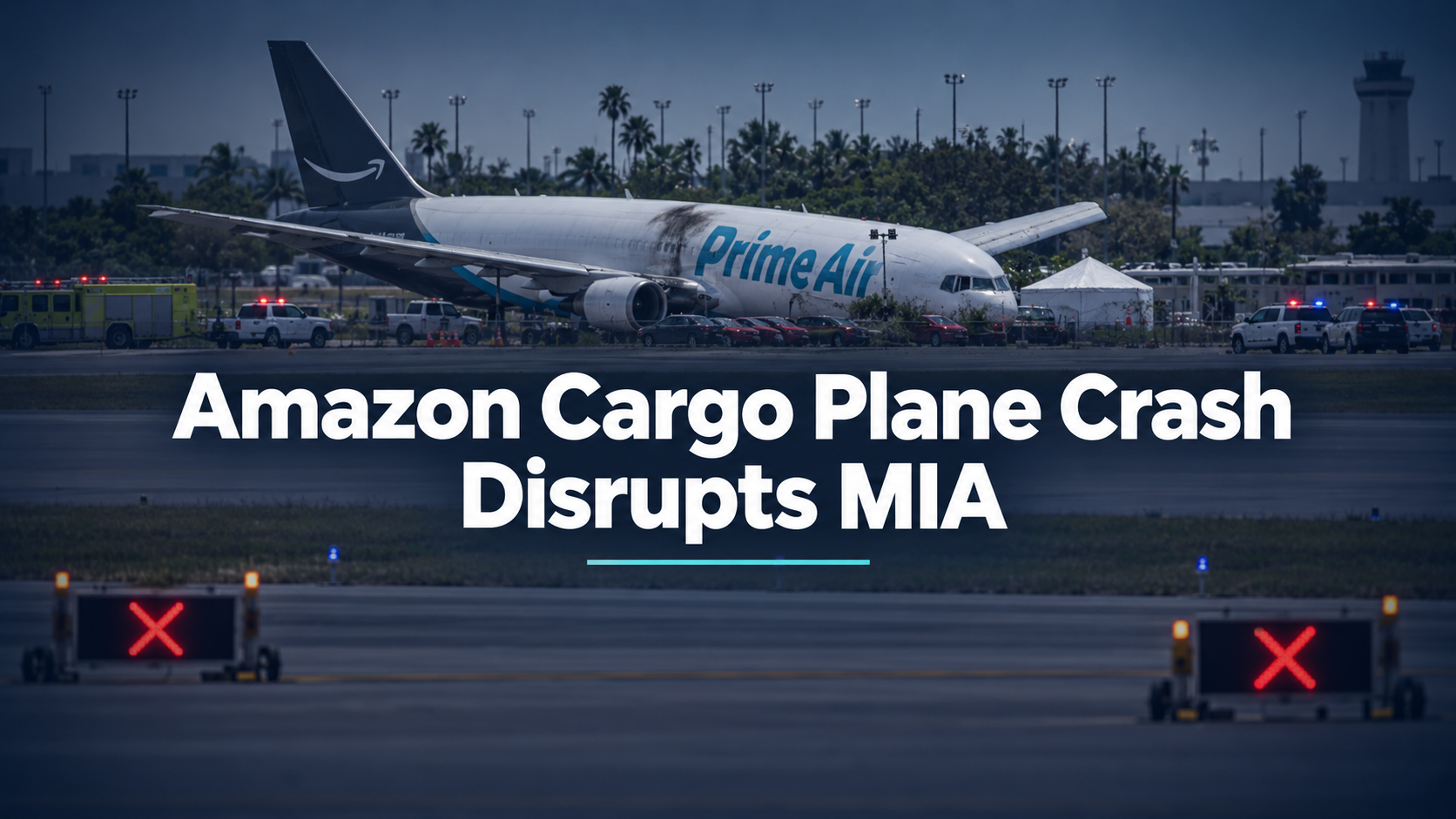
Authorities have identified the five people killed when an Amazon Prime Air cargo plane overshot a runway at Miami International Airport, while two closed runways continued to cause widespread flight disruptions Tuesday.
As of 1:30 p.m. on Sept. 8, 42 flights had been canceled and more than 100 delayed, according to FlightAware. Some incoming flights were also being diverted to other Florida airports, including Fort Lauderdale.
The Boeing 767 crashed Sunday after traveling beyond the runway, striking airport equipment, vehicles and fences before stopping in a nearby lot. More than 30 National Transportation Safety Board investigators are examining the scene.
Officials identify five people killed
Miami-Dade Sheriff Rosie Cordero-Stutz publicly released the names of those killed and injured during a Tuesday briefing.
The five people who died were:
- Rolando Aleman Leon, 55
- Yoel Rodriguez Narajo, 53
- Julio C. Pineda, 75
- Carlos Acosta Fajardo, 53
- Javierk Reyes Quevedo, 47
The Miami-Dade Sheriff’s Office also identified five people who survived the crash with injuries of varying severity.
Eugenio Corredor, 79, and Ridoel Averhoff Diaz, 32, were critically injured. Roosevelt Sebastian Perdomo Torres, 36, was listed in stable condition.
Jaime Felipe Silva Molina, 37, and Joseph Carroll, 55, suffered minor injuries and had been released from the hospital by Tuesday morning.
Officials did not provide additional information about the victims or their connection to the vehicles struck by the aircraft.
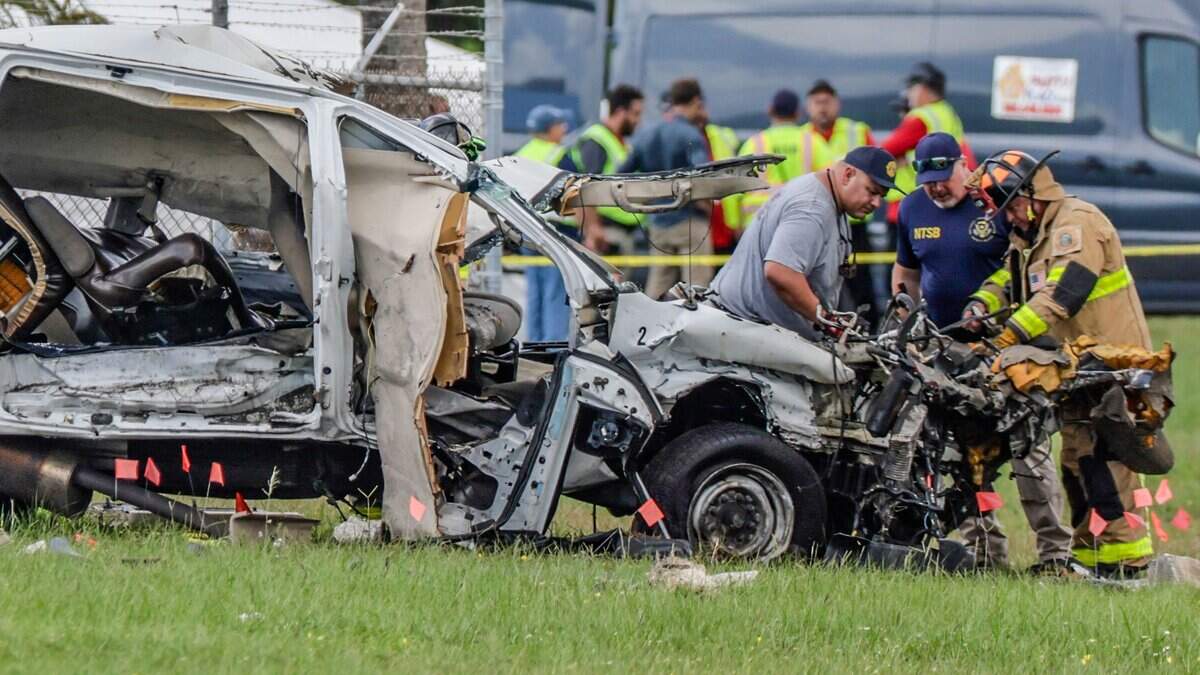
More than 140 flights canceled or delayed
Two of Miami International Airport’s four runways remained closed Tuesday as investigators documented the wreckage and recovery crews continued working at the site.
The closure affected both departing and arriving flights. By early Tuesday afternoon, FlightAware recorded 42 cancellations and more than 100 delays at MIA.
The airport warned that disruptions could continue because some aircraft and crews had not reached Miami following earlier cancellations.
“Because of aircraft and flight crews not arriving at MIA due to cancellations over the last few days, we will continue to see impacts to operations,” the airport said Tuesday.
The disruption can continue even after individual flights resume. When an aircraft or crew is out of position, later flights scheduled to use those resources may also be delayed or canceled.
Passengers traveling through MIA should check directly with their airline before leaving for the airport. Travelers with connecting flights should also verify the status of every segment of their itinerary.
Runways cannot reopen until aircraft is removed
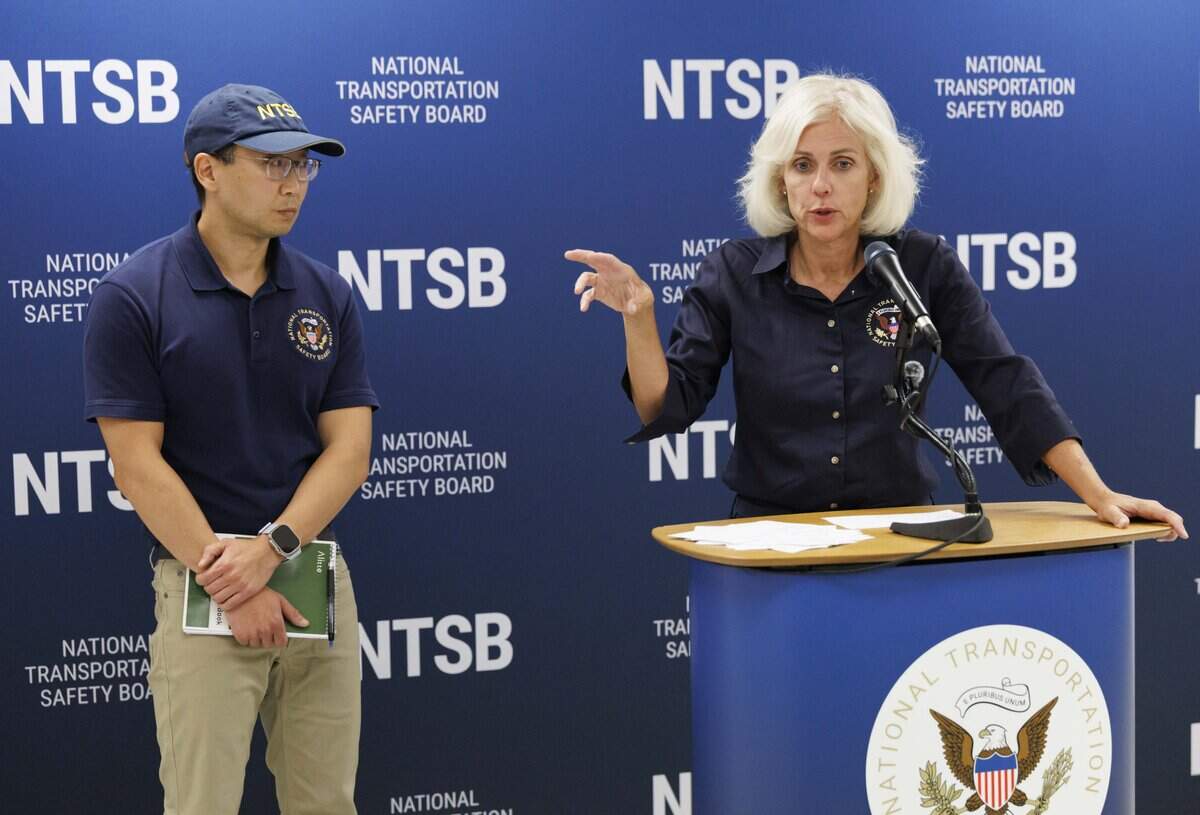
NTSB Chairwoman Jennifer Homendy said the closed runways would not reopen until investigators had documented the scene and the damaged aircraft could be removed.
Before removal begins, investigators need access to the plane and must preserve evidence that could help establish what happened.
“First of all, we need to document the scene,” Homendy said Monday. “We need to get access to the aircraft itself. We do not have that yet.”
The NTSB sent more than 30 investigators to Miami. Their work includes examining the crash site, reviewing available data and interviewing the flight crew and other witnesses.
Homendy said the agency would not announce a cause before completing its investigation.
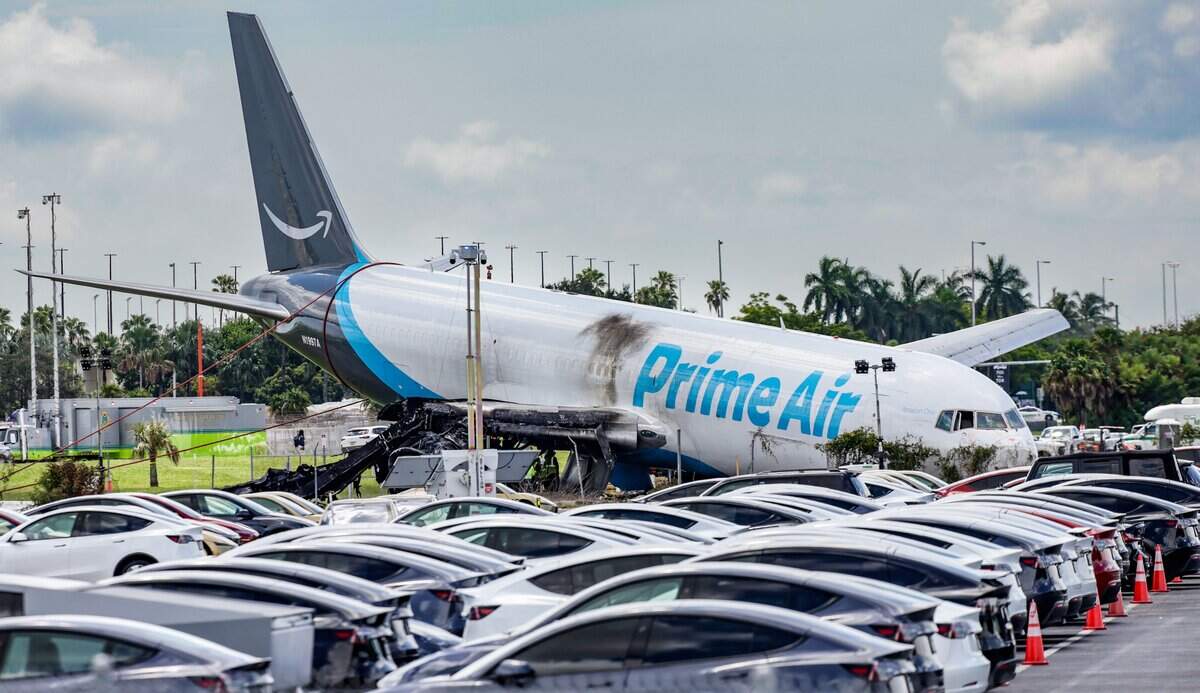
Plane traveled 1,300 feet beyond runway
According to the NTSB’s preliminary description of the sequence, the cargo plane overshot the runway by approximately 1,300 feet.
Homendy said the aircraft first struck navigational equipment and then hit a cleaning van carrying workers. It continued through an airport perimeter fence, struck an occupied Toyota SUV on Northwest 67th Avenue and passed through a second fence.
The plane eventually stopped in a lot containing Tesla robotaxis.
These details describe the aircraft’s path after it left the runway. They do not explain why the plane failed to stop within the available runway and safety area. Determining that cause is part of the NTSB investigation.
Airport entrances remain open, but nearby road is closed
Miami International Airport’s primary entrance and exit areas remained open Tuesday. County officials nevertheless asked drivers to avoid the area when possible because of the active investigation and road restrictions.
Northwest 67th Avenue was closed between Northwest 25th and 32nd streets, according to the Miami-Dade Sheriff’s Office.
The affected section runs along the airport perimeter near the crash site. Drivers who normally use that route should allow extra travel time and follow posted detours.
The runway shutdown and road closure are separate restrictions. Passengers can still reach the airport terminals, but they may encounter traffic delays in the surrounding area.
Crashed Boeing 767 was built in 1994
The Boeing 767 involved in the accident was 32 years old and had accumulated approximately 109,800 flight hours, according to aviation analytics company Cirium.
It was built in 1994 and equipped with a General Electric engine and a Honeywell auxiliary power unit.
The aircraft was operated by 21Air as part of Amazon Air’s cargo network. Cirium said 21Air operates eight aircraft for Amazon, representing approximately 8% of the company’s in-service fleet.
The average age of the aircraft supplied by 21Air is approximately 30 years. Amazon Air’s entire fleet averages nearly 27 years, according to the analytics firm.
An aircraft’s age alone does not establish why an accident occurred. Investigators must examine its maintenance history, mechanical condition, flight data, crew actions, weather and other operational factors before determining a probable cause.
oeing 767 remains central to Amazon Air fleet
Amazon Air had approximately 104 aircraft in service in 2026, up from 14 in 2016, according to Cirium. Much of that expansion took place by 2021, when the fleet reached 95 planes.
The Boeing 767 is the largest part of the network, accounting for 63 aircraft. Amazon Air also uses 29 Boeing 737 Next Generation aircraft and 11 Airbus A330s.
Several outside airlines operate aircraft for the Amazon network. Cirium listed the fleet contributions as:
- Air Transport International: 40 aircraft
- Sun Country Airlines: 22
- ABX Air: 15
- Alaska Airlines: 10
- 21Air: eight
- ASL Airlines Ireland: six
- Cargojet Airways: two
- Quickjet: one
These figures describe Amazon Air’s fleet structure and do not assign responsibility for Sunday’s crash.
Questions raised about runway safety system
Miami International Airport does not have an engineered materials arresting system, commonly called EMAS, at the end of the affected runway.
EMAS consists of crushable material designed to slow an aircraft more quickly if it travels beyond the runway. The Federal Aviation Administration says the material is installed at the far end of a runway and compresses beneath an aircraft’s weight.
Homendy said 72 U.S. airports have the system.
MIA said Runway 12/30 already has the full 1,000-foot runway safety area required by the FAA. According to the airport, EMAS is generally installed where space limitations prevent an airport from providing that full safety area.
“No U.S. airport has EMAS at a runway end that also maintains the full, unobstructed 1,000-foot safety area,” the airport said Monday night.
The airport described EMAS as an alternative for space-constrained locations, rather than an additional feature normally placed beyond a full-length safety area.
Investigators have not concluded that the absence of EMAS caused or worsened the crash. The NTSB will determine what factors contributed to the aircraft leaving the runway and continuing beyond the airport boundary.
What happens next
Investigators will continue documenting the site, inspecting the aircraft, analyzing data and interviewing those involved. The NTSB had scheduled a public briefing for 7 p.m. Tuesday at Miami International Airport.
The damaged plane must be removed before both closed runways can return to service. Until then, cancellations, delays and diversions may continue.
No probable cause has been announced. The immediate facts established by officials are that five people died, five others were injured and the aircraft traveled well beyond the runway before coming to a stop outside the airport perimeter.
