
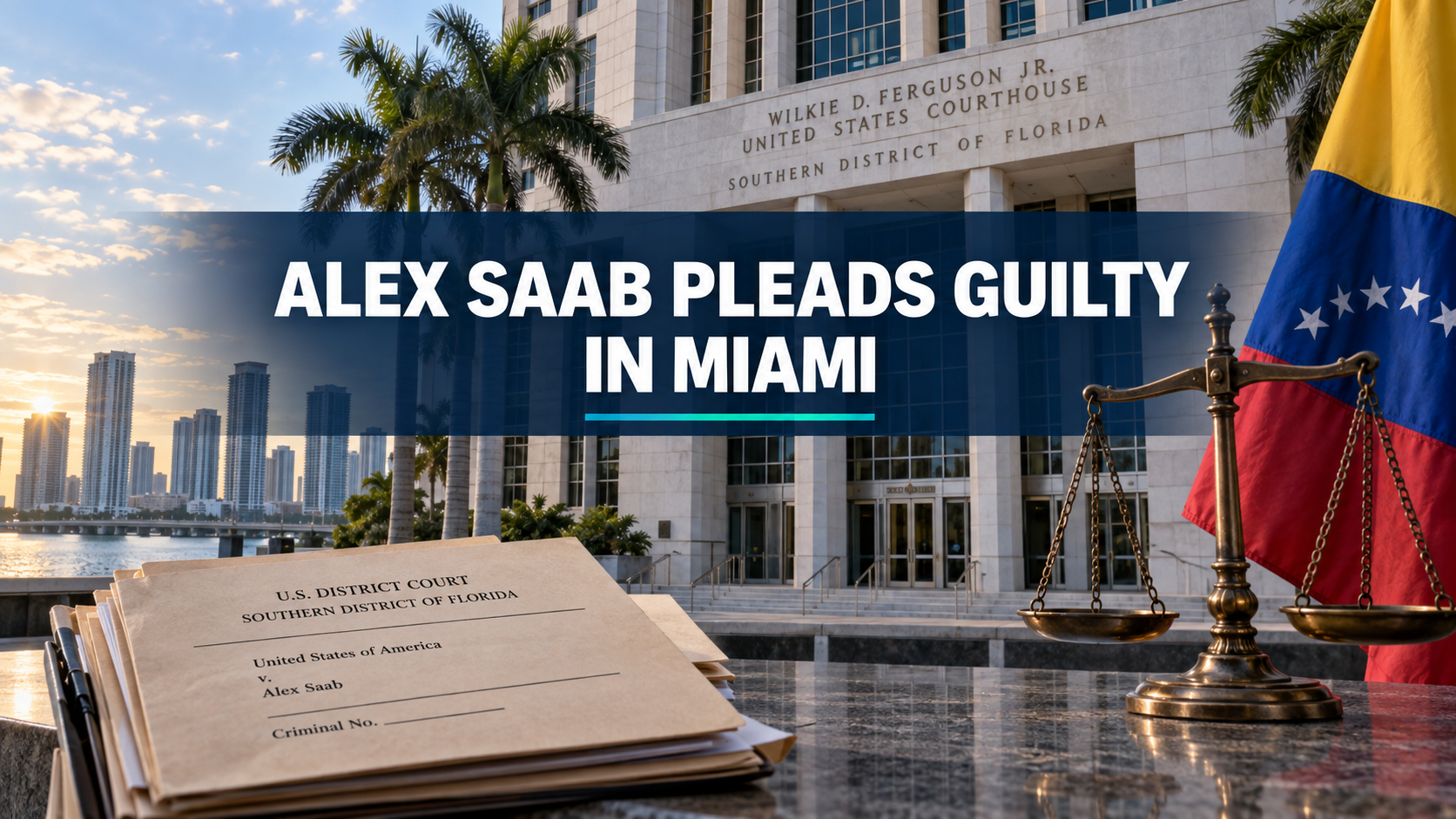
Alex Nain Saab Moran, a Colombian-born businessman and longtime associate of former Venezuelan President Nicolás Maduro, pleaded guilty in Miami federal court on September 15, 2026, to one count of money laundering. Under the plea agreement, Saab agreed to cooperate with continuing federal investigations and forfeit $195 million in proceeds linked to the corruption scheme.
The proceeding places another Venezuela-related financial case in the Southern District of Florida, a federal jurisdiction that regularly handles international money-laundering and corruption prosecutions connected to Latin America and the Caribbean. Saab has not yet been sentenced.
What Miami locals need to know
- Saab entered his guilty plea in federal court in Miami on September 15, 2026.
- He agreed to cooperate with continuing federal investigations.
- His plea agreement requires the forfeiture of $195 million.
- The money-laundering offense carries a maximum statutory sentence of 20 years, but the final sentence will be determined by the court.
- No road closures, transit changes, airport delays or public-safety threats have been announced in connection with the case.
- The case has no announced filing deadline or required action for Miami-Dade residents or local businesses.
What happened in Miami federal court
Saab, 54, pleaded guilty before U.S. District Judge Kathleen M. Williams to a single money-laundering count connected to a scheme involving Venezuelan government contracts. He had previously pleaded not guilty after the latest indictment against him was unsealed in May 2026.
The plea agreement requires Saab to assist federal investigators. Prosecutors also agreed to recommend a sentence at the lower end of the applicable federal guideline range and may seek an additional reduction if they determine that his cooperation is valuable. The cooperation could include providing information related to four unnamed co-defendants, according to the Associated Press.
Although the charge has a maximum penalty of 20 years in prison, that does not mean Saab will receive a 20-year sentence. Federal judges consider the advisory sentencing guidelines, the plea agreement, cooperation and other statutory factors before imposing a sentence. No sentencing date was confirmed in the reviewed public reports.
What prosecutors alleged about the financial scheme
Before Saab changed his plea, federal prosecutors alleged that he participated in an international money-laundering conspiracy involving Venezuela’s government-controlled food program and the country’s oil industry.
According to the U.S. Attorney’s Office for the Southern District of Florida, the indictment alleged that Saab and others bribed Venezuelan officials to obtain food-import contracts, misrepresented the nature and source of food shipped into Venezuela and used an international financial network to move proceeds from the scheme.
The allegations involved the Local Committees for Supply and Production program, commonly known by its Spanish abbreviation, CLAP. The program was established to distribute staples such as rice, corn flour and cooking oil during Venezuela’s economic crisis.
Investigators alleged that participants created companies, falsified shipping records and diverted money from contracts involving food imported from Colombia and Mexico. The criminal complaint also connected the alleged financial network to proceeds from oil sales involving Venezuela’s state-owned oil company, PDVSA.
Source: https://apnews.com/article/14baef4f4517e95b02fc6875742a8463
Saab’s guilty plea applies to the money-laundering count resolved on September 15. Allegations involving other people remain allegations unless they are admitted or proven in court.
Why this case matters in Miami local news
The case does not create an immediate public-safety or transportation issue for Miami residents. No court-related street closures, Metrorail changes, business restrictions or airport disruptions were announced.
Its local importance comes instead from Miami’s role in federal cases involving financial activity between the United States, Venezuela and other parts of Latin America. The Southern District of Florida described South Florida as a gateway to Latin America and the Caribbean when explaining its work on international corruption, sanctions, foreign influence and money laundering.
The proceedings are also closely watched in Miami-Dade County because the area has a large Venezuelan community with personal, family and business ties to Venezuela. However, the plea agreement itself does not change immigration rules, sanctions requirements or travel procedures for residents.
Miami-area businesses that conduct international transactions should continue following existing banking, sanctions and reporting requirements. Authorities have not issued any new compliance instruction to local companies as a direct result of Saab’s plea.
Saab agrees to forfeit $195 million
Under the agreement reported after the hearing, Saab will forfeit $195 million identified as criminal proceeds from the corruption scheme. Forfeiture is the legal process through which the government takes property or funds connected to criminal conduct.
The available reports do not specify which assets will be used to satisfy the entire forfeiture amount, when the money will be collected or whether any proceeds could eventually be distributed to victims. Those details may be addressed in later court filings.
The forfeiture figure should not be confused with the approximately $350 million involved in Saab’s earlier prosecution. That was a separate criminal case filed before he received executive clemency in December 2023.
What remains unknown
The court has not yet imposed Saab’s sentence, and the reviewed reports do not provide a confirmed sentencing date.
It also remains unclear how much assistance Saab will provide, which investigations will benefit from his cooperation and whether prosecutors will ultimately request a sentence below the initial guideline recommendation.
The four co-defendants referenced in reporting about the cooperation agreement have not been publicly identified. No assumptions should be made about their identities or potential criminal liability.
The next major developments to watch are the filing of sentencing documents, any court order setting the sentencing hearing and future public filings explaining whether Saab provided substantial assistance.
Conclusion
For Miami residents, the immediate development is a federal-court outcome rather than a neighborhood emergency or service disruption. Saab has now admitted to a money-laundering offense, agreed to forfeit $195 million and committed to cooperate, while his sentence and the wider consequences of that cooperation remain unresolved.
