
Search for a home cleaning service in Doral and you quickly run into a problem: many results are not actually written for homeowners.
Some pages focus on office cleaning companies. Others publish “top” lists where the company creating the list also appears as the first recommendation. A ranking can look useful at first glance, but a homeowner needs different information than a business looking for a janitorial contract.
Hiring someone to clean your home is a different decision.
You are not only comparing cleaning tasks and prices. You are deciding who will enter your home regularly, who may have access to a key or door code, and who will be around your family, pets, and personal belongings.
Before writing this guide, I looked into what cleaning companies mean when they say they are “licensed, bonded and insured” in Florida. That phrase sounds like one complete protection, but it actually combines different things. One part does not exist as a state requirement for house cleaning, one is often inexpensive for a company to obtain, and one important coverage question is missing from the phrase entirely.
Miami Goes Local is a business directory. Listed cleaning companies may hold free or paid listings, and paid placement cannot buy inclusion or position in these recommendations. See our advertising disclosure for more details.
The goal of this guide is not to tell you which cleaning company to hire. It is to help you know what questions to ask before you invite anyone into your home.
You’ll learn how to decode the “licensed, bonded and insured” phrase, what insurance coverage actually answers if something goes wrong, how to verify a cleaning business in about ten minutes, what to ask about employees and contractors, how to handle keys and valuables, what cleaning services typically cost in Doral, and what condo or HOA rules may affect whether a cleaner can access your building.
By the end, you should know what a reasonable answer sounds like, what documents you can request, and which details you can verify yourself before the first visit.
“Licensed”   What Florida Actually Requires
The word “licensed” is one of the most confusing parts of the phrase “licensed, bonded and insured” because many homeowners assume it means Florida has approved a cleaning company through a statewide licence system.
For general residential cleaning, that is not how Florida regulates the trade.
There’s no state licence for house cleaning
Florida does not issue a statewide occupational licence specifically for general residential cleaning services.
That does not mean a cleaning business can operate without any requirements. It means the verification step is different: instead of looking for a state cleaning licence, homeowners should check whether the business has the required local registrations where it operates.
The phrase “licensed cleaner” is often used casually in marketing. When you ask what licence a company means, the answer should usually point you toward its local business tax receipt.
What exists instead: the business tax receipt
A business tax receipt (formerly called an occupational licence) is a local registration showing that a business has met the requirements to operate in that jurisdiction.
For a cleaning company based in an incorporated city such as Doral, homeowners should verify the business tax receipts required by the local authorities where the company operates.
That generally means checking:
- City of Doral business tax receipt
- Miami-Dade County business tax receipt
These are not the same document. A city registration does not replace the county requirement.
What to ask a cleaning company
Instead of asking only:
“Are you licensed?”
“When you say licensed, do you mean your city and county business tax receipts?”
A straightforward company should be able to explain what registration it holds and provide details you can verify.
You do not need to rely only on a company’s website badge or wording in an advertisement. Local business tax receipt records can be checked directly through the relevant government offices.
Quick Verification Checklist
| Ask | What You Are Checking |
|---|---|
| “What licence do you mean?” | Whether the company is referring to a real credential or using the term loosely. |
| “Do you have a City of Doral business tax receipt?” | Local business registration where applicable. |
| “Do you have a Miami-Dade County business tax receipt?” | County-level business registration where applicable. |
| “Can I verify it myself?” | Whether the information is available for independent confirmation. |
Specialty cleaning work is different
Residential cleaning and specialty services are not always treated the same way.
For example, if a company offers mold assessment or mold remediation as part of a cleaning package, that is a different type of work with separate licensing requirements in Florida.
A company cleaning kitchens, bathrooms, floors, and living areas is not the same as a company performing regulated mold-related services.
If a cleaner advertises specialty work beyond normal housekeeping, verify that specific credential rather than assuming the general cleaning registration covers it.
“Insured” and “Bonded”   Two Different Risks
The words “insured” and “bonded” often appear together in cleaning company advertisements, but they protect against different situations.
One deals mainly with accidents and damage. The other deals with a specific type of loss involving dishonesty or theft. They are not interchangeable.
Understanding the difference helps you ask the right question before someone starts working inside your home.
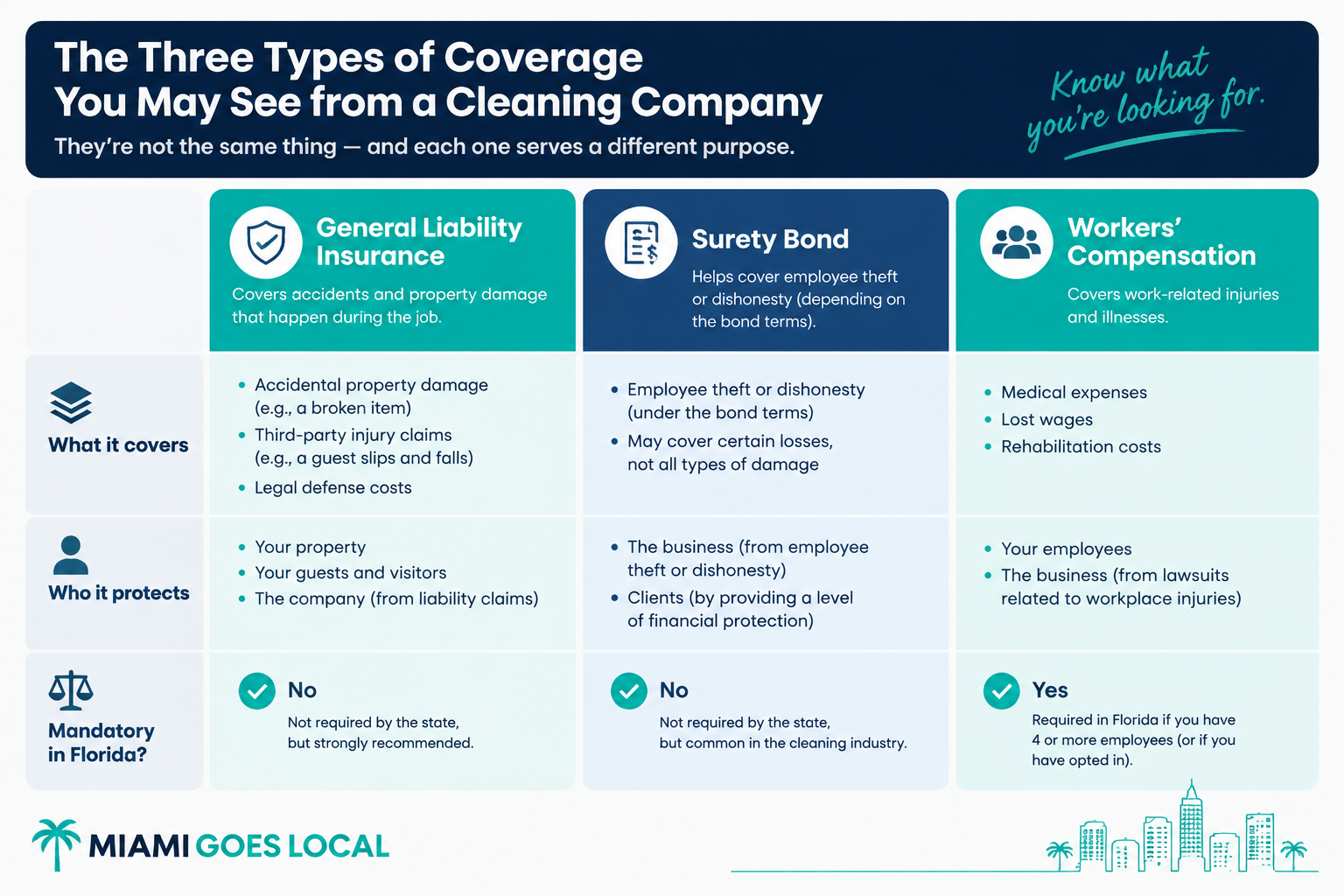
General liability insurance: damage and injury connected to the work
General liability insurance is the coverage most homeowners are thinking about when they ask, “What happens if something goes wrong in my house?”
It can cover situations such as:
- A cleaner accidentally damages your property while working
- A person is injured because of something connected to the cleaning service
- A cleaning company is responsible for certain claims arising from its work
For example, if a cleaner accidentally knocks over and breaks an expensive television while moving items during cleaning, liability coverage may be the type of policy that addresses that type of claim.
The important word is may. Insurance policies have limits, exclusions, and conditions.
Ask for the certificate of insurance
A company saying “we are insured” is different from seeing proof of current coverage.
Ask for:
- A certificate of insurance
- The insurance company or agent listed on the certificate
- The policy dates
- The coverage limits
For additional verification, you can request confirmation from the insurer or insurance agent directly rather than relying only on a document forwarded by the cleaning company.
You are not trying to make a small cleaning visit feel like a construction contract. You are simply confirming what coverage exists before allowing someone into your home.
The surety bond: a different type of protection
A cleaning bond, often called a janitorial bond or surety bond, addresses a different risk.
It is generally designed to cover losses related to employee dishonesty, such as theft by an employee, depending on the terms of the bond.
It does not mean:
- The company guarantees perfect cleaning
- Every accident is covered
- Every missing item automatically becomes a paid claim
The details depend on the bond agreement and the situation being reported.
“Bonded” is useful, but it is not the whole decision
A bond is relatively inexpensive for many cleaning businesses to obtain. Because of that, seeing the word “bonded” is a positive sign that a company has taken a common business step, but it is not a complete measure of quality.
Think of it as a baseline question:
“Do you carry a bond?”
not:
“Does this prove this is the right company for my home?”
A company’s communication, references, written policies, and how it handles access to your home still matter.
What neither one covers
There is one important coverage question that the phrase “licensed, bonded and insured” does not answer:
What happens if the cleaner is injured while working inside your home?
General liability insurance and a cleaning bond are not the same thing as workers’ compensation coverage.
That question matters because many small cleaning businesses operate with different arrangements   employees, independent contractors, or owner-operated crews   and the coverage situation can vary.
Workers’ compensation is the next piece to understand before handing over a key.
The Workers’ Compensation Question
This is the part of the cleaning company conversation that many homeowners never ask about.
The phrase “licensed, bonded and insured” sounds complete, but it does not answer one practical question:
Who is responsible if the person cleaning your home gets injured while working there?
The answer depends on the relationship between the cleaning business and the person doing the work, and whether workers’ compensation coverage applies.
This is not about whether a company is large or small, or whether the cleaners are employees or independent operators. Many small cleaning businesses in Doral are legitimate businesses. The issue is simply understanding how insurance works before someone is working inside your home.
Florida’s workers’ compensation threshold
In Florida, workers’ compensation requirements depend on the type of business and the number of employees.
For non-construction businesses, employers are generally required to carry workers’ compensation coverage when they have four or more employees, including part-time employees.
Smaller operations may not be required to carry it. Sole proprietors and certain independent contractors may also qualify for exemptions depending on their status.
That means a two-person or three-person cleaning company may be operating legally while not carrying workers’ compensation coverage.
The important point for a homeowner is not that one arrangement is automatically better than another. It is that you should know which arrangement you are hiring.
Why it matters inside your home
A cleaning visit usually involves ladders, wet floors, chemicals, moving furniture, and working around household items.
If a cleaner is injured while working in your home, workers’ compensation is the type of coverage designed to address workplace injuries for covered employees.
Without that coverage, responsibility can become more complicated.
Ask this question directly:
“Do you carry workers’ compensation coverage?”
A clear answer is more useful than simply hearing:
“We are insured.”
Those two statements refer to different types of coverage.
General liability protects against certain claims involving your property or third-party injuries. Workers’ compensation addresses employee workplace injuries when it applies.
Employees or independent contractors?
Before hiring a cleaning service, ask:
“Are your cleaners employees or independent contractors?”
Neither model automatically means a company is good or bad. The difference is understanding who is responsible for the work arrangement.
Employees vs Independent Contractors
| Arrangement | What It Means to Ask About |
|---|---|
| Employees | The company generally controls the employment relationship, training, scheduling, and payroll arrangements. |
| Independent Contractors | The individual may operate separately, and responsibility for insurance, agreements, and screening may be handled differently. |
This affects practical questions such as:
- Who screened the person entering your home?
- Who handles complaints or damage claims?
- Who provides insurance coverage?
- Who is responsible for replacing a cleaner if there is a problem?
A homeowner should not assume the answer. Ask before the first visit.
Check your own insurance policy
One of the simplest steps is also one of the most commonly skipped:
Check your own homeowner or renter insurance policy.
Ask your insurance provider:
- What happens if a worker is injured on my property?
- What coverage applies if household property is accidentally damaged?
- Are there situations where I should notify my insurer before hiring recurring help?
This does not mean you expect something to go wrong. It means you understand your own coverage before you need it.
A ten-minute call with your insurer can answer questions that a cleaning company’s marketing phrase never will.
Verify a Doral Cleaning Company in Ten Minutes
A cleaning company’s website can tell you what services it offers. It cannot independently confirm every detail that matters before someone enters your home.
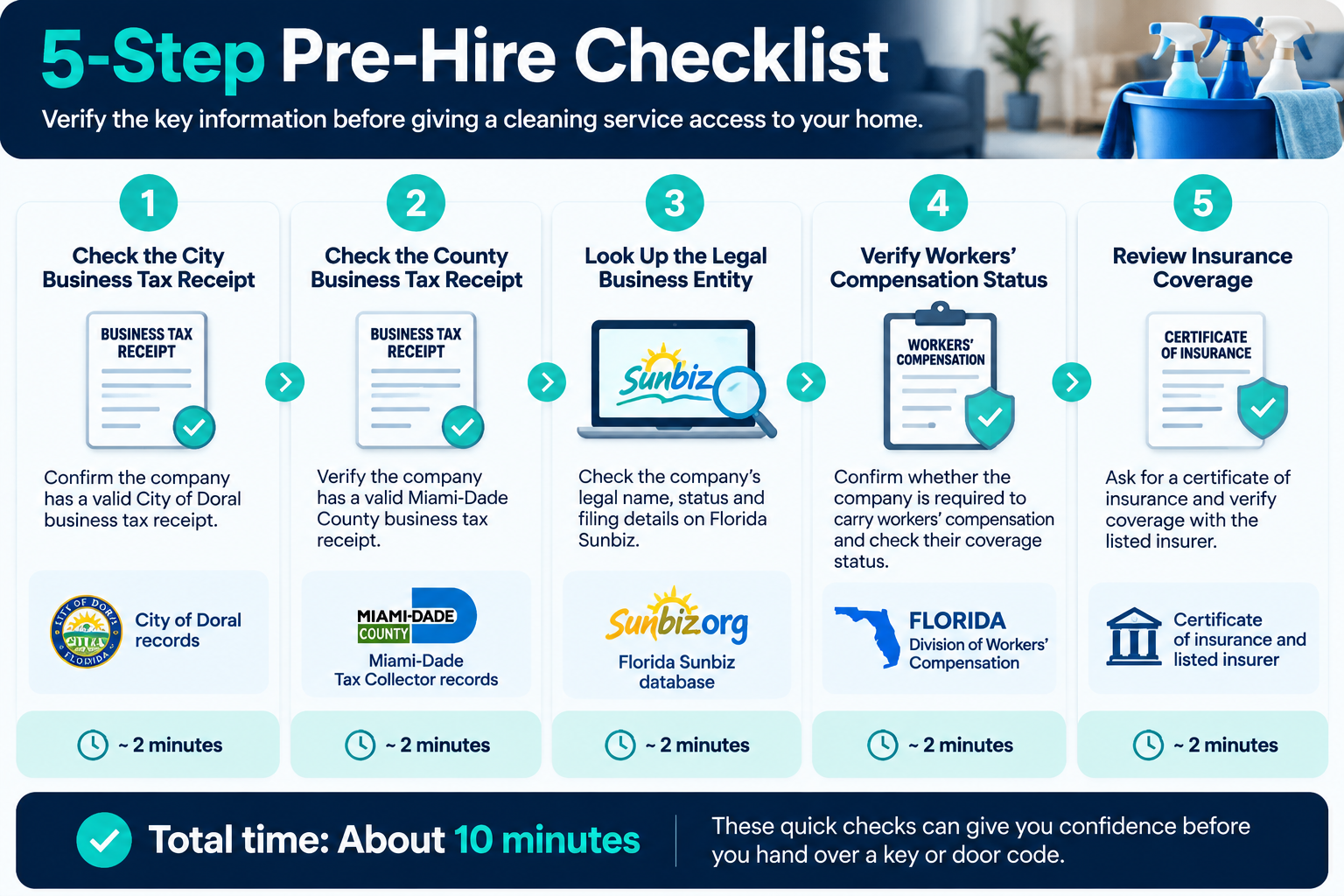
The good news is that most of the important checks do not require a complicated investigation. A homeowner can verify the basics in about ten minutes using public records and a few direct questions.
The goal is not to eliminate every small business. It is to replace assumptions with information.
Step 1   Check the business tax receipts
Start with the local registrations.
For a cleaning company operating in Doral, check:
- City of Doral business tax receipt
- Miami-Dade County business tax receipt
Confirm that the business name matches what the company uses publicly and that the registration is current.
A company may operate under a brand name that is different from its legal entity name, so do not stop at a website name alone.
“Can you provide the business name used for your tax receipt records?”
This gives you something you can verify independently.
Step 2   Confirm the legal entity behind the name
Next, search the company through Sunbiz, Florida’s official business entity database.
This helps you identify:
- The registered business entity
- Whether the entity is active
- The official business name connected to the company
Some businesses advertise under a trade name that does not immediately match their legal entity.
That is not automatically a problem. Many businesses use different public-facing names.
But if a company name cannot be connected to any active registration, it is reasonable to ask:
“Which legal entity operates this business?”
A clear answer is what you are looking for.
Step 3   Verify the certificate of insurance
Do not rely only on a website saying “fully insured.”
Ask for a certificate of insurance and review:
- The insurance company listed
- Coverage dates
- Policy limits
- The business name shown on the certificate
For additional confirmation, you can request verification from the insurer or agent listed on the certificate.
The purpose is simple: confirm that the coverage exists and applies to the business you are considering.
Step 4   Check workers’ compensation status
Workers’ compensation is separate from general liability insurance.
“Do you carry workers’ compensation coverage, or do you operate under an exemption?”
Depending on the business structure and number of employees, a company may have coverage or may qualify for an exemption.
You can verify workers’ compensation information through the Florida Division of Workers’ Compensation.
This step is about understanding the arrangement, not judging a company based on its size.
A small owner-operated cleaning business and a larger company may have different insurance setups. Your job is simply to know what applies before work begins.
Step 5   Ask about background checks in writing
This is one question many homeowners forget to ask.
A cleaning company may have a person entering your home when you are not there. That makes screening practices a reasonable part of the hiring decision.
- Who is screened?
- Employees?
- Contractors?
- Subcontractors?
- What type of screening is performed?
- Is it completed before the person enters customer homes?
- How often is screening updated?
Ask for the policy in writing.
A professional company should be able to explain its process clearly.
Your 10-minute verification toolkit
Save these resources before comparing cleaning companies:
Your 10-Minute Verification Toolkit
| Check | Where to Verify |
|---|---|
| City business tax receipt | City of Doral records |
| County business tax receipt | Miami-Dade Tax Collector records |
| Legal business entity | Florida Sunbiz database |
| Workers’ compensation status | Florida Division of Workers’ Compensation |
| Insurance coverage | Certificate of insurance and listed insurer |
A few minutes of checking can answer the questions that marketing phrases cannot. Before handing over a key or door code, it is worth knowing exactly who you are hiring and what protections are actually in place.
Who Actually Enters Your Home
Choosing a home cleaning service is not only about whether the floors are cleaned properly or whether the kitchen looks better afterward.
The more personal question is:
Who is the person coming through your door?
A company can have good reviews and fair pricing, but homeowners still need clear answers about the people entering their homes, how they are screened, and how access is handled.
This matters more in a home than in an office because the cleaner is working around your private spaces, your belongings, your family, and your daily routine.
Screening: Ask what the policy actually means
Many companies say that cleaners are “background checked,” but that phrase can mean different things.
Ask:
- Who receives the background check?
- Employees only?
- Independent contractors?
- Subcontracted crews?
- What does the screening include?
- Is screening completed before the person enters customer homes?
- Is it refreshed after a certain period?
A good answer is specific.
For example, a company should be able to explain whether every person entering customer homes follows the same screening process or whether different types of workers are handled differently.
The goal is not to assume that a certain type of worker is unsafe. It is to understand the company’s process.
Consistency: Who will you see each visit?
A question many homeowners forget to ask:
“Will the same cleaner or team come every time?”
Consistency matters more in a home than it usually does in an office.
When the same person or small team returns regularly:
- They learn your preferences
- You know who is entering your home
- Communication becomes easier
- Small issues are easier to address
Some companies use rotating teams or staffing models where different cleaners may be assigned. That is not automatically a problem, but you should know what to expect.
A well-organized company should be able to explain:
- Who is assigned to your home
- How replacements are handled
- Whether you are notified when someone new is coming
Keys and door codes: Control access from the beginning
Home access is one of the most practical parts of hiring recurring cleaning help.
If possible, avoid giving out a permanent key that remains active indefinitely.
Options to consider:
- A lockbox with controlled access
- A temporary smart-lock code
- A separate guest code for your home system
If the assigned cleaner changes, update the access information.
Ask the company:
- How are physical keys stored?
- Who can access them?
- Are keys labeled with customer information?
- What happens if a cleaner leaves the company?
A simple access process prevents confusion later.
Your household: Share the details that affect the visit
Before the first cleaning, explain anything that affects how the cleaner works in your home.
Examples:
- Pets in the home
- Children who may be present
- Alarm systems
- Areas that should not be entered
- Fragile items or special instructions
- Preferred products or surfaces that require care
A cleaner cannot follow household rules they do not know.
A short conversation before the first visit usually prevents problems later.
Language and communication
Doral households often communicate in more than one language, and that is a practical consideration when choosing a service.
The important question is not what language a cleaner speaks. The important question is whether the company can communicate clearly with you.
Confirm that you can discuss:
- Scheduling changes
- Access instructions
- Cleaning preferences
- Damage or breakage reports
- Questions about payment or services
If a company cannot clearly explain a schedule change or how it handles a problem, that communication gap can become frustrating later.
Choose a company that can communicate with your household in the language you are comfortable using. That is part of running a reliable service relationship, not a formality.
What Home Cleaning Costs in Doral
Price is usually the first thing homeowners compare when choosing a cleaning service. But the number on the quote is only useful if you know what it includes.
Two companies can quote very different prices for what sounds like the same service because “cleaning” is not always defined the same way.
One company may include bathrooms, kitchens, floors, and dusting. Another may charge extra for inside appliances, baseboards, windows, pet hair, or heavy buildup.
Before comparing prices, compare the scope.
The pricing models
Cleaning companies usually price residential work in four ways:
Home Cleaning Pricing Models
| Pricing Model | How It Works | Best Fit | Where Surprises Happen |
|---|---|---|---|
| Hourly | You pay based on the amount of time spent cleaning. | Smaller homes or flexible cleaning tasks. | The final cost depends on how long the job takes. |
| Flat Rate Per Job | One price is charged for a defined cleaning package. | Homeowners who want predictable pricing. | The cleaning scope must be clearly defined before work begins. |
| Per Square Foot | Price is calculated based on the size of the home. | Larger homes or move-in/move-out cleaning. | Square footage alone does not show how much cleaning work is required. |
| Recurring Plan | Weekly, bi-weekly, or monthly cleaning schedule. | Homes needing regular maintenance. | Discounts may come with cancellation rules or minimum-service terms. |
For recurring cleaning, ask what changes the price:
- Number of bedrooms and bathrooms
- Home size
- Pets
- Frequency of visits
- Condition of the home
- Additional requests
A first-time deep clean is often priced differently from a maintenance visit because the starting condition is different.
Typical home cleaning prices
The table below separates general market baselines from local pricing. National figures should not be treated as Doral quotes because local labor costs, demand, home size, and company structure affect pricing.
Home Cleaning Price Comparison
| Service | National Baseline | Doral Sampled |
|---|---|---|
|
Recurring Clean (weekly / bi-weekly / monthly) |
Varies by home size, frequency, and cleaning scope. | Verify with current Doral providers before publishing. |
| One-Off Standard Clean | Approximately $100–$200. | Verify with current Doral providers before publishing. |
| Deep Clean | Often higher than standard cleaning because it includes additional detail work. | Verify with current Doral providers before publishing. |
| Move-In / Move-Out | Approximately $200–$350 depending on size and condition. | Verify with current Doral providers before publishing. |
| Post-Construction Cleaning | Varies significantly based on debris, dust, and project size. | Verify with current Doral providers before publishing. |
The most important pricing question: What does “clean” include?
Before the first visit, agree on the scope room by room.
- Are inside appliances included?
- Are cabinets cleaned inside or only outside?
- Are baseboards included?
- Are windows included?
- Is pet hair removal included?
- Are supplies included?
- Is there an extra charge for heavy buildup?
Most disagreements in residential cleaning are not actually about whether a company cleaned well. They are about both sides having different definitions of what was included.
A homeowner may think “deep clean” means the inside of the oven and refrigerator. A company may mean a more detailed version of the normal cleaning checklist.
Get the scope in writing.
Ask about recurring plan terms
If you sign up for weekly or monthly cleaning, confirm:
- Cancellation policy
- Rescheduling rules
- Minimum commitment, if any
- Satisfaction or correction policy
- How missed visits are handled
A written agreement prevents confusion later.
The Sales Tax Question
Florida treats residential and nonresidential cleaning differently for sales tax purposes.
According to the Florida Department of Revenue, charges for cleaning residential facilities used as living accommodations   including homes, apartments, and residential condominiums   are generally not taxable. Nonresidential cleaning services, such as office or commercial building cleaning, are generally taxable.
For a homeowner hiring someone to clean a private residence, sales tax should not simply appear without explanation.
If you see a sales tax charge on your invoice, ask:
“Can you explain what this charge is for?”
The goal is not to assume the company made a mistake. Some invoices include multiple services, and the tax treatment can depend on what is being provided.
Ask the company to explain the charge before paying it.
Condo, HOA and Building Rules in Doral
Choosing a cleaning company is only part of the decision if you live in a condo, townhome community, or managed building.
In many Doral communities, the person cleaning your home may also need to follow building access procedures before they can enter the property.
The rules are not usually about the quality of cleaning. They are about security, insurance documentation, and controlling who has access to shared spaces.
Before booking your first cleaning, check with your association, management company, or building office.
Common requirements may include:
- Vendor registration
- Proof of insurance
- A certificate of insurance naming the association as an additional insured
- Approved access hours
- Service elevator reservations
- Parking or loading rules
- Visitor entry procedures
The exact requirements depend on the building or community. One condo association may allow a resident to schedule a cleaner directly, while another may require the vendor to be registered before any work begins.
Check the building requirements before the first visit
Ask your management office:
“Does my cleaning company need to be registered before entering the building?”
- Does the association require a certificate of insurance?
- Does the certificate need to list the association?
- Are there approved cleaning hours?
- Does the cleaner need to use a service entrance or elevator?
- Are parking permits required?
Finding out the morning of the first cleaning that a vendor cannot access the building creates problems for everyone   the homeowner, the cleaner, and the building staff.
If you rent, check your lease too
Renters should not assume the building rules are the only requirement.
Check:
- Your lease agreement
- Property management instructions
- Building vendor policies
Some buildings require the resident to register guests or service providers before entry.
A five-minute check before hiring can prevent a situation where a cleaner arrives but cannot get through the front desk or security entrance.
Reading a Cleaning Company’s Website
A cleaning company’s website can be useful, but it should be treated as the beginning of your research, not the final verification.
Marketing pages are designed to attract customers. Your job is to check whether the information actually matches the service you need.
Is it actually about home cleaning?
One of the first things to check is whether the page is written for homeowners or businesses.
A search result may mention “cleaning service in Doral” but lead to a page focused on:
- Office cleaning
- Commercial buildings
- Janitorial contracts
- Facility maintenance
Those services may be legitimate, but they answer different questions.
A homeowner needs information about things like:
- Recurring home visits
- Bedrooms and bathrooms
- Pets
- Keys and access
- Household scheduling
Make sure the page matches the service you are looking for.
Look carefully at “top” lists
Comparison articles and “best cleaning companies” lists can be useful, but understand how they are created.
- Who published the list?
- Is the publisher also a company being recommended?
- Are rankings based on clear criteria?
- Are reviews or ratings shown consistently?
A list where the publisher ranks itself first may be a business promotion page rather than an independent comparison.
That does not automatically mean the company is unreliable. It simply means you should understand what type of page you are reading.
Before the First Visit: A Homeowner’s Checklist
The first cleaning visit is where expectations become reality.
A few conversations before someone starts working can prevent most common misunderstandings   what should be cleaned, what should not be touched, how access works, and who handles questions if something goes wrong.
This is not about assuming a cleaner will cause a problem. It is about making the arrangement clear for both sides.
Use this checklist before the first visit.
Put away valuables and personal items
Before anyone enters your home, put away items such as:
- Cash
- Jewelry
- Prescription medications
- Important documents
- Personal paperwork
This is not about distrust. It is a normal household practice that removes uncertainty.
Clear instructions and organized spaces make the cleaning process easier for everyone.
Walk through the home together
If possible, be present for the first visit and walk through the home with the cleaner or team.
Point out:
- Fragile items
- Areas that should not be entered
- Surfaces requiring special products
- Items that need extra care
- Rooms with specific instructions
A quick walkthrough can prevent accidental damage and helps the cleaner understand how your home works.
Agree on the cleaning scope room by room
Before work begins, confirm exactly what is included.
Discuss:
- Kitchen surfaces
- Bathrooms
- Bedrooms
- Floors
- Dusting
- Appliances
- Baseboards
- Special requests
Do not assume that a phrase like “deep clean” means the same thing to every company.
A written checklist or service description makes expectations clear.
Organize access before the appointment
Decide in advance:
- Who provides the key or code
- Whether a lockbox will be used
- How alarm systems should be handled
- Where the cleaner can park
- Which entrance to use
If your access method changes later, update the company.
Avoid leaving important access instructions for the moment the cleaner arrives.
Plan for pets and people at home
Tell the company beforehand about:
- Dogs, cats, or other pets
- Children who may be home
- Anyone working remotely
- Areas where pets should stay during cleaning
Some pets become stressed around unfamiliar people. Some cleaners may also need instructions about gates, crates, or specific rooms.
A simple conversation before the visit avoids surprises.
Know what happens if something breaks
Ask:
“What is your process if something is damaged during a cleaning?”
A professional company should be able to explain:
- Who to contact
- How the issue is documented
- How claims are handled
- What information they need from you
Do not wait until there is a problem to find out how communication works.
Give feedback after the first clean
The first visit is when both sides learn what “clean” means in your home.
If something was missed or a preference was misunderstood, mention it early and specifically.
For example:
Instead of:
“The cleaning was not what I expected.”
Try:
“Could we include the inside edge of the shower door next time?”
“Please avoid this product on the marble countertop.”
A good cleaning company wants clear feedback. Waiting several months to mention a recurring issue makes it harder for everyone to fix.
First Visit Checklist
| Before the Cleaner Arrives | Confirmed? |
|---|---|
| Valuables and important documents put away | ☐ |
| Cleaning scope agreed room by room | ☐ |
| Fragile or restricted areas explained | ☐ |
| Key, code, alarm, and parking instructions ready | ☐ |
| Pets and household members discussed | ☐ |
| Contact person for problems confirmed | ☐ |
| Follow-up feedback planned after first visit | ☐ |
Frequently Asked Questions
Does Florida license house cleaners?
Florida does not issue a statewide occupational licence specifically for general residential cleaning services. Instead, homeowners should look for the local business registrations that apply to the company, such as business tax receipts from the relevant local authorities. For a business operating in an incorporated city such as Doral, verify the applicable city and Miami-Dade County business tax receipts through the official records of those authorities.
What does “bonded” actually mean?
A cleaning company described as “bonded” usually means it carries a surety bond that may cover certain employee theft or dishonesty claims, depending on the bond terms. A bond is different from insurance and does not cover every type of damage or accident. Because janitorial bonds are relatively common and inexpensive for businesses to obtain, being bonded is a useful baseline check, not proof by itself that a company is the right fit.
What if something is broken or goes missing?
Property damage and missing items involve different types of coverage questions. General liability insurance may address certain accidental damage or injury claims, while a cleaning bond may address certain employee dishonesty claims under its terms. Before hiring, ask the company how it handles damage reports, what documentation it requires, and what insurance or bond coverage applies.
Are cleaners employees or contractors, and does it matter?
Yes, the distinction matters because it affects responsibility, insurance arrangements, screening practices, and who controls the work relationship. A company using employees and a company working with independent contractors may structure their operations differently. Neither arrangement automatically indicates quality; the important step is asking who will enter your home and what protections apply.
Do I need to be home during the clean?
Not necessarily. Many homeowners are not home during recurring cleaning visits, but you should decide how access will work before the first appointment. If you provide a key, lockbox, or door code, ask how access information is stored, who can use it, and how the company handles changes in assigned cleaners.
How much does house cleaning cost in Doral?
Pricing depends on the home size, cleaning scope, frequency, and the company’s pricing model. Published national ranges should not be treated as Doral-specific prices unless they are based on local providers sampled at a stated date. Before agreeing to a quote, confirm what is included, such as appliances, baseboards, pet hair removal, or deep-cleaning tasks.
How often should I book a home cleaning service?
The right frequency depends on your household rather than a standard schedule. Smaller households may need occasional cleaning, while homes with children, pets, larger spaces, or frequent activity may prefer more regular visits. The useful question is how much maintenance your home requires and what schedule fits your budget.
What’s the difference between a standard clean and a deep clean?
A standard clean usually focuses on regular maintenance tasks such as floors, bathrooms, kitchen surfaces, dusting, and general tidying. A deep clean typically involves more detailed work, additional time, and tasks that are not always included in routine visits, such as heavier buildup or hard-to-reach areas. Always ask for the exact checklist because companies define these terms differently.
Do I tip a house cleaner?
Tipping is not required, but it is common for some homeowners to give a tip or bonus when they are especially satisfied with the service. In Miami, many customers handle this by adding a tip after a one-time cleaning, giving a holiday bonus, or tipping when a cleaner provides extra effort. If you are unsure, ask whether the company has a tipping policy or simply decide based on the service you received.
What should I do before the first visit?
Start with the first-visit checklist: put away valuables and important documents, explain fragile items and restricted areas, confirm the cleaning scope, arrange keys or codes, discuss pets and household members, and ask how damage or concerns are handled. A clear conversation before the first cleaning usually prevents misunderstandings later.
