
Before You Hand Over the Keys: What Florida Gives You
Florida's Motor Vehicle Repair Act   Chapter 559, Part IX of the Florida Statutes   is one of the stronger auto repair consumer laws in the country, and it applies to every shop that touches your car in Miami-Dade. Almost nobody reads it before they need it. Here's what's actually in it.
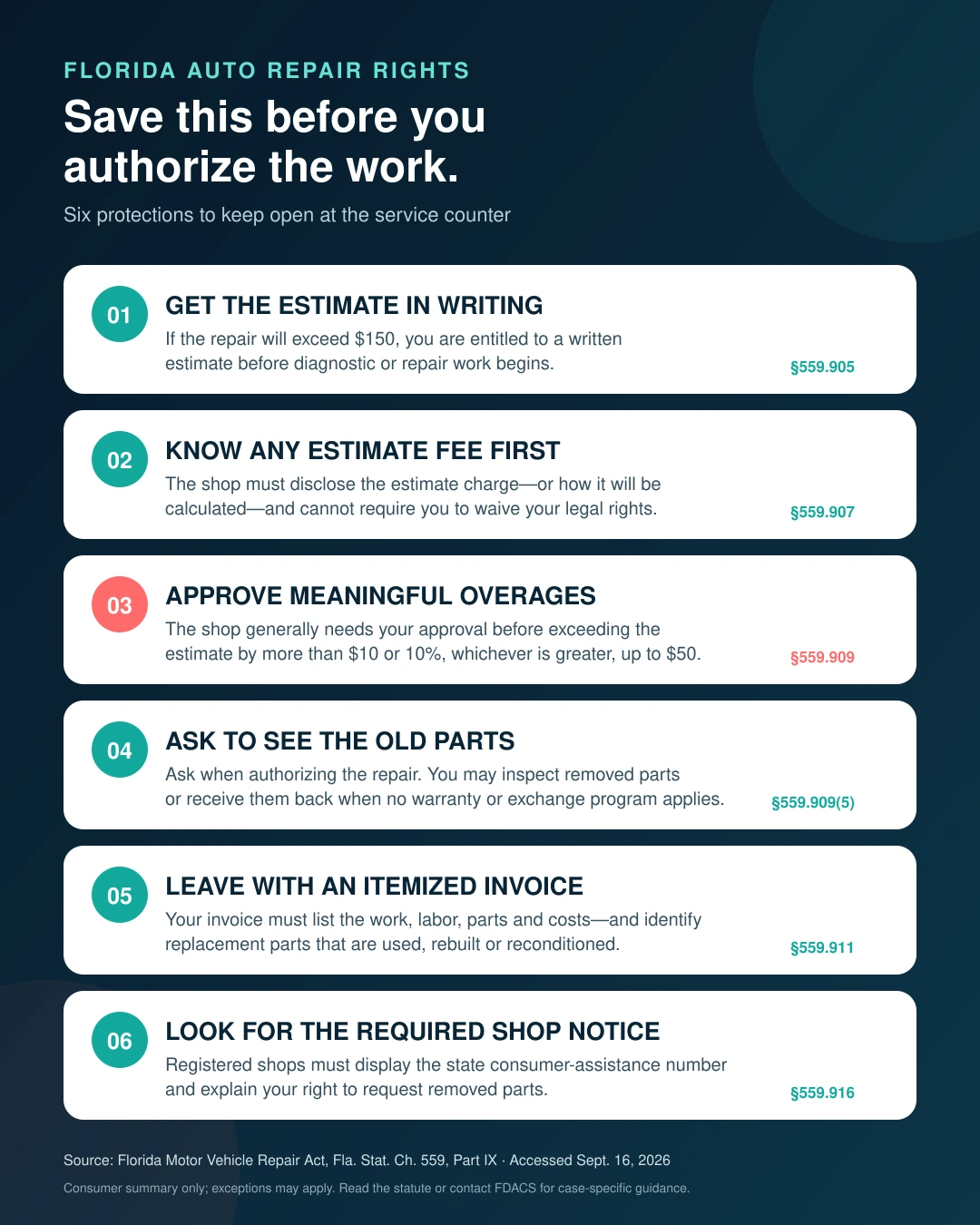
The $150 written estimate. If a repair is expected to run over $150, the shop has to hand you a written estimate before starting any diagnostic work or repair   not after, not verbally, in writing. (This threshold moved up from $100 in a 2024 update to the law; if you've seen the older figure elsewhere, that's why.) The estimate has to name the shop, describe your car and your problem, give a completion date, and   critically   say whether you're being charged a flat rate, an hourly rate, or both. Florida also requires a separate, boxed disclosure in 12-point capital letters telling you, in plain terms, that you're entitled to that estimate if the bill will exceed $150. That disclosure is the one piece of paper in this whole transaction Florida designed specifically so you can't miss it.
They can't make you waive your rights. A shop can't require you to sign away your rights under this law as a condition of doing the work. If a form asks you to waive protections you haven't heard of, that's your cue to ask what, specifically, you're giving up.
They have to tell you before they exceed it. If the final bill is going to run more than $10 or 10% over the written estimate (whichever is greater, capped at $50), the shop has to contact you   phone, mail, whatever   before doing the extra work. You then authorize it, modify it, or cancel it. Charging more than that without telling you first is against the law. So is refusing to hand back your car because you won't pay for work you never approved.
Your old parts are yours to ask for. You have the right to inspect any part the shop replaces, or to have it returned to you   but only if you ask when you authorize the repair, not after the fact. A returned part is also the simplest proof, if a dispute ever comes up, that the work actually happened.
The invoice has to be itemized. When the job's done, you get a legible invoice describing what was fixed, an itemized breakdown of every part of labor cost, and   this is the detail almost nobody asks about   a statement telling you whether any replacement part is new, used, rebuilt, or reconditioned. Ask that question before you authorize anything. It's one of the largest swings in what a quote actually means, and Florida requires the shop to answer it.
The Two Guides That Miss This Market
Search for auto repair costs in Miami and you'll mostly find two kinds of results. One is a Miami body shop's own pricing page   useful for bumpers, dents, and paint, and silent on brakes, alternators, or AC. The other is a national maintenance guide that hands you a RepairPal average with zero adjustment for climate, then, in a single FAQ line, admits that heat stresses cooling systems and humidity accelerates corrosion   and leaves it there. In a city where the air conditioning runs nearly year-round and salt is in the air off two coastlines, those two sentences are the whole local story that guide never tells.
Neither one mentions that Florida has a dedicated repair statute. Neither explains the $150 estimate rule, your right to your old parts, the itemized invoice, or what to do if a shop won't release your car over a bill you're disputing.
Below: what routine maintenance and major repairs actually cost, with national figures and Miami figures kept in separate columns so you can tell them apart; the four repairs this climate causes more than most; independent shops versus dealerships versus chains; how to read an estimate and an invoice line by line; and exactly what to do when the bill comes back higher than the number you agreed to.
Miami Goes Local is a business directory. We perform no repairs, sell no warranties, and paid placement can't buy inclusion or ranking anywhere on this page. By contrast, the Miami-specific guide on this topic is a body shop pricing its own services, and the national guide sits inside an extended-warranty funnel with repeated ZIP-code lead forms and its own disclosure that featured companies may pay for placement.
What Repairs Cost: National Baseline
| Service | National Average |
|---|---|
| Oil change | $158–$186 |
| Tire balance and rotation | $109–$159 |
| Wiper replacement | $99–$122 |
| Engine air filter | $77–$97 |
| Cabin air filter | $86–$114 |
| Wheel alignment | $187–$274 |
| Brake pads | $330–$390 |
| Rotors | $571–$694 |
| Battery | $423–$460 |
Major repairs Cost
| Repair | National Average |
|---|---|
| Ignition coil | $230–$317 |
| Oxygen sensor | $454–$551 |
| Engine mount | $629–$778 |
| Alternator | $802–$1,073 |
| Airbag control module | $855–$928 |
| Axle shaft | $951–$1,070 |
| AC compressor | $1,038–$1,383 |
| Fuel pump | $1,319–$1,504 |
| Radiator | $1,353–$1,528 |
| Catalytic converter | $2,283–$2,473 |
| Head gasket | $2,543–$3,337 |
| Transfer case | $3,220–$3,535 |
| Transmission | $6,003–$6,525 |
ConsumerAffairs is worth leaning on here precisely because it's properly built   named author, named editor, a fact-checking credit, a visible update date, and a published source list. That's rare in this space, and it's why its numbers are usable as a national baseline. Just never as a Miami one.
The Context Nobody Gives You
The U.S. Bureau of Labor Statistics has tracked the cost of motor vehicle maintenance and repair rising roughly 57% between January 2019 and June 2026. That single statistic explains why your memory of what a repair used to cost is no longer a useful benchmark   the ground has moved under it by more than half in six years.
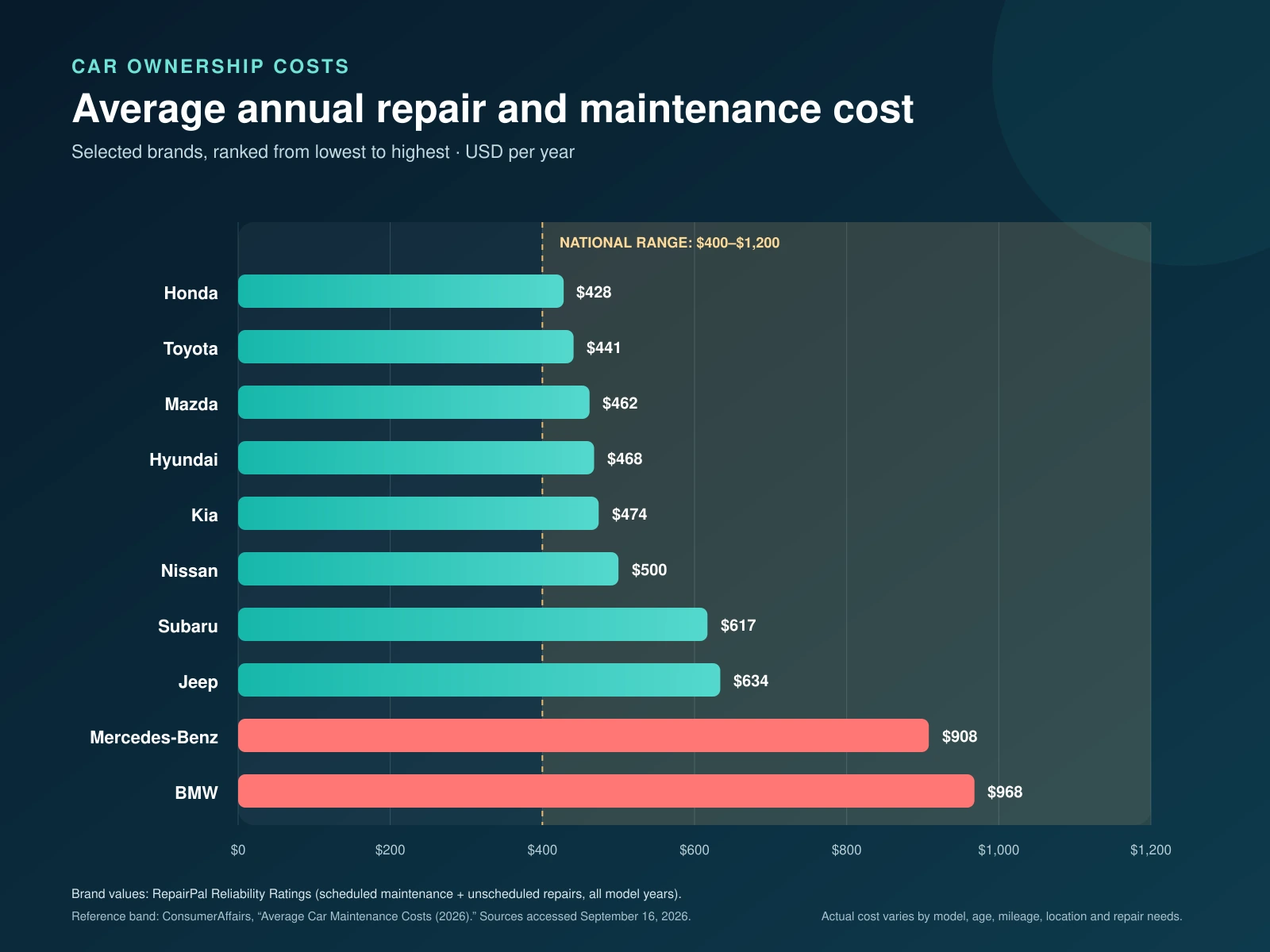
Annual budget. Nationally, annual maintenance and repair costs typically run $400 to $1,200 a year, according to RepairPal data covering more than 30 car brands, and the spread by brand is wide   economy brands like Honda and Toyota sit well under $500 a year, while brands like Land Rover and Porsche run closer to $1,200.
Labor Rates in Miami
Here's the section that should be this article's sharpest differentiator, and honestly isn't yet   neither competing guide publishes a labor rate at all. The national guide gives total job costs without ever separating labor from parts. The Miami body shop guide has a section literally titled "Labor Rates Across Different Miami Neighborhoods" that contains no rates, just the observation that wealthier areas might charge more.
We're not filling that gap with a guess. Real Miami labor-rate figures need to come from actually checking eight to twelve local shops   independent, dealership, and chain   and publishing the sample size and date, exactly as the brief for this piece specifies. Until that sampling happens, here's what's safe to say: published industry surveys place Florida's metro labor rates generally in the $100–$175+ per hour range, with independents at the lower end and dealerships $20–$40 higher, and large metro areas like Miami tending toward the upper half of that band. Treat that as context, not a quote   get an actual number from the shop in front of you.
What you can act on right now, with no sampling required:
Check whether your estimate states a flat rate or an hourly rate. Florida requires it to say which, and it's the one number on the page you can actually argue with. Flat rate means the book time for that job regardless of how long it actually takes   which can work for you or against you depending on how the job goes.
Ask whether the diagnostic fee gets credited against the repair if you go ahead with it. Many shops credit it, many don't, and it's almost never volunteered.
The Four Repairs Miami Cars Need More Than Most
This is the section that makes this a Miami guide rather than a generic one. The national guide concedes, in one FAQ line, that heat stresses cooling systems and humidity accelerates corrosion   and develops neither idea. Here's the local version.
1. Air conditioning. This is the system Miami works hardest, essentially year-round. A compressor replacement runs $1,038 to $1,383 nationally before any local adjustment, and that's before condensers, evaporators, or leak repairs. Budget for AC as a when, not an if. Even in the rare cool stretch, run the system briefly   seals and the compressor last longer with regular use than sitting idle.
2. Cooling system. Heat is the stressor here, not cold. A radiator replacement runs $1,353 to $1,528 nationally, several times what a routine coolant service costs. Get the cooling system checked on a schedule rather than waiting for the temperature gauge to move   by the time you see a symptom in Miami traffic, the cheap version of the repair has usually already passed.
3. Battery. Expect shorter battery life than the four-to-five-year national schedule implies. AAA data cited by service centers in warmer Florida cities puts typical battery life closer to three years   sustained heat accelerates the internal chemistry that shortens a battery's life, and a Florida battery frequently gives out well ahead of what the maintenance chart predicts. It's worth noting that a lot of national advice still frames this the other way around   warning about cold weather's effect on batteries   which is exactly backwards for what actually shortens battery life in this market.
4. Corrosion. Salt air, humidity, and causeway driving show up in brake lines, exhaust components, suspension parts, and electrical connectors   not in visible body rust, which is what makes it easy to miss. Rinse the undercarriage if you park near the water or drive the causeways regularly. Salt is a slow, cumulative cost, and it attacks the parts you can't see.
Independent Shop vs. Dealership vs. Chain
Each is right for different work   this isn't a case for one over the others.
| Comparison | Independent | Dealership | Chain |
|---|---|---|---|
| Labor rate | Pending local sample | Pending local sample | Pending local sample |
| Parts | Flexible tiers | Usually OEM | Often own-brand |
| Best for | General repairs and older vehicles | Warranty work, recalls and model-specific faults | Routine maintenance, tires and batteries |
| Diagnostics | Varies widely | Manufacturer-specific tooling | May be more limited |
| Warranty on work | Varies—ask before authorizing work | Usually standardized | Usually honored nationally |
Each option suits different types of work. Compare the diagnosis, written estimate, parts offered and repair warranty—not only the shop category.
Using an independent shop does not void your factory warranty for routine maintenance. Keep every receipt   documentation is what proves the maintenance happened, and missing records are what turns a warranty question into a dispute.
For a model-specific electronic fault, a dealership's manufacturer-specific diagnostic tooling is often genuinely worth the higher rate. For brake pads on an eight-year-old sedan, it rarely is.
How to Read an Estimate and an Invoice
Florida spells out what has to appear on both documents, which is exactly what makes them auditable. Here's the checklist.
On the estimate: a description of your problem or request; whether you're being charged a flat rate, an hourly rate, or both; the estimated cost; whether there's a separate charge for shop supplies or hazardous waste removal; any charges required by state or federal law; and specific language if new tires are part of the deal.
Read the shop-supply and hazardous-waste line carefully. Florida requires a disclosure stating that this charge represents costs and profit to the shop, not a pass-through fee   knowing that's on the form changes how you read the number.
On the invoice: what was done to fix the problem; an itemized breakdown of all labor, parts, and merchandise with costs; anything supplied free or at reduced cost under a warranty; and each replacement part identified as new, used, rebuilt, or reconditioned.
Hold the invoice next to the estimate and compare them line by line. That comparison is the entire reason Florida requires both documents   and almost nobody actually does it.
The signs on the wall. Florida law requires shops to post disclosure signage   the state issues a registration sign shops attach their certificate to and display at the customer service counter, in plain view. It's the same "read the wall" habit that applies in salons and tattoo shops, and it's worth a glance while you're standing there.
When the Bill Comes Back Higher Than the Estimate 
This is the moment a reader most urgently needs instructions, and it's the section neither competing guide addresses at all.
What the law says. The shop must notify you before charges exceed the estimate by more than $10 or 10% (whichever is greater, capped at $50). Charging beyond that without your authorization is unlawful. Refusing to return your vehicle over a disputed bill is unlawful. You have the right to inspect the parts that were replaced.
What to do, in order:
- Say so before you pay, and put it in writing if you can.
- Ask for the itemized invoice and compare it against the estimate, line by line.
- Ask to inspect   and take   the replaced parts.
- Ask specifically which line items exceed the estimate and what authorized them.
- If it isn't resolved, file a complaint with the Florida Department of Agriculture and Consumer Services (FDACS).
If the final bill exceeds the estimate, raise it before you pay. Once you've paid, your position weakens   the conversation shifts from a billing dispute to a refund request, and refund requests are a much harder conversation.
If the shop is holding your car. Florida provides a statutory bond mechanism, under Section 559.917, to release a possessory lien when a shop is holding a vehicle over a disputed bill. In short: you (or your attorney) post a bond with the clerk of the circuit court for the amount on the invoice, plus any accrued storage, minus whatever you've already paid; the court issues a certificate directing the shop to release the car. You are not simply stuck   knowing this mechanism exists changes the conversation with the shop considerably.
This is general information, not legal advice. The statutory bond route has its own paperwork and timelines, and a consumer attorney or FDACS's Division of Consumer Services can advise on your specific situation. You can search FDACS's Business License Lookup to confirm a shop's registration, or reach the department's consumer line at 1-800-HELP-FLA.
Body Work, Insurance, and Parts
This is the one part of the topic the Miami-specific competitor actually covers reasonably well, so it's worth keeping tight here rather than re-litigating it.
What body work costs. Bumper repair and replacement, door and panel dents, paint scratches, and frame damage span an enormous range   a scuffed bumper might run a few hundred dollars, while frame damage on a unibody vehicle can run into the thousands. Get a written, itemized quote for your specific vehicle and damage rather than anchoring to a generic range; body work pricing is unusually sensitive to make, model, and paint-match complexity.
Paintless dent repair (PDR). When the paint isn't broken, PDR can be meaningfully cheaper than conventional bodywork, because there's no filler and no repaint. How much cheaper depends heavily on the dent's size, location, and access   treat any specific percentage savings figure you see quoted online skeptically unless it's sourced, and ask your shop for a PDR quote alongside a conventional one before deciding.
The parts decision. OEM, aftermarket, and used parts differ on cost, fit, warranty, and insurance acceptance. Aftermarket parts vary widely in quality by category and manufacturer   treating them as uniformly "comparable to OEM" flattens a real tradeoff you should ask about part by part, not accept as a blanket claim.
The insurance layer. Your deductible versus the repair cost determines whether filing a claim even makes sense. Insurance-preferred shop networks exist, and understanding what that relationship means for your choice of shop   and for how an adjuster evaluates your claim   matters before you sign anything. One distinction worth getting right: Florida requires drivers to carry Personal Injury Protection (PIP) coverage, but PIP pays medical costs after a crash   it does not cover damage to your vehicle. A lot of Florida drivers conflate the two, and it's a genuinely useful thing to know before a claim, not after.
Staged-accident and PIP fraud are real and relevant to Miami, but they need current enforcement data and careful framing that belongs in a separate, dedicated piece   not folded into a cost guide.
How to Choose a Miami Shop
Registration comes first. Verifying a shop's registration status is mandatory under Florida law for motor vehicle repair shops   don't assume it, check it through FDACS's Business License Lookup.
ASE is a credential, not a license. ASE certification is a voluntary national credential showing a technician has met competence standards in specific areas   brakes, engines, electrical, transmissions. It's a genuinely useful quality signal, but it is not a state license. Florida registers shops; it doesn't license individual mechanics. Readers routinely mix the two up, and it's worth being precise about which one you're actually checking.
Check the complaint history. FDACS's Division of Consumer Services maintains a searchable record of business complaints   worth a look before you commit to a shop you haven't used before.
The county layer. Here's something neither national nor generic guides mention: motor vehicle repair shops, mechanics, technicians, and apprentices in Miami-Dade must register with Miami-Dade County itself, on top of state registration, and comply with the county's own regulations under the county's Motor Vehicle Repair Ordinance (Chapter 8A, Article VIIA of the County Code). The county's own Consumer Protection Division   separate from the state's FDACS   also fields complaints and mediates disputes locally, which means a Miami-Dade shop dispute actually has two potential channels, not one. Verifying Miami-Dade registration specifically, alongside FDACS registration, is a step this market requires that most of Florida doesn't.
What else to ask. Warranty terms on parts and labor, spelled out separately and in writing; whether the shop specializes in your make; and whether they provide written estimates as routine practice, not just when a customer requests one.
Buying Used in a Flood State
The national guide recommends a pre-purchase inspection at around $200 and treats it as generic advice. In a county that's absorbed repeated storm flooding, it's a much stronger recommendation   and a different kind of inspection.
Saltwater flooding is worse than freshwater for a vehicle's long-term health, and electrical and connector damage from it often doesn't surface until months after a car looks completely fine. Title branding tells you something, but a clean title is not proof a car was never flooded   plenty of flood vehicles move through title-washing before they reach a used-car lot.
Get a pre-purchase inspection on any used car in this market, and tell the inspector explicitly to check for flood indicators: corrosion inside connectors and under carpets, silt in body crevices, water lines in the spare-tire well, and mismatched or newly replaced electrical components.
Around $200 for a pre-purchase inspection is the standard national figure, and in a flood-prone county, it's the cheapest insurance you'll find. A flood car's real cost isn't the purchase price   it's the repair bill that shows up eight months later.
Frequently Asked Questions
How much does a mechanic charge per hour in Miami?
Published statewide surveys put Florida metro labor rates generally between $100 and $175+ per hour, with dealerships running $20–$40 above independents   but this article doesn't have a verified, dated local sample yet (see the note under Labor Rates in Miami). Ask your shop directly whether they charge flat rate or hourly, and get the number in writing.
Why is car AC repair so expensive?
Component costs alone run into four figures for a compressor   $1,038 to $1,383 nationally   before labor. Miami's climate means the AC system works harder, essentially year-round, than in most other US markets, which shows up in how often the system needs attention, not just in the cost of any one repair.
How much does a car battery cost?
Nationally, expect $423 to $460 for a replacement battery. In Miami's climate, plan to replace it sooner than the national four-to-five-year schedule suggests   heat, not cold, is what shortens battery life here.
Does Florida license mechanics?
No. Florida registers repair shops with FDACS; it doesn't license individual mechanics. ASE certification is a separate, voluntary national credential   useful as a quality signal, but not a substitute for checking a shop's state registration.
Can a shop charge more than the estimate?
Not without notifying you first. Charges beyond the written estimate by more than $10 or 10% (capped at $50) require your authorization under Section 559.909.
Can a shop keep my car if I don't pay?
Refusing to return your vehicle over a payment dispute is prohibited under Florida law. If a shop is holding your car over a disputed bill, Section 559.917 provides a statutory bond mechanism to get it released through the court. This is general information, not legal advice   a consumer attorney can advise on your specific situation.
How do I file a complaint against a mechanic in Florida?
Start with FDACS's Division of Consumer Services, which maintains a searchable complaint record and can be reached at 1-800-HELP-FLA. In Miami-Dade, the county's own Consumer Protection Division is a second, local channel for mediation.
Is the dealership always more expensive?
Usually, on labor rate. Sometimes it's cheaper in total for a model-specific electronic fault that requires manufacturer diagnostic tooling. See the independent-vs-dealership-vs-chain comparison above.
How often do I actually need an oil change?
Follow your owner's manual, not the sticker on your windshield. National service intervals now commonly run 7,500 to 10,000 miles for most modern vehicles.
Do I need to use the dealership to keep my warranty?
No   for routine maintenance, an independent shop is fine, provided you keep your records. Documentation is what protects a warranty claim, not where the work was done.
How do I tell if a used car was flood damaged?
A clean title isn't proof. Get a pre-purchase inspection and specifically ask the inspector to check for flood indicators   see the section above.
